Softcover. NY, Pantheon Books, 1st, 1982, Book: Very Good, Dust Jacket: None, Softcover, 297 pages. This compelling social history uses diaries, memoirs, fiction, trial testimony, personal recollections, and eyewitness accounts to weave a fascinating tale of what ordinary Japanese endured throughout their country's era of economic growth. Through vivid, often wrenching accounts of peasants, miners, textile workers, rebels, and prostitutes, Mikiso Hane forces us to see Japan's "modern century" (from the beginnings of contact with the West to World War II) through fresh eyes. In doing so, he mounts a formidable challenge to the success story of Japan's "economic miracle." Starting with the Meiji restoration of 1868, Hane vividly illustrates how modernization actually widened the gulf, economically and socially, between rich and poor, between the mo-bo and mo-ga ("modern boy" and "modern girl") of the cities and their rural counterparts. He interlaces his scholarly narrative with sharply etched individual stories that allow us see Japan from the bottom up. Clean copy.
Hardcover. Urbana IL, University of Illinois Press, 1st revised, 1997, Book: Very Good, Dust Jacket: Very Good, Hardcover in a bright dust jacket, 410 pages. The book that re-established Peckinpah's reputation--now thoroughly revised and updated! When critics hailed the 1995 re-release of Sam Peckinpah's masterpiece, The Wild Bunch, it was a recognition of Paul Seydor's earlier claim that this was a milestone in American film, perhaps the most important since Citizen Kane. Peckinpah: The Western Films first appeared in 1980, when the director's reputation was at low ebb. The book helped lead a generation of readers and filmgoers to a full and enduring appreciation of Peckinpah's landmark films, locating his work in the central tradition of American art that goes all the way back to Emerson, Hawthorne, and Melville. In addition to a new section on the personal significance of The Wild Bunch to Peckinpah, Seydor has added to this expanded, revised edition a complete account of the successful, but troubled, efforts to get a fully authorized director's cut released. He describes how an initial NC-17 rating of the film by the Motion Picture Association of America's ratings board nearly aborted the entire project. He also adds a great wealth of newly discovered biographical detail that has surfaced since the director's death and includes a new chapter on Noon Wine, credited with bringing Peckinpah's television work to a fitting resolution and preparing his way for The Wild Bunch. This edition stands alone in offering full treatment of all versions of Peckinpah's Westerns. It also includes discussion of all fourteen episodes of Peckinpah's television series, The Westerner, and a full description of the versions of Pat Garrett and Billy the Kid now (or formerly) in circulation, including an argument that the label "director's cut" on the version in release by Turner is misleading. Additionally, the book's final chapter has been substantially rewritten and now includes new information about Peckinpah's background and sources.
Hardcover. London, George Newnes Ltd., 1st, 1903, Book: Good, Dust Jacket: None, Hardcover, gray cloth, black, white and gilt decoration with Speaker of the house in profile on cover, 378 pages. Illustrated with text cartoons throughout and a color frontis by Gould. Sir Henry William Lucy JP, (1842 -1924) was one of the most famous English political journalists of the Victorian era. He was widely known on both sides of the Atlantic. Known as serious commentator of parliamentary affairs, he was also an accomplished humorist, and a parliamentary sketch-writer; acknowledged as the first great lobby correspondent. Owner's signature on blank prelim page, cloth is worn at spine edges with some fraying, title on spine faded. Binding is sound, tight.
Hardcover. NY, Harry N Abrams, 1st, 1998, Book: Very Good, Dust Jacket: Very Good, Hardcover, 160 pages, illustrated in b&w and color. Long before the movies were created, peepshows were appealing to a public eager for entertainment and enlightenment. The peepshowman and his box were a common sight on bustling city streets and quiet village greens. The book includes nearly 200 annotated images, many never before published.
Hardcover. New Haven CT, Yale University Press, 1st, 2000, Book: Very Good, Dust Jacket: Very Good, Hardcover in a bright dust jacket, 234 pages, b&w illustrations. Nicolas-Claude Fabri de Peiresc (1580-1637) was, during his lifetime, one of Europe's most famous men. A friend of Pope Urban VIII and Galileo, of Peter-Paul Rubens and Hugo Grotius, of Tommaso Campanella and Marin Mersenne, Peiresc played an important role in the intellectual culture of his time. This book is the first study in English of this extraordinary man, as well as a vivid portrait of his whole circle. Looking through the lens of Peiresc's life, Peter N. Miller brings into focus the early-seventeenth-century world of learning-its people, places, and ideas. Drawing on the extensive Peiresc archive (more than 50,000 pieces of paper), Miller brilliantly evokes the lives of antiquaries, philosophers, theologians, and politicians of Peiresc's day, only some of whom remain known today. He explores the age in which Peiresc's toleration and sociability, his political action and cosmopolitanism, and his serious scholarship without dogmatism were identified as a set of virtues and practices by which to live. Peiresc's notion of scholarship as a moral exercise, the sweep of his interests, and the cross-Continental reach of his intellectual life show with new clarity what it meant to be a man of learning during the decades around 1600. Name on front fly leaf, otherwise clean copy.
Hardcover. Richmind VA, Dietz Press, 1st, 1959, Book: Good, Dust Jacket: None, Hardcover, 219 pages. Ex-library copy with usual stamps and marks. No dust jacket. Tan cloth covers with gilt stamping.Primarily covers the era of the early American fur trader, as typified by the white trader and the Indian beaver hunter. Clean, tight copy.
Hardcover. St Paul MN, Voyageur Press, 1st, 2006, Book: Very Good, Dust Jacket: Very Good, Hardcover in a bright dust jacket. This authoritative, illustrated history tells the story of one of the country?s premier passenger trains, Pennsylvania Railroad?s Broadway Limited, an institution in New York-to-Chicago rail travel from 1902 to 1955. Text and pictures introduce readers to the posh cars and powerful engines, the luxuries and amenities on board, the stations, terminals, and timetables?everything that made the train the pride of the Pennsylvania. Clean copy.
Softcover. Durham NC, Duke University Press , 1st, 2013, Book: Very Good, Dust Jacket: None, Softcover, 312 pages, b&w illustrations. In People Get Ready, musicians, scholars, and journalists write about jazz since 1965, the year that Curtis Mayfield composed the famous civil rights anthem that gives this collection its title. The contributors emphasize how the political consciousness that infused jazz in the 1960s and early 1970s has informed jazz in the years since then. They bring nuance to historical accounts of the avant-garde, the New Thing, Free Jazz, "non-idiomatic" improvisation, fusion, and other forms of jazz that have flourished since the 1960s, and they reveal the contemporary relevance of those musical practices. Many of the participants in the jazz scenes discussed are still active performers. A photographic essay captures some of them in candid moments before performances. Clean copy. like new.
Softcover. Durham NC, Duke University Press , 1st, 2013, Book: Very Good, Dust Jacket: None, Softcover, 312 pages, b&w illustrations. In People Get Ready, musicians, scholars, and journalists write about jazz since 1965, the year that Curtis Mayfield composed the famous civil rights anthem that gives this collection its title. The contributors emphasize how the political consciousness that infused jazz in the 1960s and early 1970s has informed jazz in the years since then. They bring nuance to historical accounts of the avant-garde, the New Thing, Free Jazz, "non-idiomatic" improvisation, fusion, and other forms of jazz that have flourished since the 1960s, and they reveal the contemporary relevance of those musical practices. Many of the participants in the jazz scenes discussed are still active performers. A photographic essay captures some of them in candid moments before performances. Clean copy. like new.
Softcover. Notre Dame, University of Notre Dame Press, First Thus, 1986, Book: Very Good, Dust Jacket: None, 344 pages. Softcover. Black & white illustrations throughout including maps, photographs. Bright front cover, sunfade to rear cover. Clean, unmarked copy.
Softcover. NY, Morrow, reprint, 1974, Book: Very Good, Dust Jacket: None, Softcover, 331 pages. A remarkable pre-Freudian account of schizophrenia written by the son of a prime minister of England. Certifiably insane from 1830 to 1831, he wrote the autobiography of his illness and recovery with vigor and insight. Clean copy.
Hardcover. New York, Henry Holt and Co., 1st, January 22, 2008, Book: Very Good, Dust Jacket: Very Good, Hardcover, 306 pages. Minor wear to dust jacket. Small remainder mark on bottom edge. Else a very clean, tight copy.
Softcover. NY, Farrar, Straus and Giroux, 1986, Book: Very Good, Dust Jacket: None, Softcover, 280 pages. This entertaining and social history of women and cooking at the turn of the 20th century is laced with sly humor and lucid insight. The author uncovers our ancestors' widespread obsession with food, and tells readers why we think as we do about food today. The most memorable of the culinary movers was Fannie Farmer, whose cookbook was published in a modest 3000-copy edition in 1896. Stories about Farmer and other domestic scientists of the period add strong appeal to Shapiro's report. So do the parallels between early feminists and today's advocates of equal rights. Name on front fly leaf, otherwise clean.
Hardcover. NY, Rizzoli, 1st, 2006, Book: Very Good, Dust Jacket: Very Good, Hardcover, 384 pages, profusely illustrated in color and b&w. This thought-provoking volume transports readers to France of the eighteenth, nineteenth, and twentieth centuries, beginning with Napoleon's love of perfume and the erotic importance he attached to it, through the lore and symbolism fragrance enjoyed in eighteenth and nineteenth-century Europe. By the early twentieth century, perfume's place as one of France's most important luxury industries was recognized and celebrated, and timeless fragrances--such as Chanel No. 5, Shalimar, Arpeges, and Joy--were launched. The distinctive bottles for these new essences and the art movements that inspired their design are detailed throughout the book, as are paintings, poetry, and literature that reveal the power of perfume and its ability to recall the past and evoke sensuality. According to nineteenth-century perfumer Eugene Rimmel, "the history of perfume is, in some manner, the history of civilization." Through fascinating text accompanied by gorgeous imagery, including packaging, labels, and advertisements, Perfume: Joy, Scandal, Sin explores perfume's impact on history, culture, society, art, and attitudes.
Hardcover. London, Allison and Busby, 1st, 2013, Book: Very Good, Dust Jacket: Very Good, Hardcover in a bright, unclipped dust jacket. Spring, 1858. The route of the Caledonian Railway through the southern uplands of the Scottish countryside is disrupted by a fatal crash. Inspector Robert Colbeck and Sergeant Victor Leeming are called from the crime of London to investigate, and must contend with old enemy Superintendent Rory McTurk to uncover the criminals behind the disaster. Clean copy.
Softcover. NJ, Citadel Press, reprint, 1978, Book: Very Good, Dust Jacket: None, Softcover, 292 pages. Studies the distinctive personalities, problems, and cultural contributions of such women as Margaret Fuller, Lydia Maria Child, and Elizabeth Cady Stanton, examining the extent to which romanticism encouraged intellectualism among women during the three decades prior to the Civil War. Clean copy.
Hardcover. New York, Plenum Press, rep, 1998, Book: Very Good, Dust Jacket: None, 189 pages. Hardcover with laminated boards. Previous owner's stamp in front fly leaf, otherwise, clean, tight copy with minor wear to covers. Black and white pictures throughout.
Hardcover. NY, Bloomsbury USA, 1st, 2009, Book: Very Good, Dust Jacket: Very Good, Hardcover in a bright, unclipped dust jacket. The third installment to Downie's Roman Empire series--the second-century saga of a witty and courageous army surgeon, Gaius Ruso, and his smart and loyal lover, Tilla, a barbarian woman from Britannia--continues in gripping fashion. Ruso returns to his family home in southern Gaul, summoned by a forged letter pleading for his immediate return. Once Ruso and Tilla return, Ruso is thrust into a dangerous quagmire involving a missing ship, huge family debts and, before long, the murder of the family's principal creditor--a crafty phony named Severus--who is poisoned in Ruso's home. While Ruso and his family are quickly suspected of the murder, Ruso and Tilla's attempts to solve the crime are hampered by interfering family members, a lying politician, a greedy banker and a pair of too-eager investigators sent from Rome. Ruso and Tilla must also deal with prejudice, envy and a new religion, Christianity. The plotting is clever and suspenseful, with subtle clues and lots of action, while the setting and supporting cast are vividly drawn. Clean copy.
Hardcover. NY, Miramax/Hyperion, 1st, 1997, Book: Very Good, Dust Jacket: Very Good, Hardcover, 191 pages, in a bright, unclipped dust jacket.Profusely illustrated with black and white film stills. With a knowledgeable text by the director and film historian. Clean.
Hardcover. NY, Time Life, reprint, 1983, Book: Very Good, Dust Jacket: None, 476 pages. Hardcover with no dust jacket. Dark blue leather bound with gilt titles to front cover and spine. Embossed decoration on front cover. Gilt text block edges, red ribbon marker. Clean, tight copy.
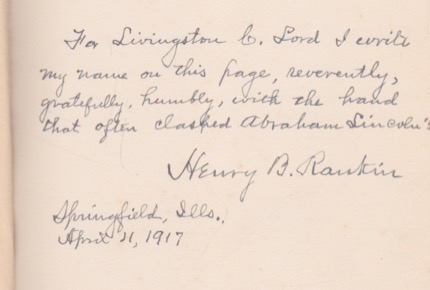
Hardcover. NY, G. P. Putnam's Sons, 1st, 1916, Book: Very Good, Dust Jacket: None, Hardcover, blue cloth with gilt lettering on spine. Illustrated with portraits. Top edge gilt. 412 pages + ads. INSCRIBED BY RANKIN to Livingston C. Lord, President of Eastern Illinois University in 1917. Rankin, who died at 90 in 1927, was an early colleague and friend of Lincoln's from his Springfield days. Small ink number on front fly leaf, otherwise clean.
Softcover. Washington and Lee University, 1st, 2005, Book: Very Good, Dust Jacket: None, Softcover, 100 pages. The 2005 issue, Volume 12, of Perspectives in Vernacular Architecture: The Journal of the Vernacular Architecture Forum contains the articles: "Selling Domestic Space: The Boarding House in the Southern Mountains" by Michael Ann Williams; "La Casa Alamense: The Mexican Hacienda as Urban Dwelling" by John Messina; "Unraveling the Benjamin Deyerle Legend: An Analysis of Mid-Nineteenth-Century Brickwork in the Roanoke Valley of Virginia" by Michael J. Pulice; "Orson S. Fowler and a Home for All: The Octagon House in the Midwest" by Rebecca Lawin McCarley; and "Roadside Shrines and Granite Sketches: Diversifying the Vernacular Landscape of Memory" by David Charles Sloane.
Hardcover. New York , Skira, 1st, 2006-09-05, Book: Very Good, Dust Jacket: Very Good, Hardcover, like new in publishers shrink-wrap. 224 pages profusely illustrated in color. This book describes the grandeur and richness of the numerous civilizations predating the Incas, including the Paracas, Nazca, Recuay, Sican-Lambayeque, Moche-Sipan, and Chimu cultures, as well as the great Inca civilization. Included in the book are the important sites and landscapes representative of the three major ecological levels of Peru, as well as a general view and a historical perspective of the pre-Columbian cultures of Peru.

 "Peasants, Rebels, Women, and Outcastes: The Underside of Modern Japanby: Mikiso Hane")
 "Peckinpah: THE WESTERN FILMS - A RECONSIDERATIONby: Paul Seydor")
 "Peeps at Parliament: Taken from Behind the Speaker's Chair by: Henry W. Lucy, F Carruthers Gould (illustrator)")
 "Peepshows: A Visual Historyby: Balzer, Richard")
 "Peiresc's Europe: Learning and Virtue in the Seventeenth Century by: Peter N. Miller")
 "Pelts and Palisades: The Story of Fur and Rivalry for Pelts in Early America by: Nathaniel C. Hale")
 "Pennsylvania Railroad's Broadway Limitedby: Joe Welsh")
 "Pentagon Propaganda Machineby: Fulbright, Senator J.W.")
 "People Get Ready ?– The Future of Jazz Is Now! by: Heble, Ajay; Wallace, Rob (Editors)")
 "People Get Ready: ?–The Future of Jazz Is Now! by: Heble, Ajay; Wallace, Rob (Editors)")
 "Peoples of Ireland, The - From Prehistory to Modern Timesby: de Paor, Liam")
 "Perceval's Narrative: A Patient's Account of His Psychosis, 1830-1832by: John Perceval; Gregory Bateson")
 "Perfect Scent, The : A Year Inside the Perfume Industry in Paris and New Yorkby: Burr, Chandler")
 "Perfection Salad: Women and Cooking at the Turn of the Centuryby: Shapiro, Laura")
 "Perfume: Joy, Scandal, Sin - A Cultural History of Fragrance from 1750 to the Presentby: Stamelman, Richard")
 "Peril on the Royal Train (The Railway Detective Series)by: Edward Marston")
 "Perish the Thought: Intellectual Women in Romantic America 1830-1860 by: Susan P. Conrad")
 "Persistence of Sail in the Age of Steam: Underwater Archaeological Evidence from the Dry Tortugasby: Souza, Donna J.")
 "Persona Non Grata: A Novel of the Roman Empireby: Ruth Downie")
 "Personal Journey With Martin Scorsese Through American Movies, Aby: Scorsese, Martin And Wilson, Michael Henry")
 "Personal Recollections of a Cavalry Man (Collector's Library of the Civil War)by: Kidd, J. H.")
 "Personal Recollections of Abraham Lincoln (INSCRIBED COPY)by: Rankin, Henry B./ Newton Joseph Fort (Introduction);")

 "Perspectives in Vernacular Architecture: The Journal of the Vernacular Architecture Forum - Volume 12by: Pamela Simpson (editors) Jennings, Jan (Author)")
 "Peru: Art from the Chavin to the Incas (Collections Du Petit Palais, Musee Des Beaux-Arts de la VILL)by: Lemasson, Patrick")