NY, St. Martins, 1st, 2000, Book: Very Good, Dust Jacket: Very Good, Hardcover, black & white illustrations. 442 pages. The story of the popular Rocky and Bullwinkle show. The legendary Jay Ward and Bill Scott produced the gleeful wonder and cumulative joy that transcended the crude drawings and occasionally muddy sound. Jay Ward was the magnificent visionary, the outrageous showman, while Bill Scott was the genial, brilliant head writer, coproducer, and all-purpose creative whirlwind. With exclusive interviews, original scripts, artwork, story notes, letters and memos, Keith Scott has written the definitive history of Jay Ward Productions.
Hardcover. US, Walt Disney Family Foundation Press, 1sr, 2015, Book: Very Good, Dust Jacket: Very Good, Hardcover, 351 pages. Clean, unmarked copy with only minor wear to dust jacket. Black and white & color photographs. In 1940, Walt Disney released his second feature film: Pinocchio, based on Carlo Collodi's 1883 Italian children's novel. The film was groundbreaking: it pioneered the latest animation and sound technology of the era, and established a blueprint for Disney filmmaking that remains intact today. It became the first animated feature to win a competitive Academy Award® (in fact, it won two), and earned a place on the roster of the National Film Registry.
Hardcover. San Francisco, CA, Walt Disney Family Museum, 1st, 2018, Book: Very Good, Dust Jacket: Very Good, 160 pages. Hardcover with dust jacket. A clean, unmarked copy with only minor rubbing to dust jacket. A tight copy. Produced in conjunction with The Walt Disney Family Museum's 2018 exhibition of the same name, Walt Disney's Nine Old Men: Masters of Animation features an array of fascinating artwork and family mementos from each of these accomplished gentlemen, such as sketchbooks, caricatures, and snapshots, as well as original art from the classic films Pinocchio, Bambi, Peter Pan, Lady and the Tramp, and Sleeping Beauty.
Softcover. NY, Applause Books, 1st, 1995, Book: Very Good, Dust Jacket: None, Softcover, 492 pages, each with an accompanying essay by Goldman. Bright, clean copy.
Softcover. Philadelphia, Ratpac/Running Press, 1st US, 2016, Book: Very Good, Dust Jacket: None, Softcover, 942 pages, b&w photos. Clean, bright copy. Renoir made more than forty films from the silent era to the late '60s and today he is revered by filmmakers and seen by many as one of the greatest of all time. Previously unknown information including Renoir's close affiliation with Communism in the '30s is detailed in this definitive biography.
Hardcover. NY, Knopf, 1st, 1982, Book: Very Good, Dust Jacket: Very Good, Hardcover, 332 pages, b&w photos. How the formation of the Screen Writers Guild and the political passions it aroused among Hollywood's writers, actors, directors, and producers in the 1930s and 40s shattered the closely knit community and led to the blacklist years. Clean in a bright dust jacket with light edgewear.
Hardcover. NY, Crown, 1st, 1999, Book: Very Good, Dust Jacket: Very Good, Hardcover, 218 pages, b&w illustrations. Mesmerizing, revelatory text combines with more than two hundred photographs -- most of them taken by the author -- in a startling illustrated memoir that will both astonish and move you. He partied with all the stars and big shots. Each weekend he carefully arranged his snapshots along with the week's invitations, telegrams, and news-clippings into a set of scrapbooks. In a bright dust jacket with sticker residue on rear panel.
Softcover. New Brunswick NJ, Rutgers University Press, 1st, 1991, Book: Very Good, Dust Jacket: None, Softcover, 346 pages. Illustrated with black and white photographs of scenes from the film. This volume includes the complete continuity script of the film, critical commentary and published reviews, interviews with the director, and a filmography and bibliography. It also includes an excellent introduction by Lucy Fischer. Light fading to spine, otherwise clean.
Hardcover. Cinecitta Holding, 1st, 2005, Book: Very Good, Dust Jacket: Very Good, Hardcover in a bright dust jacket, 174 pages. Illustrated in color and b&w. Text in Italian and English. Clean copy.
Hardcover. NY, Harpercollins , 1st, 2021, Book: Very Good, Dust Jacket: Very Good, Hardcover in a bright, unclipped dust jacket, 509 pages, color photos. Woke Up This Morning is the definitive behind-the-scenes history of the groundbreaking HBO series that became a worldwide cultural phenomenon, ushered in a new Golden Age of Television, and to this day continues to be one of the most binged shows of all time. Michael and Steve tell all the incredible stories that The Sopranos fans have been waiting to hear for over twenty years. The book covers the entire history of The Sopranos series from the original concept pitch and casting to the infamous cut to black. Clean copy.
Hardcover. Pittsburgh PA, GoodKnight Books, 1st, 2017, Book: Very Good, Dust Jacket: Very Good, Hardcover in a bright, unclipped dust jacket. The Art of Selling Movies presents the first-ever look at 60 years of newspaper advertising for motion pictures great and small. These ads created by Hollywood and adapted by local and regional exhibitors motivated patrons to leave their homes, part with precious income, and spend time in the dark. Because of the high stakes involved, theater operators used wildly creative means to make that happen. They made movie advertising equal parts art and psychology, appealing to every human instinct (especially sex) in an effort to push product and keep their theatres in business. From the pen-and-ink masterpieces of the 1920s and 30s to location-specific folk art to ad space jam-packed with enticements for every member of the family, The Art of Selling Movies dissects the psyche of the American movie-going public ... and the advertisers seeking to push just the right buttons.
NY, Farrar, Straus and Giroux, 1st, 2021, Book: Very Good, Dust Jacket: Very Good, Hardcover in a bright, unclipped dust jacket. 399 pages, b&w illustrations. In Solid Ivory, a carefully crafted mosaic of memories, portraits, and reflections, the Academy Award-winning filmmaker James Ivory, a partner in the legendary Merchant Ivory Productions and the director of A Room with a View, Howards End, Maurice, and The Remains of the Day, tells stories from his remarkable life and career as one of the most influential directors of his time. At times, he touches on his love affairs, looking back coolly and with unexpected frankness. Clean copy.
Softcover. Lexington KY, University Press of Kentucky, 2nd Ed., 2001, Softcover, 377 pages. The first part of the book deals with the production code as it existed from 1922-34 with the introduction of figures such as Will Hays, Mae West and Joe Breen. The second part deals with the administration of the production code from 1934-66. Specific detail is given on the movies Dead End; Gone With the Wind; The Outlaw and The Postman Always Rings Twice; The Bicycle Thief; Detective Story and A Streetcar Named Desire; The Moon is Blue and The French Line; Lolita and Who's Afraid of Virginia Woolf. This second edition is updated to include the introduction of the PG-13 and NC-17 ratings of the 1990s. Mild wear to covers, clean.
Hardcover. NY, Disney Press, 1st thus, 1995, Book: Very Good, Dust Jacket: Very Good, Hardcover in a bright, unclipped dust jacket. 248 pages. A new edition of a book first published by Abrams in 1981 as "Walt Disney's Treasury of Silly Symphonies". The Silly Symphonies were a series of 76 cartoon shorts produced by the Disney Studio between 1929 and 1939. In 1932. one of them became the first ever animated short film produced in color, and over the years eight of them won Academy Awards. This book features 19 of the stories, illustrated with reproductions from the films, and includes an introductory piece, "The Silly Symphonies - How They Came to Be", and a Filmography of the 76 cartoons. Clean copy.
Hardcover. NY, G. P. Putnam's Sons, 1st, 1956, Book: Very Good, Dust Jacket: None, Hardcover, light gray cloth stamped in black. 301 pages, b&w photos. SIGNED BY PASTERNAK on the front fly leaf. Pasternak's career as a producer spanned 40 years and he produced more than ninety feature-length films earning him both Oscar and Golden Globe Award nominations. He produced a number of popular films, including Destry Rides Again (1939), The Great Caruso (1951) and musicals with Elvis Presley, Doris Day and Connie Francis. Clean, square copy, no dust jacket.
Hardcover. Cambridge MA, Harvard University Press, 1st, 2014, Book: Very Good, Dust Jacket: Very Good, Hardcover in a bright dust jacket, 334 pages, b&w photos. In May 1941, Gertrude van Tijn arrived in Lisbon on a mission of mercy from German-occupied Amsterdam. She came with Nazi approval to the capital of neutral Portugal to negotiate the departure from Hitler's Europe of thousands of German and Dutch Jews. Was this middle-aged Jewish woman, burdened with such a terrible responsibility, merely a pawn of the Nazis, or was her journey a genuine opportunity to save large numbers of Jews from the gas chambers? In such impossible circumstances, what is just action, and what is complicity? A moving account of courage and of all-too-human failings in the face of extraordinary moral challenges, The Ambiguity of Virtue tells the story of Van Tijn's work on behalf of her fellow Jews as the avenues that might save them were closed off. Between 1933 and 1940 Van Tijn helped organize Jewish emigration from Germany. After the Germans occupied Holland, she worked for the Nazi-appointed Jewish Council in Amsterdam and enabled many Jews to escape. Some later called her a heroine for the choices she made; others denounced her as a collaborator. Clean copy.
Hardcover. NY, Charles Scribner's Sons, 1st US, 1973, Book: Very Good, Dust Jacket: Very Good, Hardcover in a bright, unclipped dust jacket. 246 pages, b&w illustrations. Name on front fly leaf, otherwise clean.
Hardcover. NY, Random House, 1st, 1974, Book: Very Good, Dust Jacket: Very Good, Hardcover in a bright, unclipped dust jacket. 271 pages illustrated in color and b&w. Robert Hanley "Bob" Willoughby (1927-2009) was an American photographer. Popular Photography called him "The man who virtually invented the photojournalistic motion picture still." A collection of his on set pictures taken during filming. Movies featured include From Here to Eternity, The Caine Mutiny, A Star is Born, Rebel Without a Cause, Raintree County, Marnie, The Graduate and more, 22 productions in all. Name on inside front cover, otherwise clean.
Softcover. Durham NC, Duke University Press, 1st, 2013, Book: Very Good, Dust Jacket: None, Softcover, 384 pages. Noel Burch and Genevieve Sellier adopt a sociocultural approach to films made in France before, during, and after World War II, paying particular attention to the Occupation years (1940-44). The authors contend that the films produced from the 1930s until 1956--when the state began to subsidize the movie industry, facilitating the emergence of an "auteur cinema"--are important, both as historical texts and as sources of entertainment. Citing more than 300 films and providing many in-depth interpretations, Burch and Sellier argue that films made in France between 1930 and 1956 created a national imaginary that equated masculinity with French identity. They track the changing representations of masculinity, explaining how the strong patriarch who saved fallen or troubled women from themselves in prewar films gave way to the impotent, unworthy, or incapable father figure of the Occupation. After the Liberation, the patriarch reemerged as protector and provider alongside assertive women who figured as threats not only to themselves but to society as a whole. Still in publisher's shrinkwrap.
Hardcover. NY, Harper, 5th pr., 2022, Book: Very Good, Dust Jacket: Very Good, Hardcover in a bright, unclipped dust jacket, 391 pages with index. In addition to being among the most celebrated of contemporary filmmakers, Quentin Tarantino is possibly the most joyously infectious movie lover alive. For years he has touted in interviews his eventual turn to writing books about films. Now, with Cinema Speculation, the time has come, and the results are everything his passionate fans--and all movie lovers--could have hoped for. Organized around key American films from the 1970s, all of which he first saw as a young moviegoer at the time, this book is as intellectually rigorous and insightful as it is rollicking and entertaining. At once film criticism, film theory, a feat of reporting, and wonderful personal history, it is all written in the singular voice recognizable immediately as QT's and with the rare perspective about cinema possible only from one of the greatest practitioners of the art form ever.
Hardcover. Franklin Center PA, Franklin Library, 1st, 2000, Book: Very Good, Dust Jacket: None, This is a memoir from the acclaimed author of "The Princess Bride" and numerous other books and screenplays. Includes a special message from Goldman not present in the trade edition. A fine copy in decorated full leather binding with all page edges gilt and a bound in silk book marker. SIGNED BY GOLDMAN. Something odd, if predictable, became of screenwriter William Goldman after he wrote the touchstone tell-all book on filmmaking, Adventures in the Screen Trade (1983), he became a Hollywood leper. Goldman opens his long-awaited sequel by writing about his years of exile before he found himself--again--as a valuable writer in Hollywood. Fans of the two-time Oscar-winning writer ( Butch Cassidy and the Sundance Kid , All the President's Men ) have anxiously waited for this follow-up since his career serpentined into a variety of big hits and critical bombs in the '80s and '90s. Here Goldman scoops on The Princess Bride (his own favorite), Misery , Maverick , Absolute Power , and others. Goldman's conversational style makes him easy to read for the film novice but meaty enough for the detail-oriented pro. His tendency to ramble into other subjects may be maddening (he suddenly switches from being on set with Eastwood to anecdotes about Newman and Garbo), but we can excuse him because of one fact he is so darn entertaining. An as new copy and still in the publisher's shrinkwrap.
Hardcover. Insight Editions , 1st, 2024, Book: Very Good, Dust Jacket: None, Hardcover, pictorial cloth with red cloth spine. The Sopranos is widely regarded as one of the greatest television shows of all time. Now, in honor of its 25th anniversary, this expansive volume explores the seminal series and the stories behind the stories through a plethora of photographs, archival materials, and exclusive one-on-one interviews with show creator, David Chase, key crew members, and cast, including Edie Falco, Lorraine Bracco, Steven Schirripa, and many more. Still in publisher's shrinkwrap.
Softcover. Beverly Hills CA, EMI Films, N/A, 1979, Book: Very Good, Dust Jacket: None, Softcover, 139 pages, three-hole punched photocopied screenplay for the 1980 movie starring Angela Lansbury and Edward Fox, directed by Guy Hamilton. Title page states 2nd Draft and is dated September 1979. The final screenwriter credit added Barry Sandler. Dark blue plastic cover with title lettered on bottom edge and on tape stuck to spine. Otherwise very clean.
Softcover. West Plains, MO, Bruce Hershenson, 1st, nd, Book: Very Good, Dust Jacket: None, Softcover. Color reproductions of old cowboy movie posters. Light shelfwear.
Hardcover. New York, Liveright Publishing Corp. , 1st, 2017, Book: Very Good, Dust Jacket: Very Good, 210 pages. Hardcover. Dust jacket unclipped, excellent. B/w illustrations throughout. Red cover boards, gilt title on spine and decoration on front cover board. Binding tight, like new. Clean inside and out. Looks barely read. "An indispensable and entertaining guide to a visionary new form of moviemaking that can be appreciated by the avid film buff and general movie lover alike."
Hardcover. London/New York , Faber and Faber, 1st, 1999, Book: Very Good, Dust Jacket: Very Good, Hardcover, 164 pages, b&w illustrations. Clean, bright copy in a similar dust jacket.
Hardcover. London, Taschen, 1st, 2006, Book: Very Good, Dust Jacket: Very Good, 352 pages. Hardcover with dust jacket. Adhesive residue on rear dust jacket, otherwise clean, unmarked copy with only minor wear to dust jacket. Color and black and white pictures throughout.
Hardcover. NY, Simon & Schuster, 1st, 1972, Book: Very Good, Dust Jacket: Very Good, Hardcover, 284 pages. A book of both film criticism and as a piece of Greeneiana. Nearly 100 photographs taken from the films of the period. Very good in near fine dust jacket. Publisher's remainder mark on bottom edge. Oherwise clean. In an unclipped dust jacket.
Softcover. NY, Vintage, reprint, 1984, Book: Very Good, Dust Jacket: None, Softcover, 256 pages, b&w photos. Clean copy. A provocative memoir from Luis Bunuel, the Academy Award winning creator of some of modern cinema's most important films, from Un Chien Andalou to The Discreet Charm of the Bourgeoisie. Luis Bunuel's films have the power to shock, inspire, and reinvent our world. Now, in a memoir that carries all the surrealism and subversion of his cinema, Bunuel turns his artistic gaze inward. In swift and generous prose, Bunuel traces the surprising contours of his life, from the Good Friday drumbeats of his childhood to the dreams that inspired his most famous films to his turbulent friendships with Federico Garcia Lorca and Salvador Dali. His personal narratives also encompass the pressing political issues of his time, many of which still haunt us today--the specter of fascism, the culture wars, the nuclear bomb. Filled with film trivia, framed by Bunuel's intellect and wit, this is essential reading for fans of cinema and for anyone who has ever wanted to see the world through a surrealist's eyes.
Hardcover. NY, Abrams, 1st, 1986, Book: Very Good, Dust Jacket: Very Good, Hardcover, 216 pages of nearly 200 candid, off-screen photos of actors and actresses, directors and producers, that professional photographer Louis Goldman took during his nearly 70 major films. Introduction by Gregory Peck. In a bright dust jacket.
Softcover. NY, Museum of Modern Art, 1st, 1983, Book: Very Good, Dust Jacket: None, 222 pages. Softcover. B/w illustrations throughout. Wrapper and pages have some tanning due to age, otherwise clean. Front cover has a crease. In very good condition, no rips or tears. Binding tight.
Hardcover. NY, Harper & Row, 1st, 1978, Book: Very Good, Dust Jacket: Very Good, Hardcover in a bright, unclipped dust jacket. Autobiographyy of her life and career by the provocative French star famous for such roles as 'Casque d'Or,' Les Diabliques,' "Room at the Top' (for which she won the Academy Award as Best Actress), 'Madame Rosa,' and many others. Signoret was also nominated for the Oscar for her role in 'Ship of Fools.' She was married to Yves Montand until her death in 1985 and for many years they were the reigning couple in French cinema, both also involved in social and political issues. 403 pages, clean copy.
Softcover. NY, Viking Press , 1st, 1972, Book: Very Good, Dust Jacket: None, Softcover, 148 pages. Lehman's Oscar nominated screenplay for Hitchcock's great 1959 film. Illustrated with 25 b&w stills. Name on front fly leaf otherwise clean, sharp copy.
Hardcover. Lanham MD, Rowman & Littlefield , 1st, 2022, Book: Very Good, Dust Jacket: None, Hardcover, pictorial boards, 314 pages. A fascinating history of motion pictures through the lens of the Academy Awards, the Best Picture winners, and the box-office contenders. In Best Pick: A Journey through Film History and the Academy Awards, John Dorney, Jessica Regan, and Tom Salinsky provide a captivating decade-by-decade exploration of the Oscars. For each decade, they examine the making of classic films, trends and innovations in cinema, behind-the-scenes scandals at the awards ceremony, and who won and why. Twenty films are reviewed in-depth, alongside ten detailed "making-of" accounts and capsule reviews of every single Best Picture winner in history. In addition, each Best Picture winner is carefully scrutinized to answer the ultimate question: "Did the Academy get it right?" Full of wonderful stories, cogent analysis, and fascinating insights, Best Pick is a witty and enthralling look at the people, politics, movies, and trends that have shaped our cinematic world. Clean copy.
Hardcover. NY, Macmillan Publishing, 3rd pr., 1966, Book: Very Good, Dust Jacket: Very Good, Hardcover in a bright, unclipped dust jacket. Here is the story of Joseph Frank "Buster" Keaton, the director, producer, writer and star--the sad-faced little man who was one of the prime masters of silent film comedy. The book includes hilarious accounts of the filming--usually without script--of some of his now-classic films and more the-an 100 photographs. Clean copy.
Hardcover. Louisville KY, Touchstone Publishing , 1st, 1972, Book: Very Good, Dust Jacket: Very Good, Hardcover in a lightly worn dust jacket, unclipped. Griffith's autobiography was never finished (Griffith died in 1948), here edited and annotated by James Hart, who was a friend of the filmmaker late in his life. Griffith was the leading exponent in the 'blockbuster' genre of popular film, but with style. Chronologic listing of his innovative works, all profusely illustrated. Forward by Frank Capra. Clean copy.
Softcover. Detroit, Wayne State University, reprint, 2010, Book: Very Good, Dust Jacket: None, Softcover, 280 pages. Originally published in 1977 and long out of print, Maurice Yacowar's Hitchcock's British Films was the first volume devoted solely to the twenty-three films directed by Alfred Hitchcock in his native England before he came to the United States. As such, it was the first book to challenge the assumption that Hitchcock's 'mature' period in Hollywood, from the late 1940s to the early 1960s, represented the director's best work. In this traditional auteurist examination of Hitchcock's early work, author Maurice Yacowar considers Hitchcock's British films in chronological order, reads the composition of individual shots and scenes in each, and pays special attention to the films' verbal effects.Yacowar's readings remain compelling more than thirty years after they were written,
Softcover. Providence RI, Berghahn Books, 1st, 1996, Book: Very Good, Dust Jacket: None, Softcover, 256 pages. Known as one of the great producers and promoters of the film industry, Eric Pommer had a life-long commitment to German film - despite his emigration in 1933 - and worked in France and Britian, as well as the United States. As German producer, studio executive, and film politician in the pre-Hitler era Erich (later Eric) Pommer (1889-1966), a native of Germany, was an innovator and pioneer, a vital force in leading German cinema to international acclaim with successes such as The Cabinet of Dr Caligari, The Nibelungen and The Blue Angel. As Motion Picture Control Officer of the US Military Government he undertook , from 1946-49, the difficult task of rebuilding West Germany's film industry from the ashes of the Second World War. He succeeded brilliantly, but not without paying the hefty price of becoming embroiled in the turmoil of postwar German politics which made him many friends, but also many enemies. This book is the first detailed account in English of the remarkable career of Pommer who became a legend in his own lifetime. Clean copy.
Hardcover. NY, St. Martin's Press, 1st US, 1970, Book: Very Good, Dust Jacket: Good, Hardcover in a lightly worn and chipped dust jacket. 180 pages with index. An account of the infamous showman and his adventures after descending on Victorian London in the 1840s. Clean copy.
Hardcover. NY, Wynwood Press, 1st, 1989, Book: Very Good, Dust Jacket: Very Good, Hardcover in an unclipped dust jacket with light fading to spine. Biography of the comedian from Toronto who married a Title in England, went on to become an international star as a comedienne on the stage and screen. She experienced the death of her only son in WWII. The author was a friend and confidant until Lillie's death at the age of 90. Clean copy.
Hardcover. London, George Allen & Unwin Ltd, 2nd Ed., 1955, Book: Very Good, Dust Jacket: Good, Hardcover in a worn, chipped dust jacket. 664 pages with index. Volume 2 ONLY. Masaryk was the president of Czechoslovakia after World War I. Long a student of Russia this book was first published in 1913. Clean copy.
Softcover. Baltimore, Johns Hopkins University Press, 1st, 2014, Book: Very Good, Dust Jacket: None, Softcover, 210 pages with index, b&w illustrations. Smoke. Shadows. Moody strains of jazz. Welcome to the world of "noir musical" films, where tormented antiheroes and hard-boiled musicians battle obsession and struggle with their music and ill-fated love triangles. Sultry divas dance and sing the blues in shrouded nightclubs. Romantic intrigue clashes with backstage careers. In her pioneering study, Music in the Shadows, film noir expert Sheri Chinen Biesen explores musical films that use film noir style and bluesy strains of jazz to inhabit a disturbing underworld and reveal the dark side of fame and the American Dream. Clean copy.
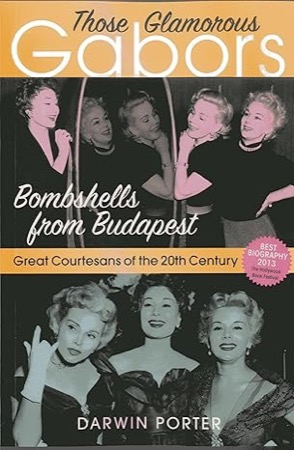
Softcover. NY, Blood Moon, 1st, 2013, Book: Very Good, Dust Jacket: None, Softcover, 752 pages, b&w illustrations. Born in Central Europe during the twilight of the Austro-Hungarian Empire, three "vonderful vimmen"--Zsa Zsa, Eva, and Magda Gabor--transferred their glittery dreams and gold-digging ambitions to Hollywood. They supplemented America's most Imperial Age with "guts, glamour, and goulash," and reigned there as the Hungarian equivalents of Helen of Troy, Madame du Barry, and Madame de Pompadour. More effectively than any army, these Bombshells from Budapest conquered kings, dukes, and princes, always with a special passion for millionaires, as they amassed fortunes, broke hearts, and amused sophisticated voyeurs on two continents. With their wit, charm, and beauty, thanks to training inspired by the glittering traditions of the Imperial Habsburgs, they became famous for being famous. Clean copy.
Softcover. NY, Pocket Books, 1st, 1997, Book: Very Good, Dust Jacket: None, Softcover, 253 pages. Collects the sketches of the artists responsible for the costumes, sets, and aliens from the original Star Trek series, offering insight into the creative talents that contributed to the show's success and the time and budget constraints they overcame. Matt Jefferies created meticulous sketches of every aspect of the Starship Enterprise and the worlds she visited. The energetic illustrations of William Theiss depicted some of the most lavish costumes ever worn in this or any other galaxy. Fred Phillips designed makeup that actualized whole new races, with just humans underneath. Wah Chang created props and hardware that are still the basis of futurist design. Clean, bright copy.
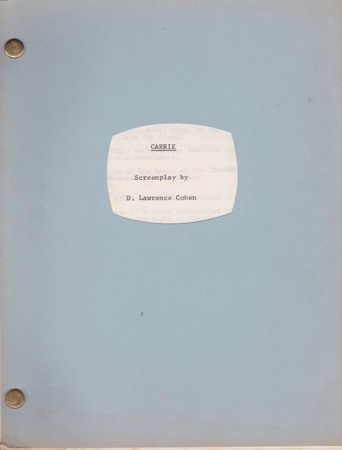
Softcover. Los Angeles, Paul Monash Productions, N/A, Book: Good, Dust Jacket: None, 138 pages, pale blue paper wraps with die-cut screen revealing title, 3-hole punched pages with two brads holding pages, top of rear cover loose from brad. Title page states: adapted from the novel by STEVEN KING (note that STEPHEN KING" is misspelled in this First Draft as "STEVEN KING"). This is an ORIGINAL REVISED FIRST DRAFT SCREENPLAY. At this point the film, Carrie, was in early development. This was, perhaps, a spec script under the umbrella of Producer Paul Monash. Stamped with logo and address of the Ziegler Ross Agency. This draft has handwritten notations, crossed-out sections, some pages initialed (unreadable) - in xeroxed image, not original. Light overall wear.
Hardcover. New York, Museum of Modern Art, 1st, 2003, Book: Very Good, Dust Jacket: Very Good, Hardcover, 152 pages, illustrated throughout in color. Spotless and tight copy. 128 Italian film posters that are a rich array of both Italian films and the international cinema. Includes text and notes on each poster. Arranged by genre from the 30's to the late 50's.

 "Garbo - Her Storyby: Gronowicz, Antoni")
 "Moose That Roared, The - The Story of Jay Ward, Bill Scott, a Flying Squirrel and a Talking Mooseby: Scott, Keith")
 "Pinocchio: The Making of the Disney Epicby: Kaufman, J.B.")


 "Walt Disney's Nine Old Men: Masters of Animationby: Hahn, Don")
 "William Goldman-Four Screenplays: Marathon Man /Butch Cassidy and the Sundance Kid /The Princess Bride/ Misery by: Goldman, William")
 "Jean Renoir: A Biographyby: Merigeau, Pascal")
 "Hollywood Writers' Wars, Theby: Schwartz, Nancy Lynn")
 "Way We Lived Then, The: Recollections of a Well-Known Name Dropperby: Dunne, Dominick")
 "Imitation of Life: Rutgers Films in Printby: Douglas Sirk and Luch Fischer")
 "The Cinema of Pupi Avati by: Maraldi, Antonio (Editor)")
 "Woke Up This Morning: The Definitive Oral History of The Sopranos by: Imperioli, Michael, and Schirripa, Steve")
 "The Art of Selling Moviesby: John McElwee")
 "Solid Ivory: Memoirs by: James Ivory/Peter Cameron (Ed.)")
 "The Dame in the Kimono. Hollywood Censorship and the Production Code by: Leff, Leonard J. & Simmons, Jerold L.")
![Walt Disney's Treasury of Cartoon Classicsby: Darlene Geis [Editor]](javascript:largeIMTop('https://www.browsingisarousing.com/shop/images/Walt-Disneys-Treasury-of-Cartoon-Classics_by_Darlene-Geis-Editor383297-429641.jpg','https://www.browsingisarousing.com/shop/images/Walt-Disneys-Treasury-of-Cartoon-Classics_by_Darlene-Geis-Editor383297-429641.jpg',0,'383297',0,'') "Walt Disney's Treasury of Cartoon Classicsby: Darlene Geis [Editor]")
 "Easy the Hard Way (SIGNED COPY)by: Joe Pasternak, David Chandler")
 "The Ambiguity of Virtue: Gertrude van Tijn and the Fate of the Dutch Jewsby: Wasserstein, Bernard")
 "Chekhov 1860-1904 by: Laffitte, Sophie; translated by Moura Budberg and Gordon Latta")
 "The Platinum Yearsby: Bob Willoughby; Richard Schickel")

 "Cinema Speculationby: Quentin Tarantino")



 "Art & Film (Art and Design Profiles)by: Academy")
 "Cowboy Movie Postersby: N/A")
 "Live Cinema and Its Techniquesby: Coppola, Francis Ford")


 "Seventy Light Years: A Life in the Moviesby: Young, Freddie")
 "Best Movies of the 70'sby: N/A")
 "Graham Greene on Film: Collected Film Criticism 1935 1939 by: Greene, Graham Edited by John Russell Taylor")
 "My Last Sigh: The Autobiography of Luis Bunuel by: Bunuel, Luis")
 "Lights, Camera, Action!: Behind the Scenes Making Movies by: Goldman, Louis")
 "MOVIE STILL- Richard Benjamin/ SIGNED/8x10/BW/by: N/A")
 "Rediscovering French Filmby: Bandy, Mary Lea (Editor), Raud, Richard (Introduction)")


 "Nostalgia Isn't What It Used To Beby: Signoret, Simone")
 "North by Northwest/ Screenplay by: Lehman, Ernest")
 "Best Pick: A Journey Through Film History and the Academy Awards by: Dorney, John; Regan, Jessica; Salinsky, Tom; O'Hara, Helen")
 "Keaton by: Rudi Blesh")
 "The Man Who Invented Hollywood: The Autobiography of D.W. Griffith by: Hart, James /Ed.")
 "Hitchcock's British Films by: Yacowar, Maurice")

 "Barnum in Londonby: Raymund Fitzsimons")
 "Beatrice Lillie: The Funniest Woman in the Worldby: Bruce Laffey")
 "The Spirit of Russia: Studies in History Literature and Philosophy - Volume 2 by: Masaryk Thomas Garrigue ; Slavik Jan ; Paul Eden and Cedar translators ; Lee W. R. &")
)
 "Music in the Shadows: Noir Musical Filmsby: Biesen, Sheri Chinen")

 "Italian Film Posters by: Kehr, Dave")