Softcover. Munich/NY, Schirmer/Mosel, reprint, 1997, Book: Very Good, Dust Jacket: None, Softcover, a collection of 123 b&w duotone photographs taken by Evans from 1927 to 1948. Essay by Michael Brix. Clean copy.
Hardcover. GR, Hatje Cantz, 1st, 2010, Book: Very Good, Dust Jacket: Very Good, Hardcover, 272 pages. Illustrated in b&w. Walker Evans (1903-1975) is, without doubt, one of the most influential American photographers ever, and many of his images have become fixed in the collective memory. But while Evans' uncompromising depiction of poverty during the Great Depression of the 1930s, the subject of a series commissioned by the Farm Security Administration, has become a key chapter in the history of photography, his equally innovative images from later decades have generally commanded less attention. Back in print, this bilingual monograph attempts to redress the balance by examining Evans' complete body of work, and features many rarely seen photographs, including his final works, a sequence of Polaroids shot in the early 1970s (a sequence made possible by an unlimited supply of film from its manufacturer). Evans' re-ascendancy in the 1970s and his relationship with legendary Museum of Modern Art curator John Szarkowski are also closely examined, in this essential and definitive volume on a great photographer who certainly achieved his aim to produce pictures that were "literate, authoritative, transcendent."
Hardcover. NY, PowerHouse Books, 1st, 2007, Book: Very Good, Dust Jacket: Very Good, Hardcover in a bright dust jacket, 263 pages. Personal history and intimate memoir by the wife of the great American artist. 50 duotone photographs and over a dozen by Walker Evans. Storey's memoir of her ten-year marriage to Walker Evans, is the story of an elegant young woman's infatuation with a great American artist--with the man himself, with what he stood for aesthetically, and with his artistic and social circle--and how her initial passion gradually cooled into disenchantment. Isabelle and Walker were married in 1960. Evans, already a prominent figure in the world of photography, introduced Isabelle to Robert Frank, Lee Friedlander, Helen Levitt, Robert Penn Warren, Alfred Kazin, William H. Whyte, and a host of other luminaries. Clean copy.
Hardcover. Rome, Salvatore Ferragamo, 1st, 2006, Book: Very Good, Dust Jacket: Very Good, Hardcover, 144 pages, illustrated with 80 color photographs of the innovative designer's stylish shoes. Four essays on his art and place in fashion history.
Hardcover. NY, W. W. Norton & Company, 1st, 1980, Book: Very Good, Dust Jacket: Very Good, Hardcover, cream cloth, gilt letters on spine & on front cover, color pictorial dust jacket, 533 pages, many BW & 55 color plates. "Surveys the most distinctive styles used in America from the seventeenth century, when their presence can first be documented, to World War I, when the taste makers began to associate the plain white wall with all that was 'Modern." Sort closed tear to dust jacket, unclipped, clean.
Softcover. New York, Disney Editions, 1st, 2016, Book: Very Good, Dust Jacket: None, 176 pages. Softcover. Very clean, unmarked copy with only minor edgewear. Nearly 60 years after Lewis Carroll's literal masterpiece Alice's Adventures in Wonderland was first published, a new filmmaker named Walt Disney created a silent film about a little girl named Alice and her adventures in Cartoonland. The pilot launched a 56-episode series and led Disney down a rabbit hole to form a company that would go on to become synonymous with fairy tales-including making further versions of the Alice story with the beloved 1951 animated film, the more-recent live-action versions, and several iconic Disney Park experiences. Walt Disney's Alice in Wonderland: An Illustrated History delves behind-the-scenes of those whimsical worlds.
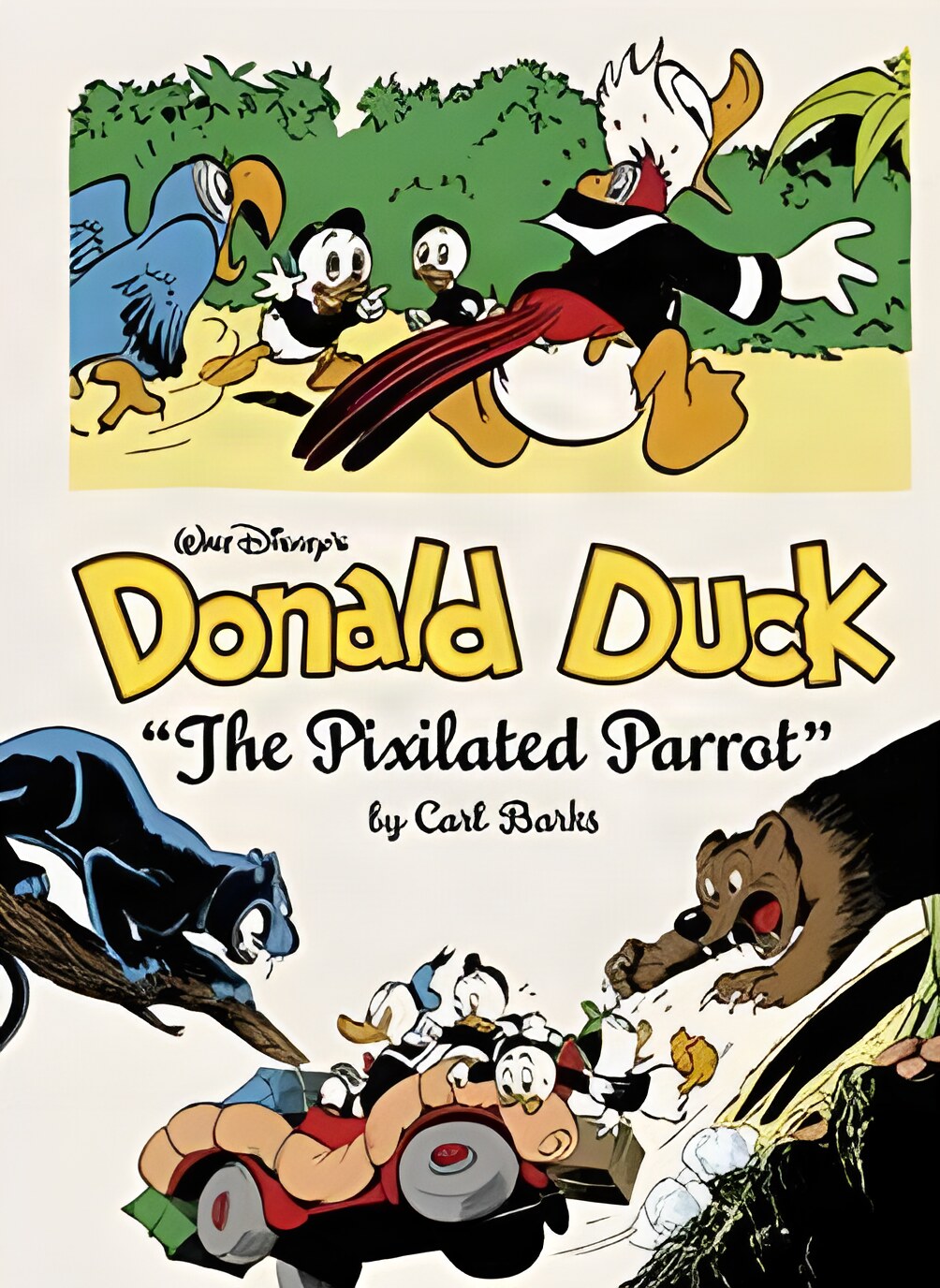
Hardcover. Seattle, WA, Fantagraphics Books, Inc., 1st, 2015, Book: Very Good, Dust Jacket: None, 210 pages. Hardcover without dust jacket. Extensive color illustrations throughout by Carl Barks, Includes appendix of sources and historical information. Clean, tight copy.
Hardcover. Seattle, Fantagraphics, 1st, 2025, Book: Very Good, Dust Jacket: None, Hardcover in pictorial boards. Carl Barks' very first Donald Duck stories! This is where it all started, as Carl Barks took control of Donald Duck's comic book adventures and began a series of clever, creative, complex, and comedic stories that would continue under his cartooning brilliance for more than 20 years -- and guarantee his place in comics history. Volume 1 in The Complete Carl Barks Disney Library is, naturally, filled with firsts: Barks' first comic book story (starring Pluto), the first Donald Duck story created for an American comic book (and also the first to see Donald and his nephews go on a treasure hunt), Barks' first Donald 10-pager, Barks' first truly solo Donald Duck story, and Barks' first solo longer-form Donald Duck adventure ("The Mummy's Ring"). More than 200 pages of story and art, each meticulously restored and newly colored, Clean, bright copy.
Hardcover. Seattle, WA, Fantagraphics Books, Inc., 1st, 2015, Book: Very Good, Dust Jacket: None, 264 pages. Hardcover without dust jacket. Extensive b&w and color illustrations throughout. Clean, tight copy. It's World War II, and Uncle Sam wants Mickey Mouse's "'Lectro Box," an amazing ray cannon that can shapeshift living matter! But also hot on Mickey's trail is gruesome Dr. Grut, who wants to use the ray to turn humans into plants-so Grut's mind-controlled "Aberzombies" can rule the world! Floyd Gottfredson produced a canon of legendary tales starring Mickey as a bold, two-fisted hero: ready to wallop the walking dead... and face off with our wartime foes! You'll see Mickey's awesome role in the war effort, as he tackles Axis bad guys, Schickelgruber subs, and the treasonous Pegleg Pete! Meanwhile, back home in Mouseton, Goofy adopts... a man-eating lion?! Black & white with over 60 pages of color
Hardcover. Taschen, 1st thus, 2020, Book: Very Good, Dust Jacket: Very Good, Hardcover. On November 18, 1928, the world's most famous Mouse made his very first public debut. Today, we celebrate 90+ years of Mickey in one of the most expansive illustrated publications on the Disney universe. Starting with the first sketches of a character who was almost named Mortimer, we trace the career of Walt Disney's and Ub Iwerks's most famous creation, one met with an explosion of worldwide popularity preceded only by the earlier successes of Charlie Chaplin.With unlimited access to Disney's vast historical collections as well as public and private collections, the authors bring Mickey's success story to life: concept art, story sketches, background paintings, and animation drawings as well as historical photographs trace the origins and evolution of such timeless favorites as Steamboat Willie, The Band Concert, and Brave Little Tailor. They also follow Mickey as he builds on this legendary library of short cartoons by appearing in two historic feature-length films, Fantasia and Fun and Fancy Free.Extensive archival research sheds new light on little-known chapters of Mickey's career, the origins of the Mickey Mouse Club, and his use as a patriotic icon during World War II. Along the way, we encounter the work of all major Mickey artists in both film and comics, including such greats as Ub Iwerks, Win Smith, Ferdinand Horvath, Fred Moore, Floyd Gottfredson, Carl Barks, Manuel Gonzales, Paul Murry, Romano Scarpa, Giorgio Cavazzano, Byron Erickson, and Cesar Ferioli.Mickey Mouse has left an indelible mark on everyday culture as well as high art, becoming a favored subject for Pop artists such as Andy Warhol, Keith Haring, and Roy Lichtenstein.
Hardcover. Seattle, WA, Fantagraphics Books, 1st, 2015, Book: Very Good, Dust Jacket: None, 288 pages. Hardcover. Extensive color illustrations by various artists throughout. Illustrated end papers and paste downs. Clean, unmarked copy in excellent condition.
Hardcover. San Francisco, Walt Disney Family Museum, 1st, 2018, Book: Very Good, Dust Jacket: Very Good, Hardcover, 160 pages, illustrated in color and b&w throughout. Clean, bright copy.
Hardcover. San Francisco, CA, Walt Disney Family Museum, 1st, 2018, Book: Very Good, Dust Jacket: Very Good, 160 pages. Hardcover with dust jacket. A clean, unmarked copy with only minor rubbing to dust jacket. A tight copy. Produced in conjunction with The Walt Disney Family Museum's 2018 exhibition of the same name, Walt Disney's Nine Old Men: Masters of Animation features an array of fascinating artwork and family mementos from each of these accomplished gentlemen, such as sketchbooks, caricatures, and snapshots, as well as original art from the classic films Pinocchio, Bambi, Peter Pan, Lady and the Tramp, and Sleeping Beauty.
Hardcover. San Francisco, CA, Walt Disney Family Museum, 1st, 2018, Book: Very Good, Dust Jacket: Very Good, 160 pages. Hardcover with dust jacket. A clean, unmarked copy with only minor rubbing to dust jacket. A tight copy. Produced in conjunction with The Walt Disney Family Museum's 2018 exhibition of the same name, Walt Disney's Nine Old Men: Masters of Animation features an array of fascinating artwork and family mementos from each of these accomplished gentlemen, such as sketchbooks, caricatures, and snapshots, as well as original art from the classic films Pinocchio, Bambi, Peter Pan, Lady and the Tramp, and Sleeping Beauty.
Hardcover. NY, Disney Press, 1st thus, 1995, Book: Very Good, Dust Jacket: Very Good, Hardcover in a bright, unclipped dust jacket. 248 pages. A new edition of a book first published by Abrams in 1981 as "Walt Disney's Treasury of Silly Symphonies". The Silly Symphonies were a series of 76 cartoon shorts produced by the Disney Studio between 1929 and 1939. In 1932. one of them became the first ever animated short film produced in color, and over the years eight of them won Academy Awards. This book features 19 of the stories, illustrated with reproductions from the films, and includes an introductory piece, "The Silly Symphonies - How They Came to Be", and a Filmography of the 76 cartoons. Clean copy.
Softcover. Cambridge MA, Harvard University Press, 1st pbk, 2014, Book: Very Good, Dust Jacket: None, Softcover, 755 pages. Walter Benjamin is one of the twentieth century's most important intellectuals, and also one of its most elusive. His writings-mosaics incorporating philosophy, literary criticism, Marxist analysis, and a syncretistic theology-defy simple categorization. And his mobile, often improvised existence has proven irresistible to mythologizers. His writing career moved from the brilliant esotericism of his early writings through his emergence as a central voice in Weimar culture and on to the exile years, with its pioneering studies of modern media and the rise of urban commodity capitalism in Paris. That career was played out amid some of the most catastrophic decades of modern European history: the horror of the First World War, the turbulence of the Weimar Republic, and the lengthening shadow of fascism. Now, a major new biography from two of the world's foremost Benjamin scholars reaches beyond the mosaic and the mythical to present this intriguing figure in full. Clean copy.
Softcover. New York, St. Martins Press , 1st US, 1975, Book: Very Good, Dust Jacket: None, 122 pages. Softcover. Small marking to front cover. Otherwise clean copy with minor edgewear. 107 illustrations, including 16 in color. Walter Crane, artist of Kensington, was a man of many talents, but is possibly best known for his original and charmingly executed designs which made him the leading illustrator of children's books of the Aesthetic Movement period. In the face of the commercial vulgarity and ugliness of Victorian industrialised society, he created a delicate and escapist fairy world which, with its emphasis on spontaneity and mobility of line, and its clever use of background and colour, popularised a completely new style of tasteful book designs, and brought them within reach of everyone. The influence of Crane's work and his highly novel theories of design make him an important figure in nineteenth century art history. Rodney Engen, American-born painter and lecturer, discusses Crane's style and ideas in a study delightfully arranged after Crane's own rules and book design.
Softcover. NY, Palgrave Macmillan, reprint, 2002, Book: Very Good, Dust Jacket: None, Softcover, 270 pages, b&w illustrations. The career of Norton and Margot, a ballroom dance team whose work was thwarted by the racial tenets of the era, serves as the barometer of the times and acts as the tour guide on this excursion through the worlds of African American vaudeville, black and white America during the swing era, the European touring circuit, and pre-Civil Rights era racial etiquette. Clean copy.
Hardcover. NY, Times Books, 1st, 1987, Book: Very Good, Dust Jacket: Very Good, Hardcover in a bright dust jacket, 533 pages. Traces the history of the Marcos regime, examines U.S. policy towards the Philippines, and argues that U.S. support of dictators is counterproductive. Bookplate on inside front cover, name on front fly leaf, otherwise clean.
Hardcover. NY, Knopf, 1st, 2024, Book: Very Good, Dust Jacket: Very Good, Hardcover in a bright, unclipped dust jacket. Tommy Orange traces the legacies of the Sand Creek Massacre of 1864 and the Carlisle Indian Industrial School through three generations of a family in a story that is by turns shattering and wondrous. Star, a young survivor of the Sand Creek Massacre, is brought to the Fort Marion prison castle, where he is forced to learn English and practice Christianity by Richard Henry Pratt, an evangelical prison guard who will go on to found the Carlisle Indian Industrial School, an institution dedicated to the eradication of Native history, culture, and identity. A generation later, Stars son, Charles, is sent to the school, where he is brutalized by the man who was once his fathers jailer. Clean copy.
Hardcover. NY, Houghton Mifflin Harcourt, 1st, 2019, Book: Very Good, Dust Jacket: Very Good, Hardcover in a bright, unclipped dust jacket. Nigel Hamilton's celebrated trilogy culminates with a story of triumph and tragedy. Just as FDR was proven right by the D-day landings he had championed, so was he found to be mortally ill in the spring of 1944. He was the architect of a victorious peace that he would not live to witness. Using hitherto unpublished documents and interviews, Hamilton rewrites the famous account of World War II strategy given by Winston Churchill in his memoirs. Seventy-five years after the D-day landings we finally get to see, close-up and in dramatic detail, who was responsible for rescuing, and insisting upon, the great American-led invasion of France in June 1944, and why the invasion was led by Eisenhower. As FDR's D-day triumph turns to personal tragedy, we watch with heartbreaking compassion the course of the disease, and how, in the months left him as US commander in chief, the dying president attempted at Hawaii, Quebec, and Yalta to prepare the United Nations for an American-backed postwar world order. Now we know: even on his deathbed, FDR was the war's great visionary.

 "Walden - Then & Now - An Alphabetical Tour of Henry Thoreau's Pondby: McCurdy, Michael")



 "Walker Evans: Decade by Decadeby: Crump and Walker Evans, James")

 "Walking Dreams: Salvatore Ferragamo 1898-1960by: Ferragamo, Salvatore")
 "Wallpaper in America: From the Seventeenth Century to World War Iby: Catherine Lynn")
 "Walt Disney Goofyby: edited by Horst Schroeder; foreword by Steve Hulett")
 "Walt Disney's Alice in Wonderland: An Illustrated Journey Through Time (Disney Editions Deluxe)by: Salisbury, Mark")

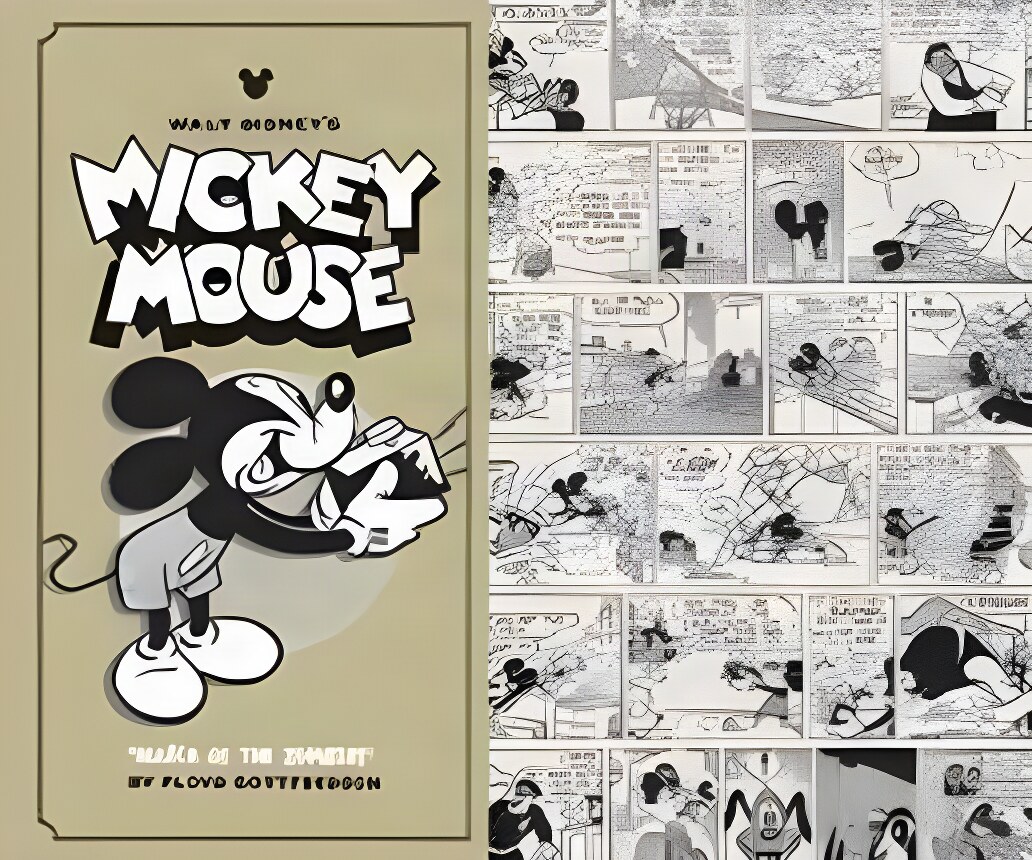

![Walt Disney's Mickey Mouse. [Volume 7], The Tomorrow Warsby: Gottfredson, Floyd](javascript:largeIMTop('https://www.browsingisarousing.com/shop/images/Walt-Disneys-Mickey-Mouse.-Volume-7-The-Tomorrow-Wars_by_Gottfredson-Floyd352376-393133.jpg','https://www.browsingisarousing.com/shop/images/Walt-Disneys-Mickey-Mouse.-Volume-7-The-Tomorrow-Wars_by_Gottfredson-Floyd352376-393133.jpg',0,'352376',0,'') "Walt Disney's Mickey Mouse. [Volume 7], The Tomorrow Warsby: Gottfredson, Floyd")
 "Walt Disney's Nine Old Men: Masters of Animationby: Hahn, Don and Charles Solomon")
 "Walt Disney's Nine Old Men: Masters of Animationby: Hahn, Don")
 "Walt Disney's Nine Old Men: Masters of Animationby: Hahn, Don")
![Walt Disney's Treasury of Cartoon Classicsby: Darlene Geis [Editor]](https://www.browsingisarousing.com/shop/images/Walt-Disneys-Treasury-of-Cartoon-Classics_by_Darlene-Geis-Editor383297-429641.jpg "Walt Disney's Treasury of Cartoon Classicsby: Darlene Geis [Editor]")
 "Walter Benjamin: A Critical Lifeby: Eiland, Howard; /Jennings, Michael W.")
 "Walter Crane as a Book Illustratorby: Crane, Walter")
 "Waltzing with a Dictator: The Marcoses and the Making of American Policyby: Raymond Bonner")
 "Wandering Stars by: Orange, Tommy")
 "Wandering the Corners of Elgin Spring Farm 2009by: Bessette, Earl W.")
 "War And Peace: FDR's Final Odyssey: D-Day to Yalta, 1943")