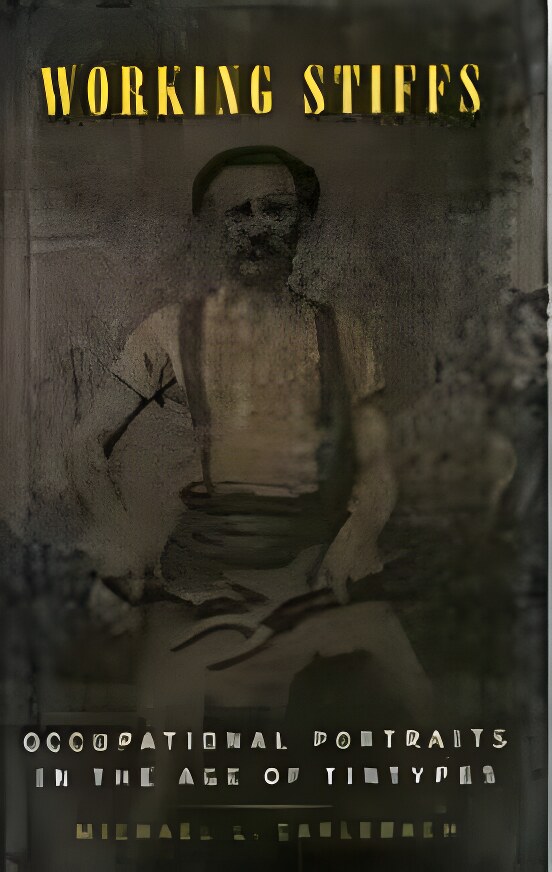
Hardcover. Washington DC, Smithsonian Institution Scholarly Press, 1st, 2002, Book: Very Good, Dust Jacket: Very Good, Hardcover, 144 pages. The tintype, patented in 1856, was a cheap, fast, easy-to-make, practically indestructible type of photograph that became enormously popular among the working class in the late nineteenth century. For common laborers and their families, the opportunity to join the ranks of those who owned pictures of family and friends--the upper classes--was momentous. This collection exhibits more than eighty examples of a specific kind of tintype: occupational portraits, photographs of working people with the tools of their trade. Michael L. Carlebach examines the historical significance of these tintypes and finds that they reveal a great deal about late nineteenth-century values. The subjects of these images are plumbers proudly holding their wrenches and pipe cutters, carpenters with their saws and lathing hatchets, textile workers with their spindles and yarn, icemen with their tongs. These people lived and worked at a time when a depersonalized factory system run by production and efficiency experts was beginning to dominate American industry and culture. Many of the men and women in these tintypes were part of a disappearing class of self-employed artisans and journeymen; their portraits proudly stress their individuality and the essential nobility of their work.
Softcover. St Paul, MN, Pogo Press, 1st thus, 1992, Book: Very Good, Dust Jacket: None, Softcover, pictorial wrappers, 108 pages, b&w illustrations. Presents a series of contemporary articles describing the 1893 Chicago world's fair for the Fargo, N.D., Sunday Argus, and discusses the author's career and the role of women journalists. Shaw's 12 newspaper articles along with contemporary photos are reprinted here.
Softcover. Norman OK, University of Oklahoma Press, 1st, 1997, Book: Very Good, Dust Jacket: None, Softcover, 656 pages. In mythic sagas of the American West, the wide western range offered boundless opportunity to a limited cast of white men. Buffalo roamed, deer and antelope played, and women's voices were never heard. Writing the Range allows us to hear many long-silenced women: Spanish-Mexican settlers and American Indians on New Spain's northern frontiers; Chinese, Basque, Japanese, Korean, Vietnamese, Slavic, and Irish immigrants; film stars Dolores del Rio and Lupe Velez; Navajos and African Americans who moved to western cities during World War II; and the activist Mothers of East Los Angeles, who organized to resist environmental dangers to their community. A valuable introduction to the rapidly changing field of western history, Writing the Range explains clearly how race, class, and culture are constructed and connected. The first section examines issues raised by more than a decade of multicultural western women's histories; following are six chronological sections spanning four centuries. Each section offers a short introduction connecting is essays and placing them in analytic and historical perspective. Clean copy.
Hardcover. GR, Gestalten, 1st, 2012, Book: Very Good, Dust Jacket: Very Good, 128 pages, hardcover, illustrated in color. A monograph on a popular German street artist who stencils images of women on buildings in Berlin. Like new in publisher's shrink-wrap.
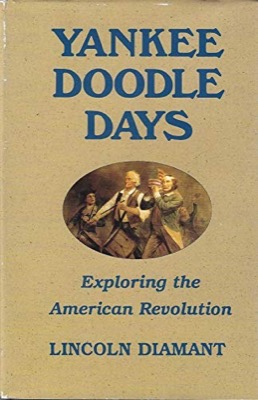
Hardcover. Fleischmanns NY, Purple Mountain Press, 1st, 1996, Book: Very Good, Dust Jacket: Very Good, Hardcover in a bright, unclipped dust jacket. 178 pages.Award-winning biographer and historian Lincoln Diamant introduces a diverse group of men and women who contributed in unique ways to the eight-year American Revolution. . . . Among them are soldiers and civilians, veteran generals and three-week militiamen, patriots and spies, a host of Native American and African-American volunteers, and more than a few courageous women. Clean copy.
Hardcover. Seattle, Fantagraphics, 1st, 2014, Book: Very Good, Dust Jacket: None, Hardcover, 200 pages. This volume covers 1947 through 1949, and includes stories about women from all walks of life from French widows to American teenagers. Simon and Kirby invented the romance comics genre and explored all the flirtations, dalliances, and passions of the young men and women who populated their stories. Get swept away by the sheer delirium that these pages induced so long ago. These comics have been meticulously restored in order to produce one of the most striking and faithful reproductions of 1940s.
Hardcover. University of Chicago, 1st, 1978, Book: Very Good, Dust Jacket: Very Good, Hardcover in a nice dust jacket. 368 pages, index, bibliography, diagrams. Pigs, yams, women and valuables are items of exchange throughout Papua New Guinea. Ceremonial exchange does not arise from economic necessity, rather a social phenomenon reflecting interplay between kinship and marriage structures, the nature of political leadership and the religious and symbolic systems found in these cultures. This work copares 13 New Guinea societies focusing on these distinctive ceremonial exchanges. Clean copy.
Softcover. Seattle, WA, Fantagraphics, 2nd, 2012, Book: Very Good, Dust Jacket: None, 250 pages. Softcover. Light wear to corners, otheriwse Clean, unmarked copy. Black and white drawings throughout. Spanning the most formative era of his life, from the painful years of adolescence to the fame and fortune of early adulthood, this collection of personal correspondences with two near-lifelong friends sheds light on the artistic development, bitter struggle, and ultimate triumph of the world's greatest living cartoonist.Crumb writes about many key events in his life: the dissolution of his first marriage, the pain of being separated from his first child, his troubles with the IRS, and his obsessions with comics, music and women, most notably his earliest experiences with Aline Kominsky-Crumb, now his wife of over 30 years. An entertaining and revealing look into the mind of a great artist and thinker; this is Crumb's sketchbook of words, featuring scores of rare art, including entire letters drawn in cartoon form.
Hardcover. NY, Firefly Books, 1st, 2019, Book: Very Good, Dust Jacket: Very Good, Hardcover in a bright, unclipped dust jacket, 528 pages, b&w illustrations. Martha Gellhorn was a strong-willed, self-made, modern woman whose journalism, and life, were widely influential at the time and cleared a path for women who came after her. An ardent anti-fascist, she abhorred "objectivity shit" and wrote about real people doing real things with intelligence and passion. She is most famous, to her enduring exasperation, as Ernest Hemingway's third wife. Long after their divorce, her short tenure as "Mrs. Hemingway" from 1940 to 1945 invariably eclipsed her writing and, consequently, she never received her full due. Gellhorn's work and personal life attracted a disparate cadre of political and celebrity friends, among them, Sylvia Beach, Ingrid Bergman, Leonard Bernstein, Norman Bethune, Robert Capa, Charlie Chaplin, Chiang Kai-shek, Madame Chiang, Colette, Gary Cooper, John Dos Passos, Dorothy Parker, Maxwell Perkins, Eleanor and Franklin D. Roosevelt, Antoine de Saint-Exupery, Orson Welles, H.G. Wells -- the people who made history in her time and beyond. Yours, for Probably Always is a curated collection of letters between Gellhorn and the extraordinary personalities that were her correspondents in the most interesting time of her life. Through these letters and the author's contextual narrative, the book covers Gellhorn's life and work, including her time reporting for Harry Hopkins and America's Federal Emergency Relief Administration in the 1930s, her newspaper and magazine reportage during the Spanish Civil War, World War II and the Vietnam War, and her relationships with Hemingway and General James M. Gavin late in the war, and her many lovers and affairs.
Hardcover. NY, Skira, 1st, 2008, Book: Very Good, Dust Jacket: Very Good, Hardcover, 168 pages. Yves Clerc, a French painter born in 1947, has ammassed a body of work of over 240 very large and colorful canvases. This publication presents about 100 of them, mostly dedicated to the interpretation of well-known portraits, but also to flowers in vases, "fashion accessories" such as handbags and shoes, nudes, stuffed animals, and adorned women with enormous gowns.
Hardcover. NY, Skira, 1st, 2008, Book: Very Good, Dust Jacket: Very Good, Hardcover, 168 pages. Yves Clerc, a French painter born in 1947, has ammassed a body of work of over 240 very large and colorful canvases. This publication presents about 100 of them, mostly dedicated to the interpretation of well-known portraits, but also to flowers in vases, "fashion accessories" such as handbags and shoes, nudes, stuffed animals, and adorned women with enormous gowns.

 "World's Fair Notes: a Woman Journalist Views Chicago's 1893 Columbian Exposition by: Shaw, Marian")

 "XOOOOXby: XOOOOX and Benjamin Wolbergs (Ed.)")
 "Young Romance 2by: Joe Simon and Jack Kirby")
 "Your Own Pigs You May Not Eat: A Comparative Study of New Guinea Societiesby: Abraham Rosman, Paula G. Rubel")
 "Your Vigor for Life Appalls Me: The R. Crumb Letters 1958-1977by: Crumb, R.")



 "Yves Clercby: Catherine Alestchenkoff and Pascal Bonafoux")
 "Yves Clercby: Catherine Alestchenkoff and Pascal Bonafoux")