Hardcover. Bennington, VT, Vermont Historical Society, 1st, 1984, Book: Very Good, Dust Jacket: None, 70 pages. Hardcover with slipcase. Very clean, unmarked copy with only minor wear to slipcase edges. One of a limited edition of 250 copies. Blue cloth covers with titles and decoration in silver. Features black & white illustrations, maps, including 3 fold out maps.
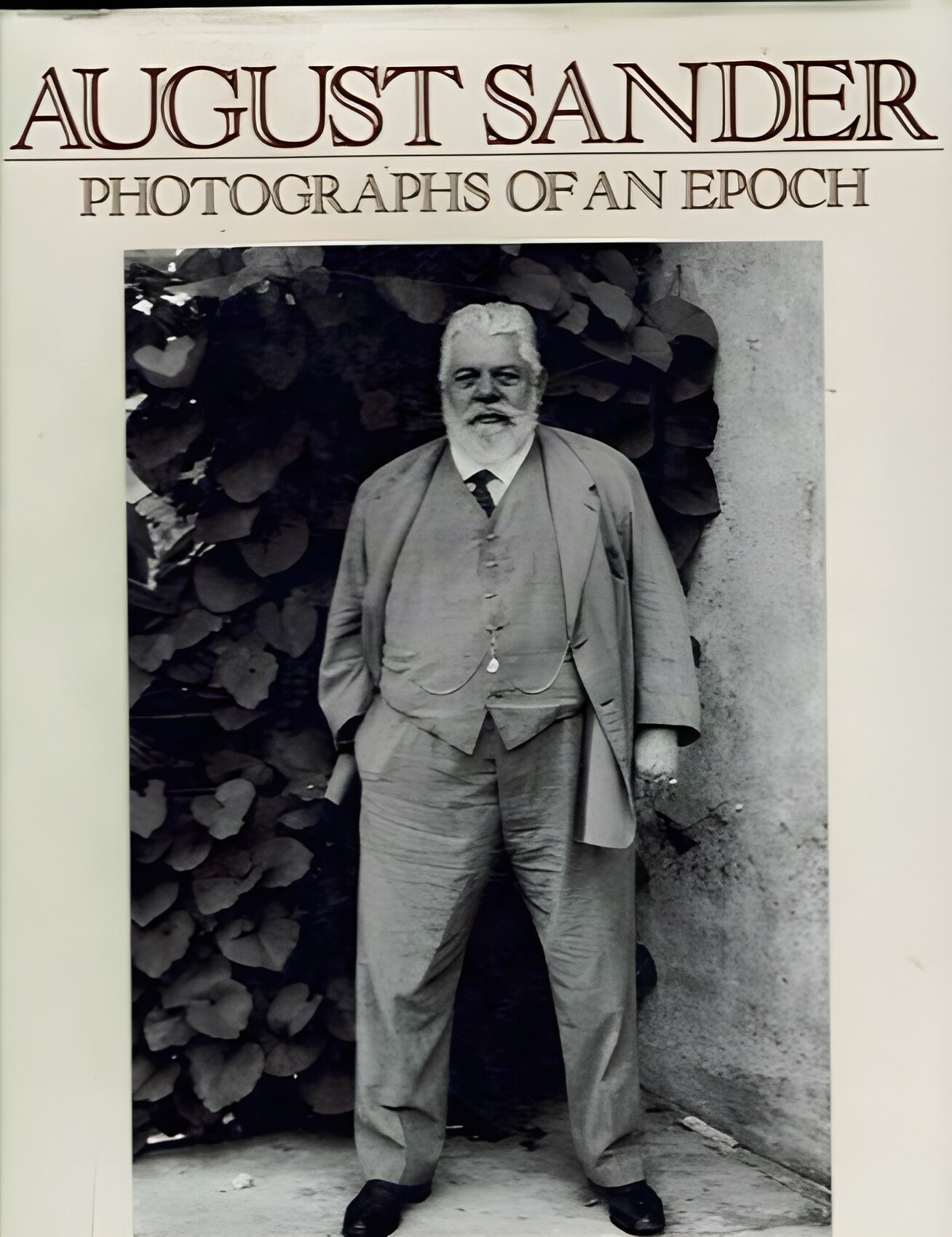
Hardcover. New York, Aperture, 1st, 1980, Book: Very Good, Dust Jacket: Good, Hardcover, 125 pages. Illustrated with black & white photographs. Previous owners inscription on front endpaper. Minor wrinkling at top of dust jacket spine; price-clipped.
Hardcover. London, National Portrait Gallery, 1st, 1997, Book: Very Good, Dust Jacket: Very Good, 269 pages, hardcover with dust jacket. Photographs throughout, spotless and tight copy. Following his maxim, 'Look, Observe and Think', the German photographer, August Sander, was a craftsman of unerring precision. Despising 'tricks, poses and effects', Sander found inspiration in his determination to create images which were absolutely 'true to nature'. His resulting body of work is a diverse catalogue of portraits which capture people of all ages, from every social setting and calling, which provide, in turn, a rich overview of the personalities who shaped Germany's Weimar Republic. A master of camera portraiture, August Sander began photographing people as a boy around the iron-ore mines of his German hometown. As he grew older, he began to foster strong ideas about the function of photography. These opinions culminated in his 'Confession of Faith in Photography', written in 1927, where he talked of showing the 'truth about our age and its people'. This vision is reflected in the universal quality his images share: the innate ability of the photographer to present more than a portrait to show the characters of his sitters. Published to coincide with the National Portrait Gallery's major exhibition of Sander's photographs, this fascinating book offers a comprehensive overview of Sander's rich body of work. Opening with an introductory essay which gives a thorough analysis of Sander's techniques, the book's range of black and white photographs (over 190 in total) are interspersed with contemporary observations regarding Sander's work (these include the photographer's own words). Spanning more than fifty years, the images shown in August Sander offer a pictorial overview of an era and its people. Dominated by the portraits which make up his huge portfolio, 'People of the 20th Century', this catalogue also includes family photographs and a selection of Sander's haunting landscapes.
Hardcover. Cambridge MA, The MIT Press, 1st thus, 1986, Book: Very Good, Dust Jacket: Very Good, Hardcover in a bright dust jacket. August Sander (1876-1964) spent his life intending to create a collective portrait of the German people, an undertaking which remained incomplete at the time of his death. This reconstruction by Keller, a professor of art history, in collaboration with Gunther Sander, the photographer's son, was compiled from Sander's notes and negatives. The photographs cover the years of the Kaisers, the Weimar Republic, the Nazi regime, and the early Federal Republic and have become a landmark in the history of photography. 512 pages; 431 full-page duo-toned b&w plates + 75 text illustrations; 9.25 x 11.75 inches. Bibliography. Clean copy. DOMESTIC SHIPPING ONLY.
Hardcover. Munich/NY, Prestel, 1st, 2019, Hardcover in a bright dust jacket, 304 pages. Featuring 60 subjects from August Sander's People of the 20th Century along with another 100 brilliant images from his large-scale project, this book presents a selection of the most stunning images from the photographer's monumental work. August Sander is one of the greatest photographers in international photographic history. With his seminal book People of the 20th Century, he set new standards in portrait photography. Sander's aspiration was to create a typological "composite image" of his time. The ambitious project began in the 1910s and was to occupy him through the 1950s. A novel feature of this book is that all the reproductions are based on vintage prints produced and authorized by August Sander himself. The croppings and the desired tonal values are authentically rendered here for the first time in the long publication history of Sander's brilliant portrait work. The originals are from the rich holdings of the Photographische Sammlung/SK Stiftung Kultur in Cologne and from additional major collections such as the Museum of Modern Art in New York, the J. Paul Getty Museum in Los Angeles, and the Pinakothek der Moderne in Munich. Like new in publisher's shrinkwrap. DOMESTIC SHIPPING ONLY.
Softcover. NY, Aperture, 1st pbk, 1980, Book: Very Good, Dust Jacket: None, Softcover. Catalog of an exhibition presented by the Philadelphia Museum of Art from Mar. 1-Apr. 27, 1980, to travel to major institutions throughout the United States. A special combined issue of Aperture Magazine. 128 pages, photo illustrated in b&w. Historical commentary by Robert Kramer. Also includes a chronology and bibliography. Clean copy.
Softcover. NY, Aperture, 1st pbk, 1980, Book: Very Good, Dust Jacket: None, Softcover. Catalog of an exhibition presented by the Philadelphia Museum of Art from Mar. 1-Apr. 27, 1980, to travel to major institutions throughout the United States. A special combined issue of Aperture Magazine. 128 pages, photo illustrated in b&w. Historical commentary by Robert Kramer. Also includes a chronology and bibliography. Clean copy.
Softcover. Oxford UK, Clarendon Press, 1st pbk, 1990, Book: Very Good, Dust Jacket: None, Softcover, 185 pages. The Rule of Augustine, the oldest monastic rule with Western origins, still provides inspiration for over 150 Christian communities. This account of Augustine's contributions to the monastic spirituality of the late Roman world and of his achievement as a monastic legislator fills a critical gap in Augustinian studies. Tracing Augustine's progress from a philosophical to a biblical spirituality and his development of a monastic ideal largely shaped by Greco-Roman philosophical and rhetorical influences, Lawless also discusses Augustine's renunciation of sexuality, property, and worldly ambition at his conversion as a foreshadowing of the future vows of chastity, poverty, and obedience. In addition, he argues for the existence of a monastery at Thagaste from 388 to 391. This book includes new English translations of the Regulations for a Monastery, the Rule, and Letter 211. Clean, bright copy.
Softcover. London, Bloomsbury, reprint, 2008, Book: Very Good, Softcover, 692 pages. Coursing through Austerity Britain is an astonishing variety of voices - vivid, unselfconscious, and unaware of what the future holds. A Chingford housewife endures the tribulations of rationing; a retired schoolteacher observes during a royal visit how well-fed the Queen looks; a pernickety civil servant in Bristol is oblivious to anyone's troubles but his own. An array of working-class witnesses describe how life in post-war Britain is, with little regard for liberal niceties or the feelings of their 'betters'. Many of these voices will stay with the reader in future volumes, jostling alongside well-known figures like John Arlott (here making his first radio broadcast, still in police uniform), Glenda Jackson (taking the 11+) and Doris Lessing, newly arrived from Africa, struck by the levelling poverty of postwar Britain. David Kynaston weaves a sophisticated narrative of how the victorious 1945 Labour government shaped the political, economic and social landscape for the next three decades.Deeply researched, often amusing and always intensely entertaining and readable, the first volume of David Kynaston's ambitious history offers an entirely fresh perspective on Britain during those six momentous years. Clean copy.
Softcover. Mechanicsburg PA, Stackpole Books, 1st, 2006, Book: Very Good, Dust Jacket: None, Softcover, 194 pages, b&w illustrations. This is a fascinating account of Australia's M/Z commando unit and the part it played in the Southwest Pacific during World War II. M Unit personnel were secretly landed to set up coast-watching posts and radio stations to monitor Japanese shipping movements and bombing flights. Members of the Z Unit carried out raids in enemy-controlled areas and also attacked targets of opportunity. Many commandos were delivered on their missions by U.S. Navy submarines that sneaked into dangerously shallow waters to put the men ashore. Other operatives were inserted by PT boats, Catalina aircraft, parachute, and snake boats. Clean, bright copy.
Hardcover. Sydney AU, George Allen & Unwin, 1st, 1983, Book: Very Good, Dust Jacket: Very Good, Hardcover in a bright dust jacket. Centenary history of the Sydney-based business Burns, Philip & Co. The company was firmly established as a merchant in Australia and throughout the South Pacific. The book is unique in relating this big mercantile firm to its customers, regardless of their culture. A rich and varied story of a truly Australian company and a major contribution to Australian business history. 392 pages, 24 b&w plates, endpapers map. Clean copy.
Softcover. Wesleyan University Press, reprint, 2004, Book: Very Good, Dust Jacket: None, Softcover, 166 pages. This book, first published in Italy in 1988 as Autoritratto di gruppo, documents the intricate web of individual and communal experiences in the political movements of the '60s. Luisa Passerini, internationally known for her work in memory, oral history, and their intersections with social movements, sets out to rescue the "forgotten memory" of her generation and to give it literary status. The year 1968 is symbolic in Italy of a whole decade of struggles by students, women, workers, intellectuals, and technicians. Framed and illuminated by sessions of psychoanalysis, this absorbing narrative weaves episodes of Passerini's autobiography - including her involvement in the 1968 uprisings - oral histories of other participants, and Passerini's sociological observations. It raises critical questions about how we reconstruct the past and vividly illustrates the forces that shaped a generation. Clean copy.
Hardcover. Wilmington, DE, Scholarly Resources Inc., 1st, 1984, Book: Very Good, Dust Jacket: Very Good, 298 pages. Hardcover. Dust jacket unclipped. Cover boards bound in blue, gilt title on spine and front cover. Dust jacket has a touch of agewear, A little foxing on top edge. Clean inside, binding tight, in great shape.
Hardcover. New York, Century Co., 1st, 1890, Book: Very Good, Dust Jacket: None, 501 pages. Hardcover. AUTHORS SIGNED INSCRIPTION PASTED ON TITLE PAGE. 3/4 Leather marbled sections, raised bands on spine. Gilt titles and highlights. Marbled endpapers. Gilt top edge. Light rubbing to cover edges. Clean, tight copy.
Softcover. Santa Fe Springs CA, Hathaway and Bowers, 1st, 1970-71, Book: Good, Dust Jacket: None, Nine softcover catalogs from the foremost dealer in antique music makers: Organs, pianinos, automatic harps, music boxes, etc. Catalogues No. 9 through 17, 1969-1971. All with b&w illustrations. Pages vary, 60-100. From a museum library with light stamping, small stickers on covers. Otherwise clean.
Hardcover. University of Nebraska, 1st, 1996, Book: Very Good, Dust Jacket: Very Good, Hardcover in a dust jacket with minor fading to edges, b&w illustrations, 179 pages. Contemporary feminist critics have often described Surrealism as a misogynist movement. In Automatic Woman, Katharine Conley addresses this issue, confirming some feminist allegations while qualifying and overturning others. Through insightful analyses of works by a range of writers and artists, Conley develops a complex view of Surrealist portrayals of Woman. Conley begins with a discussion of the composite image of Woman developed by such early male Surrealists as Andre Breton, Francis Picabia, and Paul Eluard. She labels that image "Automatic Woman"--a term that comprises views of Woman as provocative and revolutionary but also as a depersonalized object largely devoid of individuality and volition. This analysis largely confirms feminist critiques of Surrealism. The heart of the book, however, examines the writings of Leonora Carrington and Unica Zurn, two women in the Surrealist movement whose works, Conley argues, anticipate much contemporary feminist art and theory. In concluding, Conley shows how Breton's own views on women evolved in the course of his long career, arriving at last at a position far more congenial to contemporary feminists.
Hardcover. London, Sidgwick and Jackson, 1st, 1923, Book: Very Good, Dust Jacket: None, Hardcover, 332 pages. Black & white illustrations. Previous owners name at top right corner of front endpaper. Covers show standard wear with light rubbing.
Hardcover. NY, Macmillan Company, 1st, 1898, Book: Very Good, A two-volume set, taupe-colored cloth boards with gilt decorated illustration of Rome on front cover. Top edge gilt. Vol I: Fold-out map of Rome as frontis., 332 pages, 14 photogravure plates with tissue guards, numerous line illustrations in the text. Vol II: Photo of St. Peters Square as frontis., 344 pages, 13 photogravure plates with tissue guards, numerous line illustrations in the text. Light soil to covers, both volumes with mild residue to inside covers where bookplate may have been removed. Otherwise clean.
Hardcover. New York, Spiegel & Grau, 1st, 2017, Book: Very Good, Dust Jacket: Very Good, 720 pages. Hardcover with dust jacket. A very clean, unmarked copy with only minor dust jacket wear. Black and white images throughout. A tight copy.
Hardcover. New York, Spiegel & Grau, 1st, 2017, Book: Very Good, Dust Jacket: Very Good, 720 pages. Hardcover with dust jacket. A very clean, unmarked copy with only minor dust jacket wear. Black and white images throughout. A tight copy.
Hardcover. San Francisco, Chronicle Books, 1st, 2006, Book: Very Good, Dust Jacket: Very Good, 352 pages. Hardcover. B/w illustrations throughout. Dust jacket price-clipped, and a touch of age-yellow. Cover boards decorated/glossy. Clean and unmarked inside. In excellent shape.
Hardcover. New York, Ticknor & Fields, 1st, 1988, Book: Very Good, Dust Jacket: Very Good, Hardcover in a bright dust jacket, 282 pages, illustrated throughout with vintage b&w photos, documenting the Yankee star's career. Small nick to dust jacket along fore-edge, light edgewear, otherwise very good.
Hardcover. NY, Canongate , 1st, 2007, Book: Very Good, Dust Jacket: Very Good, Hardcover in a bright dustjacket, 694 pages. Destined to become a classic on the subject alongside Legs McNeil's Please Kill Me , Babylon's Burning is a groundbreaking, definitive account of punk rock, one of the most influential and lasting music movements in history--a movement that ironically was built on self-annihilation. Acclaimed critic Clinton Heylin seamlessly weaves together the lives of disparate artists who had in common not the music (there was no distribution) but the pictures, words, and fashions depicted in magazines like Creem and NME . It was a sound that eschewed conventional lyrics, promoted a gutteral musicality but yet contained a keen pop sensibility. Whether exploring the work of early progenitors like Suicide, The New York Dolls, and Patti Smith or charting the progress of the bands who legitimately took up the mantle in the eighties and nineties, Clinton Heylin brings to life the strands of a global artform. From the Sex Pistols's clarion call of a record, "Never Mind the Bollocks," to Kurt Cobain's songs of an alienated youth, Babylon's Burning is the brilliant, exhaustively researched story that once and for all defines what Punk is and is not.

 "Atlas of Lake Champlain, 1779-1780by: Chambers, William")

 "August Sander - Photographs of an Epoch 1904-1959by: N/A")
 "August Sander: 'In Photography There Are No Unexplained Shadows'by: Sander, August (Photographer)")

 "August Sander: Masterpieces by: Conrath-Scholl, Gabriele")

 "Augustine of Hippo and His Monastic Ruleby: Lawless, George")

 "Australian Commandos: Their Secret War Against the Japanese in WWII by: Feuer A. B. /foreword by Robert Barr Smith ; afterwords by George Folta and John Keith Leasure")
 "Australian Presence In The Pacific, The: Burns Philp 1914-1946 by: Buckley, Ken/ Klugman, Kris")

 "Autobiography of Du Pont de Nemours, Theby: Du Pont, Pierre Samuel, Elizabeth Fox-Genovese (Translator and Introduction)")
 "Autobiography of Joseph Jefferson, The (SIGNED COPY)by: Jefferson, Joseph")
 "Automatic Woman:The Representation of Women in Surrealism by: Katharine Conley")
 "Auxiliary Patrol, Theby: Chatterton, E. Keble")
 "Ave Roma Immortals: Studies from the Chronicles of Rome (2 Vols.)by: Francis Marion Crawford")
 "Avedon: Something Personalby: Stevens, Norma")
 "Avedon: Something Personalby: Stevens, Norma")
 "Aviation Book, The: A Survey of the World's Aircraftby: Caoimh, Fia O")

 "Babylon's Burning: From Punk to Grungeby: Clinton Heylin")