Softcover. Surrey UK, FAB Press, 4th pr., 2022, Book: Very Good, Dust Jacket: None, Softcover, 192 pages, b&w illustrations. A mind-melting compilation of gonzo writing, illustration and comics about the most insane, sexy, awkward, cheesy, hilarious, upsetting and jaw-dropping movies in the history of film, 'Cinema Sewer' joyously celebrates the sleaziest aspects of the moviegoing experience, whilst delving deep into bizarre cinematic history. Adults only material. Like new copy.
Softcover. UK, FAB Press, 3rd pr., 2024, Book: Very Good, Dust Jacket: None, Softcover, 191 pages illustrated in b&w. A mind-melting compilation of gonzo writing, illustration and comics about the most insane, sexy, awkward, cheesy, hilarious, upsetting and jaw-dropping movies in the history of film, Cinema Sewer joyously celebrates the sleaziest aspects of the moviegoing experience, whilst delving deep into bizarre cinematic history. Author and comic artist Robin Bougie takes a dive to the bottom of the cesspool of sexploitation, doing so in a distinctive manner that has made him famous amongst a loyal following of cult film fans. Issues 17 to 20 of this celebrated underground smash magazine are exhaustively revised and collated in this third wild volume, together with an additional 80 pages of never-before-seen interviews, rants, comics, hard-to-find classic movie advertising, and graphic illustrations by Bougie and a host of his talented friends from both the comic book and animation industries. Clean copy.
Hardcover. NY, Harper, 5th pr., 2022, Book: Very Good, Dust Jacket: Very Good, Hardcover in a bright, unclipped dust jacket, 391 pages with index. In addition to being among the most celebrated of contemporary filmmakers, Quentin Tarantino is possibly the most joyously infectious movie lover alive. For years he has touted in interviews his eventual turn to writing books about films. Now, with Cinema Speculation, the time has come, and the results are everything his passionate fans--and all movie lovers--could have hoped for. Organized around key American films from the 1970s, all of which he first saw as a young moviegoer at the time, this book is as intellectually rigorous and insightful as it is rollicking and entertaining. At once film criticism, film theory, a feat of reporting, and wonderful personal history, it is all written in the singular voice recognizable immediately as QT's and with the rare perspective about cinema possible only from one of the greatest practitioners of the art form ever.
Hardcover. Bloomington IN, Indiana University Press, 1st, 1999, Book: Very Good, Dust Jacket: Very Good, Hardcover in a bright, unclipped dust jacket. 199 pages, scattered maps & drawings & figures. The authors selected five reasonably well excavated settlements in southern and central Greece to stand as the exemplars for the contemporary situation and the ongoing transformations of Greek society between 1200 and 700 B.C. (?) Thus, for the late-thirteenth to twelfth centuries there is Mycenae; Nichoria for the eleventh; Athens for the tenth; Lefkandi for the ninth; Corinth for the eight; and Ascra for the early seventh. Each settlement?s particular situation provides them with an opportunity to expand on how this is similar or not to the situations of other, contemporary settlements as well as to the larger picture and trends of cultural transformation. Clean copy.
Hardcover. Urbana IL, University of Illinois Press, 1st, 1958, Book: Very Good, Dust Jacket: Very Good, Hardcover in a lightly worn dust jacket, 262 pages, b&w illustrations. A studied volume by an English military man and on-site witness to many of the events of the American Civil War enhanced with 16 pages of contemporary B&W photographs and drawings. The book was originally published in the 1860s and is one of the finest and most informative of the few records left by outside observers of the Confederacy in its own time. Name on front fly leaf otherwise clean.
Hardcover. NY, Ariel/ Farrar Straus Cudahy, 1st, 1961, Book: Very Good, Dust Jacket: Very Good, Hardcover in a lightly worn dust jacket, unclipped. A moving portrait of the young Abraham Lincoln awakening to early powers. B&w illustrations by Douglas Gorsline. 90 pages.
Hardcover. NY, Time Life, reprint, 1983, Book: Very Good, Dust Jacket: None, 401 pages. Hardcover with no dust jacket. Dark blue leather bound with gilt titles to front cover and spine. Embossed decoration on front cover. Gilt text block edges, red ribbon marker. Clean, tight copy. This is one of the more impressive (and unfortunately little known) records of the American Civil War. John Beatty was a lawyer from Ohio who joined the Union Army when the South seceded. He started his service in western Virginia under General George B. McClellan. Although McClellan would later become one of the most well-known generals of the war, it was here that he first achieved the prominence that would lead to Lincoln promoting him to head Union forces on two separate occasions. Beatty, however, was clearly not enamored of McClellan. His journal opens with a description of arriving in one of the local railroad communities and subsequent entries describe the minutiae of camp life. Beatty is relatively unique among memoirists in that his book is largely a transcription of his original diary. As a result, his recollections are of recent events and have a degree of candor not present in many post-bellum narratives.
Softcover. Freetown MA, Freetown Historical Society, 1st, 2005, Book: Very Good, Dust Jacket: None, Softcover, light gray wrappers, 327 pages. John Milton Deane (January 8, 1840 - September 2, 1914), was an American Civil War Medal of Honor recipient and a major in the United States Army. Deane was born in Assonet, Massachusetts to John and Lydia (Andros) Deane. The diary he kept is here type-written out in chronological order. B&w photo of Deane as a Lieutenant in 1863. Clean, like new.
Hardcover. Knoxville, University of Tennessee Press , 1st, 1980, Book: Very Good, Dust Jacket: Very Good, Hardcover in a bright dust jacket, 149 pages. The chief nurse of the Union Hospital in Washington, D.C., describes life and stress in the hospital and comments on notable persons of power. Her heretofore unpublished diary and letters comprise a fresh, highly significant document concerning the medical history of the Civil War and the contributions of women nurses in the Northern military hospitals. This book is edited, with Introduction and Commentary, by John R. Brumgardt.
Hardcover. NY, Jonathan Cape & Harrison Smith, 2nd pr., 1930, Book: Very Good, Dust Jacket: None, Hardcover, bound in publisher's black cloth ruled in blind with faded gilt title on the spine. Top edge stained black. Stated second printing, October 1930 on the copyright page. Translated by Alice Riviere. Ownership signature in pencil by Gertrude Franchot Tone, women's rights activist with her pencil marking in text. Owner's small embossed stamp on front fly leaf.
Hardcover. US, Prestel Publishing, 1st, 2012, Book: Good, Dust Jacket: Good, This comprehensive monograph explores the conceptual complexity and diversity of Claes Oldenburg's early work to reveal this influential artist's extraordinary inventiveness. Accompanying an exhibition of Oldenburg's seminal early work, this publication examines the breadth of his artistic career from the late 1950s to 1970. It features works including the landmark installations The Street and The Store and their accompanying performances; the highly influential spectacular sculptures of everyday objects as well as drawings and preparatory collages for public projects from the 1960s. The book traces the development of Oldenburg's practice as it follows his work up to the Mouse Museum. Also included in the publication is an extensive chronology, alongside notes as well as a variety of installation views that showcase the careful consideration given to modes of presentation. In addition to imagery of his Pop icons, this richly illustrated book contains an extensive selection of drawings, collages, and magazine and newspaper clippings as well as a wealth of previously unpublished notebook pages, preparatory studies, and photographs taken by the artist. This volume probes diverse aspects of his work to offer fresh perspectives on Oldenburg's artistic development and unprecedented insights into the conceptual process of his artistic explorations. Gash through dust jacket on front cover.
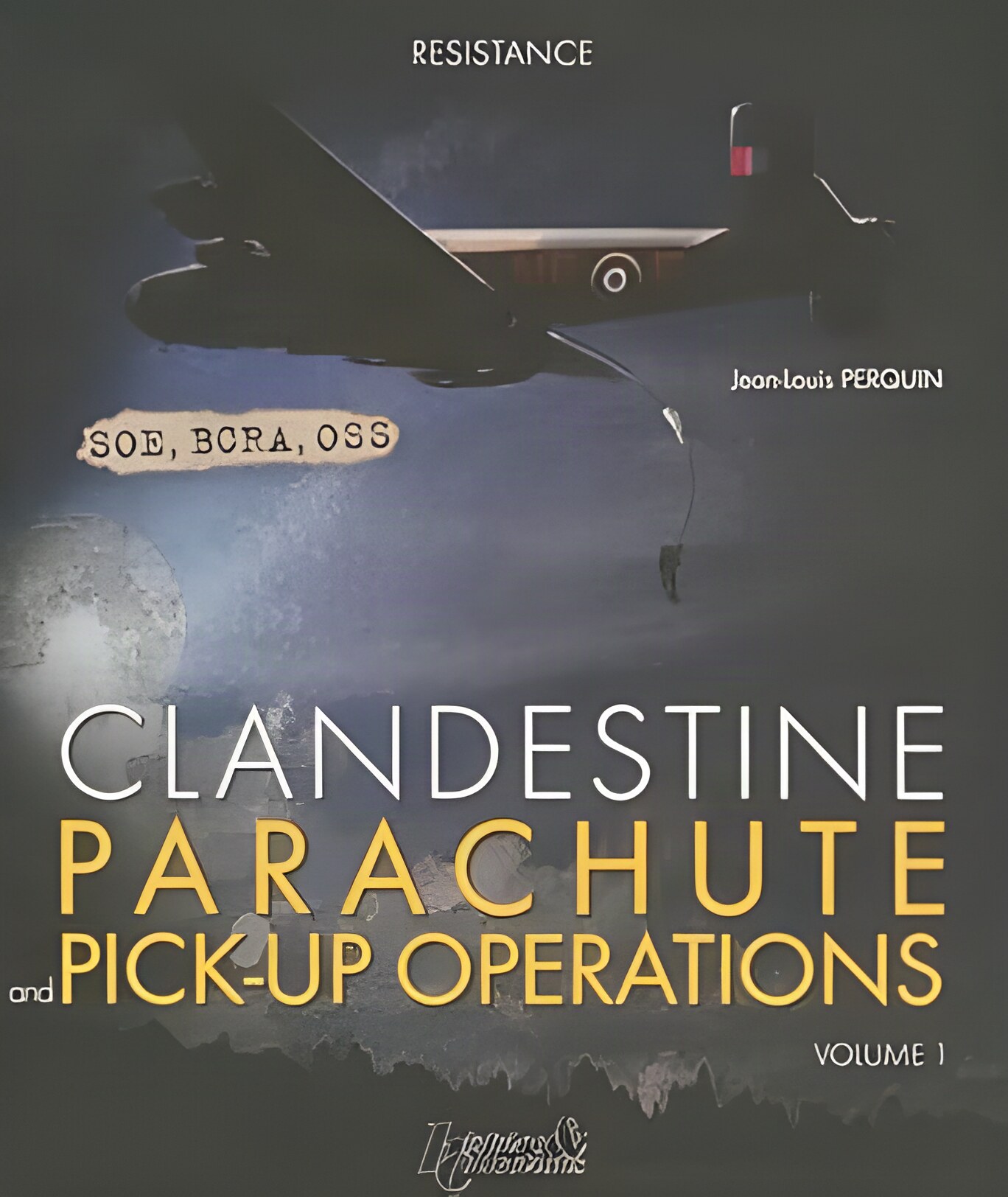
Softcover. Paris, Histoire and Collections, 1st, 2012, Book: Very Good, Dust Jacket: None, Softcover, 132 pages. profusely illustrated in color and b&w. This second volume of the collection Resistance is devoted to the parachuting and picking up of agents, from 1940 to 1944. It is a gripping frieze of these operations and a vigorous tribute to those heroes of the resistance whom the author describes here, using both his extensive personal documentation, connections among the veterans and many museum conservators throughout Europe. The reconstitution is rigorous and the information precise about both material and methods, and the wealth of pictures will live up to the expectations of most enlightened amateurs. But above all, each reader can discover the personal life stories more intimately, from the training exercises in England awaiting departure, to the sacrifices made so freely in carrying out the missions. Clean copy.
Hardcover. New York, Simon & Schuster, 1st US, 2003, Book: Very Good, Dust Jacket: Very Good, Hardcover in a bright dust jacket. 423 pages, SIGNED BY AUTHOR on title page. Very clean and tight copy. With "humanism, generosity, and a passionate, beating heart" (The Times, London), Janice Galloway's Clara reignites, from between the lines of history, the great love of Robert and Clara Schumann. In her lifetime, Clara was a celebrated concert pianist and composer, editor and teacher, friend of Brahms -- as well as mother of the eight Schumann children and caretaker of her husband through a series of crippling mental illnesses. In its luminous integrity the novel brings Clara Schumann to life as a woman of genius. Galloway is at once a meticulous researcher of her subjects' remarkable and highly dramatic artistic careers and a virtuoso storyteller whose imagination and empathy lead her to that place off limits to history and biography -- inside the human mind. Distilling the memories, poetry, and musical notes therein, she examines the ways artists divine patterns out of life's chaos. "Passion," writes Galloway of Clara's performance philosophy, "one might take for granted -- its control is the mechanism through which all else flows." Though music may have bent to Clara's will, love served her far more tragically. Dismissing the cliches of Great Art and rejecting the romantic conflation of Madness and Creativity, Clara boldly ventures that in a life marred by alienation and isolation, "Work alone endures."
Hardcover. Lexington KY, University Press of Kentucky, 1st, 2018, Book: Very Good, Dust Jacket: Very Good, Hardcover in a bright dust jacket, 448 pages. Greta Garbo proclaimed him as her favorite director. Actors, actresses, and even child stars were so at ease under his direction that they were able to deliver inspired and powerful performances. Academy-Award-nominated director Clarence Brown (1890-1987) worked with some of Hollywood's greatest stars, such as Clark Gable, Joan Crawford, Mickey Rooney, Katharine Hepburn, and Spencer Tracy. Known as the "star maker," he helped guide the acting career of child sensation Elizabeth Taylor (of whom he once said, "she has a face that is an act of God") and discovered Academy-Award-winning child star Claude Jarman Jr. for The Yearling (1946). He directed more than fifty films, including Possessed (1931), Anna Karenina (1935), National Velvet (1944), and Intruder in the Dust (1949), winning his audiences over with glamorous star vehicles, tales of families, communities, and slices of Americana, as well as hard-hitting dramas. Although Brown was admired by peers like Jean Renoir, Frank Capra, and John Ford, his illuminating work and contributions to classic cinema are rarely mentioned in the same breath as those of Hollywood's great directors. In this first full-length account of the life and career of the pioneering filmmaker, Gwenda Young discusses Brown's background to show how his hardworking parents and resilient grandparents inspired his entrepreneurial spirit. She reveals how the one-time engineer and World War I aviator established a thriving car dealership, the Brown Motor Car Company, in Alabama-only to give it all up to follow his dream of making movies. He would not only become a brilliant director but also a craftsman who was known for his innovative use of lighting and composition.
Princeton University Art Museum, 1st, 2017, Book: Very Good, Dust Jacket: Very Good, Hardcover, 408 pages. Clarence H. White (1871-1925) was one of the most influential art photographers and teachers of the early 20th century and a founding member of the Photo-Secession. This beautiful publication offers a new appraisal of White's contributions, including his groundbreaking aesthetic experiments, his commitment to the ideals of American socialism, and his embrace of the expanding fields of photographic book and fashion illustration, celebrity portraiture, and advertising. Based on extensive archival research, the book challenges the idea of an abrupt rupture between prewar, soft-focus idealizing photography and postwar "modernism" to paint a more nuanced picture of American culture in the Progressive era. The illustrations are well reproduced and comprehensive.
Softcover. Chicago's Books Press, 1st, 2008, Book: Very Good, Dust Jacket: None, Softcover, 200 pages, b&w illustrations. CD included. An interesting behind-the-scenes look at the golden age of Midwest radio. This book is a must read if you grew up in the late 1950's and 1960's listening to WLS radio in Chicago. Clark Weber takes us along with him as he starts his radio career in a little daytime station and then progresses to the "Big 89". He chronicles the rise of WLS into a 38 state "Blowtorch" during the 25+ years that the station ruled the midwest airways as THE 'Top 40' radio station. You will hear stories of the 'jocks' that worked with him, how fun it was working the big 'hops' around Chicago and the midwest, his understanding wife, and his lone solo airplane flight that almost ended the fun for him. Clean copy.
Softcover. New York, Metro Books, 1st, 2013, Book: Very Good, Dust Jacket: None, Softcover, 272 page, illustrated throughout in color and b&w. Light shelf-wear to wrappers, else a clean, tight copy.
Hardcover. Princeton NJ, Princeton University Press, 1st, 2018, Book: Very Good, Dust Jacket: Very Good, Hardcover in a bright dust jacket, 358 pages, color and b&w illustrations. What we call classical art did not simply appear in ancient Rome, or in the Renaissance, or in the eighteenth-century Academy. Endlessly repackaged and revered or rebuked, Greek and Roman artifacts have gathered an amazing array of values, both positive and negative, in each new historical period, even as these objects themselves have reshaped their surroundings. Vout shows how this process began in antiquity, as Greeks of the Hellenistic period transformed the art of fifth-century Greece, and continued through the Roman empire, Constantinople, European court societies, the neoclassical English country house, and the nineteenth century, up to the modern museum. Clean copy.
Softcover. Oxford, UK, Clarendon Press, Reprint, 1978, Book: Very Good, Dust Jacket: None, 306 pages. Softcover with light wear to wraps. Sunfade to spine. Spine faded. Small black mark on rear wrap, some lines highlighted on four pages. Light toning throughout, illustrated by tables & figures in bw.
Softcover. Baltimore, Johns Hopkins University Press, 1st, 1994, Book: Very Good, Dust Jacket: None, Softcover, 295 pages. The infamous Nuremberg Doctors' Trials of 1946-47 revealed horrifying crimes --ranging from grotesque medical experiments on humans to mass murder--committed by physicians and other health care workers in Nazi Germany. But far more common, argue the authors of Cleansing the Fatherland, were the doctors who profited professionally and financially from the killings but were never called to task--and, indeed, were actively shielded by colleagues in postwar German medical organizations. The authors examine the role of German physicians in such infamous operations as the "T 4" euthanasia program (code-named for the Berlin address of its headquarters at Number 4 Tiergartenstrasse). They also reveal details of countless lesser known killings--all ordered by doctors and all in the name of public health. Maladjusted adolescents, the handicapped, foreign laborers too illto work, even German civilians who suffered mental breakdowns after air raids were "selected for treatment." (One physician who persisted in speaking of "killings" was officially reprimanded for his "negative attitude.") The book also includes original documents--never before published in English--that give unique and chilling insight into the everyday workings of Nazi medicine. Clean copy.
Hardcover. NY, Whittlesey House, 1st, 1943, Book: Very Good, Dust Jacket: Fair, Hardcover in a worn, chipped dust jacket. recounts Joseph Bromley's career as a locomotive engineer on the Lackawanna Railway in New York. Beginning as a teenager as a callboy, by age 17 Bromley was aboard the engine, throwing wood pieces into one of the last of the old wood-burning models. At 20 he was promoted to the right-hand side of the cab, becoming the youngest engineer with the line. His entertaining reminiscences describe the more relaxed freight schedules of the day, when the crew could stop on a siding for several hours of fishing or to visit family and friends. Illustrated with line drawings by Stephen Voorhies, 288 pages. Long inscription on front fly leaf, otherwise clean.
Softcover. NY, British Film Institute/Palgrave, 1st, 2008, Book: Very Good, Dust Jacket: None, Softcover, 119 pages, b&w photos, Cleo de 5 a 7, Agnes Varda's classic work of 1962 depicts, in near real time, ninety minutes in the life of Cleo, a young woman in Paris awaiting the results of medical tests that she fears will confirm a fatal condition. The film, whose visual beauty matches its evocation of early Fifth Republic Paris, was a major point of reference for the French New Wave despite the fact that Varda, the only major female French director of the period, never considered herself a member of the core Cahiers du Cinema group of critics turned filmmakers. Ungar provides a close reading of the film and situates it in its social, political and cinematic context, tracing Varda's early career as a student of art history and a photographer, the history of post-war French film, and the lengthy Algerian war to which Cleo's health concerns and ambitions to become a pop singer make her more or less oblivious. His study is the first to set a reading of Cleo's formal and technical complexity alongside an analysis of its status as a document of a specific historical moment.




 "Citadel to City-State: The Transformation of Greece, 1200-700 BCEby: Thomas, Carol G.; Conant, Craig;")

 "Citizen of New Salemby: Horgan, Paul")
 "Citizen-Soldier, The; Or, Memoirs of a Volunteer (Collector's Library of the Civil War)by: Beatty, John")
 "City of Eros: New York City, Prostitution and the Commercialization of Sex, 1790-1920by: Gilfoyle, Timothy J.")
 "Civil War Diaries of Major John M. Deane: 1861-1865by: John Milton Deane")
 "Civil War Nurse: The Diary and Letters of Hannah Ropesby: Hannah Ropes /John R. Brumgardt (Editor)")
 "Civil War: A Narrative - 3 Volumes, Theby: Foote, Shelby")
 "Civilization and its Discontentsby: Freud, Sigmund")
 "Claes Oldenburg: The Sixtiesby: Hochoerfer, Achim")
 "Clara: A Novel (SIGNED COPY)by: Galloway, Janice")
 "Clarence Brown: Hollywood's Forgotten Master by: Gwenda Young and Kevin Brownlow")
 "Clarence H. White and His World: The Art and Craft of Photography, 1895-1925by: McCauley, Anne")

 "Classic Rock Posters: Sixty Years of Posters and Flyers, 1952 to 2012by: Loren, Dennis")

 "Classical Economists, Theby: O'Brien, D. P.")


 "Cleo de 5 a 7 (BFI Film Classics)by: Steven Ungar")