Hardcover. New York, F. W. Dodge Corporation, 2nd pr., 1956, Book: Very Good, Dust Jacket: Very Good, 219 pages. Blue cloth covers, gilt titles to spine, blue dust jacket with color illustration, 75 b&w plates, 109 b&w drawings, sketches, plans, elevations, sections, etc. Clean boards, light rubbing and edgewear to dust jacket, with a few half-inch tears and 3-4" tear to bottom edge of rear dust jacket panel, pages very crisp and unmarked, stiff binding; overall, a very clean, tight copy in great condition.
Hardcover. UK, Parragon Publishers, reprint, 2004, Book: Very Good, Dust Jacket: Very Good, Hardcover, 256 pages. A comprehensive cross section of the work of C.R. Mackintosh, including paintings from the last period of his life. It also includes photo's and renderings of the built 'House for an Art Lover' in Scotland (originally an entry for a competition) and their reconstructed, relocated own home. The controlled proportion of text to images, and the (sometimes more than) full page photo's and renderings, make it the ideal means to transport you to the world C.R. Mackintosh (and his wife, Margaret McDonald) created.
Softcover. NY, The New Press, 1st, 2003, Book: Very Good, Dust Jacket: None, Softcover, 199 pages. For thirty years, Eugene Atget photographed the historic core of Paris, its buildings and monuments, its ancient streets and civic spaces, its public parks and gardens. With the exception of his earliest photographs, he chose not to represent a particular site by a single, definitive photograph but produced sequences of interrelated images that create a cumulative portrait. A collection of case studies of archetypal urban settings, this book examines Atget's approach to photography. It features 240 of his photographs-nearly all of which have never been published-assembled to display the integral relationship between the photographer's working method and his subject matter, revealing the character of Le Vieux Paris itself. Clean copy.
Hardcover. London, John Murray, 1st, 1997, Book: Very Good, Dust Jacket: Very Good, Hardcover, 128 pages. This is a magnificent portrait of post-Raj India before the modern world swept across the subcontinent. Featuring 100 superbly reproduced, full-page photographs, this is Derry Moore's splendid photographic evocation of an independent India that had all but vanished by the late 1970s--above all, an India still untouched by mass tourism. Initially, Moore set out to photograph the princely palaces, but he became increasingly intrigued by the lesser-known buildings, and those that inhabited them. In them, he found eccentricity, originality, and an extraordinary hybrid of Indian and British taste.
Hardcover. NY, The Monacelli Press, 1st, 2012, Book: Very Good, Dust Jacket: None, Hardcover, yellow cloth stamped in black. SIGNED BY STERN on the hslf-title page. Robert A. M. Stern is the founding partner of Robert A. M. Stern Architects and dean of the Yale School of Architecture. He is the author of the monumental five-volume history of New Yorka??s architecture and urban development, culminating with New York 2000. Major current architectural projects include the new residential colleges at Yale University and the George W. Bush Presidential Center in Dallas. 400 pages; well illustrated with black and white as well as color images. No dust jacket issued.
Hardcover. Harrisburg PA, National Historical Society, reprint, 1988, Book: Good, Dust Jacket: None, Hardcover, glossy green pictorial boards. No DJ as issued. Volume 9 of the Architectural Treasures of Early America. From material originally published as White Pine Series of Architectural Monographs edited by Russell F. Whitehead and Frank Chouteau Brown. 248 page book with historic photographs and home plans. Light soil to fore-edge of text block. Otherwise clean.
Softcover. Massachusetts, MIT Press, 1st, 1982, Book: Good, Dust Jacket: None, 135 pages. Softcover. B/w and color illustrations throughout. Wrapper has some age wear. Clean inside, binding tight. In good condition.
Softcover. Berkeley CA, University of California Press, 1st, 2001, Book: Very Good, Dust Jacket: None, Still wrapped in plastic. Accompanied the exhibition "Expressionist Utopias" at the Los Angeles County Museum in 1993. In great condition. Color illustrations throughout. A nice, tight copy.
Softcover. Berkeley CA, University of California Press, 1st, 2001, Book: Near Fine, Dust Jacket: Near Fine, Still wrapped in plastic. Accompanied the exhibition "Expressionist Utopias" at the Los Angeles County Museum in 1993. In great condition. Color illustrations throughout. A nice, tight copy.The notion of utopia exists in every culture, capturing shared dreams and common goals. This book--prepared to accompany the exhibition Expressionist Utopias mounted at the Los Angeles County Museum in 1993--explores how the optimistic themes of utopia and fantasy sustained faith among artists and architects in the power of art to shape a better world during the tumultuous World War I era in Germany. The exhibition's curator, Timothy O. Benson along with David Frisby, Reinhold Heller, Anton Kaes, Wolf Prix, and Iain Boyd White present the diverse manifestations of the utopia metaphor in its progression throughout Expressionism from Arcadian to manmade utopias.
Hardcover. New York, Picador, 1st Edition, 2015, Book: Very Good, Dust Jacket: Very Good, 566 pages. Hardcover. Full page, full color and b/w illustrations throughout. Dust jacket with graphic illustration in very good condition. Clean, unmarked copy.
Hardcover. Princeton NJ, Princeton Architectural Press, 1st, 2001, Book: Very Good, Dust Jacket: Very Good, 326 pages, illustrated with b&w photographs, several color plates and architectural drawings by Vitale. Foreword by Horace Havemeyer III. Ferruccio Vitale is America's forgotten landscape architect. Though his works like Skylands and Longwood Gardens are well known, his name has been eclipsed by his contemporary, Frederick Law Olmsted, Jr. Yet Vitale's influence on the modern direction of landscape design and his promotion of it as a profession is arguably more significant than Olmsted's. His unique designs and philosophy, which challenged the then-dominant pictorial mode of landscape architecture, influenced generations of followers, and is still felt today. Vitale (1875-1933) developed his rationale designs, based on the principles of composition from the fine arts and architecture, in both civic commissions and, most notably, at the country estates of captains of industry and finance. He introduced an idealized and abstracted type of formal design that created beautiful spaces, structured large sites, and reflected informal and relaxed plant compositions. Ferruccio Vitale tours over 40 of his masterworks, photographed by some of the best landscape photographers of the time, including Samuel Gottscho. It recounts the compelling story of a life in the early twentieth century, influenced by immigrant dreams, social clubs, and professional connections, and its culmination in some of the greatest landscapes of the 20th century.
Hardcover. Princeton NJ, Princeton Architectural Press, 1st, 2001, Book: Very Good, Dust Jacket: Very Good, 326 pages, illustrated with b&w photographs, several color plates and architectural drawings by Vitale. Foreword by Horace Havemeyer III. Ferruccio Vitale is America's forgotten landscape architect. Though his works like Skylands and Longwood Gardens are well known, his name has been eclipsed by his contemporary, Frederick Law Olmsted, Jr. Yet Vitale's influence on the modern direction of landscape design and his promotion of it as a profession is arguably more significant than Olmsted's. His unique designs and philosophy, which challenged the then-dominant pictorial mode of landscape architecture, influenced generations of followers, and is still felt today. Vitale (1875-1933) developed his rationale designs, based on the principles of composition from the fine arts and architecture, in both civic commissions and, most notably, at the country estates of captains of industry and finance. He introduced an idealized and abstracted type of formal design that created beautiful spaces, structured large sites, and reflected informal and relaxed plant compositions. Ferruccio Vitale tours over 40 of his masterworks, photographed by some of the best landscape photographers of the time, including Samuel Gottscho. It recounts the compelling story of a life in the early twentieth century, influenced by immigrant dreams, social clubs, and professional connections, and its culmination in some of the greatest landscapes of the 20th century.
Hardcover. New York, Fifth Avenue Association, 1st, 1924, Book: Good, Dust Jacket: None, Hardcover, 124 pages of text and illustrations followed by 66 pages of ads. Hinges tender. Green cloth covers with full color pastedown on front. Light rubbing to cover corners. Clean, unmarked copy.
Hardcover. St. Paul MN, Voyageur Press, 1st, 2007, Book: Very Good, Dust Jacket: Very Good, Hardcover in a bright dust jacket, 208 pages. The days of full service gas stations are a thing of the past, but it will never be forgotten in the minds of many petroliana enthusiasts. Catchy slogans, architecture and color schemes of the station itself, incentives and giveaways, stamps, and clever advertising from the first few decades of the twentieth century until today's fully stocked convenience stores are covered in this book. The highly detailed text also offers a glimpse of what was happening to the gas stations in Europe and serves wonderfully as a comparison with the gas stations in North America at the time. Vintage photography and advertisements provide a wonderful visual trip back in time to the days of being greeted by a smiling attendant every time you pulled into the gas station. Clenn copy.
Hardcover. New York, St. Martins Press, 1st Edition, 1985, Book: Very Good, Dust Jacket: Very Good, 338 pages. Hardcover. Black & white illustrations throughout. Bright dust jacket with only minor wear. Light foxing to edges. Otherwise clean unmarked copy.
Softcover. Miami Beach, FL, Florida Architecture, Inc., 1st, 1951, Book: Good, Dust Jacket: None, Large softcover, 168 pages, illustrated throughout, a publication of Architecture and Allied Design in Florida, floor plan sketches by David B. Spalding. Minor corner and edge wear and fade, light foxing on top edge, otherwise, clean and tight.
Hardcover. US, Bulfinch, 1st, 2001, Book: Very Good, Dust Jacket: Very Good, 139 pages, illustrated throughout in color. Light shelf-wear to dust jacket with small tear to upper edge. Clean, tight copy. Foliage is an amazing plant book filled with artistic photos of "the architecture of nature." Close-up photos fill the 13" x 11" pages. From grasses and ferns, edibles, leaf coloration, cati and succulents, the essence of green, to seeds of change the reader is in for a visual treat.
Softcover. Liverpool Univeristy Press, 1st, 1997, Book: Very Good, Dust Jacket: None, Softcover, pages. In 1916 Thomas Wallis founded a new practice, Wallis, Gilbert & Partner, primarily to collaborate with an American company in the design of factories to be constructed of reinforced concrete. Designing factories was not then popular among architects and many manufacturers regarded the employment of an architect a wanton extravagance. Wallis's move could be seen as a reckless gamble, but his and his partners' subsequent achievements suggest that his choice had been well considered; some of the best known inter-war industrial building - Firestone, Hoover, The Gramophone Company, Glaxo Laboratories - were their work. In Form and Fancy, Dr Skinner looks first at the biographical background of Wallis, at the history and organisation of the partnership he founded, and at the many factors that contributed to its reputation in the inter-war years. She then offers a perspective on architectural thought and activity in that period, and of the attitudes and influences on factory design. Designs by the partnership for over one hundred factories and factory buildings have been discovered and at the core of the book is a third chapter which analyses and assesses them. Dr Skinner concludes with an evaluation of the design philosophy of Wallis, Gilbert & Partners, the aim of which was to contribute to the successful pursuit of business by the companies that commissioned them.
Hardcover. Thunder Bay Press, 1st, 2007, Book: Very Good, Dust Jacket: None, Hardcover, 48 pages. For over forty years, postmodern architect Frank Gehry has changed skylines with his dramatic forms. Among several other awards, his enchanting body of work earned him the prestigious Pritzker Architecture Prize-the "Nobel Prize of architecture." Experience for yourself Gehry's captivating deconstructive designs in a new interactive book, Frank Gehry in Pop-Up. This beautiful pop-up book illustrates Frank Gehry's greatest works of architecture and their natural environments, demonstrating his gift for radically redefining structure and space. Discover the inspirations behind Gehry's light and lively designs in a three-dimensional way, and learn how he combines building elements with an innovative approach. Featured within are his most iconic works, including the titanium-clad Guggenheim Museum in Bilbao, Spain, the Walt Disney Concert Hall in Los Angeles, and the pioneering, pulled-apart structure of Gehry's Venice Beach House. Get to know the man behind the buildings with a brief yet in-depth look into Gehry's personal history and lifeworks. Compare and contrast the many different sides of Gehry, from the whimsical laid-back Californian to the closet elitist-and sometimes obsessive perfectionist.
Hardcover. New York, Rizzoli/Frank Lloyd Wright Foundation, 1st, 1995, Book: Near Fine, Dust Jacket: Near Fine, Hardcover, 352 pages, edited by Bruce Brooks Pfeiffer. Illustrated mostly in b&w, some color. In publisher's shrinkwrap. This volume contains the last ten years of the writings of Frank Lloyd Wright (1869-1959)-including the famous works "The Natural House" (1954), "A Testament" (1957), and "The Living City" (1958)-which are a mixture of rehashed ideas, the reworkings of earlier published pieces, and fanciful explorations into the concepts of truth and beauty. Little new is revealed to the Wrightian scholar by these later works. Yet this last volume cannot be dismissed. As one reads these essays, earlier thoughts and beliefs of Wright, first discovered in the earlier volumes, regularly reemerge and remind the reader of Wright, great influence in art and architecture. Ultimately, this book's value lies in its comprehensiveness (even the banal is included).
Hardcover. New York, Rizzoli/Frank Lloyd Wright Foundation, 1st, 1995, Book: Near Fine, Dust Jacket: Near Fine, Hardcover, 352 pages, edited by Bruce Brooks Pfeiffer. Illustrated mostly in b&w, some color. In publisher's shrinkwrap. This volume contains the last ten years of the writings of Frank Lloyd Wright (1869-1959)-including the famous works "The Natural House" (1954), "A Testament" (1957), and "The Living City" (1958)-which are a mixture of rehashed ideas, the reworkings of earlier published pieces, and fanciful explorations into the concepts of truth and beauty. Little new is revealed to the Wrightian scholar by these later works. Yet this last volume cannot be dismissed. As one reads these essays, earlier thoughts and beliefs of Wright, first discovered in the earlier volumes, regularly reemerge and remind the reader of Wright, great influence in art and architecture. Ultimately, this book's value lies in its comprehensiveness (even the banal is included).
Hardcover. NY, Abradale Press, reprint, 1996, Book: Very Good, Dust Jacket: Very Good, Hardcover in a bright dust jacket, An authoritative study of 309 drawings - including 134 plates in full color - from Wright's Taliezin Studio by a renowned authority on Wright's work. First 20 pages with faint creases to pages, otherwise a bright, clean copy. DOMESTIC SHIPPING ONLY.
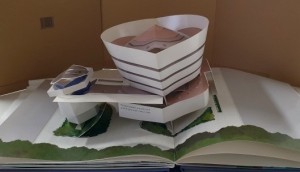
Hardcover. London, PRC Publishing, 1st, Book: Very Good, Dust Jacket: None, Hardcover, 40 pages, 6 double-page pop-ups engineered by Keit35.00h Finch, floor plans, illustrations by Andrew Crowson, most in color, commentary; square folio, blue pictorial boards. Includes Ennis-Nesbit House, Fallingwater and Guggenheim Museun. Light bump to bottom corner, minor wear to cardboard spine. All pop-ups are in working order, the book is clean, no writing in or on the book,

 "Eric Mendelsohnby: Whittick, Arnold")
 "Essential Charles Rennie Mackintosh by: Blake, Fanny")
 "Eugene Atget: Unknown Parisby: David Harris/Atget")
 "Evening Ragas: A Photographer in Indiaby: Moore, Derry")
 "Evidence: The Work of Robert A. M. Stern Architects (SIGNED COPY)by: Stern, Robert A.M.")
 "Evolution of Colonial Architecture (Architectural Treasures of Early America Vol. 9) by: Mullins, Lisa C. (editor)")
 "Experiments in Gothic Structure (SIGNED COPY)by: Mark, Robert")
 "Expressionist Utopias: Paradise, Metropolis, Architectural Fantasyby: Benson, Timothy O.")
 "Expressionist Utopias: Paradise, Metropolis, Architectural Fantasyby: Benson, Timothy O.")
 "Fallen Glory - The Lives and Deaths of History's Greatest Buildingsby: Crawford, James")
 "Ferruccio Vitale: Landscape Architect of the Country Place Eraby: Schnadelbach, R. Terry")
 "Ferruccio Vitale: Landscape Architect of the Country Place Eraby: Schnadelbach, R. Terry")
 "Fifth Avenue - Old and New 1824-1924by: Brown, Henry Collins")
 "Fill'er Up!: The Great American Gas Station by: Tim Russell")
 "Flight of Fancy - The Banishment and Return of Ornamentby: Brolin, Brent C.")
 "Foliageby: Feinstein, Harold")
 "Forgotten Shrines of Spainby: Byne, Mildred Stapley")
 "Form and Fancy: Factories and Factory Buildings by Wallis, Gilbert and Partners, 1916-1939by: Skinner, Joan S.")
 "Frank Gehry in Pop-Upby: Jinny Johnson and Roland Lewis")
 "Frank Lloyd Wright Collected Writings: Volume 5 1949-1959by: Wright, Frank Lloyd")
 "Frank Lloyd Wright Collected Writings: Volume 5 1949-1959by: Wright, Frank Lloyd")
 "Frank Lloyd Wright Drawings: Masterworks from the Frank Lloyd Wright Archives by: Pfeiffer, Bruce Brooks")
 "Frank Lloyd Wright in Pop-Upby: Thomson, Iain")