Hardcover. New York, Abbeville Press, 1st, 1993, Book: Very Good, Dust Jacket: Very Good, Hardcover, 328 pages, illustrated throughout with 213 plates in color and b&w. Maroon cloth with white title to spine, pictorial dust jacket. Beautiful copy. Like new. The rich artistic and social history of the Arts and Crafts movement in California, as well as the highly collectible objects it produced. In a brief but intensely prolific period between about 1895 and 1930. Essays by Leslie Greene Bowman, Bruce Kamerling, Cheryl Robertson, Joseph A. Taylor, David C. Streatfield, Karen J. Weitze and Richard Guy Wilson.
Hardcover. New York, Golden Press, 1st US, 1963, Book: Very Good, Dust Jacket: Good, 462 pages. Hardcover. The fourth volume of the series 'The Arts of Mankind' edited by Andre Malraux and Georges Salles. Light foxing to preliminary pages, front and rear. Profusely illustrated with full color and black & white photographs. A massive volume on the highlights of Oceanic art. Part One reviews material conditions of Oceanian life, the social & religious systems, etc. Part Two is a Gazetteer of Styles with Australia, Melanesia, Micronesia & Polynesia grouped stylistically. Dust jacket with chipping, wear along edges. Clean, tight copy.
Hardcover. Cambridge MA, The MIT Press, 1sr, Book: Very Good, Dust Jacket: Very Good, Hardcover in a bright gold foil dust wrapper, 476 pages. The artist Francis Picabia -- notorious dandy, bon vivant, painter, poet, filmmaker, and polemicist -- has emerged as the Dadaist with postmodern appeal, and one of the most enigmatic forces behind the enigma that was Dada. In this first book in English to focus on Picabia's work in Paris during the Dada years, art historian and critic George Baker reimagines Dada through Picabia's eyes. Such reimagining involves a new account of the readymade -- Marcel Duchamp's anti-art invention, which opened fine art to mass culture and the commodity. But in Picabia's hands, Baker argues, the Dada readymade aimed to reinvent art rather than destroy it. Picabia's readymade opened art not just to the commodity, but to the larger world from which the commodity stems: the fluid sea of capital and money that transforms all objects and experiences in its wake. The book thus tells the story of a set of newly transformed artistic practices, claiming them for art history -- and naming them -- for the first time: Dada Drawing, Dada Painting, Dada Photography, Dada Abstraction, Dada Cinema, Dada Montage.Along the way, Baker describes a series of nearly forgotten objects and events, from the almost lunatic range of the Paris Dada "manifestations" to Picabia's polemical writings. Clean copy.
Softcover. Chicago, University of Chicago Press, reprint, 1982, Book: Very Good, Dust Jacket: None, Red card cover, with pages and covers in pristine condition. Like new, in shrinkwrap. Rosenberg's essays cover art's relationship with the media, pop art, art as thinking; Pollock's methods; Josph Cornell's boxes; Russian constructivism; big paintings; the artist's hand; action painting, Dada etc etc. First published in 1969.
Hardcover. University of Nebraska, 1st, 1996, Book: Very Good, Dust Jacket: Very Good, Hardcover in a dust jacket with minor fading to edges, b&w illustrations, 179 pages. Contemporary feminist critics have often described Surrealism as a misogynist movement. In Automatic Woman, Katharine Conley addresses this issue, confirming some feminist allegations while qualifying and overturning others. Through insightful analyses of works by a range of writers and artists, Conley develops a complex view of Surrealist portrayals of Woman. Conley begins with a discussion of the composite image of Woman developed by such early male Surrealists as Andre Breton, Francis Picabia, and Paul Eluard. She labels that image "Automatic Woman"--a term that comprises views of Woman as provocative and revolutionary but also as a depersonalized object largely devoid of individuality and volition. This analysis largely confirms feminist critiques of Surrealism. The heart of the book, however, examines the writings of Leonora Carrington and Unica Zurn, two women in the Surrealist movement whose works, Conley argues, anticipate much contemporary feminist art and theory. In concluding, Conley shows how Breton's own views on women evolved in the course of his long career, arriving at last at a position far more congenial to contemporary feminists.
Hardcover. New York, Spiegel & Grau, 1st, 2017, Book: Very Good, Dust Jacket: Very Good, 720 pages. Hardcover with dust jacket. A very clean, unmarked copy with only minor dust jacket wear. Black and white images throughout. A tight copy.
Hardcover. New York, Spiegel & Grau, 1st, 2017, Book: Very Good, Dust Jacket: Very Good, 720 pages. Hardcover with dust jacket. A very clean, unmarked copy with only minor dust jacket wear. Black and white images throughout. A tight copy.
Hardcover. Washington D.C, National Portrait Gallery, 1st, 2014, Book: Very Good, Dust Jacket: None, Hardcover. Like new in publisher's shrink-wrap. For this exclusive collection of postcards, David Bailey, one of the worlds most distinguished and distinctive photographers, has chosen a selection of images from his archive some familiar, others previously unseen. This box of 36 portraits, reminiscent of Baileys acclaimed Box of Pin - Ups (1965), demonstrates the extraordinary range of people that he has captured during his long career;
Hardcover. Washington DC, National Portrait Gallery, 1st, 2014, Book: Very Good, Dust Jacket: None, Hardcover. Like new in publisher's shrink-wrap. For this exclusive collection of postcards, David Bailey, one of the worlds most distinguished and distinctive photographers, has chosen a selection of images from his archive some familiar, others previously unseen. This box of 36 portraits, reminiscent of Baileys acclaimed Box of Pin - Ups (1965), demonstrates the extraordinary range of people that he has captured during his long career;
Middlesex, Baltimore, Victoria, Penguin Books, 1st, 1965, Book: Very Good, Dust Jacket: Good, Hardcover, burgundy cloth covers in an edgeworn dust jacket. 370 pages, 200 black-and-white illustrations, 32 figures as drawings (floor plans, sectional and frontal views, etc), maps. Translated from the German by Elisabeth Hempel and Marguerite Kay. Clean. No slipcase.
Hardcover. New Haven CT, Yale University Press, 1st, 1968, Hardcover in a lightly worn dust jacket, ex-library copy with residue to endpapers, stamping to copyright page, spine sticker. 155 pages, illustrated with color and sepia tone plates. Documents the years when John Russell Bartlett (1805-1886)was commissioner of the Mexican Boundary Survey of 1850. A very nice collection of images drawn by a better than average hand. They depict the scenes witnessed by Bartlett along with a biographical text recounting the artist and his travels.
Softcover. NY, DC Comics, reprint, 2005-09, Book: Very Good, Dust Jacket: None, Seven softcover volumes. Collects the earliest adventures of Batman and Robin as they battle a variety of villains including the Monk and the Joker. The early adventures of Batman including his very first appearance in Detective Comics and his first solo comic are included in Volume 1, the first of a series that prints every Batman story in order. While the dialogue and artwork and plots are very basic and crude which is normal for early comics, it does show how Batman started with the basic familiar origin story still there. The action is set in New York, not Gotham and the art is by Bob Kane, the original creator. The first 7 volumes in the series are offered here.
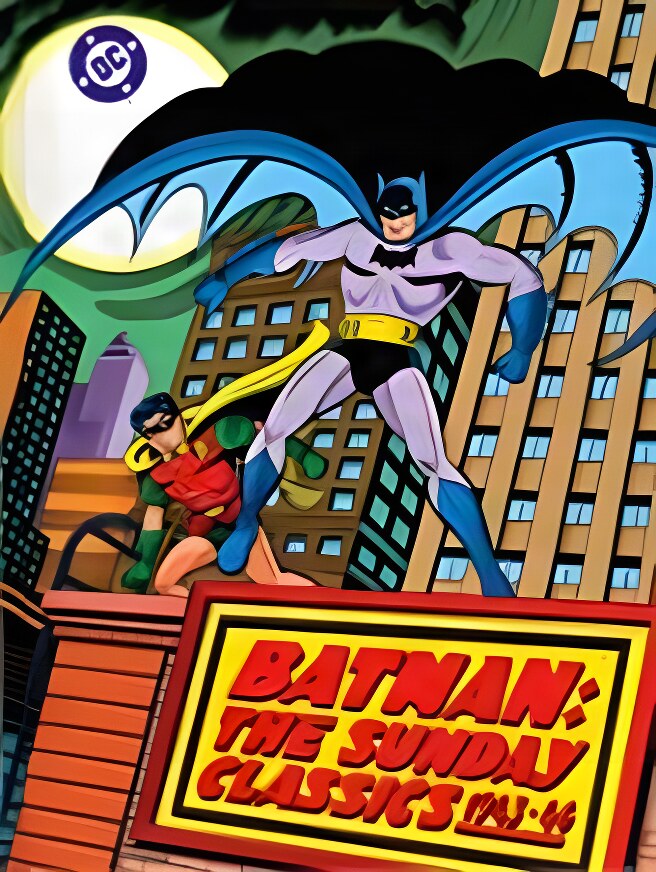
Hardcover. New Yory, Sterling, reprint, 2007, Book: Very Good, Dust Jacket: Very Good, Hardcover in a bright dust jacket. Originally published in 1990 by Kitchen Sink Press. Color throughout. 208 pages.
Hardcover. New York, Sterling, reprint, 2007, Book: Very Good, Dust Jacket: Very Good, Hardcover in a bright dust jacket. Originally published in 1990 by Kitchen Sink Press. Color throughout. 208 pages. When Bob Kane's seminal Batman first reached newspapers during World War II, only a small group of papers published it. So the early Batman and Robin comic strips have remained among the most elusive works in comics' history. Not anymore: these rare Sunday color pages are now reprinted in a generously sized format worthy of their importance. The many fans of the Caped Crusader will thrill to see Batman and the Boy Wonder do battle once again with both common thugs and outrageous villains in order to save Gotham City from plot after evil plot. Making their nefarious way across these illustrated panels are some of the Caped Crusader's most indelible adversaries, including the Joker, Catwoman, Penguin, and Two-Face. In addition to behind-the-scenes information and rare promotional materials, this deluxe edition collects the first four years of the classic Batman and Robin newspaper comics exactly as written and illustrated by the strip's most famous writers and artists. Among the classic stories are: ?The Penguin's Crime-Thunderstorms," ?Catwoman's Grasshopper Chase," and ?Half Man?Half Monster."
Hardcover. Boston Ma., Houghton Mifflin Co., 1st, 1978, Book: Very Good, Dust Jacket: Very Good, 525 pages, b&w illustrations. Green cloth, gilt titles to front and spine. Light wear and rubbing to edges and spine of pictorial dust jacket, else a very nice, tight copy.
Softcover. Baltimore, MD, Baltimore Museum of Art, 1st, 1989, Book: Near Fine, Dust Jacket: None, Softcover, 119 pages, illustrated throughout in color and b&w. Blue pictorial stiff wrappers. Lovely copy. Like new.
Softcover. Washington , Smithsonian Institution Press, 1st, 1980, Book: Very Good, Dust Jacket: None, Exhibition catalog. 202 pages, illustrated throughout with 148 plates in b&w. White pictorial stiff wrappers. Light wear to covers, small tear to upper edge of spine, else a very nice, tight copy.
Hardcover. Boston, Davis Godine, 1st, 2011, Book: Very Good, Dust Jacket: Very Good, 188 pages. Hardcover with dust jacket with only light wear. Clean tight copy. Color pictures throughout. Fine art and fine bookmaking meet in this full color selection of 77 books from Europe and the Americas. The authors select, and comment upon, the "best of both worlds": books whose pages reveal the best graphic work of the past century; artwork from the hands of masters as diverse as Braque, Calder, Dine, Hockney, Mapplethorpe, Matisse, Maillol, Picasso, Oldenburg and Rivers-coupled with memorable texts orchestrated by the best designers, printers, and binders.
Hardcover. New York, Rizzoli International Publications, reprint, 2014, Book: Very Good, Dust Jacket: None, Hardcover with dust jacket. Like new in publisher's shrink-wrap. These facsimile pages from the twelve issues of Flair are a celebration of Fleur Cowles zest for creativity in the arts. The 338 pages must have been a challenge for the Hong Kong printers, they had to cope with various foldout pages, die-cut holes, different paper stock and bind in several short pages, two concertina foldouts and five sixteen page booklets.
Hardcover. NY, Abrams, 1st, 1992, Book: Very Good, Dust Jacket: Very Good, Hardcover, 303 pages. Eclipsed by the Impressionists, Naturalist painters are restored to their rightful place in the history of art in this remarkable, lavishly illustrated study. Influenced by Emile Zola's writings, French Naturalist artists documented personalities and locales in a detached, impersonal style. With photography as their chief tool and ally, the Naturalists aimed for the look of unposed, spontaneous nature, which put them on a collision course with the Impressionists. Now this challenging book adds a new dimension to that period, showing that at the same time the Naturalists were shaping a different view of painting. Weisberg reveals that the Naturalists went beyond Impressionism in both technique and subject matter. 307 illustrations, 86 in full color. Very good in a bright dust jacket.
Hardcover. US, Yale University Press, 1st, 1992, Book: Very Good, Dust Jacket: Very Good, Hardcover, 549 pages, illustrated throughout in color and b&w. Clean, unmarked copy with only minor wear to dust jacket. This book presents a survey of Chinese painting from the eighth to the 14th century, a period during which the nature of China's pictorial art changed dramatically. Illustrated by works in the collection of The Metropolitan Museum of Art, New York, the author begins by describing the advent toward the end of the Bronze Age of figural representation in Chinese art, and next traces the development of Chinese landscape painting from the third to the tenth century. He then moves on to discuss the art of the Sung dynasty, when the imperial government was increasingly absolute and repressive. In this period artists shifted from a realistic rendition of nature to more symbolic representation of single flowers, rocks and trees. By the time of the Yuan dynasty, following the Mongol conquest of 1279, objective representation in art had been replaced by imagery that drew on the artist's inner response to his world. Because it was believed that the meaning of a painted subject, made complex by personal and symbolic associations, could no longer be expressed without language, the painter began to inscribe poems and incorporate calligraphy in his works, the multiple relationships among word, image and calligraphy forming the basis of a new art. At this stage Chinese art entered its richest and most diverse stage f development.
Hardcover. US, Reel Art Press, 1st, 2014, Book: Very Good, Dust Jacket: Very Good, Large heavy book, 448 pages, illustrated throughout in b&w. Clean, unmarked copy with only minor wear to dust jacket. This breathtaking tome is the definitive and comprehensive collection of Billy Name's black-and-white photographs from Warhol's Factory. Name's photographs from this period (1964-68) are one of the most important photographic documents of any single artist in history. Name lived in a tiny closet at the Factory. He was responsible for the legendary "silverizing" of the space using aluminum paint and foil to complete the instillation. When Warhol gave Name a Pentax Honeywell 35mm camera, he took on the role of resident photographer and archivist. This visual essay, produced in collaboration with Billy name, offers an extensive trip through Warhol's world. Name photographed the day-to-day happenings at The Factory with Andy, including visits from Lou Reed and the Velvet Underground, Nico, Edie Sedgwick, Ivy Nicholson and Bob Dylan, and filming Screen Tests and features such as Chelsea Girls, Vinyl and My Hustler.
Hardcover. Washington DC, National Portrait Gallery/Princeton University Press, 1st, 2018, Book: Very Good, Dust Jacket: Very Good, Hardcover in a bright dust jacket, Accompanied exhibition at the National Portrait Gallery. Illustrated. First major publication to focus on the development of silhouettes, gathers leading experts to shed light on the surprisingly complex historical, political, and social underpinnings of this ostensibly simple art form. This richly illustrated volume explores likenesses of everyone from presidents and celebrities to everyday citizens and enslaved people. Ultimately, the book reveals how silhouettes registered the paradoxes of the unstable young nation, roiling with tensions over slavery and political independence. Primarily tracing the rise of the silhouette in the decades leading up to the Civil War, Black Out also considers the ubiquity of the genre today, particularly in contemporary art. Historical research and four contemporary artists: Kara Walker, Kristi Malakoff, Kumi Yamashita, and Camille Utterback. Still in publisher's shrinkwrap.
Hardcover. Boston, Bulfinch Press, 1st US, 1990, Book: Very Good, Dust Jacket: Very Good, Hardcover, 327 pages, illustrations in color. Light shelf-wear and rubbing to dust jacket, else a clean, tight copy. DUE TO WEIGHT, DOMESTIC SHIPPING ONLY.

 "Arts and Crafts Movement in California, The: Living the Good Lifeby: Trapp, Kenneth R. (Ed.)")
 "Arts of the South Pacific, Theby: Guiart, Jean")
 "Artwork Caught by the Tail:Francis Picabia and Dada in Parisby: Baker, George")

 "Automatic Woman:The Representation of Women in Surrealism by: Katharine Conley")
 "Avedon: Something Personalby: Stevens, Norma")
 "Avedon: Something Personalby: Stevens, Norma")
 "Bailey's Box of Postcardsby: Bailey, David")
 "Bailey's Box of Postcardsby: Bailey, David")
 "Baroque Art and Architecture in Central Europeby: Hempel, Eberhard")
 "Bartlett's West: Drawing the Mexican Boundaryby: Robert V. Hine")
 "Batman Chronicles Volume 1-7 (7 Volumes)by: Author: Finger, Bill, Illustrator: Kane, Bob, Jerry Robinson")


 "Batman: The Sunday Classics 1943 - 1946by: Kane, Bob")
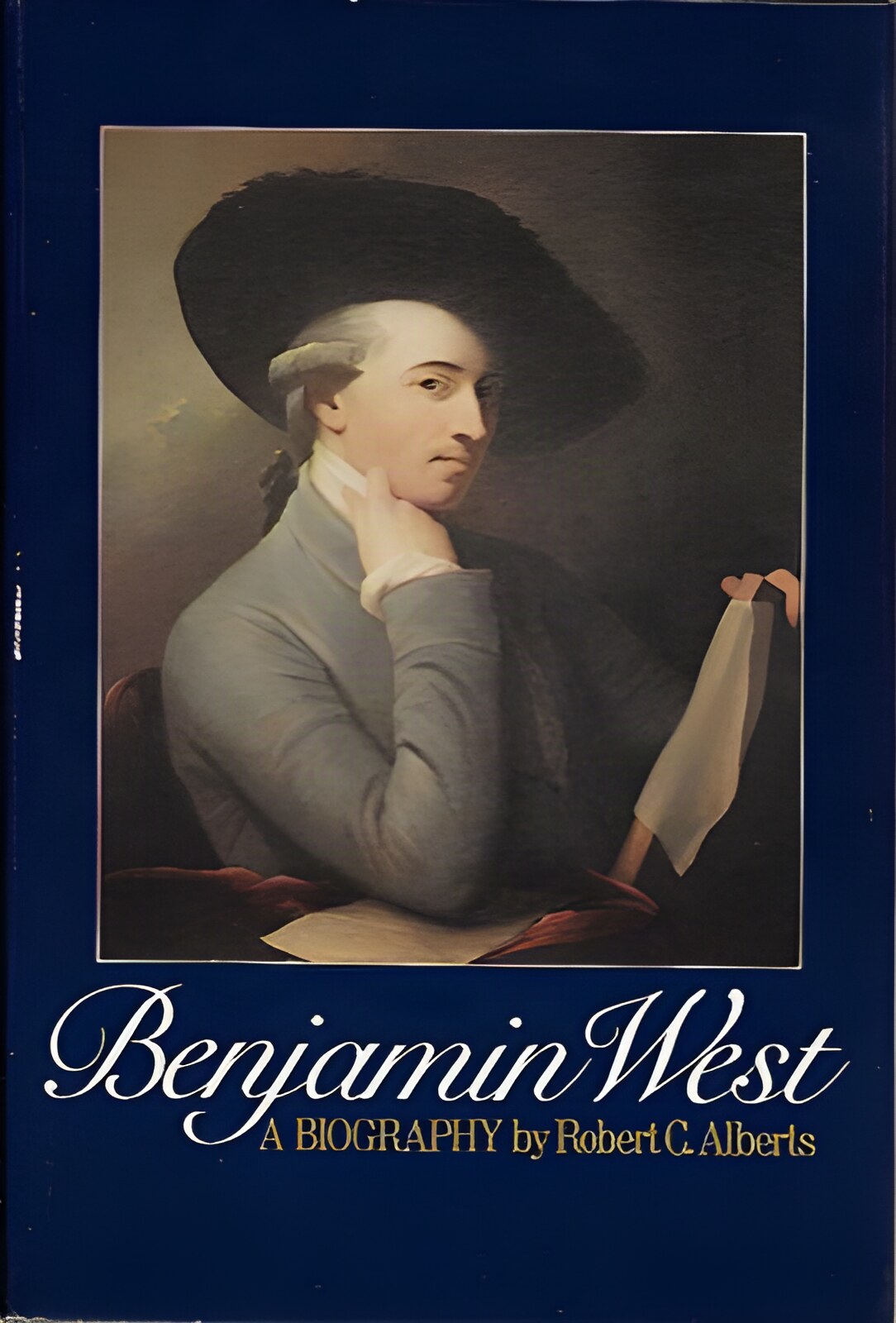
 "Benjamin West : American Painter at the English Courtby: Baltimore Museum of Art")
 "Benjamin West and His American Studentsby: Evans, Dorinda")
 "Best of Both Worlds, The; Finely Printed Livres d'Artistes 1910-2010by: Kelly, Jerry; Castleman, Riva; Hoy, Anne H.")


 "Beyond Impressionism: The Naturalist Impulseby: Weisberg, Gabriel P.")
 "Beyond Representation: Chinese Painting and Calligraphy, 8Th-14th Century (Princeton Monographs in Art and Archaeology, No 48)by: Fong, Wen C.")
 "Billy Name:The Silver Age: Black and White Photographs from Andy Warhol's Factoryby: James, Dagon")

 "Bloomsbury: Its Artists, Authors, and Designersby: Naylor, Gillian")