Hardcover. Oxford UK, Clarendon Press, reprint, 1969, Book: Very Good, Dust Jacket: Good, Hardcover, blue cloth covers with gilt lettering on spine. In a lightly worn dust jacket with tape repairs. B&w illustrations, folding map in rear. R. H. Codrington (1830-1922), was an Anglican priest who made the first systematic study of Melanesian society and culture. Described in his obituary in the journal Nature as 'the apostle of Melanesia', his work is still regarded as an ethnographic classic. First published in 1891. Clean copy.
Hardcover. NY, AMS Press, reprint, 1976, Book: Very Good, Dust Jacket: None, Hardcover, light brown cloth with black lettering on spine. A quality reprint of the edition published by Cambridge University in 1910. Pictorial frontis; 79 plates from photographs, figures in text. Fold-out map in rear, fold-out chart. Extensive study of the indigenous Melanesians of Papua New Guinea. Distinctly different from the Papuans of the archipelago, the Melanesians posed an extremely interesting problem to early 20th century ethnographers. There is some light pencil marking to about 20 pages. Also an inked biographical note about a Captain Barton (one of the contributors) on the copyright page. No dust jacket issued.
Hardcover. Ann Arbor MI, UMI Research Press, reprint, 1986, Book: Very Good, Dust Jacket: None, Hardcover, beige cloth stamped in black and red, 355 pages. Illustrations, maps, bibliography, index. Some light pencil markings to about 20 pages.
Softcover. Wellington NZ, Polynesian Society, 1st, 1980, Book: Very Good, Dust Jacket: None, Softcover, 170 pages. Originally published in 1978 as a series of articles in The Journal of the Polynesian Society. Wrappers rubbed, internally very good, clean.
Hardcover. Chicago, University of Chicago Press, 1st, 2017, Book: Very Good, Dust Jacket: Very Good, Hardcover in a bright dust jacket, 541 pages. b&w illustrations. As Joel Dinerstein reveals in this book, cool began as a stylish defiance of racism, a challenge to suppressed sexuality, a philosophy of individual rebellion, and a youthful search for social change. Through portraits of iconic figures, Dinerstein illuminates the cultural connections and artistic innovations among Lester Young, Humphrey Bogart, Robert Mitchum, Billie Holiday, Frank Sinatra, Jack Kerouac, Albert Camus, Marlon Brando, and James Dean, among others. We eavesdrop on conversations among John-Paul Sartre, Simone De Beauvoir, and Miles Davis, and on a forgotten debate between Lorraine Hansberry and Norman Mailer over the 'white negro' and Black cool. We come to understand how the cool worlds of Beat writers and Method actors emerged from the intersections of film noir, jazz, and existentialism. Clean copy.
Softcover. Cambridge UK, Cambridge University Press, reprint, 1999, Book: Very Good, Dust Jacket: None, Softcover, publisher's green wrappers lettered in white, 305 pages. Two pages with light marking (241-242). Otherwise a clean, bright copy. This introduction to the descriptive and historical linguistics of the Papuan languages of New Guinea provide an accessible account of one of the richest and most diverse linguistic situations in the world. The Papuan languages number over 700 (or 20 per cent of the world's total) in more than sixty language families. The Papuan Languages of New Guinea will be of interest not only to general and comparative linguists and to typologists, but also to sociolinguists and anthropologists for the information it provides on the social dynamics of language content.
Hardcover. NY, W W Norton & Co., 1st, 1993, Book: Very Good, Dust Jacket: Very Good, Hardcover in a bright dust jacket, 281 pages, minor dust jacket edge wear and foxing on edges, otherwise, very clean and tight copy. A brilliant, daring, and utterly original book that analyzes (even as it exemplifies) the effect that the image saturation of a hundred years of moving pictures have had on human culture and consciousness.
Hardcover. NY, Farrar, Straus and Giroux, 1st, 1997, Book: Very Good, Dust Jacket: Very Good, Hardcover in a bright, unclipped dust jacket. 721 pages, many b&w illustrations, come color. John Brewster's landmark book shows us how British artists, amateurs, entrepeneurs, and audiences created a culture that is still celebrated for its wit and brilliance. Light notations to five pages, otherwise clean.
Hardcover. Hermes Press, 1st, 2015, Book: Very Good, Dust Jacket: Very Good, Hardcover, 192 pages. Music inspired, science fiction and fantasy combined in a way that revolutionized poster art of the Psychedelic 1960's-era. Famous for his rock posters, The Psychedelic Rock Art of Carl Lundgren, a Detroit, Michigan based artist, showcases his posters which were as important to the Detroit Music and Art history as were the music legends themselves; The Who, Jefferson Airplane and Pink Floyd to name a few. The book's forward is written by Mitch Ryder, who was lead vocalist of a Detroit 1960's rock group The Detroit Wheels. The introduction is by Russ Gibb, a former radio personality and rock promoter from Dearborn, Michigan, who played a major role in the late sixties/early seventies Motor City music scene.
Hardcover. Chicago, University of Chicago Press, 1st, 1988, Book: Very Good, Dust Jacket: Very Good, Hardcover in a bright, unclipped dust jacket, 223 pages. The Nzema of West Africa, who inhabit a land of forest and lagoons along the Atlantic, continue a heritage untapped by anthropologists and scarcely influenced by Western civilization. Vinigi L. Grottanelli first discovered the rich culture of this southern Ghanaian tribe in 1954. Over the next three decades, intermittent sojourns enabled Grottanelli to develop friendships with the Nzema and learn about their beliefs, traditions, and practices. In twenty absorbing vignettes, The Python Killer renders a vivid portrayal of Nzema life. B&w illustrations. Clean copy.
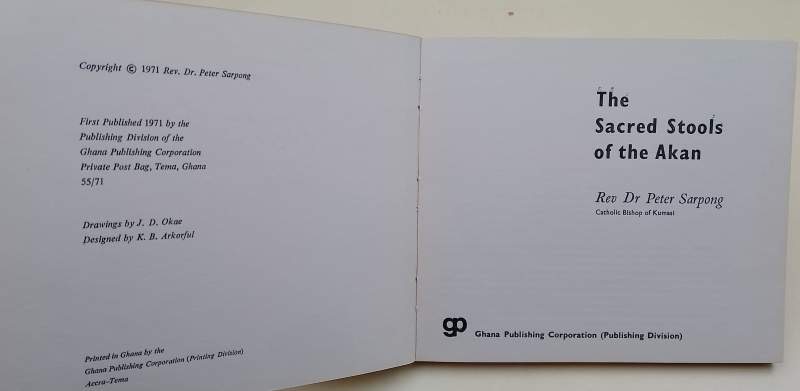
Softcover. Tema Ghana, Ghana Publishing Corp. , 1st, 1971, Book: Very Good, Dust Jacket: None, Softcover, 83 pages, b&w illustrations. Part of a doctoral thesis accepted by the University of St. Thomas Aquinas in Rome. A study of the wooden stools and their religious meaning in the culture of the Akan people of Ghana. Clean copy.
Hardcover. Princeton NJ, Princeton University Press, 1st, 2006, Book: Very Good, Dust Jacket: Very Good, Hardcover in a unclipped dust jacket with fading to spine, 260 pages. This fascinating and unusual book tells the story of an arguably catastrophic German habit - that of valuing cultural achievement above all else and envisioning it as a noble substitute for politics. Lepenies examines how this tendency has affected German history from the late eighteenth century to today. He argues that the German preference for art over politics is essential to understanding the peculiar nature of Nazism, including its aesthetic appeal to many Germans (and others) and the fact that Hitler and many in his circle were failed artists and intellectuals who seem to have practiced their politics as a substitute form of art. Clean copy.
Softcover. Boston, Back Bay Books, 1st, 1999, Book: Very Good, Dust Jacket: None, Softcover, 246 pages, b&w illustrations. Documents the history of swing music and dancing, covering the important artists, style and fashion, albums, and dance moves of swing. A bright, clean copy that has a light smoker's odor.
Softcover. NY, Holt, Rinehart and Winston , 1988, Softcover, 184 pages, b&w illustrations. INSCRIBED BY WEINER on the inside front cover. This re-examination of the Trobrianders of Papua New Guinea, the people described in Malinowski's classic ethnographic work of the early 20th century, provides a balanced view of the society from a male and female perspective, including coverage of new discoveries about the importance of woman's work and wealth in the society.
Hardcover. NY, The Dial Press, 2nd pr., 1971, Book: Very Good, Dust Jacket: Very Good, Hardccover in a bright, unclipped dust jacket, 497 pages, b&w illustrations. An overview of what entertained America for 200 years, from opera to comics. Clean copy.
Hardcover. Baltimore, Johns Hopkins University Press, 1st, 1996, Book: Very Good, Dust Jacket: Good, Hardcover in a dust jacket with sunning to spine, 325 pages, b&w illustrations. In The World of the Paris Café, W. Scott Haine investigates what the working-class café reveals about the formation of urban life in nineteenth-century France. Café society was not the product of a small elite of intellectuals and artists, he argues, but was instead the creation of a diverse and changing working population. Making unprecedented use of primary sources -- from marriage contracts to police and bankruptcy records -- Haine investigates the café in relation to work, family life, leisure, gender roles, and political activity. This rich and provocative study offers a bold reinterpretation of the social history of the working men and women of Paris. Clean copy.
Hardcover. Atglen, PA, Schiffer Publishing, 2nd, 2012, Book: Very Good, Dust Jacket: None, 489 pages. Hardcover with no dust jacket. Clean, tight copy. Color photo throughout. While You Were Sleeping was a graffiti and pop culture magazine started by graffiti supply business owner Roger Gastman when he was 19. Here are some of the greatest stories the magazine ever published-and many that are not so good. From stories on admirable serial killers and interviews with child stars to photos of graffiti and people's naked sisters, this book takes you into the dirty minds of Gastman and his team of juvenile delinquents. You've been warned.
Hardcover. Stanford CA, Stanford University Press, 1st, 1986, Book: Very Good, Dust Jacket: Very Good, Hardcover in a bright dust jacket, 264 pages, color and b&w illustrations. The book focuses on the Aboriginal system of land tenure in the northeast of Arnhem Land, Australia. Yolngu land tenure is a system based on rational economic principles while deriving its validity and moral force from a rich religious mythology. The book is a contribution to the ethnography of Australian Aborigines, to comparative hunter-gatherer studies, to the analysis of systems of land tenure, and to the history of ideas about property. Clean copy.
Hardcover. San Francisco, Chronicle Books, 1st, 2006, Book: Very Good, Dust Jacket: Very Good, Hardcover, 191 pages, color photography by Greenfield. Critically acclaimed for Girl Culture and Fast Forward, Lauren Greenfield continues her exploration of contemporary female culture with Thin, a groundbreaking book about eating disorders. Greenfield's photographs are paired with extensive interviews and journal entries from twenty girls and women who are suffering from various afflictions. Very good in a similar dust jacket.
Hardcover. Los Angeles, CA, J. Paul Getty Museum, 1st, 2013, Book: Very Good, Dust Jacket: Very Good, 128 pages. Hardcover with dust jacket. Very clean, unmarked copy still in publishers shrink-wrap. This Is the Day: The March on Washington is a stirring photo-essay by photographer Leonard Freed documenting the March on Washington for Jobs and Freedom of August 28, 1963, the historic day on which Dr. Martin Luther King Jr. delivered his "I Have a Dream" speech at the base of the Lincoln Memorial. This book commemorates the fiftieth anniversary of the historic march that ultimately led to the passage of the Civil Rights Act of 1964.
Hardcover. Los Angeles, CA, J. Paul Getty Museum, 1st, 2013, Book: Very Good, Dust Jacket: Very Good, 128 pages. Hardcover with dust jacket. Very clean, unmarked copy with only minor wear to dust jacket edges. This Is the Day: The March on Washington is a stirring photo-essay by photographer Leonard Freed documenting the March on Washington for Jobs and Freedom of August 28, 1963, the historic day on which Dr. Martin Luther King Jr. delivered his "I Have a Dream" speech at the base of the Lincoln Memorial. This book commemorates the fiftieth anniversary of the historic march that ultimately led to the passage of the Civil Rights Act of 1964.
Hardcover. New York/London, Merrell, 1st, 2008, Book: Very Good, Dust Jacket: Very Good, Hardcover, 240 pages, 165 color and b$w images. Like new in publisher's shrink-wrap. Equal parts glamour and cataclysm, sunshine and noir, few cities have provoked visual representation as insistently as LA. This Side of Paradise explores the synergistic relationship between the city and photography from the mid-nineteenth century to the present through the key themes of landscape and the body. Beautifully illustrated throughout, including images by Carleton Watkins, Edward Weston, Louise Dahl-Wolfe, Garry Winogrand, Ed Ruscha, Dennis Hopper, Herb Ritts, John Baldessari, Catherine Opie and many others.
Hardcover. US, Hatje Cantz, 1st, 2010, Book: Very Good, Dust Jacket: None, Hardcover, 144 pages, 81 color images. Like new in publisher's shrink-wrap. In 1999, the fashion and advertising photographer Thomas Hoeffgen (born 1968) flew to Nigeria for a story on soccer. He became so interested in the culture around the game there that he spent the next several years making unusual photographs of players and spectators in Nigeria, Namibia, Botswana, Zambia, Malawi and South Africa. Hoeffgen"s pictures record the frequently improvised playing fields alongside the stadiums.
Softcover. Princeton, Princeton University Press, 1st Edition, 2000, Book: Very Good, Dust Jacket: None, 382 pages. Softcover in very good condition with full color photo of Isaiah Berlin to cover. Tight copy. Clean & unmarked text.

 "THE MELANESIANS - Studies in their Anthropology and Folk-lore by: Codrington, R. H.")
 "The Melanesians of British New Guinea. With a Chapter by F. R. Barton, and an appendix by E- L. Giblinby: Seligmann, C.G. With F.R. Barton And E.L. Giblin")
 "The Miyanmin: Human Ecology in a Papua New Guinea Society (Studies in Cultural Anthropology)by: Morren, George E. B.")
 "The Nobility and the Chiefly Tradition in the Modern Kingdom of Tongaby: George E. Marcus")
 "The Origins of Cool in Postwar Americaby: Dinerstein, Joel")
 "The Papuan Languages of New Guineaby: Foley, William A.")
 "The Phantom Empire: Movies in the Mind of the Twentieth Century by: Geoffrey O'Brien")
 "The Pleasures of the Imagination: English Culture in the Eighteenth Century by: Brewer, John")
 "The Psychedelic Rock Art of Carl Lundgrenby: Lungren, Carl")
 "The Python Killer: Stories of Nzema Lifeby: Grottanelli, Vinigi L.")
 "The Sacred Stools of the Akan by: Sarpong, Peter, Illustrated by Okae, J.D.")

 "The Seduction of Culture in German Historyby: Lepenies, Wolf")
 "The Swing Bookby: Pener, Degen/ Morris, Scotty")
 "The Trobrianders of Papua New Guinea (INSCRIBED COPY)by: Weiner, Annette B.")
 "The Unembarrassed Muse: The Popular Arts in Americaby: Nye, Russell")
 "The World of the Paris Café: Sociability among the French Working Class, 1789-1914 by: W. Scott Haine")
 "The Worst of While you were Sleepingby: Gastman, Roger")
 "The Yolngu and Their Land: a System of Land Tenure and the Fight for Its Recognition by: Nancy M. Williams")
 "Thinby: Lauren Greenfield /Brumberg, Joan Jacobs (Introduction)")
 "This Is the Day: The March on Washingtonby: Freed, Leonard")
 "This Is the Day: The March on Washingtonby: Freed, Leonard")
 "This Side of Paradise: Body and Landscape in Los Angeles Photographsby: Watts, Jennifer A.")
 "Thomas Hoeffgen: African Arenasby: Hawkey, Ian")
 "Three Critics of the Enlightenment - Vico, Hamann, Herderby: Berlin, Isaiah/Henry Harder (Editor)")