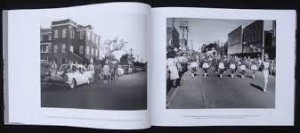
Hardcover. Austin TX, Texas State Historical Association, 1st, 1994, Book: Very Good, Dust Jacket: Very Good, Hardcover, 128 pages, 109 b&w photographs by Hickman. Bright copy in a nice dust jacket. This remarkable book reproduces more than one hundred photographs taken by R. C. Hickman, a professional photographer whose work provides a fascinating visual record of life in Dallas's black community during the three decades following World War II. After the war, he returned to Dallas and joined the staff of the Dallas Star Post. He also worked as a freelance photographer for Jet magazine, for several newspapers in the East, and for the NAACP. His work led him to photograph notables such as Martin Luther King Jr., Thurgood Marshall, Ella Fitzgerald, Joe Louis, and others when they visited Dallas.
Hardcover. New York, Sully and Kleinteich, 3rd, 1918, Book: Very Good, Dust Jacket: None, Hardcover, blue cloth with gilt, red and white decoration, 342 pages, with frontispiece portrait of Belinda Melnotte by A. O. Scott. Previous owner's signature on front fly leaf, minor corner and edge wear, otherwise, very clean and tight copy.
Hardcover. NY, Oxford University Press, 1st, 1983, Book: Very Good, Dust Jacket: Very Good, Hardcover, 288 pages. Traces the history of bells and their use by different civilizations, examines their connection with Christian churches, and discusses the use of bells to make music, mark time, and signal events
Hardcover. NY, Da Capo Press, 1st, 1973, Book: Very Good, Dust Jacket: Very Good, Hardcover, 82 pages. This is the first book devoted exclusively to Shahn's photographs. All of the photographs selected for this volume were taken during the 1930s from Rod Stryker's great Farm Security Administration project.
Softcover. US, University of Illinois Press, 1st, 2010, Book: Near Fine, Dust Jacket: None, 190 pages, illustrated throughout in b&w. Clean, unmarked copy with only minor wear to wrappers. The paintings, murals, and graphics of Ben Shahn (1898-1969) have made him one of the most heralded American artists of the twentieth century, but during the 1930s he was also among the nation's premier photographers. Much of his photographic work was sponsored by the New Deal's Farm Security Administration, where his colleagues included Dorothea Lange and Walker Evans. Ben Shahn's American Scene: Photographs, 1938 presents one hundred superb photographs from his most ambitious FSA project, a survey of small-town life in the Depression. John Raeburn's accompanying text illuminates the thematic and formal significance of individual photographs and reveals how, taken together, they address key cultural and political issues of the years leading up to World War II. Shahn's photographs highlight conflicts between traditional values and the newer ones introduced by modernity as represented by the movies, chain stores, and the tantalizing allure of consumer goods, and they are particularly rich in observation about the changes brought about by Americans' universal reliance on the automobile. They also explore the small town's standing as the nation's symbol of democratic community and expose the discriminatory social and racial practices that subverted this ideal in 1930s America.
Softcover. US, University of Illinois Press, 1st, 2010, Book: Very Good, Dust Jacket: None, 190 pages, illustrated throughout in b&w. Clean, unmarked copy with only minor wear to wrappers. The paintings, murals, and graphics of Ben Shahn (1898-1969) have made him one of the most heralded American artists of the twentieth century, but during the 1930s he was also among the nation's premier photographers. Much of his photographic work was sponsored by the New Deal's Farm Security Administration, where his colleagues included Dorothea Lange and Walker Evans. Ben Shahn's American Scene: Photographs, 1938 presents one hundred superb photographs from his most ambitious FSA project, a survey of small-town life in the Depression. John Raeburn's accompanying text illuminates the thematic and formal significance of individual photographs and reveals how, taken together, they address key cultural and political issues of the years leading up to World War II. Shahn's photographs highlight conflicts between traditional values and the newer ones introduced by modernity as represented by the movies, chain stores, and the tantalizing allure of consumer goods, and they are particularly rich in observation about the changes brought about by Americans' universal reliance on the automobile. They also explore the small town's standing as the nation's symbol of democratic community and expose the discriminatory social and racial practices that subverted this ideal in 1930s America.
Hardcover. New York, Vanguard Press, 1st, 1932, Book: Good, Dust Jacket: None, 306 pages. Hardcover. B/w illustrated frontispiece. Some age wear to covers. Bound in gray fabric. Previous owner's bookplate on front endpaper. Deckled edges. Some age yellowing to pages and edges. In good condition for its age.
Hardcover. Indianapolis/NY, Bobbs-Merrill, 1st, 1971, Book: Very Good, Dust Jacket: Good, Hardcover in a worn dust jacket, 490 pages, b&w frontis. Rush, the Philadelphia doctor who signed the Declaration of Independence, was an energetic, ambitious man given to devising reforms and, as the author puts it, meddling in politics. He studied medicine in Edinburgh and London, meeting Hume, Goldsmith, Samuel Johnson, et al. and, Hawke thinks, solidifying his republican disposition. Back in Pennsylvania he agitated for independence, made friends with John Adams, urged Paine to write Common Sense, and entered Congress. Apart from the recurrent epidemics of the age, the practice of military medicine and propaganda for resuming debt payments occupied Rush during the war; afterwards he turned to progressive education, speculated in land, fought paper money, equivocally supported the abolition of slavery, declared that tobacco is unhealthful, and boosted the Constitution before it was even written. Dust jacket chipped, faded in parts, clean internally.
Hardcover. Boston Ma., Houghton Mifflin Co., 1st, 1978, Book: Very Good, Dust Jacket: Very Good, 525 pages, b&w illustrations. Green cloth, gilt titles to front and spine. Light wear and rubbing to edges and spine of pictorial dust jacket, else a very nice, tight copy.
Softcover. Baltimore, MD, Baltimore Museum of Art, 1st, 1989, Book: Near Fine, Dust Jacket: None, Softcover, 119 pages, illustrated throughout in color and b&w. Blue pictorial stiff wrappers. Lovely copy. Like new.
Softcover. Washington , Smithsonian Institution Press, 1st, 1980, Book: Very Good, Dust Jacket: None, Exhibition catalog. 202 pages, illustrated throughout with 148 plates in b&w. White pictorial stiff wrappers. Light wear to covers, small tear to upper edge of spine, else a very nice, tight copy.
Hardcover. Philadelphia, J.B. Lippincott, 1st, 1965, Book: Very Good, Dust Jacket: Very Good, Hardcover, 192 pages. B&W illustrations by Leonard Vosburgh. In a lightly chipped dust jacket, price-clipped. A young adult novel set in the Carolinas during the Revolutionary War.
Hardcover. Hampshire UK, Bentley Milliennium Committee, 1st, 2001, Book: Very Good, Dust Jacket: Very Good, Hardcover in a bright dust jacket. 224 pages, b&w illustrations. Memories of the early 1900s in the rural village in north-east Hampshire. Previous owner's bookplate otherwise clean.
Hardcover. New York, Norton, 1st, 2018, Book: Very Good, Dust Jacket: Very Good, Hardcover, 634 pages, b&w illustrations. In a bright, unclipped dj. In Berenice Abbott: A Life in Photography, author, archivist, and curator Julia Van Haaften brings this iconic public figure to life alongside outlandish, familiar characters from artist Man Ray to cybernetics founder Norbert Wiener. A teenage rebel from Ohio, Abbott escaped first to Greenwich Village and then to Paris-photographing, in Sylvia Beach's words, "everyone who was anyone." As the Roaring Twenties ended, Abbott returned to New York, where she soon fell in love with art critic Elizabeth McCausland, with whom she would spend thirty years. In the 1930s, Abbott began her best-known work, Changing New York, in which she fearlessly documented the city's metamorphosis. When warned by an older male supervisor that "nice girls" avoid the Bowery-then Manhattan's skid row-Abbott shot back, "I'm not a nice girl. I'm a photographer...I go anywhere." This bold, feminist attitude would characterize all Abbott's accomplishments, including imaging techniques she invented in her influential, space race-era science photography and her tenure as The New School's first photography teacher. With more than ninety stunning photos, this sweeping, cinematic biography secures Berenice Abbott's place in the histories of photography and modern art, while framing her incredible accomplishments as a female artist and entrepreneur.
Softcover. Bergen County Historical Society, 1st, 1960, Book: Very Good, Dust Jacket: None, Softcover, pale rose wrappers with black type and engraving of courthouse and church in Hackensack. 112 pages, clean copy.
Softcover. Chicago, University of Chicago Press, 1st pbk., 1993, Book: Very Good, Dust Jacket: None, Softcover, 322 pages, b&w illustrations. In this first modern, critical assessment of the place of mathematics in Berkeley's philosophy and Berkeley's place in the history of mathematics, Douglas M. Jesseph provides a bold reinterpretation of Berkeley's work. Jesseph challenges the prevailing view that Berkeley's mathematical writings are peripheral to his philosophy and argues that mathematics is in fact central to his thought, developing out of his critique of abstraction. Jesseph's argument situates Berkeley's ideas within the larger historical and intellectual context of the Scientific Revolution.
Hardcover. New York, Graphis Press, 1st, 1999, Book: Very Good, Dust Jacket: Very Good, Hardcover, 106 pages, 45 full-page nude photographs by the Hungarian-born photographer Ferenc Berko, who worked in in Aspen Colorado since 1949. Like new in publishers shrink-wrap.
Hardcover. New York, Graphis Press, 1st, 1999, Book: Very Good, Dust Jacket: Very Good, Hardcover, 106 pages, 45 full-page nude photographs by the Hungarian-born photographer Ferenc Berko, who worked in in Aspen Colorado since 1949. Like new in publishers shrink-wrap.
Hardcover. NY, Norton, 1st, 1991, Book: Very Good, Dust Jacket: Very Good, Hardcover in a bright dust jacket, 352 pages. Shock waves from the fall of the Berlin Wall in November 1989 continue to pulse through German society. As the difficult process of reunification continues, it is worth recalling the revolutionary moment when immense crowds took to the streets of Leipzig and Berlin under the banner "We Are the People" and brought down one of the world's most oppressive dictatorships. Robert Darnton's eyewitness account of those historic days "is direct and vivid. His prose conveys the immediacy of the drama." He gives us a memorable cast of characters, from two experts on the repair of broken-down Trabis to the environmental councilor for the polluted city of Bitterfeld, and Isaak Behar, a Jew who managed to survive the Holocaust while hiding in wartime Berlin. With wit and insight Darnton takes us behind the scenes to meet "ordinary people grappling with great change, humanizing history."
Softcover. Corte Madera, CA, Gingko Press, 1st Wraps, 1998, Book: Very Good, Dust Jacket: None, Softcover, black & white photograph, 96 pages. "This book is a remarkable collection of photographs that will take you on a fascinating journey back to Berlin of the 1920s and early 1930s". A bright, clean copy.
Hardcover. US, Schirmer/Mosel, 1st, 2010-02-15, Book: Very Good, Dust Jacket: Very Good, Like new in publishers shrink-wrap. Text in German. English language booklet included. Text by Kurt Forster. Color photos of Berlin's unseen corners.
Hardcover. Boston, Davis Godine, 1st, 2011, Book: Very Good, Dust Jacket: Very Good, 188 pages. Hardcover with dust jacket with only light wear. Clean tight copy. Color pictures throughout. Fine art and fine bookmaking meet in this full color selection of 77 books from Europe and the Americas. The authors select, and comment upon, the "best of both worlds": books whose pages reveal the best graphic work of the past century; artwork from the hands of masters as diverse as Braque, Calder, Dine, Hockney, Mapplethorpe, Matisse, Maillol, Picasso, Oldenburg and Rivers-coupled with memorable texts orchestrated by the best designers, printers, and binders.

 "Behold the People: R.C. Hickman's Photographs of Black Dallas 1949-1961by: Hickman, R.C.")

 "Belinda of the Red Crossby: Hamilton, Robert W.")
 "Bells and Manby: Price, Percival")
 "Bells of Christmas, Theby: Hamilton, Virginia")
 "Ben Shahn Photographer: An Album from the Thirtiesby: Shahn Ben; Ed. by Margaret R Weiss")
 "Ben Shahn's American Scene: Photographs, 1938by: Raeburn, John")
 "Ben Shahn's American Scene: Photographs, 1938by: Raeburn, John")
 "Benedict Arnold: Military Racketeerby: Sullivan, Edward Dean")
 "Benjamin Rush: Revolutionary Gadfly by: David Freeman Hawke")
 "Benjamin West : A Boiographyby: Alberts, Robert C.")
 "Benjamin West : American Painter at the English Courtby: Baltimore Museum of Art")
 "Benjamin West and His American Studentsby: Evans, Dorinda")
 "Benjy Brant: Dragooning with the Swamp Foxby: Koob, Theodora")
 "Bentley: The Way We Were: Portrait of a Hampshire Villageby: Brenda Updegraff (Ed.)")
 "Berenice Abbott: A Biographyby: Van Haaften, Julia")
 "Bergen County Historical Society Papers: Revolutionary War Round Table Papers 1960by: Albert T. Klyberg et. al.")
 "Bergen County History. 1976 Annualby: Tholl, Claire K., Editor")
 "Berkeley's Philosophy of Mathematics (Science and Its Conceptual Foundations Series) by: Jesseph, Douglas M.")
 "Berko: Photographs 1935 1951 by: Berko, Ferenc")
 "Berko: Photographs 1935 1951 by: Berko, Ferenc")
 "Berlin Journal, 1989-1990by: Robert Darnton")
 "Berlin Yesterdayby: Wolsdorff, Christian (Ed.)")
 "Berlin: The City of Eternal Becomingby: Chiaramonte, Giovanni")
 "Best of Both Worlds, The; Finely Printed Livres d'Artistes 1910-2010by: Kelly, Jerry; Castleman, Riva; Hoy, Anne H.")