Hardcover. Ipswich MA, Ipswich Press, 1st, 2000, Book: Very Good, Dust Jacket: Very Good, Hardcover in a bright dust jacket, 66 pages. Illustrated with b&w photos and drawings. The lively history of the summer camp founded in the early 1900s in North Belgrade, Maine. Dust jacket with mild wear. otherwise a tight, clean copy.
Hardcover. Melbourne AUS, Macmillan, 1st, 1983, Book: Very Good, Dust Jacket: Very Good, Hardcover in a bright dust jacket, b&w illustrations. The last year of the Pacific war cost more than a thousand Australian lives in campaigns that are today almost impossible to justify either militarily or politically. The soldiers doing the fighting and the dying thought they were participating in a 'politicians' war'. They were not. They were fighting a general's war.
Hardcover. Lawrence KS, University Press of Kansas, 1st, 2007, Book: Very Good, Dust Jacket: Very Good, Hardcover in a bright dust jacket, 274 pages. With the landmark election of Franklin Delano Roosevelt in 1932, decades of Republican ascendancy gave way to a half century of Democratic dominance. It was nothing less than a major political realignment, as the direction of federal policy shifted from conservative to liberal-and liberalism itself was redefined in the process. Electing FDR is the first book in seventy years to examine in its entirety the 1932 presidential election that ushered in the New Deal. Award-winning historian Donald Ritchie looks at how candidates responded to the nation's economic crisis and how voters evaluated their performance. More important, he explains how the Democratic Party rebuilt itself after three successive Republican landslides: where the major shifts in party affiliation took place, what contingencies contributed to FDR's victory, and why the new coalition persisted as long as it did. Ritchie challenges prevailing assumptions that the Depression made Roosevelt's election inevitable. He shows that FDR came close to losing the nomination to contenders who might have run to the right of Hoover, and discusses the role of newspapers and radio in presenting the candidates to voters. He also analyzes Roosevelt's campaign strategies, recounting his attempts to appeal to disaffected voters of all ideological stripes, often by altering his positions to broaden his popularity. With the advent of the New Deal, Americans came to enjoy a wide federal safety net that provided everything from old age pensions to rural electricity-government innovations so embraced by voters that even later conservative presidents recognized their importance. Ritchie traces this legacy through the Reagan and Bush years, but he relates how FDR in 1932 was often vague about the specifics of his program and questions whether voters really knew what they were in for with the New Deal. Clean copy.
Hardcover. Lawrence KS, University Press of Kansas , 1st, 2011, Book: Very Good, Dust Jacket: Very Good, Hardcover in a bright dust jacket, 386 pages, b&w illustrations. Inept leadership, inefficient campaigning, and enormous losses would seem to spell military disaster. Yet despite these factors, the Soviet Union won its war against Nazi Germany thanks to what Roger Reese calls its military effectiveness: its ability to put troops in the field even after previous forces had been decimated. Reese probes the human dimension of the Red Army in World War II through a close analysis of soldiers' experiences and attitudes concerning mobilization, motivation, and morale. In doing so, he illuminates the Soviets' remarkable ability to recruit and retain soldiers, revealing why so many were willing to fight in the service of a repressive regime--and how that service was crucial to the army's military effectiveness. He examines the various forms of voluntarism and motivations to serve-including the influences of patriotism and Soviet ideology-and shows that many fought simply out of loyalty to the idea of historic Russia and hatred for the invading Germans. He also considers the role of political officers within the ranks, the importance of commanders who could inspire their troops, the bonds of allegiance forged within small units, and persistent fears of Stalin's secret police. Clean copy.
Hardcover. Berkeley CA, University of California Press, 1st, 1990, Book: Very Good, Dust Jacket: Very Good, Softcover, 224 pages. Given the intense competition among aristocrats seeking public office in the middle and late Roman Republic, one would expect that their persistent struggles for honor, glory, and power could have seriously undermined the state or damaged the cohesiveness of the ruling class. Rome in fact depended on aristocratic competition, since no professional bureaucracy directed public affairs and no salary was attached to any public office. But as Rosenstein adeptly shows, competition appears to have been surprisingly limited, in ways that curtailed the possible destructive effects of all-out contests between individuals. Imperatores Victi examines one particularly striking case of such checks on competition. Military success at all times represented an abundant source of prestige and political strength at Rome. Generals who led armies to victory enjoyed a better-than-average chance of securing higher office upon their return from the field. Yet this study demonstrates that defeated generals were not barred from public office and in fact went on to win the Republic's most highly coveted and hotly contested offices in numbers virtually identical with those of their undefeated peers.
Softcover. Berkeley CA, California University Press, reprint, 2018, Book: Very Good, Dust Jacket: None, Softcover, 308 pages. The German Enlightenment and the Rise of Historicism traces the thought of a large and neglected group of German thinkers and their encounter with the ideas and ideal of the Enlightenment from 1740 to 1790. Concentrating on the nature of their historical consciousness, Peter Hanns Reill addresses two basic issues in the interpretation of the Enlightenment: to what degree can one speak of the unity of the Enlightenment and to what extent can the Enlightenment be characterized as "modern"? Reill attempts to revise the traditional interpretation of the Enlightenment as an age insensitive to the postulates of modern historical thought and to dissolve the alleged opposition of the Enlightenment to later intellectual developments such as Idealism. He argues that German Enlightened thinkers generated the general presuppositions upon which modern historical thought is founded. Bright, clean copy.
Softcover. NY, Arco Publishing , reprint, 1964, Book: Very Good, Dust Jacket: None, Softcover, stapled booklet, 52 pages. Famous Aircraft Series. "This book contains: - . a history of airships - . a description of a typical "voyage" in the mighty "Hindenburg" - . 51 photographs - . 16 scale drawings - the actual Flight Handbook issued to German airship commanders". Small notation on copyright page, otherwise clean.
Hardcover. NY, Liveright, 1st, 2012, Book: Very Good, Dust Jacket: Very Good, Hardcover in a bright, unclipped dust jacket. In the summer of 1862, after a year of protracted fighting, Abraham Lincoln decided on a radical change of strategy-one that abandoned hope for a compromise peace and committed the nation to all-out war. The centerpiece of that new strategy was the Emancipation Proclamation: an unprecedented use of federal power that would revolutionize Southern society. In The Long Road to Antietam, Richard Slotkin, a renowned cultural historian, reexamines the challenges that Lincoln encountered during that anguished summer 150 years ago. In an original and incisive study of character, Slotkin re-creates the showdown between Lincoln and General George McClellan, the "Young Napoleon" whose opposition to Lincoln included obsessive fantasies of dictatorship and a military coup. He brings to three-dimensional life their ruinous conflict, demonstrating how their political struggle provided Confederate General Robert E. Lee with his best opportunity to win the war, in the grand offensive that ended in September of 1862 at the bloody Battle of Antietam. 10 illustrations; 8 maps.
Burlington VT, Samuel Mills, 2nd Ed., 1809, Book: Very Good, Dust Jacket: None, Hardcovers, 2 volume set. Second Edition, Corrected and Much Enlarged, after the first edition of 1794. 487 total pages. Vol. 1 does NOT have the folding map frontis. The handwritten name of Peter Starr (1778-1860) appears on the title page of both volumes. He was the head of a prominent Middlebury family whose name now graces two buildings: Starr Hall and Starr Library (now home to the Axinn Center). Brown calf covers with some rubbing and chipping to edges, red morocco spine labels with gilt lettering. Clean, tight set.
Hardcover. NY, Oxford University Press, 1st, 1999, Book: Very Good, Dust Jacket: Very Good, Hardcover in a bright, unclipped dust jacket. 455 pages, b&w illustrations. From John Hope Franklin, America's foremost African American historian, comes this groundbreaking analysis of slave resistance and escape. A sweeping panorama of plantation life before the Civil War, this book reveals that slaves frequently rebelled against their masters and ran away from their plantations whenever they could. For generations, important aspects about slave life on the plantations of the American South have remained shrouded. Historians thought, for instance, that slaves were generally pliant and resigned to their roles as human chattel, and that racial violence on the plantation was an aberration. In this precedent setting book, John Hope Franklin and Loren Schweninger demonstrate that, contrary to popular belief, significant numbers of slaves did in fact frequently rebel against their masters and struggled to attain their freedom. By surveying a wealth of documents, such as planters' records, petitions to county courts and state legislatures, and local newspapers, this book shows how slaves resisted, when, where, and how they escaped, where they fled to, how long they remained in hiding, and how they survived away from the plantation. Of equal importance, it examines the reactions of the white slaveholding class, revealing how they marshaled considerable effort to prevent runaways, meted out severe punishments, and established patrols to hunt down escaped slaves. Clean copy.
Softcover. Cambridge UK, Cambridge University Press, 1st pbk, 2016, Book: Very Good, Dust Jacket: None, Softcover, 325 pages. How do dictators stay in power? When, and how, do they use repression to do so? Dictators and their Secret Police explores the role of the coercive apparatus under authoritarian rule in Asia - how these secret organizations originated, how they operated, and how their violence affected ordinary citizens. Greitens argues that autocrats face a coercive dilemma: whether to create internal security forces designed to manage popular mobilization, or defend against potential coup. Violence against civilians, she suggests, is a byproduct of their attempt to resolve this dilemma. Drawing on a wealth of new historical evidence, this book challenges conventional wisdom on dictatorship: what autocrats are threatened by, how they respond, and how this affects the lives and security of the millions under their rule. It offers an unprecedented view into the use of surveillance, coercion, and violence, and sheds new light on the institutional and social foundations of authoritarian power. ^ pages with dog earred crease, otherwise clean.
Softcover. London, The Hambledon Press, 1st, 1982, Book: Very Good, Dust Jacket: None, Softcover, 288 pages. The inner workings of early medieval societies cannot be understood without also studying their links - religious, cultural, economic and political - with their neighbours. In this collection Karl Leyser shows how Ottonian and Salian Germany both influenced and was influenced by the societies with which it came into contact. While the author's central interest is in Germany, his work is of value for the study of medieval European society as a whole. Clean copy.
Hardcover. Chicago, University of Chicago Press, 1st, 2007, Book: Good, Dust Jacket: Good, Hardcover in a lightly worn dust jacket. 553 pages, b&w illustrations. A spectacular reading of Western philosophy, religion, and mythology that draws on early maps and atlases, Plato, Kant, and Wittgenstein, Thomas Pynchon, Gilgamesh, and Marcel Duchamp, Abysmal is itself a minimalist guide to the terrain of Western culture. Olsson roams widely but always returns to the problems inherent in reason, to question the outdated assumptions and fixed ideas that thinking cartographically entails. A work of ambition, scope, and sharp wit, Abysmal will appeal to an eclectic audience--to geographers and cartographers, but also to anyone interested in the history of ideas, culture, and art. Name written on front fore-edge of book, otherwise clean.
Hardcover. Shippensburg PA, White Mane, 1st, 1996, Book: Very Good, Dust Jacket: Good, Hardcover in a bright, lightly worn dust jacket. 216 pages, b/w illustration, maps. The regiment defended Washington, DC from Jubal Early's raid and served in the Shenandoah Valley among other campaigns. Clean copy.
Hardcover. Hartford CT, S. S. Scranton & Co., 1st, 1866, Book: Very Good, Dust Jacket: None, Hardcover, embossed green cloth covers with gilt stamping on front cover and spine. Frontispiece, 'Before the Battle, with tissue intact shows a few light spots. Steel engraved portraits throughout with tissues intact. 596 pages. Clean, tight copy.
Hardcover. NY, Houghton Mifflin Harcourt, 1st, 2018, Book: Very Good, Dust Jacket: Very Good, Hardcover in a bright, unclipped dust jacket. In 2008, when Michael McFaul was asked to leave his perch at Stanford and join an unlikely presidential campaign, he had no idea that he would find himself at the beating heart of one of today's most contentious and consequential international relationships As President Barack Obama's adviser on Russian affairs, McFaul helped craft the United States' policy known as "reset" that fostered new and unprecedented collaboration between the two countries And then, as US ambassador to Russia from 2012 to 2014, he had a front-row seat when this fleeting, hopeful moment crumbled with Vladimir Putin's return to the presidency This riveting inside account combines history and memoir to tell the full story of US-Russia relations from the fall of the Soviet Union to the new rise of the hostile, paranoid Russian president From the first days of McFaul's ambassadorship, the Kremlin actively sought to discredit and undermine him, hassling him with tactics that included dispatching protesters to his front gates, slandering him on state media, and tightly surveilling him, his staff, and his family. 506 pages, illustrations, clean copy.
Hardcover. NY, H. Bittner and Company, 1st, 1945, Book: Very Good, Dust Jacket: None, Hardcover, blue buckram stamped with gilt code of arms and lettering on spine. Limited to 1000 copies. A study of an artistic family who created theatrical designs dating from the 1680s to the 1780s under eight names. Illustrated with 53 plates. Small review slip tipped on front fly leaf. Some darkening to covers and spine, internally clean and bright. No dust jacket.
Hardcover. Philadelphia, W.A. Henry Press, 3rd Ed., 1926, Book: Very Good, Dust Jacket: None, Hardcover, pictorial gray cloth stamped in black and white. 330 pages, top edge gilt. frontis., b/w plates, text illustrations appendix, index. A highly regarded social history of Nantucket treats the purchase and settlement of the island, the early proprietors, and various events in Nantucket history, such as Nantucket's role in the Revolution. The balance of the work consists of histories of some thirty founding families. Genealogists should also consult the appendices for a list of Quakers who visited Nantucket between 1664 and 1847. Small embossed stamp on front fly leaf, otherwise a bright, clean copy.
Hardcover. Cambridge UK, Cambridge University Press, 1st, 2006, Book: Very Good, Dust Jacket: Very Good, Hardcover in a bright dust jacket, 767 pages. 'This book is a major new intellectual and cultural history of intolerance and toleration in early modern and early Enlightenment Europe. John Marshall offers an extensive study of late seventeenth-century practices of religious intolerance and toleration in England, Ireland, France, Piedmont and the Netherlands and of the arguments which John Locke and his associates made in defence of 'universal religious toleration'. He analyses early modern and early Enlightenment discussions of toleration; debates over toleration for Jews and Muslims as well as for Christians; the limits of toleration for the intolerant, atheists, 'libertines' and 'sodomites'; and the complex relationships between intolerance and resistance theories including Locke's own Treatises. This study is a significant contribution to the history of the 'republic of letters' of the 1680s and the development of early Enlightenment culture and will be essential reading for scholars of early modern European history, religion, political science, and philosophy.' Clean copy.
Hardcover. NY, WW Norton & Co,, 1st, 2018, Book: Very Good, Dust Jacket: Very Good, Hardcover in a bright, unclipped dust jacket. As World War II came to an end, General George Marshall was renowned as the architect of Allied victory. Set to retire, he instead accepted what he thought was a final mission-this time not to win a war, but to stop one. Across the Pacific, conflict between Chinese Nationalists and Communists threatened to suck in the United States and escalate into revolution. His assignment was to broker a peace, build a Chinese democracy, and prevent a Communist takeover, all while staving off World War III. In his thirteen months in China, Marshall journeyed across battle-scarred landscapes, grappled with Mao Zedong and Zhou Enlai, and plotted and argued with Generalissimo Chiang Kai-shek and his brilliant wife, often over card games or cocktails. The results at first seemed miraculous. But as they started to come apart, Marshall was faced with a wrenching choice. Its consequences would define the rest of his career, as the secretary of state who launched the Marshall Plan and set the standard for American leadership, and the shape of the Cold War and the US-China relationship for decades to come. It would also help spark one of the darkest turns in American civic life, as Marshall and the mission became a first prominent target of McCarthyism, and the question of "who lost China" roiled American politics. Remainder dot to top edge, otherwise like new.
Softcover. Quezon City, Malaya Books, reprint, 1970, Book: Very Good, Dust Jacket: None, Softcover, 212 pages, b&w illustrations, fold-out map in front. A 1970 reprint of a title first published in 1900. Clean copy, light edgewear to wrapper.
Hardcover. NY, Columbia University Press, 1st, 1951, Book: Very Good, Dust Jacket: Very Good, Hardcover in a very good dust jacket, 278 pages. This carefully written, well-annotated book is more than an analysis of world government intended to ascertain upon what terms it would be both feasible and desirable. The author concludes it could only happen with an expansion of democratic societies throughout the world. Clean copy.
Softcover. London, Routledge, reprint, 1996, Book: Very Good, Dust Jacket: None, Softcover, 325 pages with index, b&w illustrations. An outstanding piece of scholarship and a fascinating read, The Body Emblazoned is a compelling study of the culture of dissection the English Renaissance, which informed intellectual enquiry in Europe for nearly two hundred years. In this outstanding work, Jonathan Sawday explores the dark, morbid eroticism of the Renaissance anatomy theatre, and relates it to not only the great monuments of Renaissance art, but to the very foundation of the modern idea of knowledge. Though the dazzling displays of the exterior of the body in Renaissance literature and art have long been a subject of enquiry, The Body Emblazoned considers the interior of the body, and what it meant to men and women in early modern culture. Clean, bright copy.
Hardcover. New Haven CT, Yale University Press, 1st, 2013, Book: Very Good, Dust Jacket: Very Good, Hardcover in a bright dust jacket, 430 pages. SIGNED BY MONOD on the tile page, also INSCRIBED on the half-title page. The late seventeenth and eighteenth centuries are known as the Age of Enlightenment, a time of science and reason. But in this illuminating book, Paul Monod reveals the surprising extent to which Newton, Boyle, Locke, and other giants of rational thought and empiricism also embraced the spiritual, the magical, and the occult. Although public acceptance of occult and magical practices waxed and waned during this period they survived underground, experiencing a considerable revival in the mid-eighteenth century with the rise of new antiestablishment religious denominations. The occult spilled over into politics with the radicalism of the French Revolution and into literature in early Romanticism. Even when official disapproval was at its strongest, the evidence points to a growing audience for occult publications as well as to subversive popular enthusiasm. Ultimately, finds Monod, the occult was not discarded in favor of "reason" but was incorporated into new forms of learning. In that sense, the occult is part of the modern world, not simply a relic of an unenlightened past, and is still with us today. Clean copy.
Softcover. New Jersey, Bergen County Board, 1st, 1983, Book: Very Good, Dust Jacket: None, Softcover, 101 pages. Volume five of a seven volume set on the history and heritage of Bergen County. Clean, like new..
Hardcover. Boston, Little, Brown and Company, reprint, 1954, Book: Very Good, Dust Jacket: None, Hardcover, blue cloth with gilt lettering on spine. Volume VI in The History of United States Naval Operations in World War II. 463 pages, illustrated with maps (one fold-out) and b&w photos. Gilt on spine with fading, lacks dust jacket, otherwise clean, tight copy.
Hardcover. Boston, Little, Brown, and Company, reprints, 1899, Book: Very Good, Dust Jacket: Very Good, Two hardcover volumes, blue cloth covers with bright gilt decoration on spines. and front covers. Top edge gilt. Both volumes with original blue CLOTH dust jackets. Illustrated Holiday Edition with 45 photogravure plates. Vol. 1. Chapters I-XV (xix, 529 pages) - Vol. 2. Chapters XVI-XXXII (xv, 562 pages). Clean bright set. DUE TO WEIGHT, DOMESTIC SHIPPING ONLY.
Softcover. Indianapolis, Liberty Fund, reprint, 2001, Book: Very Good, Dust Jacket: None, Softcover, 325 pages. John Adams and Benjamin Rush were two remarkably different men who shared a devotion to liberty. Their dialogues on the implications of fame for their generation prove remarkably timely--even for the twenty-first century. Adams and Rush championed very different views on the nature of the American Revolution and of the republic established with the United States Constitution; yet they shared one of the most important correspondences of their time. John Adams and Benjamin Rush met in 1774 as members of the Continental Congress--Adams from Massachusetts, Rush from Pennsylvania. In 1805, after Adams was defeated in his quest of a second term as the new republic's second President, the two men self-consciously commenced an exchange of letters. Their recurring subject was fame. This emphasis on fame was crucial, Adams and Rush believed, because on the fame attached to individual leaders of the Revolutionary generation would depend the view of the Revolution and of the Constitution and republican government that would be embraced by generations to come, including our own. The Liberty Fund edition of The Spur of Fame reproduces a text originally published by the Huntington Library.
Hardcover. Philadelphia, University of Pennsylvania Press, 1st, 1929, Book: Very Good, Dust Jacket: None, Hardcover, maroon cloth stamped in red and gilt, 251 pages. Chapters include: Includes "'Sundry sorts of earthen ware,'" "On the trail of the tulip," "Spatter after its kind," and "The last of the old potters." Mild bumping to spine, otherwise a clean, bright copy.
Softcover. Durham NC, Duke University Press, 1st, 2014, Book: Very Good, Dust Jacket: None, Softcover, 416 pages. Open from 1942 until 1945, the Hollywood Canteen was the most famous of the patriotic home front nightclubs where civilian hostesses jitterbugged with enlisted men of the Allied Nations. Since the opening night, when the crowds were so thick that Bette Davis had to enter through the bathroom window to give her welcome speech, the storied dance floor where movie stars danced with soldiers has been the subject of much U.S. nostalgia about the 'Greatest Generation.' Drawing from oral histories with civilian volunteers and military guests who danced at the wartime nightclub, Sherrie Tucker explores how jitterbugging swing culture has come to represent the war in U.S. national memory. Yet her interviewees' varied experiences and recollections belie the possibility of any singular historical narrative. Some recall racism, sexism, and inequality on the nightclub's dance floor and in Los Angeles neighborhoods, dynamics at odds with the U.S. democratic, egalitarian ideals associated with the Hollywood Canteen and the 'Good War' in popular culture narratives. Clean copy in publisher's shrinkwrap.
Softcover. Barre VT, Potash Brook Publishing, 1st, 1996, Book: Very Good, Dust Jacket: None, Softcover, 170 pages, b&w photography. A great overview of Vermont's diverse and often quirky libraries. With photos and descriptive text, the 201 libraries that existed in the Green Mountain State in 1996. Small chip to top of spine otherwise bright and clean.
Hardcover. Glendale CA, Arthur H. Clark Co., 1st, 1951, Book: Very Good, Dust Jacket: None, Hardcover, dark blue cloth with gilt lettering on the spine, 340 pages. A biography of Thomas Pownall (1757 - 1760) who was governor of the Massachusetts Bay colony during the French and Indian War and later a member of Parliament (1767 - 1780). Pownall had sympathies for the colonial grievances and institutions. This biography is based on a study of widely scattered documentary materials and provides insight into a man of complex and contradictory ideas and actions during the pre-Revolutionary period. Includes bibliography and index. Stamping to endpapers, from an academic library.
Hardcover. Boston, Houghton Mifflin, 2nd pr., 1965, Book: Very Good, Dust Jacket: Good, Hardcover in an edgeworn dust jacket, 326 pages. Name on front fly leaf, otherwise clean.
Softcover. Wesleyan University Press, reprint, 1986, Book: Very Good, Dust Jacket: None, Softcover, 398 pages. "A Glimpse of Sion's Glory" signals an important new direction in the study of American Puritanism. The presence of dissenters in the colonies was not unknown, but never before have they been seen as a major shaping force for seventeenth-century American Puritanism. Gura displays a thorough knowledge of New England dissent from 1620 to 1660. This is a ground-braking study. Clean copy.
Hardcover. Princeton NJ, Princeton University Press, 1st, 1965, Book: Very Good, Dust Jacket: Very Good, Hardcover in a bright dust jacket, 463 pages with index. This study considers the subtle and frequently confused relationship of armed force and political control in the British Empire before the American Revolution. It also clarifies a number of points of controversy and uncertainty about the causes of the American Revolution. A crisp copy of the 1965 1st edition. Name on front fly leaf, price clipped otherwise clean.
Softcover. Philadelphia, J.B. Lippincott, reprint, 1970, Book: Very Good, Dust Jacket: None, Softcover, 186 pages. A detailed study of the politics underlying British policies of mercantilism in the American colonies. Focusing on the political activity of interest groups in the British Empire of the eighteenth century, Professor Kammen relates political influence in Georgian England to American colonial history, to the early history of the industrial revolution, to the incredible flood of writings in the later eighteenth century on political economy, and to the dynamics of Anglo-American political society, public life, and the empire. Name on front fly leaf otherwise clean.
Hardcover. NY, Harper & Row, 1st US, 1972, Book: Very Good, Dust Jacket: Very Good, Hardcover in lightly worn dust jacket, 416 pages including index, bibliography and abbreviations. "The first adequately comprehensive history of the Resistance in Europe during Hitler's war to be published in any language." Name on frontfly leaf, otherwise clean.
Hardcover. NY, Alfred A. Knopf, 1st, 1935, Book: Very Good, Dust Jacket: None, Hardcover, maroon cloth with gilt lettering on spine, pages 415-797, plus index. Volume 2 ONLY. No dust jacket. Name on front fly leaf otherwise a clean, bright copy.
Softcover. Stanford CA, Hoover Institution Press, 1st, 1977, Book: Very Good, Dust Jacket: None, Softcover, 198 pages. History, politics, economics, and diplomacy surrounding the Panama Canal controversy in the 1970s. Illustrations., maps, appendix, bibliographic note, index. Name on front fly leaf, otherwise clean.
Hardcover. Cambridge MA, Harvard University Press, 1st, 1972, Book: Very Good, Dust Jacket: Very Good, Hardcover in a bright, unclipped dust jacket, 246 pages. Preface, Introduction, Chapters on: The United States and the Dominican Republic to 1965: Background to Intervention; The Origins of the 1965 Dominican Crisis: Setting the Stage; The Decision to Intervene; Deploying the Troops; and Explaining the Dominican Intervention. Drawing on nearly 150 personal interviews with individuals in the Dominican Republic and the United States, on rare access to classified U.S. government documents, and on his own first-hand experiences during the crisis, Abraham F. Lowenthal rejects official, liberal, and radical accounts of the intervention. Instead, he explains it as the product of fundamental premises, of decision-making procedures, and of bureaucratic politics. Name on front fly leaf, otherwise clean.
Hardcover. NY, W. W. Norton, 1st, 1967, Book: Very Good, Dust Jacket: Very Good, Hardcover in a worn, chipped dust jacket, 119 pages, maps, index. As WWII ground to a close, whose forces would be the first to reach Berlin? General Dwight David Eisenhower, supreme commander of the British and American armies, chose to halt at the Elbe River and leave Berlin to the Red Army. Could he have beaten the Russians to Berlin? If so, why didn't he? If he had, would the Berlin question have arisen? Would Germany have been divided as it was? Name on front fly leaf, otherwise clean.
Hardcover. Chicago, University Of Chicago Press , 1st, 2017, Book: Very Good, Dust Jacket: Very Good, Hardcover in a bright dust jacket, 330 pages with index. At the close of the nineteenth century, new printing and paper technologies fueled an expansion of the newspaper business and publishers were soon reeling off as many copies as Americans could be convinced to buy. Newspapers quickly saturated the United States, especially its cities, which were often home to more than a dozen daily papers apiece. Using New York, Philadelphia, Milwaukee, and Chicago as case studies, Julia Guarneri shows how city dailies became active agents in creating metropolitan spaces and distinctive urban cultures. Newsprint Metropolis offers a vivid tour of these papers, from the front to the back pages. Paying attention to much-loved features, including comic strips, sports pages, advice columns, and Sunday magazines, she tells the linked histories of newspapers and the cities they served. Themed sections for women, businessmen, sports fans, and suburbanites illustrated entire ways of life built around consumer products. Guarneri also argues that while papers provided a guide to individual upward mobility, they also fostered a climate of civic concern and responsibility. Charity campaigns and metropolitan sections painted portraits of distinctive, cohesive urban communities. Real estate sections and classified ads boosted the profile of the suburbs, expanding metropolitan areas while maintaining cities' roles as economic and information hubs. Clean, like new.
Softcover. NY, Harper Torchbooks, reprint, 1966, Book: Very Good, Dust Jacket: None, Softcover, 302 pages. This book presents the historical setting of the industrial revolution in a form suitable for the general reader. It seeks to explain why 18th-century England was the theatre of the great series of mechanical inventions that caused the revolution, and what were the great social changes that preceded, accompanied and followed it. Clean copy.
Hardcover. NY, Times Books, 1st, 1979, Book: Very Good, Dust Jacket: Good, Hardcover in a lightly worn dust jacket that shows fading, 360 pages, b&w illustrations, endpaper maps. General John Burgoyne was a British army officer, politician and dramatist. He first saw action during the Seven Years' War when he participated in several battles, mostly notably during the Portugal Campaign of 1762. Burgoyne is best known for his role in the American War of Independence. During the Saratoga campaign he surrendered his army of 5,000 men to the American troops on October 17, 1777. Appointed to command a force designated to capture Albany and end the rebellion, Burgoyne advanced from Canada but soon found himself surrounded and outnumbered. He fought two battles at Saratoga, but was forced to open negotiations with Horatio Gates. Although he agreed to a convention, on 17 October 1777, which would allow his troops to return home, this was subsequently revoked and his men were made prisoners. Burgoyne faced criticism when he returned to Britain, and never held another active command. Clean copy.
Softcover. NY, W. W. Norton & Company, reprint, 1975, Book: Very Good, Dust Jacket: None, Softcover, 396 pages including index. By focusing on the Howe brothers, their political connections, their relationships with the British ministry, their attitude toward the Revolution, and their military activities in America, Gruber answers the frequently asked question of why the British failed to end the American Revolution in its early years. This book supersedes earlier studies because of its broader research and because it elucidates the complex personal interplay between Whitehall and its commanders. Clean, bright copy.
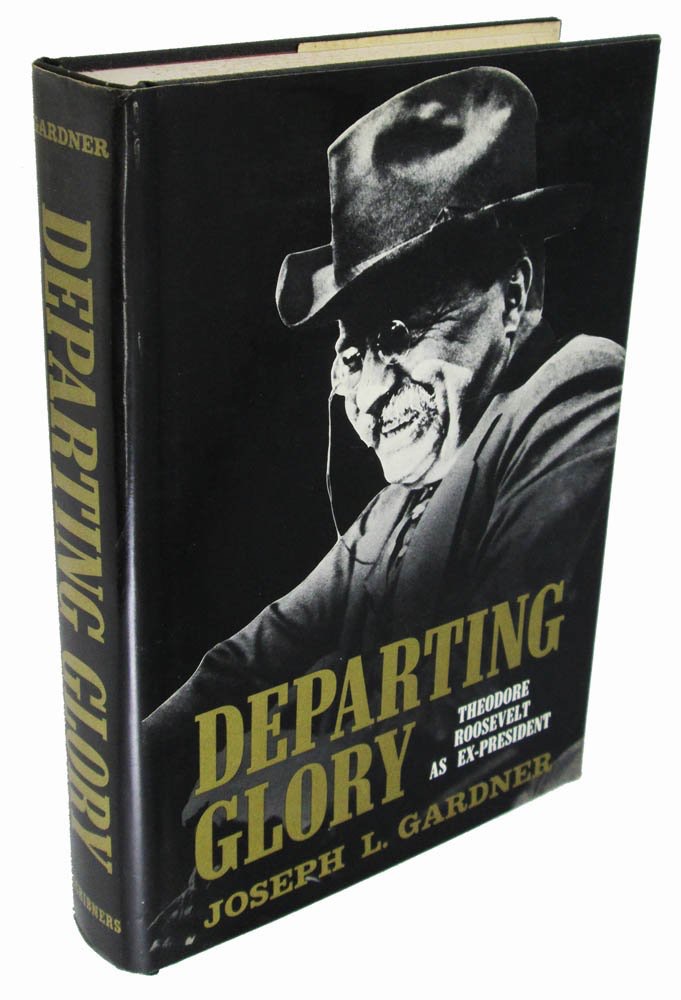
Hardcover. NY, Charles Scribner's Sons, 1st, 1973, Book: Very Good, Dust Jacket: Very Good, Hardcover in a bright, unclipped dust jacket, 432 pages, b&w illustrations. A moving account of Theodore Roosevelt's post-presidential years. Name on front fly leaf, otherwise clean.
Hardcover. Chapel Hill NC, University of North Carolina Press, reprint, Book: Very Good, Dust Jacket: None, Hardcover, black cloth, 292 pages, b&w plates. ISBN number on copyright page denotes a reprint. Clean, bright copy, lacks dust jacket.
Softcover. Annapolis MD, Naval Institute Press, 1st, 1998, Book: Very Good, Dust Jacket: None, Softcover, 343 pages, b&w illustrations. This remarkable memoir tells the compelling story of the near-mythic British district officer who helped shape the first great Allied counteroffensive. Scottish-born and Cambridge-educated, Martin Clemens managed to survive months behind Japanese lines in one of the most unfriendly climates and terrains in the world. Clean, bright copy.
Hardcover. NY, Random House, 1st, 1970, Book: Very Good, Dust Jacket: Very Good, Hardcover in a bright, unclipped dust jacket, 429 pages. Brown cloth with embossed red image of Seale gagged and bound in the courtroom during the Chicago 8 Trial. A gorgeous copy of Bobby Seale's narration of the Black Panther Party's origins and his relationship with Huey P Newton. Written as Seale was on trial as part of the Panther 14 in New Haven and during the Chicago 8/7 Conspiracy trial. Dust jacket is bright with original $6.95 price intact and unclipped. Stated First Edition on copyright page. Clean copy.

 "Admirals All: The Story of Camp Merryweatherby: Rosalind Cobb Wiggins")
 "The Unnecessary War: Island Campaigns of the South West Pacific 1944-45by: Charlton, Peter")
 "Electing FDR: The New Deal Campaign of 1932by: Donald A. Ritchie")
 "Why Stalin's Soldiers Fought: the Red Army's Military Effectiveness in World War IIby: Roger R. Reese")
 "Imperatores Victi: Military Defeat and Aristocractic Competition in the Middle and Late Republic by: Rosenstein, Nathan S.")
 "The German Enlightenment and the Rise of Historicism by: Peter H. Reill")
 "LZ 129 Hindenburgby: Douglas Robinson")
 "The Long Road To Antietam: How the Civil War Became a Revolutionby: Richard Slotkin")
 "The Natural and Civil History of Vermontby: Williams, Samuel")


 "Runaway Slaves: Rebels on the Plantationby: Franklin, John Hope & Schweninger, Loren")
 "Dictators and Their Secret Police:Coercive Institutions and State Violence by: Greitens, Sheena Chestnut")
 "Medieval Germany and its Neighbours: 900-1250by: Leyser, K. J.")
 "Abysmal: A Critique of Cartographic Reasonby: Gunnar Olsson")
 "Put the Vermonters Ahead: The First Vermont Brigade in the Civil War by: Parsons, George W.")
 "Women of the War: Their Heroism and Self-Sacrificeby: Frank Moore")
 "From Cold War to Hot Peace: An American Ambassador in Putin's Russia by: McFaul, Michael")


 "The China Mission: George Marshall's Unfinished War 1945-1947 by: Daniel Kurtz-Phelan")
 "The Filipino Martyrs: A Story of the Crime of February 4, 1899by: Sheridan, Richard Brinsley")
 "The Idea and Practice of World Government by: Mangone, Gerard J.")
 "The Body Emblazoned: Dissection and the Human Body in Renaissance Culture by: Sawday, Jonathan")
 "Solomon's Secret Arts: The Occult in the Age of Enlightenment (SIGNED COPY(by: Monod, Paul Kl?©ber")

 "Breaking the Bismarcks Barrier: 22, July 1942-1 May, 1944 (History of United States Naval Operations in World War II, Vol. 6) by: Morison, Samuel Eliot")
 "Montcalm and Wolfe (2 Volume Set )by: Francis Parkman")


 "Spur of Fame: Dialogues of John Adams and Benjamin Rush, 1805-1813 by: Schutz, John A / Douglass Adair")
 "The Red Hills: A Record of Good Old Days Outdoors and In, With Things Pennsylvania Dutch (Keystone State Historical Publications No. 7)by: Weygandt, Cornelius")




 "E Pluribus Unum: The Formation of the American Republic, 1776 to 1790 by: Forrest McDonald")
 "A Glimpse of Sion's Glory: Puritan Radicalism in New England, 1620-1660 by: Gura, Philip F.")
 "Toward Lexington: The Role of the British Army in the Coming of the American Revolution by: Shy, John")
 "Empire and Interest: The American Colonies and the Politics of Mercantilismby: Michael Kammen")
 "Background for Radical Reconstruction Testimony taken from the Hearings of the Joint Committee on Reconstruction the Select Committee on the Memphis Riots and Massacres and the Select Committee on the New Orleans Riots 1866 and 1867")
 "The Shadow War: European Resistance, 1939-1945by: Henri Michel")
 "The Diplomacy of Imperialism, 1890-1902: Volume 2 by: William L. Langer")
 "The Panama Canal Controversy: US. Diplomacy and Defense Interests by: Ryan, Paul B.")
 "The Dominican Interventionby: Lowenthal, Abraham F.")

 "Newsprint Metropolis City Papers and the Making of Modern Americans by: Guarneri, Julia")
 "The Rise of Modern Industry by: Hammond, J. L. and Barbara")




)