Hardcover. NY, Grove Press, 1st, 2023, Book: Very Good, Dust Jacket: Very Good, Hardcover in a bright, unclipped dust jacket. 259 pages. When Ada Calhoun stumbled upon old cassette tapes of interviews her father, celebrated art critic Peter Schjeldahl, had conducted for his never-completed biography of poet Frank O'Hara, she set out to finish the book her father had started forty years earlier. As a lifelong O'Hara fan who grew up amid his bohemian cohort in the East Village, Calhoun thought the project would be easy, even fun, but the deeper she dove, the more she had to face not just O'Hara's past, but also her father's, and her own. The result is a groundbreaking and kaleidoscopic memoir that weaves compelling literary history with a moving, honest, and tender story of a complicated father-daughter bond. Also a Poet explores what happens when we want to do better than our parents, yet fear what that might cost us; when we seek their approval, yet mistrust it.
Hardcover. NY, Farrar Straus Giroux, 1st, 2023, Book: Very Good, Dust Jacket: Very Good, Hardcover in a bright, unclipped dust jacket. 530 pages, b&w illustrations. The dramatic story of W. E. B. Du Bois's reckoning with the betrayal of Black soldiers during World War I-and a new understanding of one of the great twentieth-century writers. When W. E. B. Du Bois, believing in the possibility of full citizenship and democratic change, encouraged African Americans to "close ranks" and support the Allied cause in World War I, he made a decision that would haunt him for the rest of his life. Seeking both intellectual clarity and personal atonement, for more than two decades Du Bois attempted to write the definitive history of Black participation in World War I. His book, however, remained unfinished. In The Wounded World, Chad Williams offers the dramatic account of Du Bois's failed efforts to complete what would have been one of his most significant works. The surprising story of this unpublished book offers new insight into Du Bois's struggles to reckon with both the history and the troubling memory of the war, along with the broader meanings of race and democracy for Black people in the twentieth century. Drawing on a broad range of sources, most notably Du Bois's unpublished manuscript and research materials, Williams tells a sweeping story of hope, betrayal, disillusionment, and transformation, setting into motion a fresh understanding of the life and mind of arguably the most significant scholar-activist in African American history. In uncovering what happened to Du Bois's largely forgotten book, Williams offers a captivating reminder of the importance of World War I, why it mattered to Du Bois, and why it continues to matter today. Remainder mark on top edhge, otherwise clean.
Hardcover. Berkeley CA, Frog Books, 1st, 2003, Book: Very Good, Dust Jacket: Very Good, Hardcover in a bright dust jacket. Amy Wallace's first meeting with Carlos Castaneda, the infamous anthropologist-turned-shaman, whose books described meetings with Yaqui Indian spiritual teacher Don Juan. Castaneda's rise was meteoric in the late 1960s as he wrote massive bestsellers, inspired many to experiment with psychedelics, and was dubbed "The Godfather of the New Age". The possibility that Castaneda's experiences may have been fabricated did little to compromise his legend. As the daughter of best-selling novelist Irving Wallace, Amy was rarely shy around famous people. When her father insisted she meet Castaneda, she at first demurred. Little did she know that a delightful first meeting would begin a 20-year friendship, followed by her descent into the dramatic and deeply troubled affair chronicled in this book. Wallace reveals the inner workings of the "Cult of Carlos", run by a charismatic authoritarian in his sixties who controlled his young female followers through emotional abuse, mind games, bizarre rituals, dubious teachings, and sexual excess. Bright, clean copy.
Hardcover. London, Faber and Faber, 1st, 1969, Book: Very Good, Dust Jacket: None, Hardcover, light gray cloth with maroon and gilt title on spine, 608 pages. Clean copy.
Hardcover. NY, Houghton Mifflin, reprint, 2022, Book: Very Good, Dust Jacket: Very Good, Hardcover in a bright dust jacket. Illustrated in color by the Reys. A reprint of a title first published in 1946. The story of Pretzel, the longest dachshund in the world, his wife Greta and five children. Clean copy.
Hardcover. Athens GA, University of Georgia Press, 1st, 1986, Book: Very Good, Dust Jacket: Very Good, Hardcover in a bright dust jacket. 176 pages. INSCRIBED BY AUTHOR on front end paper. In the 1960s, as the underpinnings of society weakened, the traditional novel form seemed less suited to describe American reality. Theorists groped towards non-mimetic fiction as the tools that had sustained the novel since its birth-coherent characterization, linear plot, symbolism-became tools of New Journalism. The New American Novel of Manners explores the virtual reinvention of the novel of manners in America out of the same subjectivity that charged the works of New Journalism. In place of the rigid social structures that never seemed to depict America, novelists such as Richard Yates, Dan Wakefield, and Thomas McGuane located America's modern-day manners in its semiotics, in the system of signs that envelops us-the blue jeans people wear, the fast food they eat, the decor of the bars they drink in and the rock-and-roll lyrics that play through memories. The new generation of mannerists describe lifestyles that are determined by words and images, by actions that are dictated by what has been read and seen, and patterns of behavior in which life is edited and fictionalized. Klinkowitz reveals a fiction that is once again capable of reflecting the way people live. Clean copy.
Hardcover. NY, Farrar, Straus & Giroux, 1st, 2006, Book: Very Good, Dust Jacket: Very Good, Hardcover in a bright dust jacket. 375 pages. B&W photographs and illustrations. Pictorial dust jacket. Green cloth with gilt title to spine. Erratum laid-in. Overall, a clean, tight copy. ohn Betjeman was by far the most popular poet of the twentieth century; his collected poems sold more than two million copies. As poet laureate of England, he became a national icon, but behind the public man were doubts and demons. The poet best known for writing hymns of praise to athletic middle-class girls on the tennis courts led a tempestuous emotional life. For much of his fifty-year marriage to Penelope Chetwode, the daughter of a field marshal, Betjeman had a relationship with Elizabeth Cavendish, the daughter of the Duke of Devonshire and lady-in-waiting to Princess Margaret. Betjeman, a devout Anglican, was tormented by guilt about the storms this emotional triangle caused. Betjeman, published to coincide with the hundredth anniversary of the poet's birth, is the first to use fully the vast archive of personal material relating to his private life, including literally hundreds of letters written by his wife about their life together and apart. Here too are chronicled his many friendships, ranging from "Bosie" Douglas to the young satirists of Private Eye, from the Mitford sisters to the Crazy Gang. This is a celebration of a much-loved poet, a brave campaigner for architecture at risk, and a highly popular public performer. Betjeman was the classic example of the melancholy clown, whose sadness found its perfect mood music in the hymns of a poignant Anglicanism. Clean copy.
Softcover. Los Angeles, The Augustan Reprint Society , reprint, 1984, Book: Very Good, Dust Jacket: None, Softcover, 56 pages. Introduction by Frank Ellis. A facsimile reprint.
Hardcover. Oxford, Basil Blackwell, 1st, 1926, Book: Very Good, Dust Jacket: None, Hardcover, blue cloth with faded gilt lettering on spine. 191 pages, b&w frontis. of Hawker. Small name stamp on front fly leaf, otherwise clean copy.
Hardcover. NY, Farrar Straus and Giroux, 1st, 2017, Book: Very Good, Dust Jacket: Very Good, Hardcover in a bright dust jacket, 530 pages. A captivating exploration of A. E. Housman and the influence of his particular brand of Englishness. A. E. Housman's A Shropshire Lad made little impression when it was first published in 1896 but has since become one of the best-loved volumes of poetry in the English language. Its evocation of the English countryside, thwarted love, and a yearning for things lost is as potent today as it was more than a century ago, and the book has never been out of print. In Housman Country, Peter Parker explores the lives of A. E. Housman and his most famous book, and in doing so shows how A Shropshire Lad has permeated English life and culture since its publication. Clean copy.
Hardcover. Cambridge MA, Harvard University Press, 1st, 1995, Book: Very Good, Dust Jacket: Very Good, Hardcover in a bright dust jacket, 145 pages. Gordimer examines the tension for a writer between life's experiences and narrative creations. She tries to unravel the mysterious process that breathes "real" life into fiction by exploring the writings of revolutionaries in South Africa and the works of Naguib Mahfouz, Chinua Achebe and Amos Oz. Ending on a personal note, Gordimer reveals her own experience of "writing her way out of" the confines of a dying colonialism.
Hardcover. Athens GA, University of Georgia Press, 1st, 1996, Book: Very Good, Dust Jacket: Very Good, Hardcover in a bright dust jacket, 397 pages. This documentary history chronicles what in duration and volatile intensity was the most important love relationship in H.L. Mencken's life, one that he tried to obscure and hoped would remain buried within the copious record of his achievements as author and editor. The love between Marion Bloom and Mencken flourished during a period when he wrote frequently about women's issues. In Defense of Marion both illuminates Mencken's ambivalent attitudes toward the "New Woman" and presents a particularized social history of the intellectual and personal aspirations of many women during the early twentieth century. Bloom and Mencken met in 1914 and became lovers within a few months. Their intimacy continued, on and off, until about a year before Mencken's marriage to Sara Haardt in 1930. Edward A. Martin, who supplies a wealth of interpretive notes and commentary, tells of the Mencken-Bloom affair not only through selections from their letters and diaries but also through excerpts from the personal writings of others who were close to the two and who often complicated their relationship. Such relevant figures include Sara Haardt; Estelle Bloom, Marion's sister; Theodore Dreiser, Estelle's lover and employer as an editorial assistant; and the movie star Aileen Pringle, with whom Mencken was infatuated. Clean copy.
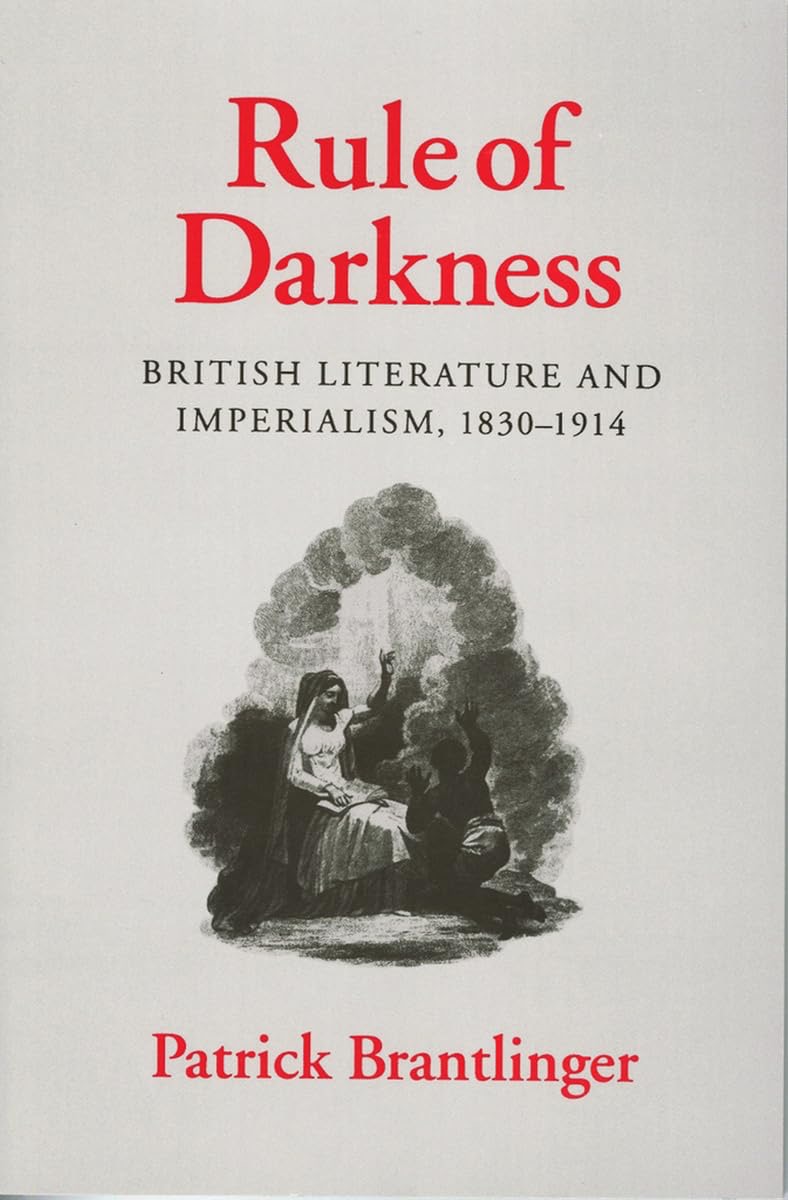
Softcover. Ithaca NY, Cornell University Press, reprint, 1990, Book: Very Good, Dust Jacket: None, Softcover, 309 pages. A major contribution to the cultural and literary history of the Victorian age, Rule of Darkness maps the complex relationship between Victorian literary forms, genres, and theories and imperialist, racist ideology. Critics and cultural historians have usually regarded the Empire as being of marginal importance to early and mid-Victorian writers. Patrick Brantlinger asserts that the Empire was central to British culture as a source of ideological and artistic energy, both supported by and lending support to widespread belief in racial superiority, the need to transform "savagery" into "civilization," and the urgency of promoting emigration. Rule of Darkness brings together material from public records, memoirs, popular culture, and canonical literature. Brantlinger explores the influence of the novels of Captain Frederick Marryat, pioneer of British adolescent adventure fiction, and shows the importance of William Makepeace Thackeray's experience of India to his novels. He treats a number of Victorian best sellers previously ignored by literary historians, including the Anglo-Indian writer Philip Meadows Taylor's Confessions of a Thug and Seeta. Brantlinger situates explorers' narratives and travelogues by such famous author-adventurers as David Livingstone and Sir Richard Burton in relation to other forms of Victorian and Edwardian prose. Through readings of works by Arthur Conan Doyle, Joseph Conrad, H. Rider Haggard, Rudyard Kipling, John Hobson, and many others, he considers representations of Africa, India, and other non-British parts of the world in both fiction and nonfiction. Clean, bright copy.
Hardcover. Port Washington NY, Kennikat Press, 1ST, 1981, Book: Very Good, Dust Jacket: None, Hardcover, brown covers with yellow and green lettering on front and spine and green sports figures on front. 112 pages. A Critical Look at Game, Sport, and Survival in Contemporary American Fiction. Clean copy.
Hardcover. NY, Charles Scribner's Sons, 1st, 1978, Book: Very Good, Dust Jacket: Very Good, Two hardcovers in dust jackets. 737 pages. Index. The dust jackets are faded on the spine. Edited by R.F. Christian. Vol. 1 1828-1879. Vol. 2 1880-1910. In a cardboard slipcase. Clean, bright set.
Hardcover. New Haven CT, Yale University Press, reprint, 1991, Book: Very Good, Dust Jacket: None, Hardcover in a dust jacket with fading to some areas, 338 pages. Margaret Fuller - journalist, critic, radical feminist, and political activist - traveled in Europe between 1846 and 1850 as a foreign correspondent for the New York Tribune. Her letters from England, France, and Italy, which began as engaging travel sketches, soon became moving accounts of the most widespread revolutionary upheaval within modern history. These dispatches are now reproduced in their entirety for the first time. Clean copy.
Hardcover. NY, Simon & Schuster, 1st, 1966, Book: Very Good, Dust Jacket: Very Good, Hardcover in a lightly worn, unclipped dust jacket with mild tanning, 254 pages. Bound in bright blue cloth in white dust jacket printed in red and black. First Printing stated. A collection of Isherwood's writings from nearly four decades. Clean copy.
Hardcover. NY, John Day/Reynal & Hitchcock, 1st, 1937, Book: Very Good, Dust Jacket: None, Hardcover, light tan cloth, 119 pages. B&w line illustrations by Bernadine Custer. Rudyard Kipling lived with his wife on a small estate in Dummerston, Vermont, in a house they built called Naulakha, from 1892 to 1896. It was while he was here that he wrote both "The Jungle Book" and "Captains Courageous". Kipling would have been content to live out his life there but in 1896, a dispute arose between the Kiplings an a neighbor led to a court case and the Kiplings left Vermont never to return. This volume, written by a Dummerston native and historian, tells the story of that dispute. Lacks dust jacket, otherwise clean, very good.
Hardcover. Iowa City, University Of Iowa Press, 1st, 1993, Book: Very Good, Dust Jacket: Very Good, Hardcover in a bright dust jacket, INSCRIBED BY THE AUTHOR on the half-title page. 268 pages. In this vigorous challenge to dominant literary criticism, Jerome Loving extends the traditional period of American literary rebirth to the end of the 19th century and argues for the intrinsic value of literature in the face of new historicist and deconstructionist readings. Bucking the trend for revisionist interpretations, Loving discusses the major work of the 19th century's canonized writers as restorative adventures with the self and society. Clean copy.
Hardcover. London, Oxford University Press, 1st, 1927, Book: Very Good, Dust Jacket: None, Hardcover, green cloth with gilt lettering on spine, 274 pages. Nine lectures. Contents: Introductory; What is Meant by Tradition; The Molpe; Drama; Metre; Poetic Diction; Unity and Organic Construction; The Heroic Age; Hamlet and Orestes; Poetry; Index. Clean copy. Top of cloth spine frayed. Remnants of dust jacket laid in.
Hardcover. NY, Methuen Publishing , 1st, 1988, Book: Very Good, Dust Jacket: Very Good, Hardcover in a bright dust jacket. 235 pages. Covers such subjects as black literature; the reconstruction of culture, changing arts, letters and sciences to include the topics of women and gender; and, the nature of family and the changing roles of women within society. As such, Catharine Stimpson employs a transdisciplinary approach, to encourage greater understanding of the differences among women, and thus socially-constructed differences in general. Where the Meanings Are tells of some of the arguments within feminism during the re-designing and designing of cultural spaces, as post-modernism began to change the boundaries of race, class, and gender. Clean copy.
Hardcover. Cambridge MA, Harvard University Press, 1st, 1995, Book: Very Good, Dust Jacket: Very Good, Hardcover in a bright, unclipped dust jacket, 266 pages. In these eloquent essays on recent American, British, and Irish poetry, Helen Vendler shows us contemporary life and culture captured in lyric form by some of our most celebrated poets. An incomparable reader of poetry, Vendler explains its power; it is, she says, more often the voice of the soul than the socially marked self, speaking directly to us through the stylization of verse. 'Souls Says,' the title of a poem by Jorie Graham, is thus the name of this collection. In essays on Seamus Heaney, Donald Davie, Allen Ginsberg, John Ashbery, Rita Dove, Jorie Graham, and others, Vendler makes difficult poetry accessible and explores the force and beauty of contemporary lyric verse. Clean copy.
Hardcover. NY, W.W. Norton & Co., 1st, 2005, Book: Very Good, Dust Jacket: Very Good, Hardcover in a bright, unclipped dust jacket, 299 pages. The author investigate the trauma behind poets Robert Lowell, Elizabeth Bishop, Sylvia Plath, John Berryman, Randall Jarrell, and Delmore Schwartz. They formed one of the great constellations of talent in American literature. In the decades after World War II, they changed American poetry forever by putting themselves at risk in their poems in a new and provocative way. Their daring work helped to inspire the popular style of poetry now known as 'confessional.' But partly as a result of their openness, they have become better known for their tumultuous lives-afflicted by mental illness, alcoholism, and suicide-than for their work. This book reclaims their achievement by offering critical 'biographies of the poetry'-tracing the development of each poet's work, exploring their major themes and techniques, and examining how they transformed life into art. Clean copy.
Hardcover. NY, Shoemaker and Hoard, 1st, 2005, Book: Very Good, Dust Jacket: Very Good, Hardcover in a bright, unclipped dust jacket, 222 pages. INSCRIBED BY CASTRONOVO on the title page. Edmund Wilson, 20th century America's most direct and readable critic of literature and society, was a man of many loves. In his half century as a major force in American letters he had an outsize romantic career that reflected the complex depths of his personality. Each woman whom he came to love was an alluring interpretative problem, an erotic and analytic challenge, a presence that fired his imagination. They came from the Greenwich Village of the 1920s, from his own upper middle class world of privilege, from New York's working class, from the high reaches of literary New York as well as from the workaday world of Talcottville in upper New York State. Who were they? Poet Edna St. Vincent Millay; actress Mary Blair; friends and drinking buddies Dorothy Parker, Louise Bogan, Dawn Powell, and Elinor Wylie; poet Leonie Adams; writer and intellectual Mary McCarthy; Mamaine Paget, later the wife of Arthur Koestler; and screenwriter and journalist Penelope Gilliatt were the best known. They appear here as personalities in their own right as well as in the roles they play in Wilson's biography. His Rabelaisian appetites, ardors and vulnerabilities, and conceptions of love and sex are a story in themselves. Clean copy.
Hardcover. London, Alcove Press , 1st, 1972, Book: Very Good, Dust Jacket: Good, Hardcover in a lightly worn dust jacket with foxing, tanning. No markings.
Softcover. NY, Seven Stories Press, reprint, 2017, Book: Very Good, Dust Jacket: None, Softcover, 237 pages. On its 2008 publication in France, The Years came as a surprise. Though Ernaux had for years been hailed as a beloved, bestselling and award-winning author, The Years was in many ways a departure: both an intimate memoir "written" by entire generations, and a story of generations telling a very personal story. Like the generation before hers, the narrator eschews the "I" for the "we" (or "they", or "one") as if collective life were inextricably intertwined with a private life that in her parents' generation ceased to exist. She writes of her parents' generation (and could be writing of her own book): "From a common fund of hunger and fear, everything was told in the "we" and impersonal pronouns." Clean, bright copy.
Softcover. Philadelphia, Owlswick Press, 1st pbk, 1989, Book: Very Good, Dust Jacket: None, Softcover, 180 pages. Foreword by L. Sprague de Camp, with essays, bibliography and index. Four b&w plates by Tim Kirk. Clean copy.
Hardcover. NY, New Directions, 1st, 2013, Book: Very Good, Dust Jacket: Very Good, Hardcover in a bright, unclipped dust jacket. In English at last, Borges's erudite and entertaining lectures on English literature from Beowulf to Oscar Wilde. Writing for Harper's Magazine, Edgardo Krebs describes Professor Borges: "A compilation of the twenty-five lectures Borges gave in 1966 at the University of Buenos Aires, where he taught English literature. Starting with the Vikings' kennings and Beowulf and ending with Stevenson and Oscar Wilde, the book traverses a landscape of 'precursors,'cross-cultural borrowings, and genres of expression, all connected by Borges into a vast interpretive web. This is the most surprising and useful of Borges's works to have appeared posthumously." Clean copy.
Hardcover. Ohio, Kent State University Press , 1st, 1973, Book: Very Good, Dust Jacket: None, Hardcover,115 pages, cream cloth with black lettering on spine.
Hardcover. New York, Viking Press, 1st, 1980, Book: Very Good, Dust Jacket: Very Good, Hardcover, 274 pages. Faint foxing to upper edge of brodart protected dust jacket and to top edge, else a very nice, tight copy.
Hardcover. New York, W W Norton & Co Inc, 1st, 1989, Book: Very Good, Dust Jacket: Very Good, Hardcover, 568 pages. Clean, unmarked copy in excellent condition. Profiles the enigmatic soldier, statesman, and man of letters, offering a wealth of never-before-published missives that shed light on his role in the Arab revolt, his sexuality, and his retreat into obscurity.
Hardcover. NY, Harper, 1st, 2012, Book: Very Good, Dust Jacket: Very Good, Hardcover, 376 pages. Light scratch top rear cover, else a clean, unmarked copy with only minor wear to dust jacket.
Hardcover. New York, Thomas Y. Crowell, 1st, 1913, Book: Very Good, Dust Jacket: None, 125 pages. Red Cloth Boards. Front endpaper missing. Small black stain at top of front hinge. Foxing on top edge. Otherwise, clean, tight copy.
Hardcover. Chicago, University of Chicago Press, 1st, 1935, Book: Very Good, Dust Jacket: None, 62 pages. Hardcover. Previous owners bookplate on inside front cover. Fading to spine and along left edge of front cover. Clean, tight copy.
Hardcover. New York , Vanguard Press, 1st, 1976, Book: Very Good, Dust Jacket: Very Good, Hardcover, 320 pages. Light edgewear, tanning to dust jacket else a clean, tight copy.
Softcover. New York, Lewis Carroll Society of North America, 1st, 1984, Book: Very Good, Dust Jacket: None, Softcover, 29 pages, SIGNED BY AUTHOR, number 289 of a limited edition of 350 copies, with photographs. Light edge wear, else, very clean and tight.
Hardcover. London, John Murray, 1st definitive ed., 1832-33, Book: Near Fine, Dust Jacket: None, Pub. orig. as 14 vols. then 3 more were added. Uniform complete 17 volume set in stunning condition: 3/4 black leather with elaborate design on spines with raised bands, marbled boards and end papers, top edge gilt . Black & white engraved frontis in each volume. Previous owner's bookplate (one on each front end paper), The slightest bumping to a few corners.
Hardcover. Watertown, MA, Charlesbridge, reprint , 2010, Book: Very Good, Dust Jacket: None, Hardcover, non-paginated. Extensive b&w woodcut illustrations throughout. Gilt titles on spine and cover. Color illustration on front cover. Clean, unmarked copy.
Hardcover. London, Macmillan Company, 1st, 1904, Book: Very Good, Dust Jacket: None, 541 pages. Hardcover with no dust jacket. Light fraying on edges of cover boards. Previous owner's name on front end paper. Gilt lettering on spine, light brown covers.
Hardcover. New York, Doubleday, 1t, 2017, Book: Very Good, Dust Jacket: Very Good, 256 pages. Hardcover with dust jacket. Very clean, unmarked copy with only minor wear to dust jacket edges. A tight copy. Color illustrations throughout.
Hardcover. NY, Norton, 1st, 2004, Book: Very Good, Dust Jacket: Very Good, Hardcover in a bright, unclipped dust jacket, 530 pages. An affectionate portrait of the prolific twentieth-century comic writer discusses his creation of such characters as Jeeves, Psmith, and the Empress of Blandings; describes his contributions to Broadway and the London stage; details his internment in Berlin during World War II; and reveals a following of literary figures who are among his top fans.
Hardcover. NY, Prentice Hall, 2nd pr., 1967, Book: Very Good, Dust Jacket: Very Good, Hardcover in a bright, unclipped dust jacket, 258 pages, b&w photographs. The story of Edgar Rice Burroughs and Tarzan in the movies.
Hardcover. NY, Arcade Publishing, 1st, 1999, Book: Very Good, Dust Jacket: Very Good, Hardcover in a bright, unclipped dust jacket. 401pages. The 1990s saw a resurgence of interest in the Marquis de Sade, with several biographies competing to put their version of his life story before the public. But Sadean scholar Richard Seaver takes us directly to the source, translating Sade's prison correspondence. Seaver's translations retain the aristocratic hauteur of Sade's prose, which still possesses a clarity that any reader can appreciate. "When will my horrible situation cease?" he wrote to his wife shortly after his incarceration began in 1777. "When in God's name will I be let out of the tomb where I have been buried alive? There is nothing to equal the horror of my fate!" But he was never reduced to pleading for long, and not always so solicitous of his wife's feelings; a few years later, he would write, "This morning I received a fat letter from you that seemed endless. Please, I beg of you, don't go on at such length: do you believe that I have nothing better to do than to read your endless repetitions?" For those interested in learning about the man responsible for some of the most infamous philosophical fiction in history, Letters from Prison is an indispensable collection. Clean copy.
Hardcover. Boston, The Beacon Press, 1st, 1956, Book: Very Good, Dust Jacket: None, Hardcover, gray cloth covers, 289 pages. 12 pages of b&w photos. Fifty years of letters (1899-1949) by the crusader for liberal and humane causes as well as Jewish rights. Clean copy.
Hardcover. NY, Random House, 1st, 2002, Book: Very Good, Dust Jacket: Very Good, Hardcover in a bright dust jacket, 416 pages. The essays, speeches, and opinion pieces assembled in Step Across This Line, written over ten years, cover an astonishing range of subjects. The collection chronicles Rushdie's intellectual odyssey and is also an especially personal look into the writer's psyche. With the same fierce intelligence, uncanny social commentary, and very strong opinions that distinguish his fiction, Rushdie writes about his fascination with The Wizard of Oz, his obsession with soccer, and the state of the novel, among many other topics. Most notably, delving into his unique personal experience fighting the Iranian fatwa, he addresses the subject of militant Islam in a series of challenging and deeply felt responses to the terrorist attacks of September 11, 2001. The book ends with the eponymous "Step Across This Line," a lecture Rushdie delivered at Yale in the spring of 2002, which has never been published before and is sure to prompt discussion.
Hardcover. Little Rock AK, Butler Center for Arkansas Studies, 1st, Book: Very Good, Dust Jacket: Very Good, Hardcover in a bright, unclipped dust jacket. 358 pages. For those who care about literature or simply love a good laugh (or both), Charles Portis has long been one of America's most admired novelists. His 1968 novel True Grit is fixed in the contemporary canon, and four more have been hailed as comic masterpieces. Now, for the first time, his other writings--journalism, travel stories, short fiction, memoir, and even a play--have been brought together in Escape Velocity: A Charles Portis Miscellany, his first new book in more than twenty years. All the familiar Portis elements are here: picaresque adventures, deadpan humor, an expert eye for detail and keen ear for the spoken word, and encounters with oddball characters both real and imagined. The collection encompasses the breadth of his fifty-year writing career, from his gripping reportage of the civil rights movement for the New York Herald Tribune to a comic short story about the demise of journalism in the 21st century. New to even the most ardent fan is his three-act play, Delray's New Moon, performed onstage in 1996 and published here for the first time.

 "The Von Richthofen Sisters: The Triumphant and Tragic Modes of Love: Else and Frieda Von Richtofen, Otto Gross, Max Weber, and D. H. Lawrence in the Years 1870-1970 by:")
 "Also a Poet: Frank O'Hara, My Father, and Meby: Calhoun, Ada")
 "The Wounded World: W. E. B. Du Bois and the First World Warby: Williams, Chad L.")
 "The Sorcerer's Apprentice: My Life with Carlos Castanedaby: Amy Wallace")
 "Complete Poems and Playsby: Eliot, T.S.")
 "Pretzel and the Puppiesby: Rey, Margret / Rey, H. A.")
 "The New American Novel of Manners: The Fiction of Richard Yates, Dan Wakefield, and Thomas McGuane (SIGNED COPY)by: Klinkowitz, Jerome")
 "Betjeman: A Life by: Wilson, A.N.")
 "Essay on the Stile of Doctor Samuel Johnson (1787)by: Johnson, Samuel) Burrows, Robert")
 "Robert Stephen Hawker: A Study of His Thought and Poetry by: Burrows, M.F.")

 "Writing and Being: The Charles Eliot Norton Lectures 1994 by: Nadine Gordimer")
 "In Defense of Marion: The Love of Marion Bloom and H. L. Menckenby: Martin, Edward A./ Mencken, H. L.")

 "Tolstoy's Letters (2 Volumes)by: Tolstoy, Lev (Edited by R.F. Christian)")



 "Exhumations: Stories Articles Versesby: Christopher Isherwood")
 "Rudyard Kipling's Vermont Feud by: Van de Water, Frederic F.; Custer, Bernadine (drawings)")



 "Anais Nin: A Bibliographyby: Franklin V, Benjamin")
 "Of Outlaws, Con Men, Whores and Politicians & Other Artistsby: King, Larry L.")
 "T. E. Lawrence: The Selected Lettersby: Lawrence, T. E. (Malcolm Brown)")
 "Grand Tour, The : Around the World with the Queen of Mysteryby: Christie, Agatha/Edited By Mathew Prichard")
 "Kipling Birthday Bookby: Bryant, Alice Crandell")
 "Narration - Four Lectures by Gertrude Steinby: Stein, Gertrude")
 "Edith Sitwell: Fire of the Mindby: Salter, Elizabeth & Allanah Harper")
 "Feed the Mind: A Centenary Celebration of Lewis Carroll's Visit to Alfreton in 1884 (SIGNED)by: Goodacre, Selwyn H.")


 "King and the Corpse, The: Tales of the Soul's Conquest of Evilby: Zimmer, Heinrich")
 "Works of Lord Byron, The - With His Letters and Journals and His Life (17 vols.)by: Moore, Thomas")
 "New Year's Masque and Other Poems, Aby: Thomas, Edith M.")
 "WALDEN THEN & NOW : AN ALPHABETICAL TOUR OF HENRY THOREAU'S PONDby: McCurdy, Michael")
 "Japan: An Attempt at Interpretationby: Hearn, Lafcadio")
 "There's a Mystery There: The Primal Vision of Maurice Sendakby: Cott, Jonathan")
 "Wodehouse: A Lifeby: Robert McCrum")
 "Big Swingers, The - A Biographyby: Fenton, Robert W.")
 "E. E. Cummings: A Life by: Cheever, Susan")
 "Letters from Prison by: Marquis De Sade (Author), Richard Seaver (Translator)")
 "The Personal Letters Of Stephen Wise by: Wise Polier Justine, Waterman Wise James (Ed.)")
 "Step Across This Line: Collected Nonfiction 1992-2002by: Salman Rushdie")
