Hardcover. Lewiston NY, Edwin Mellen Press, 1st, 1990, Book: Very Good, Dust Jacket: None, Hardcover, green cloth with gilt lettering, 424 pages plus appendix. This study provides an examination of the Spanish novelist Perez Galdos' turn to the stage in 1892 and his simultaneous shift in approach towards the roles of women in society. Faint pencil marking to about 25 pages in front of volume. Otherwise a tight, clean copy.
Hardcover. Austin TX, University of Texas Press, 1st, 1962, Book: Very Good, Dust Jacket: Fair, Hardcover in a worn and chipped dust jacket. Foreword by George Orwell. Introduction by Christopher Fyfe. 241 pages. Reprints two books by Irish novelist Joyce Cary (1888-1957), "The Case for African Freedom" (1941) and "Britain and West Africa" (1946), and three shorter magazine pieces. Illustrated in black and white, with three maps of Africa. Cary was English novelist who served in the Nigerian political service.
Hardcover. Athens GA, University of Georgia Press, 2nd pr., 1967, Book: Good, Dust Jacket: Good, Hardcover in a lightly worn dust jacket. 182 pages, 5 pages with red underlining. Brookes examines how Harris drew on his extensive knowledge of African American folklore and culture to create the characters in his work. Brookes classifies the Uncle Remus books under seven major categories: trickster tales, other "creeturs," myths, supernatural tales, proverbs, dialect, and songs.
Hardcover. NY, Sheed and Ward, 1st, 1974, Book: Very Good, Dust Jacket: Very Good, Hardcover in a lightly worn dust jacket with faded spine, 480 pages. Richard Kostelanetz's monumental evisceration of the American book world circa 1974--the self-appointed backslapping elites, the perpetual disdain for the unconventional, the laziness in book reviewing and fear of losing one's status when criticising the wrong thing--remains, as a final sadness, itself a rare out of print tome. Kostelanetz has written perhaps the most fearless exploration of literary politics in print, taking on and naming the titans at the top of the heap, dissecting the power structures that emerged in the 1950s and 60s, and the emergence of the plutocratic hierarchies that continue to dominate publishing. Outing the various cliques as mobs, and using apt and amusing mafia parallels, Kostelanetz is unrelenting in his meticulousness, and counteracts the status quo with a passionate defence of the avant-garde, using the second half of the book to bring light to the various emerging authors of experimental poetry, fiction, and mixed media works around the time. At times a touch long-winded and overfed with quotes, this nevertheless is an essential read for those requiring a hard slap as to the inherent evil of the corporate book world and why indie is the only way forward. Clean copy.
Hardcover. NY, Columbia University Press, 1st, 1939, Book: Very Good, Dust Jacket: None, Six matching volumes, red cloth bindings with black/gilt titling on spines, gilt initials on front board. Covers Emerson's letters from 1813 to 1881. Ralph Waldo Emerson (1803-1882) was an influential American essayist, philosopher, and poet, known for leading the Transcendentalist movement. His works emphasized individualism, nature, and self-reliance, significantly impacting American literature and thought. NOT ex-lib, clean complete set. Due to weight DOMESTIC SHIPPING ONLY.
Hardcover. NY, Random House, 1st US, 1978, Book: Very Good, Dust Jacket: Very Good, Hardcover in a bright, unclipped dust jacket, 382 pages. A biography of Ivan Turgenev, 19th-century Russian writer. The book is not a critical examination of Turgenev's literary output, but, of the man himself - enigmatic and unknown - and the world in which he lived, and the people he knew and associated with. Clean copy.
Softcover. South Royalton VT, Steerforth Press, reprint, 2001, Book: Very Good, Dust Jacket: None, Softcover, 187 pages plus b&w photos. With haunting photographs and piercing descriptions, Women of the Shadows depicts the secluded women of southern Italy and their passionate, painful, heartrending existence. Cornelisen, who lived among these women in the mountainous villages of Lucania after World War II, reveals their struggles during a time when most of their men had to leave for factories in the industrial north. The women remained behind to work the fields. There's Peppina, Ninetta, Teresa, Maria, Pinuccia, and Cettina, all women who "have done things of which they are not proud; they know it in their hearts, as one woman said, that nothing is private, they would also agree with her conclusion: That doesn't mean you get used to it." With an extraordinary understanding of the interior lives of these and other women, Cornelisen brings them out of the shadows to tell their heroic stories in a book which truly merits the label "classic." A new introduction by the author suggests that the more things change, the more, in essence, they remain the same. Wrappers sunned, otherwise tight and clean.
Softcover. Berkeley CA, University of California Press, 1st pbk, 1997, Book: Very Good, Dust Jacket: None, Softcover, 472 pages. The prose writings of Charles Olson (1910-1970) have had a far-reaching and continuing impact on post-World War II American poetics. Olson's theories, which made explicit the principles of his own poetics and those of the Black Mountain poets, were instrumental in defining the sense of the postmodern in poetry and form the basis of most postwar free verse. The Collected Prose brings together in one volume the works published for the most part between 1946 and 1969, many of which are now out of print. A valuable companion to editions of Olson's poetry, the book backgrounds the poetics, preoccupations, and fascinations that underpin his great poems. Included are Call Me Ishmael, a classic of American literary criticism; the influential essays "Projective Verse" and "Human Universe"; and essays, book reviews, and Olson's notes on his studies. In these pieces one can trace the development of his new science of man, called "muthologos," a radical mix of myth and phenomenology that Olson offered in opposition to the mechanistic discourse and rationalizing policy he associated with America's recent wars in Europe and Asia. Clean copy.
Softcover. NY, Swann Auction Galleries, 2018, Book: Very Good, Dust Jacket: None, Softcover, 310 lots illustrated with color photos of rare books, many in dust jackets. Description and comments for each lot, prices realized list laid in. Great reference for the avid collector. Clean copy.
Hardcover. NY, Pegasus , 2nd pr., 2022, Book: Very Good, Dust Jacket: Very Good, Hardcover in a bright, unclipped dust jacket, 415 pages. Why did Agatha Christie spend her career pretending that she was 'just' an ordinary housewife, when clearly she wasn't? As Lucy Worsley says, 'She was thrillingly, scintillatingly modern'. She went surfing in Hawaii, she loved fast cars, and she was intrigued by the new science of psychology, which helped her through devastating mental illness. So why - despite all the evidence to the contrary - did Agatha present herself as a retiring Edwardian lady of leisure? She was born in 1890 into a world which had its own rules about what women could and couldn't do. With access to personal letters and papers that have rarely been seen, Lucy Worsley's biography is both authoritative and riveting. Clean copy.
Hardcover. Stanford CA, Stanford University Press, 1st, 1993, Book: Very Good, Dust Jacket: Very Good, Hardcover in a bright dust jacket, 308 pages including index. Friendship between the sexes is notoriously difficult to describe. Seeing Together examines the efforts of some of England's key writers - from poets to propagandists - during a period when 'mere friendship' came to seem intensely important and when discussion of professional relations between men and women came to touch upon a troubling network of sexual, social and political dynamics. Among the authors discussed are John Stuart Mill, Robert Browning, George Eliot, Thomas Hardy, Henry James, Joseph Conrad, D. H. Lawrence and Virginia Woolf. Small name on fly leaf otherwise a bright, clean copy.
Hardcover. NY, Simon & Schuster , 1st, 2023, Book: Very Good, Dust Jacket: Very Good, Hardcover in a bright, unclipped dust jacket, 509 pages. Remembrance offers the first sustained look at the author's life in letters from his late teens to his ninth decade. Bradbury's correspondence was far-reaching--he interacted with a rich cross-section of 20th-Century cultural figures, writers, film directors, editors, and others who simply wanted insights or encouragement from a writer who had enriched their lives through his stories and novels. Bradbury scholar and biographer, Jonathan R. Eller, organized this volume into categories of correspondents, showing Bradbury's progression through life as he knew it, and not necessarily as the public perceived him. Letters to and from mentors and other writers are followed by correspondence with such film directors as John Huston, Francois Truffaut, and Federico Fellini. Letters with publishers and agents are followed by letters that capture moments of national and international recognition, the shadows of war and family members who shared the memories of his life. Among the writers whose letters illuminate Remembrance are Theodore Sturgeon, Sir Arthur C. Clarke, Twilight Zone writers Charles Beaumont and Richard Matheson, Dan Chaon, Bernard Berenson, Nobel Laureate Bertrand Russell, Graham Greene, Anais Nin, Gore Vidal, Carl Sandburg, and Jessamyn West. Clean copy.
Hardcover. Albany NY, State University of New York Press, 1st, 1970, Book: Very Good, Dust Jacket: Good, Hardcover in a lightly worn and tanned dust jacket, 262 pages. A critical introduction to major English poetry of the nineteenth century with an analysis of the changes in subject matter form, tone, and technique resulting from romantic influences. Clean copy.
Hardcover. Kent OH, Kent State University, 1st, 1971, Book: Very Good, Dust Jacket: Good, Hardcover in a lightly worn dust jacket, 315 pages. 9 illustrations. A collection of 23 scholarly essays from this conference commemorating the 200th anniversary of the death of Irish novelist and clergyman Laurence Sterne (1713-1768). Clean copy.
Hardcover. NY, Knopf , 1st, 1976, Book: Very Good, Dust Jacket: Very Good, Hardcover in a bright, price-clipped dust jacket. The author's first book about growing up in Stockton, California with her immigrant parents from a small peasant village in China.
Hardcover. Columbia MO, University of Missouri Press, 1st, 1993, Book: Very Good, Dust Jacket: Very Good, Hardcover in a bright dust jacket, 356 pages. Eleanor Roosevelt called her one of the most influential women in America. Among the earliest and most assertive members of the Book-of-the-Month Club selection committee, Dorothy Canfield Fisher helped define literary taste in America for more than three decades. She helped shape the careers of such great writers as Pearl Buck, Isak Dinesen, and Richard Wright. A best-selling author herself, Fisher was also a deeply committed social activist. In Keeping Fires Night and Day, Mark J. Madigan collects much of Fisher's copious correspondence. With letters to Willa Cather, W.E.B. Du Bois, Albert Einstein, Robert Frost, Margaret Mead, James Thurber, and E.B. White, he documents Fisher's personal and professional life and career in a way that no biography could. Clean copy.
Hardcover. NY, Random House, 1st, 1991, Book: Very Good, Dust Jacket: Very Good, Hardcover in a bright dust jacket, 179 pages. The author discusses the influence of John Updike on his novels, explains what features of Updike's writings he finds most attractive, and examines the life of a writer. Clean copy.
Softcover. New York, Viking Press, 1st, 1962, Book: Very Good, Dust Jacket: None, 12 page booklet with light tan wrappers, reddish brown type. The text of the author's speech with a b&w photograph of him. Minor discoloration to top of wrapper, probably due to dampness at some time. Still very good.
Hardcover. Boston, Ticknor and Fields, 1st, 1863, Book: Very Good, Dust Jacket: None, Hardcover, 319 pages. Portrait of Thoreau on frontispiece with tissue guard. First edition, one of 1,558 copies printed. Original publisher's blue-green pebbled cloth with blind-stamped borders and center wreath. Spine lettered in gilt. Brown-coated end papers. Ten essays including a 33 page biographical sketch by Emerson of Thoreau and nine essays by Thoreau, among them the famous "Walking."
Hardcover. New York, Atlantic Monthly Press, 1st, 1988, Book: Very Good, Dust Jacket: Very Good, Hardcover, 288 pages, INSCRIBED BY AUTHOR on title page. Spotless and clean copy.
Hardcover. NY, Knopf, 1st, 1980, Book: Very Good, Dust Jacket: Very Good, Hardcover in a bright dust jacket. 227 pages. Previous owner's signature on front fly leaf, else a clean, tight copy. Naipaul presents here four essays about the "half-made" societies, those still suffering from the profound deprivations of colonialism and prey to corruption." He examines the role of Eva Peron as the catalyst for violence in Argentina, with its yearning for a European culture and the physical, historical, cultural reality of the land in which the native Indians were wiped out and the colonialists took over. He writes of the infamous Michael X in Trinidad whose pretensions to power and destiny led to the man's insanity and execution following two pointless murders. Shorter essays address nihilism in the Congo and Naipaul's take on Joseph Conrad and the Heart of Darkness.
Hardcover. London , Macmillan, 1st, 1933, Book: Very Good, Dust Jacket: None, Hardcover, 268 pages, illustrated with facsimile drawings and 8 collotype plates. Previous owner's inscription on front fly leaf. Blue cloth spine faded.
Hardcover. London, Jonathan Cape, Reprint, 1960, Book: Very Good, Dust Jacket: Very Good, Hardcover, 350 pages. Previous owners stamp on front endpaper. Dust jacket shows standard wear. Clean, tight copy.
Hardcover. Cambridge, Cambridge University Press, 1st, 1974-1981, Book: Very Good, Dust Jacket: Very Good, All six volumes. Hardcover with dust jackets. Release dates range from 1974-1981. All first editions. Volume six has clipped dust jacket. Light fraying to dust jackets otherwise, clean, tight copies. Decorative staining on top text block. Black and white dust jacket.
Softcover. Evanston, IL, Northwestern University Press, reprint, 2001, Book: Very Good, Dust Jacket: None, 355 pages. Softcover with light edgewear to paper wrappers. In this groundbreaking volume, Krzysztof Ziarek rethinks modern experience by bringing together philosophical critiques of modernity and avant-garde poetry. Ziarek explores, through selective readings of avant-garde poetry, the key aspects of the radical critique of experience: technology, everydayness, event, and sexual difference. To that extent, The Historicity of Experience is less a book about the avant-garde than a critique of experience through the avant-garde. Ziarek reads the avant-garde in dialogue with the work of some of the major critics of modernity (Martin Heidegger, Walter Benjamin, Jean-Francois Lyotard, and Luce Irigaray) to show how avant-garde experiments bear critically on the issue of modern experience and its technological organization. The four poets Ziarek considers--Gertrude Stein, Velimir Khlebnikov, Miron Biaoszewski, and Susan Howe--demonstrate the broad reach of and variety of forms taken by the avant-garde revision of experience and aesthetics.
Hardcover. New York, Fred De Fau & Company, reprints, 1901, Book: Very Good, Dust Jacket: None, Two volumes, hardcovers. 810 pages total. B/w frontipieces with tissue guards. B/w illustrations throughout. Top edges gilt. Dark green cloth boards, gilt titles on spines, some light shelf wear. Tanning to pages and edges from age. Split at gutter of Introduction page in vol. 1, doesn't affect binding, no pages loose. Bindings good. Pages unmarked. Spines straight. The second of the three Valois romances, a continuation of Marguerite de Valois. Takes up the story three years later with Henry III seated, but not securely, on the throne.
Softcover. Willamette, Willamette Week, 1st wraps, 1990, Book: Very Good, Dust Jacket: None, Softcover. Columns from her early column in the Willamette Week newspaper. SIGNED BY DUNN.
Hardcover. Boston, Houghton Mifflin, 2nd pr., 1998, Book: Very Good, Dust Jacket: Very Good, Hardcover, 414 pages, b&w illustrations. Very good, clean, in a lightly worn, unclipped dust jacket. World famous at twenty-four, brilliant and reckless, hard-living and scandalous, Stephen Crane wrote The Red Badge of Courage before he ever experienced war first-hand. So true was his portrait of a young man who runs from his first confrontation with battle that Civil War veterans argued about whose regiment Crane had been in. Considered by H.G. Wells as "beyond dispute, the best writer of our generation," Crane was also famous in his time as an unforgettable personality, an Adonis with tawny hair and gray-blue eyes that Willa Cather described as "full of luster and changing lights." A lover of women and truth at any cost, Crane, in his short life, paid dearly for both. He alienated the New York police when he testified against a policeman on behalf of a prostitute falsely accused of soliciting, forcing him to live the rest of his short life as an expatriate in England. Reporting on the Spanish American War, Crane described the Rough Riders blundering into a trap after arriving in Cuba, infuriating Roosevelt. He died tragically young, leaving behind a handful of fine short stories, including The Open Boat and The Blue Hotel, along with war reporting, novels, and poetry.
Hardcover. NY, E.P. Dutton & Co., 1st, 1907, Book: Very Good, Dust Jacket: None, Hardcover, illustrated frontispiece etching of Blenheim. Burgundy cloth with gilt titles and decoration, top edge gilt. The memoirs of the author of "Land of Hope and Glory." Clean, bright copy.
Hardcover. Syracuse University Press , 1st, 1991, Book: Very Good, Dust Jacket: Very Good, Hardcover, 493 pages. Remainder line and foxing to top edge, light edgewear to dust jacket, else a clean, tight copy.
Hardcover. Brooklyn NY, Melville House, 1st, 2013, Book: Very Good, Dust Jacket: Very Good, Hardcover in a bright, unclipped dust jacket. This is the original 30,000 word article Agee wrote for Fortune magazine in 1936 that was never published. Accompanied by 30 Walker Evans photos. Clean copy.
Softcover. Berkeley CA, University of California Press, 1st, 1994, Book: Very Good, Dust Jacket: None, Softcover, 316 pages. Few twentieth-century thinkers have proven as influential as Walter Benjamin, the German-Jewish philosopher and cultural and literary critic. Richard Wolin's book remains among the clearest and most insightful introductions to Benjamin's writings, offering a philosophically rich exposition of his complex relationship to Adorno, Brecht, Jewish Messianism, and Western Marxism. Wolin provides nuanced interpretations of Benjamin's widely studied writings on Baudelaire, historiography, and art in the age of mechanical reproduction. In a new Introduction written especially for this edition, Wolin discusses the unfinished Arcades Project, as well as recent tendencies in the reception of Benjamin's work and the relevance of his ideas to contemporary debates about modernity and postmodernity. Clean, bright copy.
Hardcover. NY, McGraw-Hill, 1st, 1951, Book: Good, Dust Jacket: Good, Hardcover in a lightly worn dust jacket with fading to spine, 263 pages. Pencil underlining to first 20 pages, otherwise clean. Discusses the works of postwar writers of the Forties, such as Norman Mailer, John Horne Burns, Truman Capote, Paul Bowles, Alfred Hayes and others; along with three writers of the Twenties: Ernest Hemingway, John Dos Passos, and F. Scott Fitzgerald.
Softcover. NY, New Directions, 2nd pr., 1969, Book: Very Good, Dust Jacket: None, Softcover, second printing, 316 pages plus index, sewn paperback cover price $2.45, very good lightly used copy.
Hardcover. NY, Crown, 1st, 1995, Book: Very Good, Dust Jacket: Very Good, Hardcover in a bright, unclipped dust jacket, 644 pages, b&w illustrations. After a protracted squabble over private papers with the playwright's estate, Leverich delivers this hefty first volume of a projected two-volume life of Tennessee Williams (1911-1983). In it, Leverich, who produced several of Williams's plays and calls himself Williams's "chosen biographer", covers the years through 1945, when The Glass Menagerie opened on Broadway. Treated are Williams's youth in Mississippi and St. Louis; the college years at the universities of Missouri and Iowa; bumming around (but always writing) in New Orleans and Greenwich Village; the disaster of his first Broadway play (it closed in Boston); script writing, or avoiding it, at MGM's Hollywood mill; and, finally, the evolution of Menagerie, a wonderfully detailed and dramatic case history in itself. Leverich's overworked conceit, which he restates at intervals, is that this is the life of Tom Williams, a "repressed puritan" poet, who in time created a more flamboyant public persona called Tennessee. A few matters are set straight. Leverich maintains his subject's active homosexual life started in his late 20s, later than Williams stated in his memoirs, and that his sister's infamous lobotomy came later than his mother claimed. Although the accumulation of information is impressive, the lower Leverich keeps his own profile and editorial commentary the better his book is, which means it is at its best when it simply reproduces Williams's sporadically kept journal. If you believe that all the details of a life are but preparation for a single event, in this case, the opening of a remarkable play, this is an impressively argued biography.
Hardcover. Watertown, MA, Charlesbridge, reprint , 2010, Book: Very Good, Dust Jacket: None, Hardcover, non-paginated. Extensive b&w woodcut illustrations throughout. Gilt titles on spine and cover. Color illustration on front cover. Clean, unmarked copy.
Hardcover. NY, Grove Press, 1st, 2017, Book: Very Good, Dust Jacket: Very Good, Hardcover in a bright, unclipped dust jacket. Jim Harrison was one of America's most beloved writers, a muscular, brilliantly economic stylist with a salty wisdom. He also wrote some of the best essays on food around, earning praise as 'the poet laureate of appetite' (Dallas Morning News). A Really Big Lunch collects many of his food pieces for the first time - and taps into his larger-than-life appetite with wit and verve. Clean copy.
Hardcover. NY, Knopf, 1st, 1993, Book: Very Good, Dust Jacket: Very Good, Hardcover in a bright, unclipped dust jacket. 551 pages, illustrated, notes and sources, Anthony Trollope's works, index. Name on front fly leaf, otherwise clean.
Softcover. NY, Unmuzzled Ox, 1st, 2001, Book: Very Good, Dust Jacket: None, Softcover, 117 pages. publisher's ads, introduction, libretto, illustrated with photos and collages, very good literary arts journal. Clean copy. The libretto of an almost-forgotten opera is translated by a poet of the very first rank, W.H. Auden.
Hardcover. London, Arthur Baker, 1st, 1952, Book: Very Good, Dust Jacket: Poor, Hardcover in a poor, worn dust jacket with a large chunk gone from front panel. Book is bright and clean, 180 pages. Illustrated with color and b&w plates by John Leech. A biography of the novelist who wrote of country sports like hunting in a comical way.
Hardcover. NY, The Macmillan Company, 1st Ltd. Ed., 1921, Book: Very Good, Dust Jacket: Very Good, Hardcover in a tan dust wrapper with black lettering, 111 pages. A tight, lovely first edition of Brown's first book, a study of the works of the just-deceased and little-known New England poet and essayist Guiney (1861-1920). The frontispiece, a head and shoulders wood engraving of a young woman (presumably Guiney) wearing a crown of laurels, is signed boldly in pencil just below the image by famed wood engraver TIMOTHY COLE (1852-1931). ALSO INSCRIBED BY AUTHOR BROWN on the front fly leaf. Number 11 of 100 special copies.
Hardcover. Boston, Houghton Mifflin, 1st, 1905, Book: Very Good, Dust Jacket: None, Hardcover, black cloth stamped in gilt, 3 colors. Beautiful gilt and sihouette vignette of the London skyline. 80 black and white drawings by Joseph Pennell. Top edge gilt. A collection of periodical pieces written over a span of thirty years by James, all about his travels in England. Name and date on front fly leaf, otherwise a clean, bright copy.
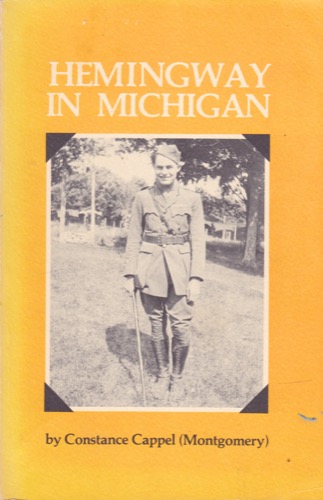
Softcover. Waitsfield VT, Vermont Crossroads Press, reprint, 1977, Book: Very Good, Dust Jacket: None, Softcover, 224 pages, b&w illustrations. Originally published in hardcover in 1966. Harbor Springs in northern Michigan was where the Hemingway family vacationed from Chicago as early as 1900, when Ernest was age 1. Trips there followed during his youth and into his early years as a professional writer. The setting of Walloon Lake and the region and characters of Little Traverse Bay found their way into some of his stories. Includes three of Hemingway's short stories originally published in the Oak Park (Ill. ) High School Tabula, here reprinted for the first time. Mild wear, INSCRIBED BY AUTHOR on the front fly leaf. Otherwise clean.
Hardcover. NY, Houghton Mifflin, reprint, 2022, Book: Very Good, Dust Jacket: Very Good, Hardcover in a bright dust jacket. Illustrated in color by the Reys. A reprint of a title first published in 1946. The story of Pretzel, the longest dachshund in the world, his wife Greta and five children. Clean copy.
Hardcover. Athens GA, University of Georgia Press, 1st, 1986, Book: Very Good, Dust Jacket: Very Good, Hardcover in a bright dust jacket. 176 pages. INSCRIBED BY AUTHOR on front end paper. In the 1960s, as the underpinnings of society weakened, the traditional novel form seemed less suited to describe American reality. Theorists groped towards non-mimetic fiction as the tools that had sustained the novel since its birth-coherent characterization, linear plot, symbolism-became tools of New Journalism. The New American Novel of Manners explores the virtual reinvention of the novel of manners in America out of the same subjectivity that charged the works of New Journalism. In place of the rigid social structures that never seemed to depict America, novelists such as Richard Yates, Dan Wakefield, and Thomas McGuane located America's modern-day manners in its semiotics, in the system of signs that envelops us-the blue jeans people wear, the fast food they eat, the decor of the bars they drink in and the rock-and-roll lyrics that play through memories. The new generation of mannerists describe lifestyles that are determined by words and images, by actions that are dictated by what has been read and seen, and patterns of behavior in which life is edited and fictionalized. Klinkowitz reveals a fiction that is once again capable of reflecting the way people live. Clean copy.

 "Women in the Theatre of Galdos: From Realidad (1892) to Voluntad (1895)by: Lisa P. Conde")


 "The Case for African Freedom and Other Writings on Africa by: Cary, Joyce")
 "Joel Chandler Harris: Folkloristby: Stella Brewer Brookes")
 "The End of Intelligent Writing: Literary Politics in Americaby: Kostelanetz, Richard")
 "The Letters of Ralph Waldo Emerson (6 Volumes)by: Emerson, Ralph Waldo and Rusk, Ralph L. (Ed.)")
 "The Unpublished Dostoevsky: Diaries and Notebooks, Volume III (1860-81) by: Dostoevsky, Fyodor/Proffer, Carl R. (Editor)")
 "Turgenev: His Life and Times by: Leonard Schapiro")
 "Women of the Shadows: Wives and Mothers of Southern Italy by: Ann Cornelisen")
 "Collected Proseby: Olson, Charles / Allen, Donald and Friedlander, Benjamin (Eds.)")
 "19th & 20th Century Literature with selections from the estate of Stanley Simon/ Sale 2478by: Swann")
 "Agatha Christie: A Very Elusive Womanby: Worsley, Lucy")
 "Seeing Together : Friendship Between the Sexes in English Writing from Mill to Woolfby: Luftig, Victor")
 "Remembrance: Selected Correspondence of Ray Bradbury by: Bradbury, Ray/ Eller, Jonathan R. (Editor)")
 "Victorian Poetry and the Romantic Religionby: Derek Colville")
 "Winged Skull: Papers from the Laurence Sterne Bicentenary Conference by: Cash, Arthur H. & Stedmond, John M. (eds.)")
 "The Woman Warrior: Memoirs of a Girlhood Among Ghostsby: Kingston, Maxine Hong")
 "Keeping Fires Night and Day: Selected Letters of Dorothy Canfield Fisher by: Madigan, Mark J. (Ed.)")
 "U and I: A True Storyby: Nicholson Baker")

 "Excursionsby: Thoreau, Henry D.")
 "This Boy's Life; a Memoir (SIGNED COPY)by: Wolff, Tobias")
 "Return of Eva Peron with The Killings in Trinidadby: Naipaul, V. S.")
 "Selection from the Letters of Lewis Carroll to His Child-Friends, A - Together with Eight or Nine Wise Words About Letter-Writingby: Hatch (Ed.), Evelyn M.")
 "Kilvert's Diary 1870-1879 - Selections from the Diary of The Rev. Francis Kilvertby: Plomer, William")
 "Letters of Thomas Babington Macaulay, The (ALL SIX VOLUMES)by: Pinney (Editor), Thomas")
 "Private Diaries of Stendhal, Theby: Sage, Robert (Ed.)")
 "Inventing the Enemyby: Eco, Umberto")
 "Historicity of Experience: Modernity, the Avant-Garde, and the Event, Theby: Ziarek, Krzysztof")
 "La Dame de Monsoreau - Volumes 1 & 2 (Volumes 10 & 11 of Dumas collection)by: Dumas, Alexandre")


 "Slice, The - Information With An Attitude (SIGNED COPY)by: Dunn, Katherine")
 "Neurotic Nightingale, The (SIGNED COPY)by: Fisher, Vardis")


 "Badge of Courage: The Life of Stephen Craneby: Davis, Linda H.")
 "The House of Quiet: An Autobiographyby: Benson, Arthur Christopher")
 "Patrick Kavanagh: A Critical Study (Irish Studies)by: Quinn, Antoinette")
 "Cotton Tenants: Three Familiesby: Agee James; Summers John Editor; Evans Walker Photographer; Haslett Adam Introduction;")
 "Walter Benjamin: An Aesthetic of Redemptionby: Richard Wolin")
 "After the Lost Generation: A Critical Study of the Writers of Two Wars by: Aldridge, John W.")
 "The Books in My Lifeby: Miller, Henry")
 "Tom: The Unknown Tennessee Williams by: Lyle Leverich")
 "WALDEN THEN & NOW : AN ALPHABETICAL TOUR OF HENRY THOREAU'S PONDby: McCurdy, Michael")
 "A Really Big Lunch: The Roving Gourmand on Food and Life by: Harrison, Jim")
 "Hesiod and the Language of Poetryby: Pietro Pucci")
 "Anthony Trollopeby: Glendinning, Victoria")
 "Arcifanfaro: King of Foolsby: Carlo Goldoni Michael I. Andre Editor/ W. H. Auden Translator")
 "R. S. Surteesby: Cooper, Leonard.")
 "Louise Imogen Guiney (SIGNED COPY)by: Brown, Alice")


 "English Hoursby: Henry James/Joseph Pennell")
 "Pretzel and the Puppiesby: Rey, Margret / Rey, H. A.")
 "The New American Novel of Manners: The Fiction of Richard Yates, Dan Wakefield, and Thomas McGuane (SIGNED COPY)by: Klinkowitz, Jerome")