Softcover. Cambridge UK, Cambridge University Press, 1st, 1970, Book: Very Good, Dust Jacket: None, Softcover, 310 pages. One of the incidental consequences of the success of British arms in eighteenth-century India was the appearance of a number of publications which reflect the intense curiosity of contemporary Europeans about strange peoples, their manners and religions. Of the three principal religions of India, Hinduism attracted the most attention. European contact with Islam was several centuries old, while few travellers could identify Buddhism with any certainty. This book reprints some of the most significant English contributions to the early European understanding of Hinduism. Paper covers with light wear.
Hardcover. Berkeley CA, University of California Press, 1st, 1999, Book: Very Good, Dust Jacket: Very Good, Hardcover in a bright dust jacket, 150 pages. Superbly illustrated in full color throughout, bound in black cloth over boards, gilt lettering to spine. Illustrated endpapers. Includes major treasures such as the Domesday Book and the Magna Carta, Oscar Wilde's calling card and the last letter written by Mary Queen of Scots. Clean copy.
Hardcover. Berkeley CA, University of California Press, 1st, 1999, Book: Very Good, Dust Jacket: Very Good, Hardcover in a bright dust jacket, 150 pages. Superbly illustrated in full color throughout, bound in black cloth over boards, gilt lettering to spine. Illustrated endpapers. Includes major treasures such as the Domesday Book and the Magna Carta, Oscar Wilde's calling card and the last letter written by Mary Queen of Scots. Clean copy.
Hardcover. NY, Farrar & Rinehart, 1st US, 1939, Book: Good, Hardcover, blue cloth with dark blue lettering, 251 pages. Endpapers tanned and soiled at edges. Name on front fly leaf, otherwise clean.
Softcover. Williston VT, privately printed, 1st, 1988, Book: Very Good, Dust Jacket: None, Softcover, pictorial green wraps, 74 pages, b&w illustrations. Due to cheap binding several pages in rear loose. Book bright and clean.
Hardcover. Norman OK, University of Oklahoma Press, Revised Ed., 2003, Book: Very Good, Dust Jacket: Very Good, Hardcover in a bright dust jacket, 319 pages. B&w illustrations. A well-researched and authoritative study of 'negro' soldiers who wished to remain in the United States Army following the Civil War. They were eventually organized into the Ninth and Tenth Cavalry Regiments their service in controlling Indians on the Great Plains during the next twenty years was as invaluable as it was unpraised. With Bibliography and Index. Clean copy.
Hardcover. Boston, Houghton Mifflin, 1st, 1970, Book: Very Good, Dust Jacket: Very Good, Hardcover in a lightly worn dust jacket, 695 pages. A prolific and colorful period in American letters is reflected in this history of a great publishing firm. A cultural retrospective as well as a business history, b&w illustrations. Mild edge wear to the jacket, a clean copy.
Hardcover. NY, Oxford University Press, 1st, 1954, Book: Very Good, Dust Jacket: None, Hardcover, light brown cloth with black lettering on spine, 301 pages. Endpapers map, frontis. portrait. Light ring stain on front cover otherwise clean, no dust jacket.
Hardcover. Boulder CO, Westview Press, 1st, 1992, Book: Very Good, Dust Jacket: Very Good, Hardcover in a bright dust jacket, 304 pages, b&w illustrations. INSCRIBED BY AUTHOR on front fly leaf to fellow anthropologist William Mitchell.Images of the Bushman--from the innocent hero of the hit movie, The Gods Must Be Crazy, to "vermin" eradicated by the colonists, to the superhuman trackers conscripted by the South African Defense Forces, and the living embodiment of prehistory for the academic--shape our perceptions rather than the actuality. Looking at this interplay between imagery, history, and policy, Robert Gordon focuses not on the Bushman but on the colonizers' image of them and the consequences of that image for the people assumed to be Bushmen. Clean copy.
Softcover. Stanford CA, Stanford University Press;, reprint, 1992, Book: Very Good, Dust Jacket: None, Softcover, 584 pages. The only field guide to cover all North American butterfly species, this monumental work is also a complete natural history, fully describing the biological and ecological world of butterflies in general. It is without question the most important book on butterflies in several decades, and the most complete treatment of a major butterfly faun ever published. The book is written at several levels of detail, most of it accessible to anyone, and employs the minimum of technical terms necessary for ensuring scientific accuracy. Extensive introductory material-a book in itself-stresses butterfly biology and ecology: structure, flight, metamorphosis, hibernation, physiology, roosting, migration, mating, egg laying, intelligence, social behavior, larval and adult foods, enemies, mimicry, variation, evolution, habitats, distribution, and conservation. The main text is arranged in phylogenetic sequence, and characteristics or behavior common to all members of a family, subfamily, or tribe are discussed at those levels. The skippers, a large group often excluded, are treated in full. Several unique features make identification easier and more certain than with any other field guide. First, every species (and many subspecies) of butterfly ever recorded north of Mexico (or in Bermuda or Hawaii) is treated at length and illustrated in color. Over 1,800 butterflies representing all 679 species (males, females, uppersides, undersides, subspecies, etc.) are illustrated on 42 full-page plats. Another 136 color photographs illustrate the various life forms in natural habitat: eggs, larvae, pupae, and the more familiar and more spectacular adults.
Hardcover. NY, Avon Books, 1st, 1995, Book: Very Good, Dust Jacket: Very Good, Hardcover in a bright dust jacket. It begins in a near future New York City, when Antar, a low-level programmer and data analyst for a large bureaucratic concern, comes upon the lost and battered I.D. card of a man he once knew--a man who vanished without a trace some where in the teeming excess of Calcutta, India, several years before. Strangely compelled, Antar initiates a search into the facts behind the disappearance of the enigmatic L. Murugan, and is unwittingly drawn into a bizarre alternate history of medical science. Clean copy.
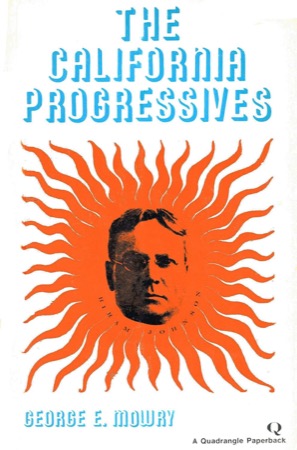
Softcover. NY, Quadrangle, reprint, 1976, Book: Very Good, Dust Jacket: None, Softcover, 344 pages. In this exciting history, Professor Mowry has determined the motives and actions of men who established the Progressive movement in California, and has reconstructed the conditions which opened the way to their ascendancy and fall. The progressive represented, in the author's words, "a pivot on which the democratic process could swing." By examining progressivism in California, its grassroots development and its leaders, Professor Mowry contributes to an understanding of the nature of national progressivism and recent American liberalism. He also illuminates the curious and paradoxical social phenomena of American reform movements - why they begin and why they die. Name on front fly leaf, otherwise clean.
Softcover. UK, Cambridge University Press, 4th pr., 2008, Book: Very Good, Dust Jacket: None, Softcover, 745 pages. Beginning with Homer and ending in late antiquity with Christian and pagan reflections on divine and human order, this volume is the first general and comprehensive treatment of Rome ever to be published in English. Its international team of distinguished scholars includes historians of law, politics, culture and religion, as well as philosophers. The volume will long remain an accessible and authoritative guide to Greek and Roman thinking about government and community. Remainder line on bottom edge otherwise clean.
Hardcover. Cambridge UK, Cambridge University Press, 1st, 1998, Book: Very Good, Dust Jacket: Very Good, Hardcover in a dust jacket with mild fading to spine, 949 pages. Volume 1 only of a 2-volume set. The Cambridge History of Seventeenth-Century Philosophy offers a uniquely comprehensive and authoritative overview of early-modern philosophy written by an international team of specialists. As with previous Cambridge Histories of Philosophy the subject is treated by topic and theme, and since history does not come packaged in neat bundles, the subject is also treated with great temporal flexibility, incorporating frequent reference to medieval and Renaissance ideas. The basic structure corresponds to the way an educated seventeenth-century European might have organized the domain of philosophy. Thus, the history of science, religious doctrine, and politics feature very prominently. Name on front fly leaf, about 12 pages with light pencil markings. Otherwise clean.
Hardcover. Chicago, University of Chicago Press, 1st, 2015, Book: Very Good, Dust Jacket: None, Hardcover, 336 pages. In a world where nearly everyone has a cellphone camera capable of zapping countless instant photos, it can be a challenge to remember just how special and transformative Polaroid photography was in its day. And yet, theres still something magical for those of us who recall waiting for a Polaroid picture to develop. Writing in the context of two Polaroid Corporation bankruptcies, not to mention the obsolescence of its film, Peter Buse argues that Polaroid was, and is, distinguished by its processby the fact that, as the New York Times put it in 1947, the camera does the rest. Polaroid was often dismissed as a toy, but Buse takes it seriously, showing how it encouraged photographic play as well as new forms of artistic practice. Drawing on unprecedented access to the archives of the Polaroid Corporation, Buse reveals Polaroid as photography at its most intimate, where the photographer, photograph, and subject sit in close proximity in both time and spacemaking Polaroid not only the perfect party camera but also the tool for frankly salacious pictures taking. Along the way, Buse tells the story of the Polaroid Corporation and its ultimately doomed hard-copy wager against the rising tide of digital imaging technology. Still in publisher's shrinkwrap.
Hardcover. NY, Abrams, 1st, 1994, Book: Very Good, Dust Jacket: Very Good, Hardcover, 240 pages. Here, brought together for the first time, are great self-portraits of the masters of photography from the 1850s to the present, including Andre Kertesz, Nadar, Cecil Beaton, Edward Weston, Irving Penn, Duane Michals, and Cindy Sherman. A probing essay by Robert A. Sobieszek illuminates each of the 149 images.
Hardcover. Westholme Publishing, 1st, 2012, Book: Very Good, Dust Jacket: Very Good, Hardcover in a bright dust jacket, 374 pages, b&w illustrations. Bright, clean. INSCRIBED BY AUTHOR on title page. "Early in the afternoon of May 22, 1856, ardent pro-slavery Congressman Preston S. Brooks of South Carolina strode into the United States Senate Chamber in Washington, D.C., and began beating renowned anti-slavery Senator Charles Sumner with a cane until it splintered and the helpless Massachusetts senator lay unconscious and covered in blood. One of the most shocking and provocative events in American history, the caning convinced each side that the gulf between them was unbridgeable and that they could no longer discuss their vast differences of opinion regarding slavery on any reasonable level."
Softcover. U. S. Department of the Interior, 1st, 2007, Book: Very Good, Dust Jacket: None, Softcover, horizontal format, 264 pages with b&w illustrations plus 14 pages of vintage packaging labels in rear. Chronicles the world's greatest concentration of salmon and canneries and their influence on Native and non-Native people in southwestern Alaska. This book documents long abandoned canneries, and those still in use, during the hey-day in the late nineteenth and early twentieth centuries with maps, historic photographs, and first hand accounts that give the reader an impression of the unique Bristol Bay way of life. Also offers a view of life upriver, during the winter, along the length and breadth of the three great salmon rivers in the Bay, The Nushagak, the Kvichak, and the Naknek. Historic photographs document a variety of cabins, houses, caches, and some of the people who built them and relied on them for shelter and storage. NOTE: front cover is missing so title page serves as cover, otherwise a clean, tight copy of this scarce regional history.
Hardcover. London/NY, Thames & Hudson, reprint, 2016, Book: Very Good, Dust Jacket: Very Good, Hardcover in a bright dust jacket. Originally published in Sweden in 1953. 24 pages illustrated in color by Poul Stroyer. The most maddening crow in world history is out to cause trouble! He can't resist the farmer's cherries - and one day he gets caught. The farmer tries to punish the crow with hard labor, but the crow only causes a lot of bother. Then the farmer tries to sell the crow at the market, but who wants to buy a troublesome crow? Clean copy.
Hardcover. Boston, Houghton Mifflin, 2nd pr., 1979, Book: Very Good, Dust Jacket: Very Good, Hardcover in a bright dust jacket, 211 pages. Number line starts with "2". Clean copy.
Hardcover. NY, William Morrow, 1st, 2007, Book: Very Good, Dust Jacket: Very Good, Hardcover in a bright, unclipped dust jacket, 245 pages, b&w illustrations. Only a few dozen T206 Wagners are known to still exist, having been released in limited numbers just after the turn of the twentieth century. Most, with their creases and stains, look like they've been around for nearly one hundred years. But one -- The Card --appears to have defied the travails of time. Its sharp corners and still-crisp portrait make it the single-most famous -- and most desired -- baseball card on the planet, valued today at more than two million dollars. It has transformed a simple hobby into a billion-dollar industry that is at times as lawless as the Wild West. Everything about The Card, which has made men wealthy as well as poisoned lifelong relationships, is fraught with controversy -- from its uncertain origins to the nagging possibility that it might not be exactly as it seems. In this intriguing, eye-opening, and groundbreaking look at a uniquely American obsession, award-winning investigative reporters Michael O'Keeffe and Teri Thompson follow The Card's trail from a Florida flea market to the hands of the world's most prominent collectors.
Hardcover. NY, Macmillan , 1st US, 1976, Book: Very Good, Dust Jacket: Very Good, Hardcover in a bright, unclipped dust jacket, 278 pages. Name on front fly leaf otherwise clean.
Hardcover. Montreal, McGill-Queen's University Press, 1st, 1997, Book: Very Good, Dust Jacket: None, Hardcover, gray cloth stamped in black. 164 pages. The Career of Toleration considers the Locke-Proast controversy from the standpoint of political theory, examining Locke's and Proast's texts and tracing their relationship to later discussions of toleration. Vernon reconstructs the grounds of the dispute, drawing attention to the long-term importance of the arguments and evaluating their relative strength. He then examines issues of toleration in later contexts, specifically James Fitzjames Stephen's critique of John Stuart Mill, the perfectionist alternative to contractualist liberalism, and the view that the traditional attachment to toleration must, by the force of its own arguments, move from liberalism to a defence of a much stronger form of democracy. Arguing that Locke's and Proast's exchange marks a turning point in the intellectual history that has helped to structure the terms of modern political debate, Vernon presents a solid case for thinking that the exchange between Locke and Proast is as important for the twentieth century as it was for the seventeenth. Bright, clean copy.
Hardcover. NY, Doubleday, reprint, 1972, Book: Very Good, Dust Jacket: Good, Hardcover in a worn, price-clipped dust jacket with sunned spine, 821 pages, b&w illustrations. No date on title page, no first edition statement so assumed an early reprint. A comprehensive history of the Catskill Mountain region of New York by the popular local author. Includes notes, a select bibliography & index. Name on front fly leaf, otherwise clean.






 "THE BUFFALO SOLDIERS: A Narrative of the Black Cavalry in the Westby: Leckie William H. & Leckie Shirley A.")


 "The Bushman Myth: The Making Of A Namibian Underclass (Conflict and Social Change Series) (SIGNED COPY)by: Robert J. Gordon")




 "The Camera Does the Rest: How Polaroid Changed Photographyby: Peter Buse")
 "The Camera I: Photographic Self-Portraits from the Audrey and Sydney Irmas Collectionby: Robert A. Sobieszek and Deborah Irmas")
 "The Caning: The Assault That Drove America to Civil War (SIGNED COPY)by: Puleo, Stephen")
 "The Canneries, Cabins and Caches of Bristol Bay, Alaskaby: John B. Branson")
 "The Cantankerous Crow by: Hellsing, Lennart / Stroyer, Poul")
 "The Captiveby: O'Dell, Scott")


 "The Career of Toleration: John Locke, Jonas Proast, and After by: Vernon, Richard")