Hardcover. New York , Pantheon, 1st, 1998, Book: Very Good, Dust Jacket: Very Good, 60 pages. Clean, unmarked copy with only minor wear to dust jacket. For more than ten years, Robert Bergman--a brilliant artist who has purposefully withheld himself from the mainstream--traveled by car with two friends, for months at a time, throughout the Rust Belt (Chicago, Detroit, Pittsburgh, Gary) and the East Coast, taking color pictures of everyday people who moved him profoundly. Even as he used a simple 35-mm camera, amateur film, no tripod, and no special lighting, his was a monumental, Whitmanesque project: to document the physical appearance and spirit of Americans, and to gauge the climate of our times. A Kind of Rapture, which is certain to be a classic work of photography, brings together the first selection from Bergman's epic enterprise. Having taken, developed, and printed his own pictures since the age of five, Bergman has now, for A Kind of Rapture, created his own color separations, using high-resolution digital equipment, in an effort to exercise more control over the quality of reproduction than photographers have ever had. Bergman and his colleagues have helped define a new paradigm for art-book publishing--each and every image in this book is extraordinary for its fidelity to the artistic sensibility that informs its original print.
Hardcover. NY, W. W. Norton & Company, 1st, 1988, Book: Very Good, Dust Jacket: Very Good, Hardcover in a bright, unclipped dust jacket. Written by two members of archaeological expeditions which have excavated at Caesarea, the ancient city on the coast of Israel built by Herod the Great, this book tells the story of the great city, from its beginnings to its destruction in the 13th century. Readers discover this past through archaeologists' eyes, as the text considers not only artifacts and written sources but the processes by which archaeologists reconstruct the past. A companion volume to a traveling exhibition of Caesarean artifacts, this is very highly recommended for both its clarity and creativity. 244 pages illustrated in color plus index. Clean.
Softcover. Montpelier, VT, Vermont Bureau of Publicity, 1st Edition, 1917, Book: Very Good, Dust Jacket: None, 63 pages. Softcover pamphlet with string binding. Buff, textured endpapers, some tanning throughout from age. B/w illustrations throughout. Wrapper has some moisture staining and other soil, but otherwise very good and intact (see image).
Hardcover. London, Seeley & Co, 1st, Book: Very Good, Dust Jacket: None, Hardcover bound in brown gilt decorated cloth, 355 pages, many b&w illustrations.
Hardcover. Boston, Little Brown, 1st, 1906, Book: Very Good, Dust Jacket: None, Hardcover, black & white photos. 347 pages. Super bright copy with gilt design, lettering on cover. Top edge gilt.
Hardcover. New York, Harper & Brothers, 1881, Book: Very Good, Dust Jacket: None, Hardcover. Two volumes. 441 and 474 pages. 235 black & white illustrations. Volume One has a map in rear pocket. Previous owner's bookplate on front end papers in both volumes. Rubbing to corners, spine, and covers. Corners a little bumped otherwise a bright, collectible set.
Hardcover. San Francisco, CA, Chronicle Books, 1st, 1997, Book: Very Good, Dust Jacket: Very Good, 298 pages. Dark blue cloth covers, embossed titles to spine, dark blue dust jacket with photographic illustration, profusely illustrated with gorgeous color photographs. Light rubbing to dust jacket, small nick to dust jacket at mid-spine, pages crisp and unmarked, clean boards; a beautiful book in great condition. Author Harvey H. Kaiser spent ten years exploring the historic architecture of the Western National Parks, from the rain forrests of the Olympic Peninsular to the awesome wonder of the Grand Canyon, and from rough-hewn travelers' cabins to Yosemite's spectacular Ahwahnee Hotel and Mount Hood's Timberline Lodge. Organized by region and park, and rich with historic detail.
Hardcover. New York, Dutton, 1st, 1980, Book: Very Good, Dust Jacket: Very Good, 142 pages, INSCRIBED BY AUTHOR on title page, handwritten letter by author laid-in. Minor dust jacket edge fade, otherwise, very clean and tight copy.
Hardcover. NY, Norton, 1st, 2001, Book: Very Good, Dust Jacket: Very Good, Hardcover in a bright, unclipped dust jacket, 112 pages. Stern's 12th collection is his first since winning the 1998 National Book Award for the new and selected This Time. The poems still rely on Stern's inimitable blend of coiled anger, love of life and raffish, on-the-outside-looking-in wit. Poem after poem reflects on what it means to have been a Jew, a Pennslyvanian, a nature-and-weather watcher, a world traveler and, for a longer time than many poets of his stature, an unknown writer during the middle of the last century: "If you can stand Strauss then so can I,/ oh filthy Danube, oh filthy Delaware, oh filthy Allegheny.// And anyone who never opened a Murphy bed/ night after night for seven years without ripping/ the sheet and had neither desk nor dresser can't walk/ in my shoes or wear my crocodile t-shirt." Stern's remembrances are not so much nostalgias as attempts to telescope the speaker's world and worldview through verse-talking, to test everyday language's ability to render his experiences to his liking, or at least his satisfaction.
Hardcover. Cambridge MA, MIT Press, 1st, 2001, Book: Very Good, Dust Jacket: Very Good, 406 pages, Hardcover with dust jacket. B&w illustrations. Clean, tight copy. How Le Corbusier's first trip to the United States shaped his critique of the country and affected both his work and the diffusion of his ideas. Le Corbusier's first trip to the United States in 1935 is generally considered a failure because it produced no commissions. The experience nevertheless had a profound effect on him, both personally and professionally. Sponsored by the Museum of Modern Art in New York, Le Corbusier promoted his ideas through a lecture tour, exhibition, and press conferences, as well as in meetings with industrialists, housing reformers, New Deal technocrats, and editors. His lectures were watershed events that advanced the cause of European modernism. Yet he returned to France empty-handed and published a bittersweet account, Quand les Cathedrales etaient blanches: Voyage au Pays des Timid Personnes (When the Cathedrals Were White: Journey to the Country of Timid People), which faulted America for lacking the courage to adopt his ideas.
Hardcover. NY, Phaidon Press, 1st, 2008, Book: Very Good, Dust Jacket: None, This slip-cased, oversized book, weighing 20 pounds and containing over 2000 illustrations, summarizes the life and work of the most important modern architect of the 20th century: the legendary, controversial, and confrontational Le Corbusier. Le Corbusier was not exclusively an architect but an artist (painter and sculptor), urbanist, author, furniture designer, world traveler, and media figure. What is most impressive in this volume are the huge-scale photographs drawn from the Le Corbusier archives at the Fondation Le Corbusier in France. These photographs are personal, professional, indicative, anecdotal, illustrative, and symbolic of the entire saga of Le Corbusier's life and career over 60 years. They make this book an absolute gold mine for anyone wanting to understand and steep themselves in the spirit and character of this greatest modern architect of the last century. The written material is also first-rate: Jean-Louis Cohen, France's best-known historian of modern architecture, contributes an informative introduction, and Tim Benton, a well-known British architectural historian, writes opening texts for individual chapters. Recommended for architecture and art libraries as well as public libraries with serious art collections.--Peter S. Kaufman, Boston Architectural Ctr. NOTE; DUE TO SIZE AND WEIGHT THIS VOLUME CANNOT BE SHIPPED OUTSIDE THE U.S.
Hardcover. Chapel Hill, North Carolina, Algonquin Young Readers, 1st, 2014, Book: Very Good, Dust Jacket: Very Good, 113 pages. Hardcover. Extensive color illustrations by James McMullan throughout. Illustrated paste downs and end papers. Clean, unmarked copy with only minor wear to dust jacket. McMullan explained, "In my late seventies I decided to organize my memories of my childhood before and during the Second World War into a coherent narrative. The tension of our lives when the Japanese army took over our town in China and the subsequent anxieties of traveling from country to country with my mother has imprinted the incidents of those years into my memory with an enduring lucidity that defies the otherwise fading recall of my aging mind."
Hardcover. NY, Alfred A. Knopf, 1st, 1997, Book: Very Good, Dust Jacket: Very Good, Hardcover in a bright, unclipped dust jacket. 533 pages. In this amazing narrative, Shoumatoff records his quest to capture the vast multiplicity of the American Southwest. Beginning with his first trip after college across the desert in a station wagon, some twenty-five years ago, he surveys the boundless variety of people and experiences constituting the place--the idea--that has become America's symbol and last redoubt of the "Other. From the Biosphere to the Mormons, from the deadly world of narcotraffickers to the secret lives of the covertly Jewish conversos, Shoumatoff explores the many alternative states of being who have staked their claim in the Southwest, making it a haven for every brand of refugee, fugitive, and utopian. Clean, bright copy.
Hardcover. Koln GR, Taschen, 1st, 2001, Book: Very Good, Dust Jacket: Very Good, Hardcover, 336 pages. One remarkable woman, five remarkable careers: Leni Riefenstahl is the exception to the rule. From dancer to actress to film-maker to photographer to diver, she has excelled in each field and is one of the most important and controversial artists of the 20th century. Her contributions to the art and technique of film-making were vast, most notably in her epochal film "Olympia" (1938). Critically acclaimed during the 1930's for her work under the Hitler administration and harshly criticized after the war, Riefenstahl surged on, completing the famous "Tiefland" in 1954. In the 1960s and 70s she traveled to Africa and extensively photographed East Africa and the Nuba tribes in Sudan, publishing three books. Ready for yet another change, she took up deep-sea diving at the age of 71, beginning a new chapter as an underwater photographer. Though she has attracted much attention throughout her life and has been the subject of many books, articles, and films, Leni Riefenstahl Five Lives is the first book to showcase her entire career in pictures. Produced in collaboration with Riefenstahl herself, the book includes her most famous images as well as many previously unpublished pictures from her private archives.
Softcover. London, Reaktion Books, 1st, 2000, Book: Very Good, Dust Jacket: None, Softcover, 224 pages illustrated in color. Leon Golub was a leading exponent of history painting - painting as a narrative, symbolic expression of global, social and political relations and of the realities of power. In this book, published to accompany a major retrospective exhibition traveling to Ireland, England and the United States, Jon Bird examines the artist's work from the classically influenced early paintings through depictions of conflict and masculine aggression to compelling images of his recent work. Crease to rear cover, otherwise clean, bright copy.
Hardcover. Geneva, De Vente Naville & Co., Deluxe Edition, 1926, Book: Very Good, Dust Jacket: None, Deluxe Edition, limited to 400. 576 pages crammed with 1001 detailed photogravure views of Switzerland. Introduction by B. Motta. 3/4 brown morocco with raised bands on spine, gilt lettering. top edge gilt , previous owner's signature on front fly leaf (Children's book author, Edith Hurd Thacher)
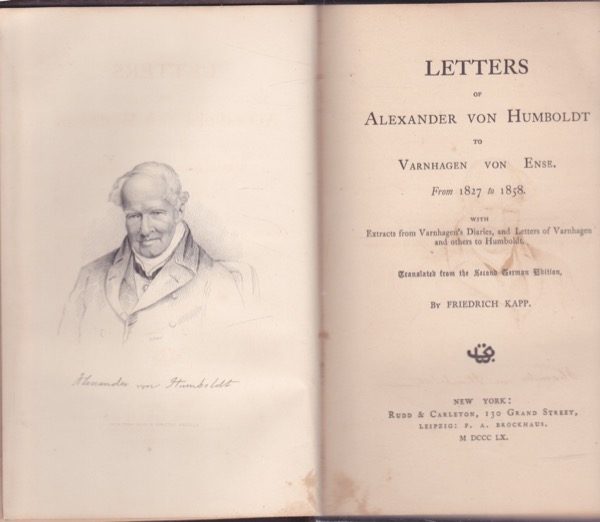
Hardcover. NY, Rudd and Carleton, 1st US, 1860, Book: Good, Dust Jacket: None, Hardcover, embossed brown cloth with gilt lettering on spine, 407 pages plus publisher's ads. A collection of correspondence written in the 19th century. This compilation features Humboldt's letters to his friend Varnhagen von Ense, reflecting their intellectual friendship and offering insightful glimpses into Humboldt's thoughts, scientific inquiries, and the sociopolitical landscape of his time. The letters encapsulate Humboldt's legacy as a pioneering scientist and thinker, showcasing his multifaceted contributions to various fields of knowledge. At the start of the work, we are introduced to Humboldt as he begins his correspondence with Varnhagen, exemplifying their close friendship and the candid nature of their exchanges. Humboldt expresses gratitude for Varnhagen's acknowledgement of his literary endeavors and shares details about his scholarly work, specifically discussing the titles and themes of his upcoming publications. The initial letters highlight Humboldt's artistic and scientific pursuits, while also touching on broader social issues of the era, providing a rich context for readers interested in the intersection of science, literature, and personal relationships among intellectuals of the time. Light edgewear to covers, faint marginal water stain to first 10 pages along foredge.
Softcover. Fleischmanns NY, Purple Mountain Press Ltd, 1st, 2004, Book: Very Good, Dust Jacket: None, Softcover, 320 pages illustrated in b&w. INSCRIBED on half-title page by Bellico and by Barbara Bartley on the title page. During the latter 19th century, inland waterways were a primary means of commercial and public transportation in the northeast. Captain Theodore D Bartley owned 3 Lake Champlain (NY-VT) canal boats and kept a daily descriptive journal of his life over 30 years. His routes included the Canadian Waterways north of the St Lawrence River along the Rideau Canal; the Northern Waterway from Quebec Province to New York Harbor; the Western Route via the Erie Canal from Troy NY to Lake Erie. He and his canal boat family witnessed many landmark historical events, as well as ordinary life alongside the canals. His original diaries of 1500 pages were transcribed by Bartley, Barbara B., great-grand-daughter-in-law of Theodore.
Softcover. NY, W. W. Norton & Company, 1st pbk, 1969, Book: Very Good, Softcover, 334 pages. Study of the living conditions of the Black Americans and the changes - migration to the cities which in the mid 20th century led to riots & social unrest. The authors traveled all over the USA & interviewed many directly involved in the rioting. Different responses to ghetto life, ranging from the apathetic to the militant, from the skid-row bum to the affluent, from the head of a numbers racket to ministers. Observes the riots in Watts, Houston, Hunters Point (Oakland), Newark, Detroit, and Orangeburg,
Hardcover. London, Chatto and Windus, 1st, 1955, Hardcover in a bright dust jacket. 288 pages, color frontis, 23 color plates, 26 black and white plates, from photos by the author, map, index. Based on the author's extensive travels, over 17,000 miles during a year in eastern and south-east Africa, where he travelled with his wife and three children, from Cape Town, Basutoland, Swaziland, through the Congo to Uganda, Kenya, Tanganyika (Tanzania), Nyasaland, Zambesi, Rhodesia (Zimbabwe), etc, with much on the wildlife, peoples, conditions.
Hardcover. San Francisco, H.S. Crocker Company, 1st, 1926, Book: Very Good, Dust Jacket: None, Hardcover, 87 pages, original dark mustard paper covered boards with dark brown web-lined patterns and tan cloth back strip with brown lettering on spine; numerous photographs including some by well renowned photographer Ansel Adams (4 photos by Adams). 6 1/4 x 8 1/2 inches. The book "being a collection of favorite Yosemite views, together with a brief account of its history and legends, for those who want to know and enjoy Yosemite more". Bookplate on inside front cover, otherwise clean, bright copy.
Hardcover. London/New York, Edward Arnold, 1st, 1895, Book: Very Good, Dust Jacket: None, 297 pages. Hardcover with no dust jacket. Red cloth covers with gilt design. Multiple gutter cracks. Moderate to heavy rubbing to edges. Top corners bumped. Clean copy.
Hardcover. New York, Grove/Atlantic, Inc., 1st, 2007, Book: Very Good, Dust Jacket: Very Good, 272 pages. Hardcover with dust jacket. SIGNED BY MICHAEL TUCKER AND JILL EIKENBERRY (Author dedicated book to wife, Jill) on title page. Clean, unmarked copy with only minor wear to dust jacket.
Hardcover. Philadelphia, G.G. Evans, 1st, 1860, Book: Good, Hardcover, embossed Brown cloth cover worn with fraying to bumped corners. 442 pages, 11 b&w engravings. Gilt title on spine visible, but faded.Light dampstaining to prelim pages, frontis and title page. Interior of book clean and tight.