Softcover. Cambridge, UK, Cambridge University Press, 1st, 2006, Book: Very Good, Dust Jacket: None, Softcover, 331 pages including index. Who would the Saviour have to be, what would the Saviour have to do to rescue human beings from the meaning-destroying experiences of their lives? This book offers a systematic Christology that is at once biblical and philosophical. Starting with human radical vulnerability to horrors such as permanent pain, sadistic abuse or genocide, it develops what must be true about Christ if He is the horror-defeater who ultimately resolves all the problems affecting the human condition and Divine-human relations. Distinctive elements of Marilyn McCord Adams' study are her defence of the two-natures theory, of Christ as Inner Teacher and a functional partner in human flourishing, and her arguments in favour of literal bodily resurrection (Christ's and ours) and of a strong doctrine of corporeal Eucharistic presence. The book concludes that Christ is the One in Whom, not only Christian doctrine, but cosmos, church, and the human psyche hold together.
Hardcover. London, Routledge/Thoemmes Press, 1st thus, 1995, Book: Very Good, Dust Jacket: None, Hardcover, maroon cloth with gilt lettering on spine. Facsimile reprints of the two works (1696 and 1697). Introduction by John Valdimir Price. Approx, 430 pages, light pencil markings to about 20 pages. Otherwise clean, tight copy.
Hardcover. Hillsdale NJ, Lawrence Erlbaum, 1st, 1982, Book: Very Good, Dust Jacket: None, Hardcover, green cloth covers with light blue stamping, 422 pages. This highly readable translation of the major works of the 18th- century philosopher Etienne Bonnot, Abbe de Condillac, a disciple of Locke and a contemporary of Rousseau, Voltaire, and Diderot, shows his influence on psychiatric diagnosis as well as on the education of the deaf, the retarded, and the preschool child. Published two hundred years after Condillac's death, this translation contains treatises which were, until now, virtually unavailable in English: A Treatise on Systems, A Treatise of the Sensations, Logic. Name on front fly leaf, light bumps to cover corners.
Hardcover. Oxford UK, Clarendon Press, 1st, 1935, Book: Very Good, Dust Jacket: None, Hardcover, blue cloth with gilt lettering on spine, 347 pages. Light pencil notes on rear fly leaf, otherwise clean, tight copy. Volume 1 only of a two volume set.
Softcover. San Rafael CA, Coracle Press, reprint, 2007, Book: Very Good, Dust Jacket: None, Softcover, 330 pages, b&w frontis. A new printing of the journal and letters of Stephen Mackenna (1872-1934), a vivid and representative thinker whose life intersected with many of the leading figures of his day, and especially those of the Irish literary renaissance. The editor, E. R. Dodds, writes: Stephen MacKenna's working life was divided among three countries, and was further broken by two complete changes of occupation and by continual changes of residence. When he died, he left behind him no wife, child or lifelong friend; . . . and with the exception of the 1907-9 Journal no papers of any considerable biographical value. He left instead a legend. In the Memoir which follows I have endeavored to recover and present the facts underlying the legend. Best known for what AE (George William Russell) called his 'noble translation of Plotinus', MacKenna nonetheless harbored views that collided with those of Plotinus, and so speaks to us as an authentic forerunner of the 'modern' human being, by which is meant those who, once their individual inner light is lit-and no matter how it may gutter in the wind of uncertain freedoms-must, even while hallowing earlier and magisterial records of paths of spiritual ascent, accept the need for a complete 'descent' (without which the whole engine of creation will have had no final purpose), with all the provisional darkness this may entail, so that the final ascent may be made in personal love and freedom. Clean, bright copy.
Hardcover. NY, Cambridge University Press, 1st, 2013, Book: Very Good, Dust Jacket: Very Good, Hardcover in a bright dust jacket, 227 pages. Emily Brady takes a fresh look at the sublime and shows why it endures as a meaningful concept in contemporary philosophy. In a reassessment of historical approaches, the first part of the book identifies the scope and value of the sublime in eighteenth-century philosophy (with a focus on Kant), nineteenth-century philosophy and Romanticism, and early wilderness aesthetics. The second part examines the sublime's contemporary significance through its relationship to the arts; its position with respect to other aesthetic categories involving mixed or negative emotions, such as tragedy; and its place in environmental aesthetics and ethics. Far from being an outmoded concept, Brady argues that the sublime is a distinctive aesthetic category which reveals an important, if sometimes challenging, aesthetic-moral relationship with the natural world. Clean, bright copy.
Softcover. Boston, Reidel Publishing, 1st, 1979, Book: Very Good, Dust Jacket: None, Softcover, 314 pages. The goal of the present volume is to discuss the notion of a 'conceptual framework' or 'conceptual scheme', which has been dominating much work in the analysis and justification of knowledge in recent years. More specifi- cally, this volume is designed to clarify the contrast between two competing approaches in the area of problems indicated by this notion: On the one hand, we have the conviction, underlying much present-day work in the philosophy of science, that the best we can hope for in the justifi- cation of empirical knowledge is to reconstruct the conceptual means actually employed by science, and to develop suitable models for analyzing conceptual change involved in the progress of science. This view involves the assumption that we should stop taking foundational questions of epistemology seriously and discard once and for all the quest for uncontrovertible truth. The result- ing program of justifying epistemic claims by subsequently describing patterns of inferentially connected concepts as they are at work in actual science is closely connected with the idea of naturalizing epistemology, with concep- tual relativism, and with a pragmatic interpretation of knowledge. On the other hand, recent epistemology tends to claim that no subsequent reconstruction of actually employed conceptual frameworks is sufficient for providing epistemic justification for our beliefs about the world. This second claim tries to resist the naturalistic and pragmatic approach to epistemology and insists on taking the epistemological sceptic seriously. Name on front fly leaf, otherwise clean.
Softcover. New Haven CT, Yale University Press, 2nd pr., 1987, Book: Very Good, Dust Jacket: None, Softcover, 450 pages. The rise of atheism in the modern world is a religious phenomenon unprecedented in history, both in the number of its adherents and in the security of its cultural establishment. How did so revolutionary a conviction as this arise? What can theological reflection learn from this massive shift in religious consciousness? In this book, Michael J. Buckley investigates the origins and development of modern atheism and argues convincingly that its impetus lies paradoxically in the very attempts to counter it. Although modern atheism finds its initial exponents in Denis Diderot and Paul d'Holbach in the eighteenth century, their works bring to completion a dialectical process that reaches back to the theologians and philosophers of an earlier period. During the seventeenth century, theologians such as Leonard Lessius and Marin Mersenne determined that in order to defend the existence of god, religious apologetics must become philosophy, surrendering as its primary warrant any intrinsically religious experience or evidence. The most influential philosophers of the period, Rene Descartes and Isaac Newton, and the theologians who followed them accepted this settlement, and the new sciences were enlisted to provide the foundation for religion. Clean, bright copy.
Hardcover. Phillipsburg NJ, P & R Publishing, 1st, 1994, Book: Very Good, Dust Jacket: Very Good, Hardcover in a bright dust jacket, 724 pages. Vol. 2 only. Francis Turretin (1623-87) has been called "the best expounder of the doctrine of the Reformed Church" (Samuel Alexander), "a marvelous synthesizer" (Roger Nicole), and "a towering figure among the Genevan Reformers (Leon Morris). His Institutio Theologiae Elencticae, first published In 1679-85, was the fruit of some thirty years' teaching at the Academy of Geneva. A very insightful work for those seeking clarification on several theological issues such as free will, sanctification and good works, the person of Christ, and sin.Clean copy.
Softcover. Cambridge UK, Polity, reprint, 2014, Book: Very Good, Dust Jacket: None, Softcover, 231 pages. Few philosophers have left a legacy like that of Gottfried Wilhelm Leibniz. He has been credited not only with inventing the differential calculus, but also with anticipating the basic ideas of modern logic, information science, and fractal geometry. He made important contributions to such diverse fields as jurisprudence, geology and etymology, while sketching designs for calculating machines, wind pumps, and submarines. But the common presentation of his philosophy as a kind of unworldly idealism is at odds with all this bustling practical activity. In this book Richard. T. W. Arthur offers a fresh reading of Leibniz's philosophy, clearly situating it in its scientific, political and theological contexts. He argues that Leibniz aimed to provide an improved foundation for the mechanical philosophy based on a new kind of universal language. His contributions to natural philosophy are an integral part of this programme, which his metaphysics, dynamics and organic philosophy were designed to support. Rather than denying that substances really exist in space and time, as the idealist reading proposes, Leibniz sought to provide a deeper understanding of substance and body, and a correct understanding of space as an order of situations and time as an order of successive things. Clean, bright copy.
Hardcover. UK, Oxford University Press, 1st, 2019, Book: Very Good, Dust Jacket: Very Good, Hardcover in a bright dust jacket, 277 pages. The seventeenth and eighteenth centuries represent a period of remarkable intellectual vitality in British philosophy, as figures such as Hobbes, Locke, Hume, and Smith attempted to explain the origins and sustaining mechanisms of civil society. Their insights continue to inform how political and moral theorists think about the world in which we live. From Moral Theology to Moral Philosophy reconstructs a debate which preoccupied contemporaries but which seems arcane to us today. It concerned the relationship between reason and revelation as the two sources of mankind's knowledge, particularly in the ethical realm: to what extent, they asked, could reason alone discover the content and obligatory character of morality? This was held to be a historical, rather than a merely theoretical question: had the philosophers of pre-Christian antiquity, ignorant of Christ, been able satisfactorily to explain the moral universe? What role had natural theology played in their ethical theories - and was it consistent with the teachings delivered by revelation? Much recent scholarship has drawn attention to the early-modern interest in two late Hellenistic philosophical traditions - Stoicism and Epicureanism. Yet in the English context, three figures above all - John Locke, Conyers Middleton, and David Hume - quite deliberately and explicitly identified their approaches with Cicero as the representative of an alternative philosophical tradition, critical of both the Stoic and the Epicurean: academic scepticism. All argued that Cicero provided a means of addressing what they considered to be the most pressing question facing contemporary philosophy: the relationship between moral philosophy and moral theology. Clean copy.
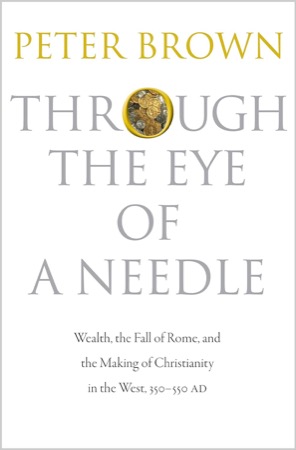
Hardcover. Princeton NJ, Princeton University Press, 1st, 2012, Book: Very Good, Dust Jacket: Very Good, Hardcover in a bright dust jacket, 759 pages, b&w illustrations. A sweeping intellectual history of the role of wealth in the church in the last days of the Roman Empire Jesus taught his followers that it is easier for a camel to go through the eye of a needle than for a rich man to enter heaven. Yet by the fall of Rome, the church was becoming rich beyond measure. Through the Eye of a Needle is a sweeping intellectual and social history of the vexing problem of wealth in Christianity in the waning days of the Roman Empire, written by the world's foremost scholar of late antiquity. Peter Brown examines the rise of the church through the lens of money and the challenges it posed to an institution that espoused the virtue of poverty and called avarice the root of all evil. Drawing on the writings of major Christian thinkers such as Augustine, Ambrose, and Jerome, Brown examines the controversies and changing attitudes toward money caused by the influx of new wealth into church coffers, and describes the spectacular acts of divestment by rich donors and their growing influence in an empire beset with crisis. He shows how the use of wealth for the care of the poor competed with older forms of philanthropy deeply rooted in the Roman world, and sheds light on the ordinary people who gave away their money in hopes of treasure in heaven. Clean copy.
Softcover. Cambridge UK, Cambridge University Press, reprint, 1983, Book: Good, Dust Jacket: None, Two softcover volumes, Parts 1 and 2, 259 and 368 pages. A philosophical study of the nature of bodily action and the will - and the responsibility we have for our own active bodily movements, which is distinct from though closely related to both causal and moral responsibility. Name on front fly leaf and light pencil notations to 20 pages in volume 1, light stain in volume 2 on copy block, not affecting text.
Hardcover. Edinburgh, Edinburgh University Press, 1st, 1996, Book: Very Good, Dust Jacket: Very Good, Hardcover in a bright dust jacket, 340 pages. Proclus was the most important figure in Neo-Platonism when it was established as the dominant philosophy of Late Antiquity. Neo-Platonism is not only the final flowering of Greek thought but also the mode in which it was transmitted to the Byzantine, Western European and Islamic civilisations. Stripping away the complexities surrounding this traditionally difficult philosopher, Lucas Siorvanes takes the reader through Proclus' metaphysics and theory of knowledge with original research examining all aspects of Proclus' work. This is the first book which places Proclus in his complete intellectual context and sheds new light on aspects of Proclus' thought, to which previous scholars have rarely done justice. - Presents a general survey of Proclus and his Neo-Platonism- Introduces results of original research, mainly on his metaphysics, theory of knowledge and science. All areas of Proclus' philosophical interest are covered including religion, physics, astronomy, mathematics and poetry. His philosophy is found in all these because concern with being and truth is central to all. Also introduced is the neglected area of his natural philosophy with its remarkable freshness of thought punctuated by the rejection of Aristotelian science and Ptolemy's cosmology. In this book, Proclus is shown as much more than just a metaphysician. Clean copy.
Hardcover. NY, Octagon Books, reprint, 1971, Book: Very Good, Dust Jacket: None, Hardcover, blue cloth with gilt stamping, 224 pages. First published in 1933. Name on front fly leaf, otherwise bright and clean.
Hardcover. NY, Garland Publishing, reprint, 1977, Book: Very Good, Dust Jacket: None, Hardcover, orange cloth with black lettering on spine, 253 pages. A Garland Series, British Philosophers and Theologians of the 17th and 18th Centuries. A facsimile reprint of the 1655 London edition. Name on front fly leaf, otherwise clean.
Softcover. London/NY, Bloomsbury, 1st, 2016, Book: Very Good, Dust Jacket: None, Softcover, 346 pages. This volume makes the key essays of 19th century French philosopher Felix Ravaisson available in English for the first time. In recent years, Ravaisson has emerged as an extremely important and influential figure in the history of modern European philosophy. The volume contains the classic 1838 dissertation Of Habit, studies of Pascal, Stoicism and the wider history of philosophy together with the Philosophical Testament that he left unfinished when he died in 1900. The volume also features Ravaisson's work in archaeology, the history of religions and art-theory, and his essay on the Venus de Milo, which occupied him over a period of twenty years after he noticed, when hiding the statue behind a false wall in a dingy Parisian basement during the Franco-Prussian war, that it had previously been presented in a way that deformed its original bearing and meaning. Clean copy.
Hardcover. Cambridge MA, Harvard University Press, 1st, 1989, Book: Very Good, Dust Jacket: Very Good, Hardcover, 192 pages. Light sun-fade to dust jacket spine, else a clean, tight copy. Michael Slote challenges the long-dominant conception of individual rationality, which has to a large extent shaped the very way we think about the essential problems and nature of rationality, morality, and the relations between them. He contests the accepted view by appealing to a set of real-life examples, claiming that our intuitive reaction to these examples illustrates a significant and prevalent, if not always dominant, way of thinking. Slote argues that common sense recognizes that one can reach a point where "enough is enough," be satisfied with what one has, and, hence, rationally decline an optimizing alternative. He suggests that, in the light of common sense, optimizing behavior is often irrational.
Softcover. Amherst MA, Warring States Project, 1st, 2017, Book: Very Good, Dust Jacket: None, Softcover, 191 pages. This book is an overview of the history of Early Christianity. Each chapter is based on one selection from Jewish texts or from those produced by the Jesus sect of Judaism. It gives a sense of how things happened, from the words of certain ancient prophets, to Jesus' effort to bring about those prophecies, to the efforts of his followers to reshape their expectations after his death. It follows the movement as it came to regard Jesus himself as divine, a process which eventually led to the separation of the sect from the parent religion. It ends with a glimpse of a surviving early Christian church on the shores of the Black Sea, and how it appeared to the Roman administrator who was in charge of executing those who, like the Early Christians, refused Emperor worship. From the evidence of two deaconesses whom he tortured, which Pliny reported to Emperor Trajan, we too learn what were the regular practices of that church. Clean copy.
Hardcover. Staten Island NY, Center Migration Studies , 1st, 2000, Book: Very Good, Dust Jacket: Very Good, Hardcover in a bright dust jacket, 359 pages. Clean copy.
Hardcover. Bristol UK, Thoemmes Press, reprint, 1998, Book: Very Good, Dust Jacket: None, Hardcover, maroon cloth, 537 pages. Gilt lettering on a green band on the spine. A reprint of the 1830 edition. Clean copy.
Hardcover. New York, Harper and Brothers, reprint, Book: Very Good, Dust Jacket: Good, Hardcover, 331 pages, putty color cloth covers with black lettering on spine. Dust jacket with edgewear, chipping. Previous owner's signature on front fly leaf.
Hardcover. Cambridge, U.K. ; New York, Cambridge University Press, 1st, 2001, Book: Very Good, Dust Jacket: Very Good, Hardcover, 442 pages. Light shelf-wear to dust jacket with slight sun-fade on spine. Clean, tight copy.
Hardcover. Albany, New York, State University of New York Press, 1st, 1989, Book: Good, Dust Jacket: None, Hardcover, 451 pages, with Japanese text in back. Slight wear/rubbing to edges and spine. INSCRIBED BY AUTHOR on front flyleaf and handwritten note by author laid-in. Crisp, clean pages and tight binding.
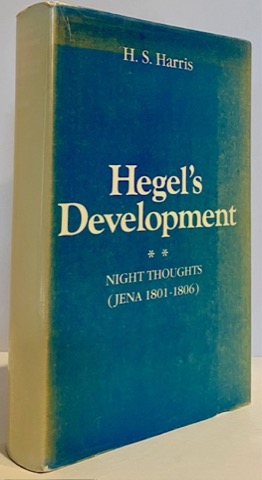
Hardcover. Oxford, England, Clarendon Press, 1st Edition, 1983, Book: Very Good, Dust Jacket: Very Good, 627 pages. Hardcover. Sequel to Hegel's Development: Toward the Sunlight 1770-1801(Clarendon Press, 1972). Black cover boards, gilt title and design on spine. Pages clean and bright. Binding tight. Spine straight. Dust jacket unclipped, faded (shelfwear), light agewear, glossy. Harris distinguishes three main phases in Hegel's development over this period: the period of callaboration with Schelling (1801-3); the appearance of a three-part 'phenomenological' system (1803-50; and the emergence of the mature system.
Hardcover. NY, Knopf, 1st, 1929, Book: Very Good, Dust Jacket: None, Hardcover, green cloth stamped with black design. Shows some minor wear but mostly a clean, nice copy. Black & white illustrations by Daugherty. No dust jacket.
Hardcover. NY/London, Oxford University Press, 1st, 2011, Book: Very Good, Dust Jacket: Very Good, Hardcover in a bright, unclipped dust jacket, 350 pages. Reason in Action collects John Finnis' work on the theory of practical reason and moral philosophy. The essays in the volume range from foundational issues of meta-ethics to the practical application of natural law theory to ethical problems such as nuclear deterrence, obscenity and free speech, and abortion and cloning.
Hardcover. London, Viking, 1st, 1992, Book: Very Good, Dust Jacket: Very Good, Hardcover in a bright, unclipped dust jacket. A dark comedy recreates the biblical books of Genesis and Exodus from Cain's point of view, depicting a capricious God who resents Eve's flirting with an angel, an envious and sullen Adam, and Abel, Cain's irreconcilable opposite. Clean copy.
Softcover. Chico CA, Scholars Press, reprint, 1985, Book: Very Good, Dust Jacket: None, Softcover, 374 pages. A collection of essays first published in 1869. Clean copy.
Hardcover. Chicago, University of Chicago Press, 1st, 2005, Book: Very Good, Dust Jacket: Very Good, Hardcover in a bright dust jacket, 282 pages. In 1994, a devout Catholic woman from Vermont began having religious visions and hearing the voice of the Virgin Mary. To spread word about her mystical experiences, she turned to the Internet. As Paolo Apolito records here, she is only one of many people who use the Web as a tool of religious devotion. Every day, thousands of Catholics--from Italy and Latin America to the United States and Bosnia--use the Internet to describe and celebrate apparitions of Mary, to exchange relics and advice in chat rooms, to make pilgrimages to religious Web sites, and to practice the rites of their faith online. But how has this potent new mix of technology and religiosity changed the way Catholics view their faith? And what challenges do the autonomous qualities of the Internet pose to the broader authority of Catholicism? Clean, bright copy.
Hardcover. Cambridge UK, Cambridge University Press, 1st, 2004, Book: Very Good, Dust Jacket: Very Good, Hardcover in a bright dust jacket, 218 pages. The Timaeus-Critias is concerned with cosmology and Plato's claim that its central task is to articulate the way in which the cosmos manifests the values of goodness and beauty. This book examines this important dialogue in its entirety using current methods of Platonic scholarship. Arguing that Aristotle's physics is far closer to the Timaeus than usually realized, the study's other prominent findings reinforce the dialogue's essentially moral message, and clarify its literary character.
Hardcover. Oxford UK, Oxford University Press, 1st, 2015, Book: Very Good, Dust Jacket: Very Good, Hardcover in a bright dust jacket, 286 pages. Sarah Hutton presents a rich historical study of one of the most fertile periods in modern philosophy. It was in the seventeenth century that Britain's first philosophers of international stature and lasting influence emerged. Its most famous names, Hobbes and Locke, rank alongside the greatest names in the European philosophical canon. Bacon too belongs with this constellation of great thinkers, although his status as a philosopher tends to be obscured by his statusas father of modern science. The seventeenth century is normally regarded as the dawn of modernity following the breakdown of the Aristotelian synthesis which had dominated intellectual life since the middle ages. In this period of transformational change, Bacon, Hobbes, Locke are acknowledged tohave contributed significantly to the shape of European philosophy from their own time to the present day. But these figures did not work in isolation. Sarah Hutton places them in their intellectual context, including the social, political and religious conditions in which philosophy was practised. She treats seventeenth-century philosophy as an ongoing like all conversations, some voices will dominate, some will be more persuasive than others and there will be enormous variationsin tone from the polite to polemical, matter-of-fact, intemperate. The conversation model allows voices to be heard which would otherwise be discounted. Hutton shows the importance of figures normally regarded as 'minor' players in philosophy (e.g. Herbert of Cherbury, Cudworth, More, Burthogge,Norris, Toland) as well as others who have been completely overlooked, notably female philosophers. Crucially, instead of emphasizing the break between seventeenth-century philosophy and its past, the conversation model makes it possible to trace continuities between the Renaissance and seventeenth century, across the seventeenth century and into the eighteenth century, while at the same time acknowledging the major changes which occurred.
Hardcover. Oxford UK, Oxford University Press, 1st, 2016, Book: Very Good, Dust Jacket: Very Good, Hardcover in a bright dust jacket, 175 pages. Despite recent advances in Locke scholarship, philosophers and political theorists have paid little attention to the relations among his three greatest works: An Essay Concerning Human Understanding, Two Treatises of Government, and Epistola de Tolerantia. As a result our picture of Locke's thought is a curiously fragmented one. Toleration and Understanding in Locke argues that these works are unified by a concern to promote the cause of religious toleration. Making extensive use of Locke's neglected replies to Proast, Nicholas Jolley shows how Locke draws on his epistemological principles to criticize religious persecution - for Locke, since revelation is an object of belief, not knowledge, coercion by the state in religious matters is not morally justified. In this volume Jolley also seeks to show how the Two Treatises of Government and the letters for toleration adopt the same contractualist approach to political theory; Locke argues for toleration from the function of the state where this is determined by the decisions of rational contracting parties. Throughout, attention is paid to demonstrating the range of Locke's arguments for toleration and to defending them, where possible, against recent criticisms. The book includes an account of the development of Locke's views about religious toleration from the beginning to the end of his career; it also includes discussions of his individualism about knowledge and belief, his critique of religious enthusiasm, his commitment to the minimal creed, and his teachings about natural law. Locke emerges as a rather systematic thinker whose arguments are highly relevant to modern debates about religious toleration. Light pencil marking to some pages.
Hardcover. Chicago, University Of Chicago Press, reprint, 1990, Book: Very Good, Dust Jacket: None, Softcover, 334 pages. The Spirit of Modern Republicanism sets forth a radical reinterpretation of the foundations on which the American regime was constructed. Thomas L. Pangle argues that the Founders had a dramatically new vision of civic virtue, religious faith, and intellectual life, rooted in an unprecedented commitment to private and economic liberties. It is in the thought of John Locke that Pangle finds the fullest elaboration of the principles supporting the Founders' moral vision. Clean copy.
Hardcover. Montreal, McGill-Queen's University Press, 1st, 1997, Book: Very Good, Dust Jacket: None, Hardcover, gray cloth stamped in black. 164 pages. The Career of Toleration considers the Locke-Proast controversy from the standpoint of political theory, examining Locke's and Proast's texts and tracing their relationship to later discussions of toleration. Vernon reconstructs the grounds of the dispute, drawing attention to the long-term importance of the arguments and evaluating their relative strength. He then examines issues of toleration in later contexts, specifically James Fitzjames Stephen's critique of John Stuart Mill, the perfectionist alternative to contractualist liberalism, and the view that the traditional attachment to toleration must, by the force of its own arguments, move from liberalism to a defence of a much stronger form of democracy. Arguing that Locke's and Proast's exchange marks a turning point in the intellectual history that has helped to structure the terms of modern political debate, Vernon presents a solid case for thinking that the exchange between Locke and Proast is as important for the twentieth century as it was for the seventeenth. Bright, clean copy.
Hardcover. UK, Bristol Thoemmes, reprint, 1990, Book: Very Good, Dust Jacket: None, Hardcover, green cloth, gilt title on spine, 120 pages. Originally published in 1951, this concise book presents an engaging study of the works and influence of the renowned English philosopher Ralph Cudworth (1617-88), the leader of the Cambridge Platonists. A bibliography of writings by and about Cudworth is also included, together with an appendix section on his manuscripts. The text was an early work by Australian philosopher and historian of ideas John Passmore (1914-2004). This book will be of value to anyone with an interest in Cudworth, the Cambridge Platonists and the historical development of philosophy. Light pencil marking in margins, ink name on front fly leaf. Tight copy.
Hardcover. Cambridge MA, Harvard University Press , 1st, 1981, Book: Very Good, Dust Jacket: None, Hardcover, blue cloth with gilt lettering and design to spine and front cover. The writings of Richard Hooker are of central interest to those studying English Renaissance thought and literature. In this, the third volume of a much-needed critical edition of the Works of Richard Hooker, are the posthumous books of the Laws of Ecclesiastical Polity. Hooker planned the Laws in eight books, but he died shortly after publication of Book Five. Books Six, Seven, and Eight, which contain his analysis of jurisdiction, episcopacy, and the royal supremacy, are here transcribed from versions that have the most authority. The volume also includes Hooker's autograph notes toward those texts (brought to light by P. G. Stanwood in the course of his research) and the contemporary notes by George Cranmer and Edwin Sandys on a lost draft of Book Six. Mr. Stanwood's introduction lays to rest all doubts about the authenticity of the last three books as we have them, doubts current since publication of Walton's Life of Hooker in 1662.Clean, bright copy.
Hardcover. UK, Cambridge University Press, 1st, 1994, Book: Very Good, Dust Jacket: Good, Hardcover in a dust jacket with mild fading to spine edge, short closed tear, 227 pages. William Walker's analysis of John Locke's An Essay Concerning Human Understanding offers a challenging and provocative assessment of Locke's importance as a thinker, bridging the gap between philosophical and literary-critical discussion of his work. He is revealed as a crucial figure for emerging modernity, less the familiar empiricist innovator and more a proto-Nietzschean thinker. Walker's reading of Locke is finely attentive to the text and resourceful in placing the Essay in its broadest philosophical and historical context. Light pencil notations on front fly leaf.
Hardcover. Chapel Hill, University of North Carolina Press, 1st, 1982, Book: Very Good, Dust Jacket: Very Good, Hardcover, red dust jacket with sunned spine, 195 pages. Hobart demonstrates how Malebranche's theories of truth, ideas, and intelligible extension were formulated under the influence of mathematics and how these theories conflicted with the assumptions and patterns of thought needed for traditional substance philosophy and natural theology. The conflict produced inconsistencies in key concepts--necessity, infinity, being, faith, and reason--rendering any reconciliation between science and religion intellectually unattainable. Name on front fly leaf, otherwise clean.
Hardcover. NY, AMS Press, reprint, 1972, Book: Very Good, Dust Jacket: None, Hardcover, brown cloth with gilt lettering on spine, 499 pages. Volume II only (of 3 volumes). A reprint of the Oxford edition of 1838. Name on front fly leaf with pencil notations, otherwise a clean, bright copy.
Hardcover. UK, Oxford University Press, 1st, 2019, Book: Very Good, Dust Jacket: Very Good, Hardcover in a bright dust jacket, 409 pages. This is the first critical edition of the literary and historical writings of John Locke (1632-1704): poems, orations, a plan for a play, a guide to compiling a commonplace book, rules for societies, writings on the liberty of the press, and a memoir of Locke. Vol. 23 of The Clarendon Edition of the Works of John Locke. Clean copy.
Hardcover. Edinburgh, T and T Clark, 1st, 1998, Book: Very Good, Dust Jacket: Very Good, Hardcover in a bright dust jacket, 342 pages. Jewish-Christian contact and controversy were central to early Christian experience. An understanding of this contact and controversy and its continuation over the centuries is also central to any true understanding of the history of Christianity and of the history of Judaism. The twelve chapters of this book deal especially with the interconnected subjects of polemic and biblical interpretation. Nine are concerned with the ancient world, beginning with post-exilic Jewish writing and the New Testament and going on to later pagan, Jewish and Christian controversies. Three concentrate on medieval and early modern Jewish controversies. Clean copy.
Hardcover. UK, Routledge / Thoemmes, reprint, 1995, Book: Very Good, Dust Jacket: None, Hardcover, maroon cloth with gilt lettering on spine. 450 pages plus index. A facsimile reprint of the second edition published in 1738. One of 8 volumes in the series History of British Deism. Clean, bright copy.
Hardcover. Princeton NJ, Princeton University Press, 1st, 1986, Book: Very Good, Dust Jacket: Very Good, Hardcover in a bright dust jacket, 234 pages. When Leviathan first appeared in 1651, it was recognized as a work of extraordinary scope, uniting metaphysical, theological, and political arguments into a single distinctive outlook. Contending that modern readers do the book an injustice by neglecting its metaphysical and theological themes, David Johnston supports his claim with a detailed examination of the text as a whole and with a reinterpretation of the genesis of the work. Clean copy.
Softcover. Oxford UK, Clarendon Press, Revised Ed., 1993, Book: Very Good, Dust Jacket: None, Softcover, 312 pages. This book investigates what it means, and whether it is coherent, to say that there is a God. The author concludes that, despite philosophical objections, the claims which religious believers make about God are generally coherent; and that although some important claims are coherent only if the words by which they are expressed are being used in stretched or analogical senses, this is in fact the way in which theologians have usually claimed they are being used. This revised edition includes various minor corrections and clarifications. Name on front fly leaf, otherwise clean.
Hardcover. Bloomington, Indiana University Press, 1st, 1999, Book: Very Good, Dust Jacket: Good, Hardcover in a very good dust jacket with fading to spine and spine edge, 138 pages. "With thematic trajectories pointing both toward and beyond Being and Time, this translation ...is of enormous significance for students of the development of Heidegger's early thought." - Daniel O. Dahlstrom, Boston University. First published in 1988 as volume 63 of Heidegger's Collected Works, "Ontology" follows Heidegger's lectures at the University of Freiburg during the summer semester of 1923. In these lectures, Heidegger reviews and makes critical appropriation of the hermeneutical tradition from Plato, Aristotle, and Augustine to Schleiermacher and Dilthey. Other important themes that are taken up are his turn to the facticity and everyday world of Dasein, his interpretation of human existence in the present historically and philosophically, his understanding of phenomenology, and his repeated insistence on the temporal dimension of interpretation and significance. Students of Heidegger's thought will find initial breakthroughs in his unique elaboration of the meaning of human existence and "question of Being," which received mature expression in Being and Time. Name on front fly leaf, light pencil notations to rear endpapers, 3 pages.
Hardcover. Ithaca NY, Cornell University Press, 1st, 1990, Book: Very Good, Dust Jacket: Very Good, Hardcover in a bright dust jacket, 249 pages. Berkeley's Essay towards a New Theory of Vision (1709), his first substantial publication, revolutionized the theory of vision. His approach provided the framework for subsequent work in the psychology of vision and remains influential to this day. Among philosophers, however, the New Theory has not always been read as a landmark in the history of scientific thought, but instead as a halfway house to Berkeley's later metaphysics. In this book, Margaret Atherton seeks to redress the balance through a commentary on and a reinterpretation of Berkeley's New Theory. Clean copy.

 "Christ and Horrors: The Coherence of Christology by: Adams, Marilyn McCord")

 "Philosophical Writings of Etienne Bonnot, Abbe De Condillac:by: Franklin Philip/ Harlan Lane")
 "Collected Essays (Volume 1) by: Bradley, F. H.")
 "Il Seicento e Descartes. Dibattiti Cartesianiby: Del Prete, Antonella")
 "Journals and Letters of Stephen Mackennaby: Stephen Mackenna / E. R. Dodds /Padraic Colum (Editor)")
 "The Sublime in Modern Philosophy: Aesthetics, Ethics, and Natureby: Emily Brady")
 "Schleiermacher's Soliloquies: An English Translation of the Monologen with a Critical Introduction and Appendixby: Friedrich Schleiermacher, Horace L Friess (Translat")
 "Transcendental Arguments and Science: Essays in Epistemology Synthese Library - Volume 133 by: Peter Bieri, Lorenz Kruger, Rolf-P. Horstmann")
 "At the Origins of Modern Atheismby: Buckley, Michael J.")
 "Institutes of Elenctic Theology: Vol. 2: Eleventh Through Seventeenth Topics by: Francis Turretin")
 "Leibniz (Classic Thinkers)by: Arthur, Richard T. W.")
 "From Moral Theology to Moral Philosophy: Cicero and Visions of Humanity from Locke to Hume by: Stuart-Buttle, Tim")
 "Through the Eye of a Needle: Wealth, the Fall of Rome, and the Making of Christianity in the West, 350-550 ADby: Peter Brown")
 "The Will: A Dual Aspect Theory (2 Volumes)by: Brian O'Shaughnessy")
 "Proclus: Neo-Platonic Philosophy and Scienceby: Siorvanes, Lucas (Ed.)")
 "Classic Deities in Bacon: A Study in Mythological Symbolism by: Lemmi, Charles")
 "A Defence of True Libertyby: John Bramhall")

 "F?©lix Ravaisson: Selected Essays by: Sinclair, Mark (Ed.)")
 "Beyond Optimizing:A Study of Rational Choiceby: Slote, Michael")
 "Jesus and After: The First Eighty Years (Studies in Early Christianity) by: E. Bruce Brooks")
 "For the Love of Immigrants: Migration Writings and Letters of Bishop John Baptist Scalabrini 1839-1905 by: Scalabrini, Giovanni Battista, Editor: Tomasi, Silvano M.")
 "Theological Essaysby: Maurice, Frederick Denison")
 "Hegel and Aristotleby: Ferrarin, Alfredo")
 "Encontro \"Magick\" de Fertnando Pessoa e Aleister Crowleyby: Roza (Luiz Miguel Rosa Dias), Miguel")
 "Moral and Spiritual Cultivation in Japanese Neo-Confucianism: The Life and Thought of Kaibara Ekken 1630-1740 (SIGNED COPY)by: Tucker, Mary Evelyn")
 "Hegel's Development: Night Thoughts (Jena 1801-1806)by: Harris, H.S.")
 "Kingdom and the Power and the Glory, The - Stories of Faith and Marvel Selected from the King Jamesby: Daugherty, James")
 "Reason in Action (Collected Essays, Vol. 1)by: John Finnis")
 "The Very Model Of A Manby: Howard Jacobson")
 "Chips from a German Workshop, Vol. 1: Essays on the Science of Religionby: Max Muller")
 "The Internet and the Madonna: Religious Visionary Experience on the Web by: Paolo Apolito/Translator Antony Shugaar")
 "Plato's Natural Philosophy: A Study of the Timaeus-Critiasby: Johansen, Thomas Kjeller")
 "British Philosophy in the Seventeenth Century by: Hutton, Sarah")
 "Toleration and Understanding in Locke by: Jolley, Nicholas")
 "The Spirit of Modern Republicanism: The Moral Vision of the American Founders And the Philosophy of Locke by: Pangle, Thomas L.")
 "The Career of Toleration: John Locke, Jonas Proast, and After by: Vernon, Richard")
 "Ralph Cudworth: An Interpretation by: J. A. Passmore")

 "The Folger Library Edition of the Works of Richard Hooker - Volume Three: Of the Laws of Ecclesiastical Polity, Books Vi VII VIII by: Richard Hooker/ P.G. Stanwood (E")
 "Locke, Literary Criticism, and Philosophy by: Walker, William")
 "Science and Religion in the Thought of Nicolas Malebranche by: Hobart, Michael E.")
 "The Works of William Chillingworth, Volume 2by: Chillingworth, William")
 "John Locke: Literary and Historical Writings by: Locke, John/Edited by J.R. Milton, others")
 "Jews and Christians: In Contact and Controversy by: Horbury, William")
 "The Moral Philosopherby: Morgan, Thomas /Price, John V. (Intro)")
 "The Rhetoric of Leviathan: Thomas Hobbes and the Politics of Cultural Transformationby: David Johnston")
 "The Coherence of Theism (Clarendon Library of Logic and Philosophy) Revised Editionby: Swinburne, Richard")
 "Ontology: The Hermeneutics of Facticity by: Martin Heidegger")
 "Berkeley's Revolution in Vision by: Atherton, Margaret")