Softcover. UK, Oxford University Press, reprint, 2010, Book: Very Good, Dust Jacket: None, Softcover, 331 pages. This is a revised and expanded edition of a seminal work in the logic and philosophy of time, originally published in 1968. Arthur N. Prior (1914-1969) was the founding father of temporal logic, and his book offers an excellent introduction to the fundamental questions in the field. Several important papers have been added to the original selection, as well as a comprehensive bibliography of Prior's work and an illuminating interview with his widow, Mary Prior. In addition, the Polish logic which made Prior's writings difficult for many readers has been replaced by standard logical notation. This new edition will secure the classic status of the book. Clean, bright copy.
Hardcover. Oxford UK, Cambridge University Press, 1st, 1992, Book: Good, Dust Jacket: Very Good, Hardcover in a bright dust jacket, 287 pages. This collection of essays looks at the distinctively English intellectual, social and political phenomenon of Latitudinarianism, which emerged during the Civil War and Interregnum and came into its own after the Restoration, becoming a virtual orthodoxy after 1688. Dividing into two parts, it first examines the importance of the Cambridge Platonists, who sought to embrace the newest philosophical and scientific movements within Church of England orthodoxy, and then moves into the later seventeenth century, from the Restoration onwards, culminating in essays on the philosopher John Locke. These contributions establish a firmly interdisciplinary basis for the subject, while collectively gravitating towards the importance of discourse and language as the medium for cultural exchange. The variety of approaches serves to illuminate the cultural indeterminacy of the period, in which inherited models and vocabularies were forced to undergo revisions, coinciding with the formation of many cultural institutions still governing English society. Name on front fly, pencil marking to about 20 pages.
Hardcover. Berkeley CA, University of California Press, 1st, 1985, Book: Very Good, Dust Jacket: Very Good, Hardcover in a bright dust jacket, 423 pages. Volume III only. Edited by Peter C. Hodgson. Translated from the German by R. F. Brown, et al. The third volume of philosopher G.W.F. Hegel's LECTURES ON THE PHILOSOPHY OF RELIGION covers Hegel's philosophical interpretation of Christianity. Taken together, the three volumes establish a critical study, separating the material and publishing it as autonomous units on the basis of a complete re-editing of the sources--a series of actual lectures delivered by Hegel in 1821, 1824, 1827, and 1831. Name on front fly leaf, otherwise clean.
Hardcover. UK, Oxford University Press, 1st, 2004, Book: Very Good, Dust Jacket: Very Good, Hardcover in a bright dust jacket, 482 pages. This is the first comprehensive study of Gangraena, an intemperate anti-sectarian polemic written by a London Presbyterian Thomas Edwards and published in three parts in 1646. These books, which bitterly opposed any moves to religious toleration, were the most notorious and widely debated texts in a Revolution in which print was crucial to political moblization. They have been equally important to later scholars who have continued the lively debate over the value of Gangraena as a source for the ideas and movements its author condemned. This study includes a thorough assessment of the usefulness of Edwards' work as a historical source, but goes beyond this to provide a wide-ranging discussion of the importance of Gangraena in its own right as a lively work of propaganda, crucial to Presbyterian campaigning in the mid-1640s. Name, date on front fly leaf, otherwise clean.
Hardcover. Bristol UK, Thoemmes Press, reprint, 1991, Book: Very Good, Dust Jacket: None, Hardcover, blue cloth with gilt lettering on spine, 132 pages. A facsimile reprint of the 1738 edition. Clean copy.
Hardcover. UK, Routledge, 1st, 2022, Book: Very Good, Dust Jacket: None, Hardcover in pictorial boards, 599 pages. John Locke (1632-1704) is considered one of the most important philosophers of the modern era and the first of what are often called 'the Great British Empiricists.' His major work, An Essay Concerning Human Understanding, was the single most widely read academic text in Britain for fifty years after its publication and set new limits to the scope and certainty of what we can claim to know about ourselves and the natural world. The Declaration of Independence and the United States Constitution were both highly influenced by Locke's libertarian philosophical ideas, and Locke continues to have an impact on political thought, both conservative and liberal. It is less commonly known that Locke was a practicing physician, an influential interpreter of the Bible, and a policy maker in the English Carolina colonies. Clean, bright copy.
Hardcover. New Haven CT, Yale University Press, 1st, 2000, Book: Very Good, Dust Jacket: Very Good, Hardcover in a bright dust jacket, 234 pages, b&w illustrations. Nicolas-Claude Fabri de Peiresc (1580-1637) was, during his lifetime, one of Europe's most famous men. A friend of Pope Urban VIII and Galileo, of Peter-Paul Rubens and Hugo Grotius, of Tommaso Campanella and Marin Mersenne, Peiresc played an important role in the intellectual culture of his time. This book is the first study in English of this extraordinary man, as well as a vivid portrait of his whole circle. Looking through the lens of Peiresc's life, Peter N. Miller brings into focus the early-seventeenth-century world of learning-its people, places, and ideas. Drawing on the extensive Peiresc archive (more than 50,000 pieces of paper), Miller brilliantly evokes the lives of antiquaries, philosophers, theologians, and politicians of Peiresc's day, only some of whom remain known today. He explores the age in which Peiresc's toleration and sociability, his political action and cosmopolitanism, and his serious scholarship without dogmatism were identified as a set of virtues and practices by which to live. Peiresc's notion of scholarship as a moral exercise, the sweep of his interests, and the cross-Continental reach of his intellectual life show with new clarity what it meant to be a man of learning during the decades around 1600. Name on front fly leaf, otherwise clean copy.
Softcover. UK, Cambridge University Press, reprint, 2004, Book: Very Good, Dust Jacket: None, Softcover, orange wrappers, 341 pages. Classic scholarly text contains a collection of the surviving attested fragments of Posidonius, the leading stoic philosopher of his time in the first half of the first century, B.C. This exhaustive work was begun by Prof. Edelstein, a preeminent authority on Posidonius, and subsequently completed and edited after his death by Ian Kidd. There are some sixty different ancient reporters represented in this volume. First published in 1972, this re-issue contains 60 new readings, nearly eighty alterations to the apparatus criticus and corrections of errors. GREEK AND LATIN TEXT. Name on front fly leaf, otherwise, clean.
Hardcover. UK, Cambridge at the University Press, 2nd pr., 1926, Book: Very Good, Dust Jacket: None, Hardcover, dark blue cloth with gilt lettering on spine, 202 pages. When The Concept of Nature by Alfred North Whitehead was first published in 1920 it was declared to be one of the most important works on the relation between philosophy and science for many years, and several generations later it continues to deserve careful attention. This is the second printing published six years later. Whitehead explores the fundamental problems of substance, space and time, and offers a criticism of Einstein's method of interpreting results while developing his own well-known theory of the four-dimensional 'space-time manifold'. Name on front fly leaf, light pencil notations to 15 pages.
Hardcover. Bristol UK, Thoemmes Press, reprint, 1995, Book: Very Good, Dust Jacket: None, Hardcover, red cloth with gilt lettering on spine, 182 pages. Mostly written in 1712, "Second Characters" contains the plan and fourth treatise of a work intended as a complement to the "Characteristics" and represents an application of the theoretical principles of that work to the realm of art. B&w frontispiece. Includes dictionary of art terms and index of ease. A facsimile reprint of the 1914 edition. Clean copy.
Hardcover. Cambridge MA, Harvard University Press, 1st, 1970, Book: Very Good, Dust Jacket: Very Good, Hardcover in a lightly worn dust jacket, 478 pages. Name on half-title page, otherwise clean.
Hardcover. Boston, Rogers & Fowle, 7th Ed., 1746, Book: Fair, Dust Jacket: None, Hardcover, contemporary calf. Sermons on Various Subjects, Divine and Moral: With a Sacred Hymn Suited to each Subject. Designed for the Use of Christian Families, as well as for the Hours of Devout Retirement. By I. Watts, D.D., Formerly published in Two Volumes, and now reduced into One. The Seventh Edition. Boston, New-England, Printed and Sold by Rogers and Fowle in Queen-street, next to the Prison, and by J. Blanchard at the Bible and Crown in Dock-Squre. 1746. VOLUMES I & II BOUND IN ONE; A COMPLETE WORK. 740 pages. Two title pages, but first 8 leaves of text (Dedication) torn and chipped. Partial 28 page pamphlet laid-in at rear (only pp 5-23), very worn. Book itself is firmly bound with mostly bright, clean pages. Previous owner's name on front fly leaf. Three pages of advertisements in rear with tears, light stain. DUE TO SIZE, DOMESTIC SHIPPING ONLY.
Softcover. Berkeley CA, University of California Press, reprint, 1988, Book: Very Good, Dust Jacket: None, Softcover, 392 pages. Provides a comprehensive analysis of the politics that are implicit and explicit in Nietzsche's work. This book examines both the personal and the political sides of Nietzsche's writings to show how his writings can expand notions of democratic politics and democratic understanding. Light pencil underlining to about 15 pages.
Hardcover. NY, Holt, Rinehart and Winston, 1st, 1964, Book: Very Good, Dust Jacket: Good, From Nihilism to Atheism, from Agnosticism to Apathy: Explorations in American Religion. Hardcover in a lightly worn and chipped dust jacket, 231 pages. No markings.
Hardcover. Princeton, N.J., Kingston Press, Incorporated, The, 1st, 1984, Book: Very Good, Dust Jacket: Very Good, SIGNED BY AUTHOR. 227 pages. Light foxing to top and fore-edge. Minor wear to dust jacket; spine slightly faded. Else a very clean, tight copy.
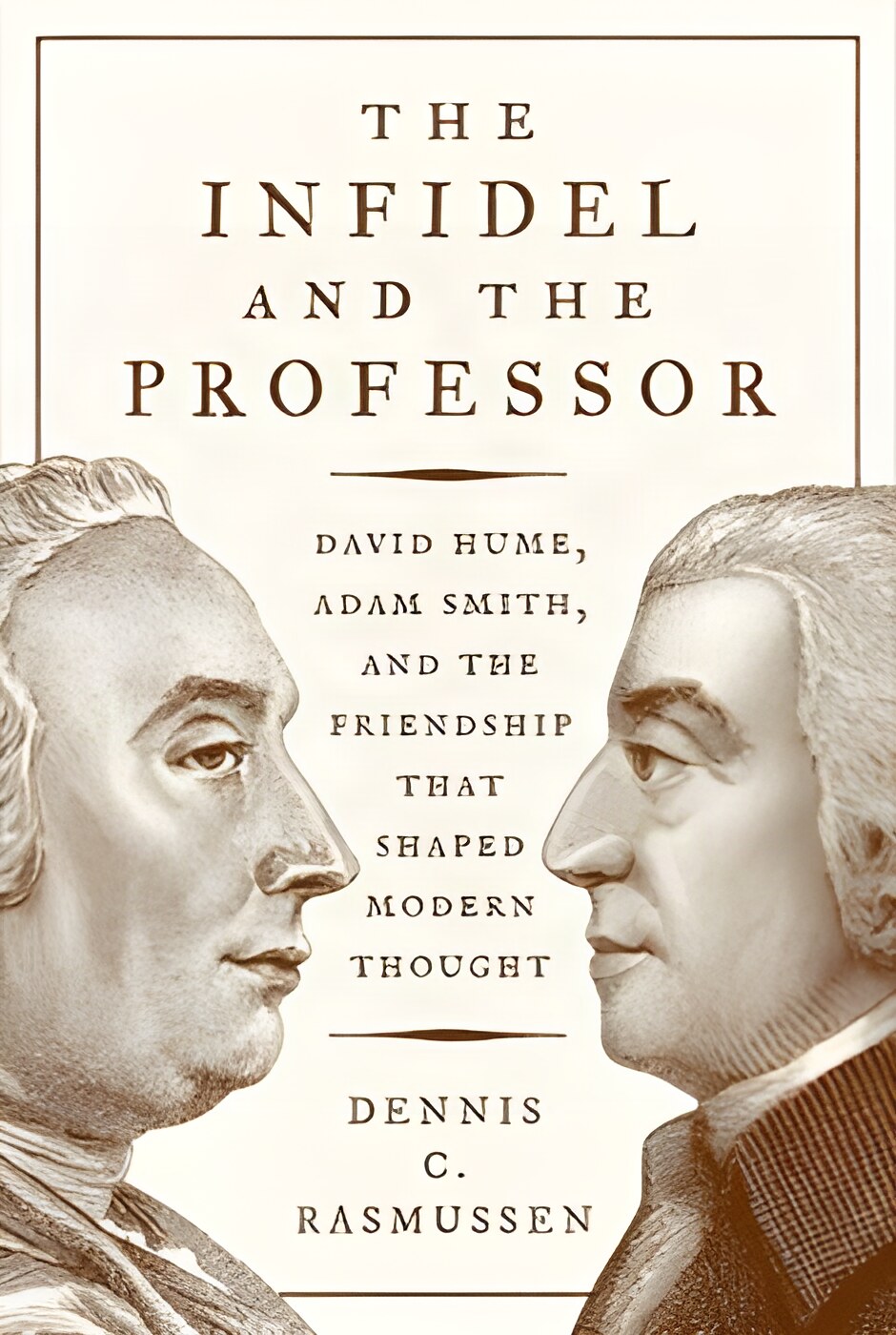
Hardcover. Princeton NJ, Princeton University Press, 3rd pr., 2017, Book: Very Good, Dust Jacket: Very Good, Hardcover in a bright dust jacket, 316 pages. David Hume is widely regarded as the most important philosopher ever to write in English, but during his lifetime he was attacked as "the Great Infidel" for his skeptical religious views and deemed unfit to teach the young. In contrast, Adam Smith was a revered professor of moral philosophy, and is now often hailed as the founding father of capitalism. Remarkably, the two were best friends for most of their adult lives, sharing what Dennis Rasmussen calls the greatest of all philosophical friendships. The Infidel and the Professor is the first book to tell the fascinating story of the friendship of these towering Enlightenment thinkers-and how it influenced their world-changing ideas. The book follows Hume and Smith's relationship from their first meeting in 1749 until Hume's death in 1776. It describes how they commented on each other's writings, supported each other's careers and literary ambitions, and advised each other on personal matters, most notably after Hume's quarrel with Jean-Jacques Rousseau. Clean copy.
Hardcover. Boston, William White & Co, 3rd, 1862, Book: Very Good, Dust Jacket: None, 344 pages. Black boards with embossed pictorial border, gilt titles to spine. Previous owner's signature to front endpaper, light rubbing to covers, top third of outside of front hinge cracked, mild edgewear, pages crisp and unmarked; overall, a very neat, tight copy.
Hardcover. New York, Garland Publishing, reprint, 1976, Book: Very Good, Dust Jacket: None, Hardcover, maroon cloth with gilt titles on spine, 347 pages. A reprint of the 1912 London edition. Previous owner's signature on front fly leaf. Otherwise, tight clean copy.
Hardcover. London, England, SPCK, 1st Edition, 1950, Book: Very Good, Dust Jacket: None, 175 pages. Hardcover. Red cover boards, fading to spine and edges, gilt title on spine. Pages unmarked. Binding tight. Spine straight. The Epitome covers a wide range of topics, including the nature of God, the creation of the world, the fall of man, the life and teachings of Jesus Christ, and the end of the world. It also discusses various aspects of Christian morality.
Hardcover. New York, Harper & Brothers, 1st, 1887, Book: Very Good, Dust Jacket: None, Hardcover, 310 pages. Brown cloth, gilt lettering to spine. Light wear and rubbing to covers and edges of spine. Clean, tight copy.
Hardcover. NY/London, Oxford University Press, 1st, 2013, Book: Very Good, Dust Jacket: Very Good, Hardcover in a bright, unclipped dust jacket, 450 pages. The essays in Religion and Public Reasons seek to argue for, and illustrate, a central element of John Finnis' theory of natural law: that the main tenets of personal and political morality, and of a good legal order, are taught both by reason (arguments accessible to everyone) and byauthentic divine revelation (teachings accessible to all who have a reasonable faith in its witnesses). The author's main books each include arguments for rejecting atheism and agnosticism; several papers here take up these arguments and indicate ways in which they open onto the reasonable grounds for accepting that more about God's nature, and about the meaning of Creation (including ongoing naturalevolution), is disclosed by the revelation carried far forward among the Jewish people, and given definitive form by the Jews and Greeks who assembled in the universal Church, as witnesses of Christ, to carry forward that revelation into our present. Several papers argue that "public reason"properly includes such a religion, and that Humeian, Nietzschean, Deweyian, Rawlsian or other atheistically or deistic understandings of a reasonable secularism are badly mistaken. Many substantial papers record the author's position in controversies within Catholicism since the 1960's: on social justice, contraception and abortion; nuclear deterrence; Newman on conscience before pope; Maritain's hopes for a new Christendom and von Balthasar's for a hell empty of human persons; and on "proportionalism" and Lonerganian "historical consciousness" as moral-theological methods. Previously unpublished papers include several University and college sermons, and a substantial introduction.
Softcover. NY, Cambridge University Press, reprint, 2006, Book: Very Good, Dust Jacket: None, Softcover, like new. A comprehensive and authoritative anthology of Rousseau's important early political writings in faithful English translations. This volume includes the Discourse on the Sciences and Arts and the Discourse on the Origin and the Foundations of Inequality among Men - the so-called First and Second Discourses - together with Rousseau's extensive Replies to critics of these Discourses; the Essay on the Origin of Languages; the Letter to Voltaire on Providence; as well as several minor but illuminating writings - the Discourse on Heroic Virtue and the essay Idea of the Method in the Composition of a Book. In these as well as in his later writings, Rousseau probes the very premises of modern thought. His influence was wide-reaching from the very first, and it has continued to grow since his death. The American and the French Revolutions were profoundly affected by his thought, as were Romanticism and Idealism. 437 pages.
Hardcover. London, Ruskin House, George Allen and Unwin, 1st, 1959, Book: Very Good, Dust Jacket: Good, Hardcover in a worn dust jacket, 194 pages. This study traces the origin of Buddhism in Brahmanism, and fixes its relationship to Hinduism, describing and stressing the basic importance of Buddhist contemplation. No markings.
Hardcover. Oxford UK, The Voltaire Foundation, 1st, 1991, Book: Very Good, Dust Jacket: None, Hardcover in blue cloth, gilt lettering on spine, 251 pages. As France moved from the seventeenth to the eighteenth century, it found itself in the grip of anglomanie - a fascination with new English ideas in the domains of science and philosophy. Chief among the English thinkers it enthusiastically embraced was John Locke. On his visits to France and in his personal correspondence, Locke interacted with prominent French thinkers, scientists and savants of the day, such as Charles Barbeyrac and Pierre Magnol, and his works engaged in a critical dialogue with those of Descartes. However, Locke has been feted to such an extent that his position in the history of ideas in France is often overlooked. In Locke in France 1688-1734, Ross Hutchison re-examines and re-contextualises the precise nature and extent of Locke's influence in France by exploring how his ideas were incorporated into contemporary French debates and controversies in the transitional period from the seventeenth to the eighteenth century. Hutchison highlights the various channels of dissemination which brought Locke to the attention of the French, including translations of his major works and his personal friendships with French Protestant exiles. Hutchison also presents case studies of interactions in which Lockean ideas played a dominant role in the evolution of French thought, ranging from political theory to the nature of language, theories of education, and the relation between soul and matter. Clean copy, no dust jacket.
Hardcover. Boston, Beacon Press, reprint, 1972, Book: Very Good, Dust Jacket: Good, Hardcover in an edgeworn, chipped dust jacket, 617 pages. This is the first of Wilbur's two-volume history and the scarcer of the two. First published in 1945. Small owner's sticker on front fly leaf, otherwise clean.
Hardcover. NY, Oxford University Press, 1st, 1987, Book: Very Good, Dust Jacket: Very Good, Hardcover in a bright dust jacket, 186 pages. What is the origin of Christian faith? Are the roots of the concept the same in both the Old and New Testaments? With the support of semantic, historical, and analytical evidence, Kinneavy develops a controversial and persuasive hypothesis that the origin of the Christian concept of faith can be traced to Greek classical rhetoric. The author examines the notions of faith formulated by eight major Christian and Jewish theologians, presents a meticulous case for the historical influence of Greek rhetoric on Hebraic thought, and concludes with a novel rhetorical study of the several hundred occurrences of the Greek terms for "faith" and "to believe," emerging with overwhelming support for the Greek influence on Christian faith. Name on front fly leaf, otherwise clean.
Hardcover. Oxford UK, Clarendon Press, 1st, 1936, Book: Good, Dust Jacket: None, Hardcover, blue cloth covers, 132 pages. Name on front fly leaf, pencil markings to about 20 pages. Light edgewear to covers, no dust jacket.
Softcover. Kessinger Publishing, reprint, Book: Very Good, Dust Jacket: None, Softcover, 457 pages. A photocopied facsimile reprint of the 1685 volume. FRENCH TEXT. Clean copy.
Hardcover. Thoemmes Press, 1st, 1997, Book: Very Good, Dust Jacket: None, Hardcover, black cloth with gilt lettering on spine. 284 pages. the first scholarly edition of John Locke's A Vindication (1695) and A Second Vindication of the Reasonableness of Christianity (1697), in which Locke defends the New Testament and the Christian Religion against charges of heterodoxy. The texts are accompanied by a wealth of critical and contextual apparatus. Clean copy.
Hardcover. Cambridge MA, Harvard University Press, 1st, 1982, Book: Very Good, Dust Jacket: None, Hardcover, blue cloth with gilt lettering and design to spine and front cover. 274 pages. Clean, bright copy.
Softcover. UK , Cambridge University Press, reprint, 1992, Book: Very Good, Dust Jacket: None, Softcover, 231 pages. Schleiermacher's On Religion: Speeches to its Cultured Despisers is a classic of modern Protestant religious thought that powerfully displays the tensions between the Romantic and Enlightenment accounts of religion. This edition presents the original 1799 text in English for the first time. Richard Crouter's introduction places the work in the milieu of early German Romanticism, Kant criticism, the revival of Spinoza and Plato studies, and theories of literary criticism and of the physical sciences. This fully annotated edition also contains a chronology and notes on further reading. Name on front fly leaf, otherwise clean.
Softcover. Urbana IL, University of Illinois Press, 1st pbk, 2006, Book: Very Good, Dust Jacket: None, Softcover, 83 pages. In Humanism of the Other, Emmanuel Levinas argues that it is not only possible but of the highest exigency to understand one's humanity through the humanity of others. In paperback for the first time, Levinas's work here is based in a new appreciation for ethics and takes new distances from phenomenology, idealism, and skepticism to rehabilitate humanism and restore its promises. Painfully aware of the long history of dehumanization that reached its apotheosis in Hitler and Nazism, Levinas does not underestimate the difficulty of reconciling oneself with another. The humanity of the human, Levinas argues, is not discoverable through mathematics, rational metaphysics, or introspection. Rather, it is found in the recognition that the other person comes first, that the suffering and mortality of others are the obligations and morality of the self. Clean copy.
Hardcover. NY, Cooper Square, reprint, 1972, Book: Very Good, Dust Jacket: None, Hardcover, light blue cloth with gilt lettering on spine, 862 pages. All four parts in one volume. Name on front fly leaf, otherwise clean, bright copy.
Hardcover. UK, Oxford University at the Clarendon Press, 2nd Ed., 1980, Book: Very Good, Dust Jacket: Very Good, Hardcover in a bright dust jacket, 709 pages. B&W frontispiece portrait of Hume and folding family tree to rear. Mossner's Life of David Hume remains the standard biography of this great thinker and writer. First published in 1954, and now updated, in response to an overwhelming interest in Hume's brilliant ideas. Containing more than a simple biography, this exemplary work is also a study of intellectual reaction in the eighteenth century. In this new edition are a detailed bibliography, index, and textual supplements, making it the perfect text for scholars and advanced students of Hume, epistemology, and the history of philosophy. It is also ideal for historians and literary scholars working on the eighteenth century, and for anyone with an interest in philosophy. Name and date on front fly leaf, otherwise clean.
Softcover. Baltimore, Johns Hopkins University Press, reprint, 2007, Book: Very Good, Dust Jacket: None, Softcover, 285 pages. In this book noted scholar Thomas L. Pangle brings back a lost and crucial dimension of political theory: the mutually illuminating encounter between skeptically rationalist political philosophy and faith-based political theology guided ultimately by the authority of the Bible. Focusing on the chapters of Genesis in which the foundation of the Bible is laid, Pangle provides an interpretive reading illuminated by the questions and concerns of the Socratic tradition and its medieval heirs in the Christian, Jewish, and Islamic worlds. He brings into contrast the rival interpretive framework set by the biblical criticism of the modern rationalists Hobbes and Spinoza, along with their heirs from Locke to Hegel. The full meaning of these diverse philosophic responses to the Bible is clarified through a dialogue with hermeneutic discussions by leading political theologians in the Judaic, Muslim, and Christian traditions, from Josephus and Augustine to our day. Profound and subtle in its argument, this book will be of interest not only to students and scholars of politics, philosophy, and religion but also to thoughtful readers in every walk of life who seek to deepen their understanding of the perplexing relationship between religious faith and philosophic reason. Name and date on front fly leaf, otherwise clean.
Hardcover. NY, Fordham University Press, 1st, 2012, Book: Very Good, Dust Jacket: Very Good, Hardcover in a bright dust jacket, 321 pages. This volume explores the three normative sciences that Peirce distinguished (aesthetics, ethics, and logic) and their relation to phenomenology and metaphysics. The essays approach this topic from a variety of angles, ranging from questions concerning the normativity of logic to an application of Peirce's semiotics to John Coltrane's A Love Supreme. A recurrent question throughout is whether a moral theory can be grounded in Peirce's work, despite his rather vehement denial that this can be done. Some essays ask whether a dichotomy exists between theoretical and practical ethics. Other essays show that Peirce's philosophy embraces meliorism, examine the role played by self-control, seek to ground communication theory in Peirce's speculative rhetoric, or examine the normative aspect of the notion of truth. Proceedings of a conference held June 26-30, 2007 at Opole University, Poland. Clean copy.
Hardcover. Chicago, Open Court, 1st, 1921, Book: Very Good, Dust Jacket: None, Hardcover, blue cloth with gilt lettering on front cover and spine, 245 pages. Top edge gilt. Pencil notations to about 20 pages.
Hardcover. Bloomington, Indiana University Press, 1st, 1997, Book: Very Good, Dust Jacket: Very Good, Hardcover in a bright dust jacket, 476 pages. Reconstructs Martin Heidegger's lecture course at the University of Marburg in the winter semester of 1924-25, which was devoted to an interpretation of Plato and Aristotle. This volume approaches Plato through Aristotle. Translated by Richard Rojcewicz and Andre Schuwer. Name, date, light pencil making to 9 pages toward front.
Hardcover. Ottawa CAN, Dovehouse Editions, reprint, 1996, Book: Very Good, Dust Jacket: None, Hardcover, green cloth stamped with gilt lettering on spine and decoration to front cover. 379 pages. Originally written in 1645 by the author who was also known as Lord Herbert of Chirbury. Herbert's major work is the De veritate, prout distinguitur a revelatione, a verisimili, a possibili, et a falso](On Truth, as It Is Distinguished from Revelation, the Probable, the Possible, and the False). He published it on the advice of Grotius. In the De veritate Herbert produced the first purely metaphysical treatise, written by an Englishman. Herbert's real claim to fame is as the father of English Deism. The common notions of religion are the famous five articles, which became the charter of the English deists. Name, light pencil notations to front endpaper and about a dozen pages.
Hardcover. London, Pickering & Chatto, 1st, 1999, Book: Very Good, Dust Jacket: None, Hardcover, black cloth, spine with maroon title block and gilt lettering, 377 pages. Vol. 2 ONLY of a six volume set. Clean, bright copy, no markings.
Hardcover. NY, Farrar, Straus and Giroux, 2nd pr., 2008, Book: Very Good, Dust Jacket: Very Good, Hardcover in a bright dust jacket, 335 pages. Giordano Bruno is one of the great figures of early modern Europe, and one of the least understood. Ingrid D. Rowland's pathbreaking life of Bruno establishes him once and for all as a peer of Erasmus, Shakespeare, and Galileo, a thinker whose vision of the world prefigures ours. By the time Bruno was burned at the stake as a heretic in 1600 on Rome's Campo dei Fiori, he had taught in Naples, Rome, Venice, Geneva, France, England, Germany, and the Prague of Emperor Rudolph II. His powers of memory and his provocative ideas about the infinity of the universe had attracted the attention of the pope, Queen Elizabeth and the Inquisition, which condemned him to death in Rome as part of a yearlong jubilee. Writing with great verve and sympathy for her protagonist, Rowland traces Bruno's wanderings through a sixteenth-century Europe where every certainty of religion and philosophy had been called into question and shows him valiantly defending his ideas (and his right to maintain them) to the very end. Clean copy.
Softcover. Chicago, University of Chicago Press, 2nd pr., 2007, Book: Very Good, Dust Jacket: None, Softcover, 246 pages. Between the years 1643 and 1649, Princess Elisabeth of Bohemia (1618-80) and Rene Descartes (1596-1650) exchanged fifty-eight letters--thirty-two from Descartes and twenty-six from Elisabeth. Their correspondence contains the only known extant philosophical writings by Elisabeth, revealing her mastery of metaphysics, analytic geometry, and moral philosophy, as well as her keen interest in natural philosophy. The letters are essential reading for anyone interested in Descartes's philosophy, in particular his account of the human being as a union of mind and body, as well as his ethics. They also provide a unique insight into the character of their authors and the way ideas develop through intellectual collaboration.
Hardcover. NY, Da Capo Press, reprint, 1971, Book: Very Good, Dust Jacket: None, Original publisher's red cloth, lettered gilt on spine and front cover, 64 pages. English experience, no. 354. A facsimile reprint made from a copy in the library of King's College Cambridge. Clean copy.
Hardcover. NY, Doubleday and Company, 1st, 1983, Book: Very Good, Dust Jacket: Very Good, Hardcover in a lightly chipped dust jacket. The writers of the Bible, like any other authors, were dependent on a vast array of literary sources from their time-the ancient world. Many of these documents are tragically lost, but what remains provides insight into the voluminous, fascinating, complex, and dynamic literary world that shaped the expressions of faith found in the Old and New Testaments. Part of these extant sources are known as the Pseudepigrapha. This collection of Jewish and Christian writings shed light on early Judaism and Christianity and their doctrines. Volume 1 only (of a 2-volume set). 995 pages. Clean copy.
Hardcover. Washington DC, Corpus Books, 1st, 1968, Book: Good, Dust Jacket: Fair, Hardcover in a worn, chipped dust jacket, Light blue cloth covers with dark blue lettering to spine. 390 pages. Maurice Blondel was a phenomenologist long before the term was used to describe an identifiable movement. His monumental work, L'Action (1893). set the stage for an intellectual revolution that is still in progress. It remains a classic effort to demonstrate the integral unity of science, metaphysics, and the moral life in the light of man's religious aspirations. Name on front fly leaf, otherwise clean.
Hardcover. Boston, Beacon Press, 1st, 1963, Book: Very Good, Dust Jacket: Very Good, Hardcover in a bright, unclipped dust jacket. Clean, bright copy of an uncommon book.
Hardcover. Cambridge MA, Harvard University Press, 1st, 1969, Book: Very Good, Dust Jacket: Very Good, Hardcover in a bright dust jacket, 556 pages. Clean copy.
Hardcover. New York, Thomas Whittaker, 1st, 1886, Book: Very Good, Dust Jacket: None, 225 pages, blue cloth covers with gilt lettering on spine. Clean, bright copy.
Hardcover. Exeter UK, Imprint Academic, 1st, 2006, Book: Very Good, Dust Jacket: Very Good, Hardcover, 179 pages. Light shelf-wear and scratching to dust jacket, else a clean, tight copy. Much of the scholarly attention attracted by Michael Oakeshott's writings has focused upon his philosophical characterisation of the relations that constitute moral association in the modern world. A less noticed, but equally significant, aspect of Oakeshott's moral philosophy is his account of the type of person (or persona) required to enter into and enjoy moral association. Oakeshott's best known characterisation of the persona best suited to moral association occurs in his identification of a 'morality of the individual'. The book argues that Oakeshott's characterisations of religious and poetic experience provide a more detailed account of the type of persona that emerged in response to what it perceived as an invitation to participate in moral association in the modern world.