Hardcover. Geneva, Labor et Fides, 1st, 1960, Book: Very Good, Dust Jacket: None, Epitre aux Romains. Texte etabli par Jules-Marcel Nicole avec la collaboration de Pierre Marcel et de Michel Reveillaud. Edition nouvelle publiee par la Societe Calviniste de France. Hardcover, gold cloth stamped in gilt, 380 pages. FRENCH TEXT. Name on front fly leaf otherwise clean.
Hardcover. Bristol UK, Thoemmes Press, reprint, 1995, Book: Very Good, Dust Jacket: None, Hardcover, red cloth with gilt lettering on the spine, 535 pages. This work contains Shaftesbury's philosophical notebooks from 1698 to 1712. It includes reflections on such topics as the natural affections, good and evil, God, self, the passions, pleasure and pain, nature, life, and philosophy, as well as a brief Life of the 3rd Earl of Shaftesbury, by his son. A reprint of the 1900 edition. Name on front fly leaf, otherwise clean.
Hardcover. Bristol UK, Thoemmes Press, reprint, 1997, Book: Very Good, Dust Jacket: None, Hardcover, red cloth with gilt lettering on spine, 196 pages plus a 98 page addition: A Dissertation Upon the Argument a Priori For Proving the Existence of a First Cause. A facsimile reprint of the 1734 Edition. Clean copy.
Softcover. Amherst MA, University Of Massachusetts , 1st, 1990, Book: Very Good, Dust Jacket: None, Softcover, 205 pages. This study challenges the common view that Nietzsche passed through several discrete periods of thought, each based on a different set of values, and that his work can best be understood as a collection of isolated insights. Through close textual analysis, Robert John Ackermann exposes the underlying unity and consistency in Nietzsche's thought that has long been overlooked. Ackermann is to be highly commended for this clearly written introduction to Nietzsche. Light pencil underlining to several pages.
Hardcover. Princeton, N.J., Princeton University Press, 1st, 1992, Book: Very Good, Dust Jacket: Very Good, Hardcover, 287 pages. Clean, unmarked copy with only minor wear to dust jacket.
Hardcover. Albany, New York, State University of New York Press, 1st, 1989, Book: Good, Dust Jacket: None, Hardcover, 451 pages, with Japanese text in back. Slight wear/rubbing to edges and spine. INSCRIBED BY AUTHOR on front flyleaf and handwritten note by author laid-in. Crisp, clean pages and tight binding.
Hardcover. Oxford, England, Clarendon Press, 1st Edition, 1983, Book: Very Good, Dust Jacket: Very Good, 627 pages. Hardcover. Sequel to Hegel's Development: Toward the Sunlight 1770-1801(Clarendon Press, 1972). Black cover boards, gilt title and design on spine. Pages clean and bright. Binding tight. Spine straight. Dust jacket unclipped, faded (shelfwear), light agewear, glossy. Harris distinguishes three main phases in Hegel's development over this period: the period of callaboration with Schelling (1801-3); the appearance of a three-part 'phenomenological' system (1803-50; and the emergence of the mature system.
Hardcover. London, UK, Routledge & Kegan Paul, Reprint, 1975, Book: Very Good, Dust Jacket: Very Good, 404 pages. Hardcover. Volume 2 ONLY. Red cloth cover boards, gilt title on spine. Foldout family trees of the House of Medici, etc. attached. Previous owner's notes/underlining on a few pages in pencil. Top edge dyed orange. Dust jacket price clipped. Some tape outlines on front flyleaf and back page. First published in 1950, this classic translation by the late Leslie J. Waker has been out of print for some years. It is now reissued complete, together with an introductory essay by Cecil H. Clough which places Father Walker's contribution in the context of current researches.
Hardcover. NY, March & Greenwood, 1st, 1938, Book: Very Good, Dust Jacket: None, Hardcover, purple cloth with gilt lettering on spine. 23.4*16.3cm, 123 pages. Printed on one side of double leaves, folded once in Chinese style. Now uncommon in commerce, this was the first English translation by a Chinese scholar of the foundational book of Taoism. The enigmatic polymath Dr Sum Nung Au-Young (1893-1942) was an accomplished poet, philosopher, lawyer and economist. There is some faint discoloration but hardly visible unless held at an angle, otherwise a very good hardcover. "Author's edition".
Softcover. NY/London, Routledge, 1st, 2008, Book: Good, Dust Jacket: None, Softcover, 248 pages. Light pecil marking to 6 pages. Mild shelf wear. Laurel Schneider takes the reader on a vivid journey from the origins of "the logic of the One" - only recently dubbed monotheism - through to the modern day, where monotheism has increasingly failed to adequately address spiritual, scientific, and ethical experiences in the changing world. In Part I, Schneider traces a trajectory from the ancient history of monotheism and multiplicity in Greece, Israel, and Africa through the Constantinian valorization of the logic of the One, to medieval and modern challenges to that logic in poetry and science. She pursues an alternative and constructive approach in Part II: a "logic of multiplicity" already resident in Christian traditions in which the complexity of life and the presence of God may be better articulated. Part III takes up the open-ended question of ethics from within that multiplicity, exploring the implications of this radical and realistic new theology for the questions that lie underneath theological construction: questions of belonging and nationalism, of the possibility of love, and of unity. In this groundbreaking work of contemporary theology, Schneider shows that the One is not lost in divine multiplicity, and that in spite of its abstractions, divine multiplicity is realistic and worldly, impossible ultimately to abstract.
Hardcover. Chatham UK, The Limited Editions Club, Ltd Ed, 1969, Book: Very Good, Dust Jacket: None, Hardcover, embossed gray cloth covers with gilt lettering on spine, slipcased. Illustrated with wood engravings by Reynolds Stone. No. 38 of 1500 copies, signed by the artist. Designed by Will Carter and printed by W & J Mackay & Company. Bright, clean copy with minor wear to slip case.
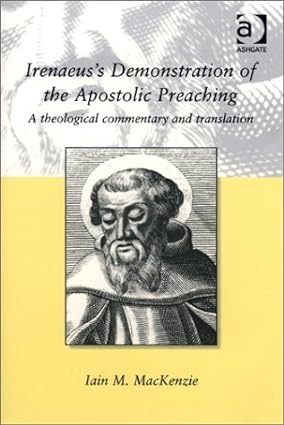
Softcover. Burlington VY, Ashgate Publishing , 1st, 2002, Book: Very Good, Dust Jacket: None, Softcover, 241 pages. The theology of Irenaeus, and the Demonstration of the Apostolic Preaching in particular, is pivotal in showing the way in which the fathers of the church interpreted scripture and distilled doctrine. The Demonstration is an important hinge showing how the doctrine of the fourth century with its definitive councils and definitions of faith, opens out from the new testament apostolic and evangelical witness. Presenting the full translation of the Demonstration of Irenaeus by Dean Armitage Robinson, this book offers a detailed theological commentary by Canon Iain MacKenzie on this foundational doctrinal text. MacKenzie sets out the main theological themes throughout Irenaeus' work, and explores his method of systematic theology, Athanasius's dependence on Irenaeus, and Irenaeus' influence on doctrine in the fourth century - particularly the works of Athanasius, Basil of Caesarea, Gregory of Nazianzus and Gregory of Nyssa. Highlighting the importance of this second century theologian for theology today, this commentary and theological interpretation offers an incentive to study Irenaeus in the wider development of Christian doctrine as a cardinal figure in the appreciation of systematic theology. Name on front fly leaf otherwise clean.
Hardcover. Munchen/Leipzig, K.G. Saur, 1st, 2004, Book: Very Good, Dust Jacket: None, Hardcover, blue cloth with light gray stamping, 269 pages. Name on front fly leaf, otherwise clean. Name on front fly leaf, otherwise clean.
Softcover. Oxford UK, Clarendon Press, reprint, 2016, Book: Very Good, Dust Jacket: None, Softcover, 400 pages. Clean, bright copy. This volume makes available for the first time critical editions of John Locke's A Vindication and A Second Vindication of the Reasonableness of Christianity, in which Locke defends his interpretation of the New Testament and of the Christian Religion against charges of heterodoxy. These works contribute greatly to our understanding of Locke's Christian commitments, which it is now recognized played an important role in shaping his philosophical opinions; they also demonstrate his sophistication as a biblical scholar, and the breadth of his theological learning. The texts are accompanied by a historical introduction explaining the origin of the works and setting them in context. In addition to a textual introduction and critical apparatus, editorial notes help to clarify the text. The volume also includes a French translation and abridgment by Pierre Coste, a Huguenot scholar, who was patronized by Locke and worked on his translations while residing in Locke's household. This definitive edition is an important contribution to an understanding of the development of modern enlightened Christian attitudes.
Hardcover. Oxford UK, Oxford University Press, 2nd Ed., 1939, Book: Good, Dust Jacket: None, Blue cloth covers with gilt lettering on spine. Ex-library copy with light stamping, label on spine. 182 pages. Except for library stamping text pages are clean, firm binding. Originally published in 1906, this with a new preface by author.
Hardcover. UK, Bristol Thoemmes, reprint, 1990, Book: Very Good, Dust Jacket: None, Hardcover, green cloth, gilt title on spine, 120 pages. Originally published in 1951, this concise book presents an engaging study of the works and influence of the renowned English philosopher Ralph Cudworth (1617-88), the leader of the Cambridge Platonists. A bibliography of writings by and about Cudworth is also included, together with an appendix section on his manuscripts. The text was an early work by Australian philosopher and historian of ideas John Passmore (1914-2004). This book will be of value to anyone with an interest in Cudworth, the Cambridge Platonists and the historical development of philosophy. Light pencil marking in margins, ink name on front fly leaf. Tight copy.
Hardcover. Cambridge MA, Harvard University Press , 1st, 1990, Book: Very Good, Dust Jacket: None, Hardcover, blue cloth with gilt lettering and design to spine and front cover, 926 pages. Although Richard Hooker (1554-1600) is now known principally as the author of the Laws of Ecclesiastical Polity, in his lifetime the Tractates and Sermons brought him greater notoriety. Hooker's views on justification, the perseverance of faith, and the relationship of the Church of Rome to the reformed Church of England were widely reported, and texts of the tracts were extensively circulated in manuscript. Thanks to the meticulous editing of Laetitia Yeandle, Curator of Manuscripts at the Folger Shakespeare Library, the contemporary impact of these debates can now be appreciated for the first time. These tracts provide a unique perspective on the turbulent world of late Elizabethan theology. In addition, they lay the doctrinal foundations of the Laws of Ecclesiastical Polity itself and-with the excellent commentary of Egil Grislis, Professor of Theology at the University of Manitoba in Winnipeg, enable us to trace the intellectual formation of sixteenth-century England's most innovative and provocative theologian. The volume includes a newly discovered letter; three newly attributed sermon fragments; and analysis by P. F. Forte of Hooker's distinctive preaching style. Clean, bright copy.
Hardcover. UK, Oxford University Press, 1st, 2012, Book: Very Good, Dust Jacket: Very Good, Hardcover in a bright, unclipped dust jacket. God in the Age of Science? is a critical examination of strategies for the philosophical defence of religious belief. The main options may be presented as the end nodes of a decision tree for religious believers. The faithful can interpret a creedal statement (e.g. "God exists") either as a truth claim, or otherwise. If it is a truth claim, they can either be warranted to endorse it without evidence, or not. Finally, if evidence is needed, should its evidential support be assessed by the same logical criteria that we use in evaluating evidence in science, or not? Each of these options has been defended by prominent analytic philosophers of religion. In part I Herman Philipse assesses these options and argues that the most promising for believers who want to be justified in accepting their creed in our scientific age is the Bayesian cumulative case strategy developed by Richard Swinburne. Parts II and III are devoted to an in-depth analysis of this case for theism. Using a "strategy of subsidiary arguments," Philipse concludes (1) that theism cannot be stated meaningfully; (2) that if theism were meaningful, it would have no predictive power concerning existing evidence, so that Bayesian arguments cannot get started; and (3) that if the Bayesian cumulative case strategy did work, one should conclude that atheism is more probable than theism. Philipse provides a careful, rigorous, and original critique of theism in the world today. Clean copy.
Hardcover. UK, Oxford University Press, reprint, 2003, Hardcover in pictorial boards, 309 pages. Byzantine philosophy is an almost unexplored field. Being regarded either as mere scholars or as primarily religious thinkers, Byzantine philosophers have not been studied on their own philosophical merit. The eleven contributions in this volume, which cover most periods of Byzantine culture from the 4th to the 15th century, for the first time systematically investigate the attitude the Byzantines took towards the views of ancient philosophers, to uncover the distinctive character of Byzantine thought. Clean, bright copy.
Hardcover. Bristol UK, Thoemmes Press, reprint, 1997, Book: Very Good, Dust Jacket: None, Hardcover, blue cloth with gilt lettering on spine, 310 pages. A facsimile reprint of the 1911 edition. One of 9 volumes in More's collected works. Includes Parts One and Two. Name on front fly leaf otherwise a clean, bright copy.
Hardcover. Durham NC, Duke University Press, 1st, Book: Very Good, Dust Jacket: Very Good, Hardcover in a bright dust jacket, 348 pages. Perhaps best known as a political philosopher, Richard Price (1723-1791) made important contributions to British and American intellectual life in a variety of fields--philosophy, theology, mathematics, demography, probability and public finance, and private and social insurance. The first in a three-volume series edited by W. Bernard Peach and D. O. Thomas, The Correspondence of Richard Price makes available the extant copies of the correspondence to and from Price, including many published for the first time. These letters reveal Price's absorption with financial problems, his influence on the policies adopted by the British government, his defense of Newtonianism against Lord Monboddo, as well as important insights into the political and cultural life in Britain and America. Correspondents include John Adams, William Adams, J. D. van der Capellen, Benjamin Franklin, Thomas Jefferson, Henry Laurens, Lord Monboddo, William Pitt, Joseph Priestly, the Earl of Shelburne, Ezra Stiles, P. W. Wargentin, and Joseph Willard. Clean copy.
Hardcover. Oxford UK, Clarendon Press, 1st, 1957, Book: Very Good, Dust Jacket: None, Hardcover, blue cloth with gilt lettering on spine, 148 pages, paper with light tanning. The relationship between formal logic and general philosophy is discussed under headings such as A Re-examination of Our Tense-Logical Postulates, Modal Logic in the Style of Frege, and Intentional Logic and Indeterminism. The relationship between formal logic and general philosophy is discussed under headings such as A Re-examination of Our Tense-Logical Postulates, Modal Logic in the Style of Frege, and Intentional Logic and Indeterminism. Name on front fly leaf, otherwise clean.
Softcover. Cambridge MA, Harvard University Press, reprint, 2019, Book: Very Good, Dust Jacket: None, Softcover, 272 pages. We are facing a crisis of civility, a war of words polluting our public sphere. In liberal democracies committed to tolerating active, often heated disagreement, the loss of this virtue appears critical. Most modern appeals to civility follow arguments by Hobbes or Locke by proposing to suppress disagreement or exclude views we deem "uncivil" for the sake of social harmony. By comparison, mere civility-a grudging conformity to norms of respectful behavior-as defended by Rhode Island's founder, Roger Williams, might seem minimal and unappealing. Yet Teresa Bejan argues that Williams's outlook offers a promising path forward in confronting our own crisis, one that challenges our fundamental assumptions about what a tolerant-and civil-society should look like. Clean copy.
Hardcover. UK, Oxford at the Clarendon Press, reprint, 1970, Book: Very Good, Dust Jacket: Good, Hardcover in a worn dust jacket with chipping and closed tears, 180 pages. Name on front fly leaf, otherwise clean.
Hardcover. UK, Oxford University Press, 1st, 2014, Book: Very Good, Dust Jacket: Very Good, Hardcover in a bright dust jacket, 284 pages. Thirteen original essays by leading scholars explore aspects of Spinoza's ethical theory and, in doing so, deepen our understanding of the richly rewarding core of his system. Given its importance to his philosophical ambitions, it is surprising that his ethics has, until recently, received relatively little scholarly attention. Anglophone philosophy has tended to focus on Spinoza's contribution to metaphysics and epistemology, while philosophy in continental Europe has tended to show greater interest in his political philosophy. This tendency is problematic not only because it overlooks a central part of Spinoza's project, but also because it threatens to present a distorted picture of his philosophy. Moreover, Spinoza's ethics, like other branches of his philosophy, is complex, difficult, and, at times, paradoxical. The essays in this volume advance our understanding of his ethics and also help us to appreciate it as the centerpiece of his system. Clean copy.
Softcover. Padova Italy, Editrice Antenore, 1st, 1961, Book: Very Good, Dust Jacket: None, Softcover, cream color wrappers with black and blue type, 141 pages with index. Foreword by author. English text. Name on front fly leaf, light pencil marking to 10 pages.
Hardcover. Cambridge MA, Harvard University Press, 1st, 2007, Book: Very Good, Dust Jacket: Very Good, Hardcover in a bright dust jacket, 206 pages. Lorenzo Valla (1407-1457) was the most important theorist of the humanist movement. He wrote a major work on Latin style, On Elegance in the Latin Language, which became a battle-standard in the struggle for the reform of Latin across Europe, and Dialectical Disputations, a wide-ranging attack on scholastic logic. His most famous work is On the Donation of Constantine, an oration in which Valla uses new philological methods to attack the authenticity of the most important document justifying the papacy's claims to temporal rule. It appears here in a new translation with introduction and notes by G. W. Bowersock, based on the critical text of Wolfram Setz (1976). This volume also includes a text and translation of the Constitutum Constantini, commonly known as the Donation of Constantine.
Hardcover. UK, Clarendon Press, 1st, 1983, Book: Very Good, Dust Jacket: Very Good, Hardcover in a bright dust jacket, 327 pages. This is the volume with the text in Latin, 5 b&w plates. Name on front fly leaf, otherwise clean.
Hardcover. Cambridge MA, Belknap Press / Harvard University Press, 1st, 1979, Book: Very Good, Dust Jacket: Very Good, Hardcover in a lightly worn dust jacket, 896 pages. This masterly study has a grand sweep. It ranges over centuries, with a long look backward over several millennia. Yet the history it unfolds is primarily the story of individuals: thinkers and dreamers who envisaged an ideal social order and described it persuasively, leaving a mark on their own and later times. The roster of utopians includes men of all stripes in different countries and eras--figures as disparate as More and Fourier, the Marquis de Sade and Edward Bellamy, Rousseau and Marx. Fascinating character studies of the major figures are among the delights of the book. 1980 National Book Award winner. Name on front fly leaf, otherwise clean.
Hardcover. Stanford CA, Stanford University Press, 1st, 1964, Book: Very Good, Dust Jacket: Very Good, Hardcover in a bright dust jacket, 194 pages. Based upon the 1961 Arensberg Lectures, given at Stanford University, this collection of essays offers a genuinely unified interpretation of Italian Renaissance thought by describing and evaluating the philosophies of eight pivotal figures: 1). Francesco Petrarch. 2). Lorenzo Valla. 3). Marsilio Ficino. 4). Giovanni Pico della Mirandola. 5). Pietro Pomponazzi. 6). Bernardino Telesio. 7). Francesco Patrizi. 8). Giordano Bruno. With appendix: The medieval antecedents of Renaisssance Humanism, notes, bibliographical survey and index. Name on front fly leaf, otherwise clean.
Hardcover. Cambridge MA, Harvard University Press, 1st, 1990, Book: Very Good, Dust Jacket: Good, Hardcover in a lightly worn dust jacket, 346 pages. This book examines some of the deepest questions in philosophy: What is involved in judging a belief, action, or feeling to be rational? What place does morality have in the kind of life it makes most sense to lead? How are to understand claims to objectivity in moral judgments and in judgments of rationality? When we find ourselves in fundamental disagreement with whole communities, how can we understand out disagreement and cope with it? To shed light on such issues, Alan Gibbard develops what he calls a "norm-expressionistic analysis" of rationality. He refines this analysis by drawing on evolutionary theory and experimental psychology, as well as on more traditional moral and political philosophy. What emerges is an interpretation of human normative life, with its quandaries and disputes over what is rational and irrational, morally right and morally wrong. Judgments of what it makes sense to do, to think, and to feel, Gibbard agrues, are central to shaping the way we live our lives. Name on front fly leaf, otherwise clean.
Softcover. Rochester NY, University of Rochester Press, reprint, 1994, Book: Very Good, Dust Jacket: None, Softcover, 539 pages. The essays in this collection illustrate the interdisciplinary approach to the history of ideas fostered by the Journal of the History of Ideas. Science, philosophy and religion were closely connected in the 17th and 18th centuries, and common threads run through all the articles. A number of essays revolve around Locke: the implications of his doctrines for religion, and their relation to and support of the new science; several of these articles refer to Descartes, Leibniz andHume. There are essays on optics and vision in the work of Berkeley, Reid and Newton, and on the relation between biology and physiology, especially as these disciplines contribute to the science of man. The authors include HENRY GUERLAC, MARGARET C. JACOB, SHIRLEY ROE, L. LAUDAN, NICHOLAS JOLLEY, JAMES FORCE, G. A. J. ROGERS and CATHERINE WILSON. Name on front fly leaf, otherwise clean.
Softcover. Lanham MD, Rowman & Littlefield , 1st, 2003, Book: Very Good, Dust Jacket: None, Softcover, 349 pages. In Vergil's Empire, Eve Adler offers an exciting new interpretation of the political thought of Vergil's Aeneid. Adler argues that in this epic poem, Vergil presents the theoretical foundations of a new political order, one that resolves the conflict between scientific enlightenment and ancestral religion that permeated the ancient world. The work concentrates on Vergil's response to the physics, psychology, and political implications of Lucretius' Epicurean doctrine expressed in De Rerum Natura. Proceeding by a close analysis of the Aeneid, Adler examines Vergil's critique of Carthage as a model of universal enlightenment, his positive doctrine of Rome as a model of universal religion, and his criticism of the heroism of Achilles, Odysseus, and Epicurus in favor of the heroism of Aeneas. Beautifully written and clearly argued, Vergil's Empire will be of great value to all interested in the classical world. Clean copy.
Hardcover. Windsor VT, Richard and Tracy, 1st US, 1833, Book: Very Good, Dust Jacket: None, Hardcover, polished brown calf, 213 pages. Eleven page preliminary essay by the American editors, followed by 9 sermons, title label on spine. Clean, bright copy.
Softcover. Evanston IL, Northwestern University , 1st, 2002, Book: Very Good, Dust Jacket: None, Softcover, 325 pages. Devoted to the most important American Continental philosopher of his generation and one of the discipline's founding fathers, and featuring some of the field's most distinguished luminaries, this anthology constitutes a critical document in Continental philosophy, reflecting its recent history, its present state, and its debt to Calvin Schrag. Taking up themes central to Schrag's own philosophical concerns, these essays refer throughout to his salient "interventions" in the dialogue of late twentieth-century thought characterized as "postmodernity." In doing so, all contributors address, implicitly or directly, the question of philosophy's role and responsibility, or "task." The volume begins with an overview of this task and of Schrag's contributions to it, written from the perspective of a resolute defender of the phenomenological tradition that Schrag's work has extended and reconfigured. Clean copy.
Hardcover. Chicago, The University Of Chicago Press, 1st, 1990, Book: Very Good, Dust Jacket: Very Good, Hardcover in a bright dust jacket, 242 pages. There is no thinker more relevant to the thought of the last century than Friedrich Nietzsche; nor any more troubling. In this book, Detwiler offers a balanced yet unstinting examination of the political dimension of Nietzsche's thought. He addresses Nietzsche's profoundly illiberal and aristocratic ideas without apology, but does not denigrate the magnitude of this important philosopher's overall intellectual achievement.
Hardcover. NY, Holt, Rinehart and Winston, 1st, 1964, Book: Very Good, Dust Jacket: Good, From Nihilism to Atheism, from Agnosticism to Apathy: Explorations in American Religion. Hardcover in a lightly worn and chipped dust jacket, 231 pages. No markings.
Hardcover. Princeton, N.J., Kingston Press, Incorporated, The, 1st, 1984, Book: Very Good, Dust Jacket: Very Good, SIGNED BY AUTHOR. 227 pages. Light foxing to top and fore-edge. Minor wear to dust jacket; spine slightly faded. Else a very clean, tight copy.
Hardcover. Princeton NJ, Princeton University Press, 1st, 1992, Book: Very Good, Dust Jacket: Very Good, Hardcover, 387 pages. Black cloth covers slightly bowed. Some light notes in pencil. Previous owners name on front endpaper. Dust jacket shows light wear.
Hardcover. New York, Cassell, 1st, 1880, Book: Fair, Dust Jacket: None, Unpaginated, 100 b&w illustrations by Dore. Brown cloth covers w/ faded gilt lettering and design. Rubbing, chipping to corners. Hinges and binding cracked. Foxing to end papers. Previous owner's signature on front fly leaf. Else pages clean and crisp
Hardcover. New York, Mahlon Day, reprint , 1836, Book: Good, Dust Jacket: None, 270 pages. Compilation of three separate volumes published in different times. Rear fly leaf creased. Foxing throughout. Otherwise clean, tight copy.
Hardcover. London, England, Oxford at the Clarendon Press, 1st Edition, 1967, Book: Very Good, Dust Jacket: Fair, 406 pages. Hardcover. Previous owner's name on front flyleaf. Dust jacket price clipped, has some damage to top right corner of front cover, as well as agewear. Navy blue cover boards, gilt title on spine. The years between the two wars saw a rich flowering of work in formal logic in Poland. Yet the writings of Polish logicians of that time have largely remained inaccessible to English-speaking readers.
Softcover. Rochester, NY, Austin Publishing Co., 1st, 1908, Book: Good, Dust Jacket: None, Softcover booklet with stapled binding. Paper wrappers have heavy wear, soil and chipping. Booklet spiritualism in New York. Edges are chipped and frayed.
Hardcover. NY, Doubleday, 1st, 1994, Book: Very Good, Dust Jacket: Very Good, Hardcover in a bright, unclipped dust jacket with minor edgewear. 1118 pages. This book is the second volume in John Meier's masterful trilogy on the life of Jesus. In it he continues his quest for the answer to the greatest puzzle of modern religious scholarship: Who was Jesus? To answer this Meier imagines the following scenario: "Suppose that a Catholic, a Protestant, a Jew, and an agnostic were locked up in the bowels of the Harvard Divinity School library... and not allowed to emerge until they had hammered out a consensus document on who Jesus of Nazareth was and what he intended...". A Marginal Jew is what Meier thinks that document would reveal. Volume one concluded with Jesus approaching adulthood. Now, in this volume, Meier focuses on the Jesus of our memory and the development of his ministry. To begin, Meier identifies Jesus's mentor, the one person who had the greatest single influence on him, John the Baptist. All of the Baptist's fiery talk about the end of time had a powerful effect on the young Jesus and the formulation of his key symbol of the coming of the "kingdom of God." And, finally, we are given a full investigation of one of the most striking manifestations of Jesus's message: Jesus's practice of exorcisms, hearings, and other miracles. In all, Meier brings to life the story of a man, Jesus, who by his life and teaching gradually made himself marginal even to the marginal society that was first century Palestine. Clean copy.
Hardcover. Ithaca NY, Cornell University Press, 1st, 1992, Book: Very Good, Dust Jacket: Very Good, Hardcover in a dust jacket with mild fading to spine. 224 pages. Clean copy.


 "The Life, Unpublished Letters, and Philosophical Regimen of Anthony, Earl of Shaftesburyby: Rand, Benjjamin (editor)")
 "Nietzsche: A Frenzied Look by: Ackerman, Robert John")


 "Encontro \"Magick\" de Fertnando Pessoa e Aleister Crowleyby: Roza (Luiz Miguel Rosa Dias), Miguel")
 "Moral and Spiritual Cultivation in Japanese Neo-Confucianism: The Life and Thought of Kaibara Ekken 1630-1740 (SIGNED COPY)by: Tucker, Mary Evelyn")
 "Hegel's Development: Night Thoughts (Jena 1801-1806)by: Harris, H.S.")


 "Discourses of Niccolo Machiavelli, The (Volume 2 only)by: Walker, Leslie J. (English translation, Introduction, Notes), Cecil H. Clough (New Introduction)")


 "Lao Tze's Tao Teh King: The Bible of Taoism. English Version, by Sum Nung Au-Young. With an Introduction by Merton S. Yewdaleby: Sum Nung Au-Young; Lao Tze")


 "Beyond Monotheism: A Theology of Multiplicity by: Schneider, Laurel C.")
 "Saint Thomas Aquinas: Selections from his Works Made by George N. Shusterby: Aquinas, Saint Thomas")



 "The Nature of Truth: An Essayby: Harold H. Joachim")

 "Ralph Cudworth: An Interpretation by: J. A. Passmore")


 "The Folger Library Edition of the Works of Richard Hooker-Tractates & Sermons - Volume 5 (V)by: Richard Hooker/ Laetitia Yeandle (Editor), Egil Grislis (Commentaries")
 "God in the Age of Science?: A Critique of Religious Reasonby: Philipse, Herman")
![Byzantine Philosophy and Its Ancient Sources by: Ierodiakonou, Katerina [Editor]](javascript:largeIMTop('https://www.browsingisarousing.com/shop/images/Byzantine-Philosophy-and-Its-Ancient-Sources_by_Ierodiakonou-Katerina-Editor386262-438221.jpg','https://www.browsingisarousing.com/shop/images/Byzantine-Philosophy-and-Its-Ancient-Sources_by_Ierodiakonou-Katerina-Editor386262-438221.jpg',0,'386262',0,'') "Byzantine Philosophy and Its Ancient Sources by: Ierodiakonou, Katerina [Editor]")
 "The Life of the Learned and Pious Dr. Henry More, Late Fellow of Christ's College in Cambridgeby: Richard Ward")
 "The Correspondence of Richard Price - Volume I: July 1748-March 1778 by: Thomas, D. O./ W. Bernard Peach (Ed.)")
 "Time and Modality: Being the John Locke Lectures for 1955-6 Delivered in the University of Oxford by: Prior, A. N.")


 "An Introduction to Hegelby: Mure, G. R. G.")
 "Essays on Spinoza's Ethical Theoryby: Matthew J. Kisner /Andrew Youpa (Editors)")
 "The School of Padua and the Emergence of Modern Scienceby: Randall, John Herman")
 "On the Donation of Constantine (The I Tatti Renaissance Library)by: Valla, Lorenzo/ Bowersock G. W. (Translator)")
 "De Cive: The Latin Version (Clarendon Edition of the Works of Thomas Hobbes) by: Hobbes, Thomas / Editor: Warrender, Howard")
 "Utopian Thought in the Western World by: Manuel, Frank E. and Fritzie P. Manuel")
 "Eight Philosophers of the Italian Renaissanceby: Kristeller, Paul")
 "Wise Choices, Apt Feelings: A Theory of Normative Judgment by: Allan Gibbard")
 "Vergil's Empire: Political Thought in the Aeneidby: Eve Adler")
 "Sermons on Infidelity: First American Edition with a Preliminary Essayby: Thomson, Andrew")


 "Varieties of Unbeliefby: Marty, Martin E.")
 "Religious Revolt in the Seventeenth Century: The Schism of the Russian Church (SIGNED COPY)by: Lupinin, Nickolas B.")
 "Lockean Theory of Rights, Theby: Simmons, A. John")
 "Bible Gallery, Theby: Chambers, Talbot W. and Gustave Dore")
 "Memorials Concerning Several Ministers, and Others, Deceased: Of the Religious Society of Frineds, Within the Limits of the Yearly Meeting of New York. by: N/A")


 "Reason: DECEMBER Vol. 6. Number 2. Psychic Science, Social Reform, Education, Healing Successby: n/a")
 "From Rousseau to Ritschl being the translation of eleven chapters of Die Protestantische Theologie im 19. Jahrhundertby: Barth, Karl")
 "A Marginal Jew: Rethinking the Historical Jesus, Vol. 2 - Mentor, Message, and Miraclesby: John P. Meier")
 "Alexander of Aphrodisias: On Aristotle's Metaphysics 2 & 3 by: Aristotle Alexander of Aphrodisias. William E. Dooley and Arthur Madigan (transl.)")
)