Hardcover. NY, Harcourt Brace and Company, 1st US, 1939, Book: Very Good, Dust Jacket: Good, Hardcover in a lightly worn and faded dust jacket, 366 pages. A collection of speeches by the Right Hon. Anthony Eden in the House of Commons and elsewhere through 1938, which offers a criticism on British foreign policy. Previous owner's inscription on front fly leaf, otherwise clean.
Hardcover. New York , Arno Press, reprint, 1976, Book: Very Good, Dust Jacket: None, 295 pages, green cloth covers with gilt lettering. Previous owner's stamp on front fly leaf, otherwise clean, very good. Facsimile reprint of the 1933 edition. Scarce in hardcover.
Hardcover. Princeton University Press , 1st, 1967, Book: Very Good, Dust Jacket: None, Hardcover, gray cloth-covered boards, gilt titles to spine on black ground, 350 pages., illustrated with tables. The book sets out to "describe the inception, organisation, and administration of the Nazi foreign labor program and the relationship of the program to the Nazi war economy and government". It uses captured documents as well as material published during the war. Spine slightly cocked, clean copy.
Hardcover. Privately Printed, 1st, 1928, Book: Very Good, Dust Jacket: Good, Hardcover, blue paper-covered boards, black cloth spine with paper label, fore- and bottom edges untrimmed, frontis portrait and other black-and-white illustrations. Glassine wrapper present, chipped and worn. These letters document the nascent history of Smith College, Northampton, Mass. Pages unopened. Clean copy.
Hardcover. Jefferson NC, McFarland & Co., 1st, 2000, Book: Very Good, Dust Jacket: None, Hardcover, maroon cloth with gilt lettering. Part 1: A Korean Childhood in Japan, 1930-1944; Part 2: Growing Up in Korea, 1944- 1951. No Dust jacket issued.
Softcover. Liverpool Univeristy Press, 1st, 1997, Book: Very Good, Dust Jacket: None, Softcover, pages. In 1916 Thomas Wallis founded a new practice, Wallis, Gilbert & Partner, primarily to collaborate with an American company in the design of factories to be constructed of reinforced concrete. Designing factories was not then popular among architects and many manufacturers regarded the employment of an architect a wanton extravagance. Wallis's move could be seen as a reckless gamble, but his and his partners' subsequent achievements suggest that his choice had been well considered; some of the best known inter-war industrial building - Firestone, Hoover, The Gramophone Company, Glaxo Laboratories - were their work. In Form and Fancy, Dr Skinner looks first at the biographical background of Wallis, at the history and organisation of the partnership he founded, and at the many factors that contributed to its reputation in the inter-war years. She then offers a perspective on architectural thought and activity in that period, and of the attitudes and influences on factory design. Designs by the partnership for over one hundred factories and factory buildings have been discovered and at the core of the book is a third chapter which analyses and assesses them. Dr Skinner concludes with an evaluation of the design philosophy of Wallis, Gilbert & Partners, the aim of which was to contribute to the successful pursuit of business by the companies that commissioned them.
Hardcover. Canberra/London, Australian Institute of Aboriginal Studies/Gerald Duckworth and Co., 1st, 1977, Book: Very Good, Dust Jacket: Very Good, Oblong hardcover in a lightly worn dust jacket. 486 pages with illustrations in b&w and color. From Papers presented to a symposium at the 1974 meeting of the Australian Institute of Aboriginal Studies. A look at the art works of Aboriginal Australia from the past & present, as seen in the context of the art of prehistoric Europe. An attempt at an ethnographic juxtaposition of prehistoric art. Clean copy.
Hardcover. Austin, TX, University of Texas Press, 1st, 1985, Book: Very Good, Dust Jacket: None, 164 pages. Hardcover. B/w illustrations throughout. Covers and spine slightly yellowed from age. Very clean inside. From the back cover: "The years 1839-1920 were a period of the most intense creative ferment in early photography. For the eight decades Great Britain, birthplace of the challenging new medium, led the world in photographic innovations and established most standards of photographic artistry and application. (This book) describes the extraordinary breadth of photography during this dynamic era."
Softcover. Charleston, SC, Arcadia Publishing, 1st, 2004, Book: Very Good, Dust Jacket: None, Softcover, 128 pages, b&w photos throughout. At the foot of the Huachuca Mountains, the U.S. Army founded one of the most crucial military posts for American expansion into the southwest frontier. Soldiers had been stationed in the region for decades, but in 1877 Fort Huachuca became the symbolic cornerstone of America's western domain. The Native American word huachuca, meaning "place of thunder," described the sporadic but marvelous electrical storms in the area, but the skies would not be the only thing booming. During the tumultuous campaigns to resolve American and Indian disputes, the U.S. infantry and famed Buffalo Soldiers faced off with Geronimo and his Apache nation in both tense negotiations and bitter combat. As time marched on, the fort developed into a permanent installation with barracks, modern training grounds, and other facilities to accommodate troop rotations and eventually became the innovative Center for Military Intelligence. Clean copy.
Hardcover. Mobile AL, Colonial Books, 1st, 1968, Book: Very Good, Dust Jacket: None, Hardcover, green cloth covers, 93 pages plus bibliography and index. Gilt lettering on the spine. SIGNED BY HIGGINBOTHAM on the half-title page. A clean, bright copy.
Hardcover. NY, William Morrow and Company, 1st, 1961, Book: Very Good, Dust Jacket: Good, Hardcover, 369 pages, b&w maps. Edge wear, chipping to price-clipped dust jacket. Light smudging to top edge. Else a clean, tight copy. "Reveals something of the majesty of the westward movement of the American people as they grappled to win and hold the first great West beyond the Appalachians."
Softcover. Philadelphia, PA, N. W. Ayer & Son, 1st, 1909, Book: Very Good, Dust Jacket: None, 60 pages. Dark green covers, gilt titles to front and spine, cloth endpapers. Light edgewear to covers, faint watermarks to front, pages crisp and unmarked; overall, a very neat, tight copy of an unusual book.
Hardcover. Chicago, The Disabled Veterans of the World War, reprint, 1939, Book: Very Good, Dust Jacket: None, Two volumes complete, 496 pages total. INSCRIBED BY MACKEY on title page. Matching hardcover volumes in blue striped moire cloth boards with silvered title and ornament on front; silvered ornament on spine. No dust jackets, as issued. Both books are crisp and clean and almost as new, with barely any wear at all. Interior pages are in fine condition, with page after page of photos and maps documenting the First World War and its aftermath. Produced by the Disabled Veterans of the World War, Department of Rehabilitation. Folio. The two volumes are numbers sequentially. Volume 2 concludes with a Pronouncing Dictionary of War Names and a bibliography. Very heavy-- about 12 pounds; will require substantial additional postage if shipped outside the U.S.
Hardcover. New York, Gosset & Dunlap, Reprint, 1932, Book: Very Good, Dust Jacket: Very Good, 216 pages. Pages age darkened. Green cloth covers. Dust jacket with light wear along edges. Clean, tight copy.
Hardcover. NY, Time Life, reprint, 1983, Book: Very Good, Dust Jacket: None, 376 pages. Hardcover with no dust jacket. Dark blue leather bound with gilt titles to front cover and spine. Embossed decoration on front cover. Gilt text block edges, red ribbon marker. Clean, tight copy.
Hardcover. NY, Knopf, 1st, 2019, Book: Very Good, Dust Jacket: Good, Hardcover, A captivating, spirited account of the intense relationship among four artists whose strong personalities, passionate feelings, and aesthetic ideals drew them together, pulled them apart, and profoundly influenced the very shape of twentieth-century art. Rear of dj has a crimp at top and a short trar at spine edge.
Hardcover. New York, Crown Publishers, 1st Thus, 1971, Book: Very Good, Dust Jacket: Very Good, 239 pages. Hardcover. Black & white illustrations. Dust jacket in protective clear plastic cover. Clean, unmarked text.
Hardcover. New Haven CT, Yale University Press, 1st, 2010, Book: Very Good, Dust Jacket: Very Good, Hardcover, 272 pages. In a lightly worn dust jacket with mild fading to spine.The image of the untamed American West persists as one of our country's most enduring cultural myths, and few photographers have captured more compelling images of the frontier than Timothy H. O'Sullivan. Trained under Mathew Brady, O'Sullivan accompanied several government expeditions to the West--most notably with geologist Clarence King in 1867 and cartographer George M. Wheeler in 1871. Along these journeys, O'Sullivan produced many beautiful photographs that exhibit a forthright and rigorous style formed in response to the landscapes he encountered. Faced with challenging terrain and lacking previous photographic examples on which to rely, O'Sullivan created a body of work that was without precedent in its visual and emotional complexities. The first major publication on O'Sullivan in more than thirty years, Framing the West offers a new aesthetic and formal interpretation of O'Sullivan's photographs and assesses his influence on the larger photographic canon. The book features previously unpublished and rarely seen images and serves as a field guide for O'Sullivan's original prints, presenting them for the first time in sequence with the chronology of their production.
Hardcover. New Haven CT, Yale University Press, 1st, 2010, Book: Very Good, Dust Jacket: Very Good, Hardcover, 272 pages. The image of the untamed American West persists as one of our country's most enduring cultural myths, and few photographers have captured more compelling images of the frontier than Timothy H. O'Sullivan. Trained under Mathew Brady, O'Sullivan accompanied several government expeditions to the West--most notably with geologist Clarence King in 1867 and cartographer George M. Wheeler in 1871. Along these journeys, O'Sullivan produced many beautiful photographs that exhibit a forthright and rigorous style formed in response to the landscapes he encountered. Faced with challenging terrain and lacking previous photographic examples on which to rely, O'Sullivan created a body of work that was without precedent in its visual and emotional complexities. The first major publication on O'Sullivan in more than thirty years, Framing the West offers a new aesthetic and formal interpretation of O'Sullivan's photographs and assesses his influence on the larger photographic canon. The book features previously unpublished and rarely seen images and serves as a field guide for O'Sullivan's original prints, presenting them for the first time in sequence with the chronology of their production.
Softcover. Rome, Bulzoni Editore, 1st, 2008, Book: Very Good, Dust Jacket: None, Softcover, 700 pages, Color plates in rear section. Very good condition. Card wraps. Appendices appear to have original text from letters in Italian. Previous owner's inscription on front fly leaf, otherwise clean.
Softcover. Crossroad Pub Co, reprint, January 1992, Book: Good, Dust Jacket: None, 720 pages. Light wear, creasing, rubbing to wrappers, faint soil to edges, small dent to spine. Previous owner's notation in ink on contents-page.
Hardcover. Chicago, University Of Chicago Press, 1st, 1994, Book: Very Good, Dust Jacket: Very Good, Hardcover, 397 pages, illustrated throughout in b&w. Slight crease to dust jacket front flap, slight dent to rear cover upper corner, else a clean, unmarked copy in excellent condition.

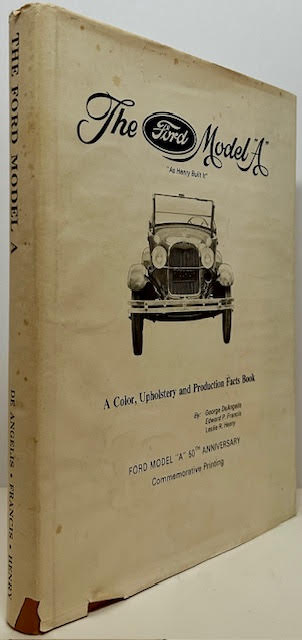
 "Ford Model A, As Henry Built It: Color, Upholstery and Production Facts Bookby: DeAngelis, George, Edward P. Francis, Leslie R. Henry")
 "Foreign Affairsby: Eden, Anthony")
 "Foreign Bonds; An Autopsy - A Study of Defaults and Repudiations of Government Obligationsby: Winkler, Max")
 "Foreign Labor in Nazi Germany by: Edward L. Homze")
 "Foreshadowings of Smith College, Selections from Letters of Louisa Dickinson to John Morton Greene, 1856-1857 by: Dickinson, Louisa; Greene, Helen French (ed.)")
 "Forever Alien: A Korean Memoir 1930 -1951by: Che, Sunny")
 "Form and Fancy: Factories and Factory Buildings by Wallis, Gilbert and Partners, 1916-1939by: Skinner, Joan S.")
 "Form in Indigenous Art. Schematisation in the art of Aboriginal Australia and prehistoric Europeby: Ucko, Peter J. (Ed.)")
 "Formative Decades, The: Photography in Great Britain, 1839-1920by: Flukinger, Roy")
 "Fort Huachuca by: Price, Ethel Jackson")
 "Fort Maurepas: The Birth of Louisiana 1699-1702 (SIGNED COPY)by: Jay Higginbotham")

 "Forty Years of Advertising 1869-1909by: N. W. Ayer & Son")
 "Forward-March!: The Photographic Record of America in the World War and the Post War Social Upheaval (Volumes 1 and 2) SIGNED COPYby: Mackey, Frank J. and Marcus Wils")

 "Four Acesby: Burtis, Thomson")
 "Four Years in Rebel Capitals (Collector's Library of the Civil War)by: DeLeon, Thomas Cooper")
 "Foursome: Alfred Stieglitz, Georgia O'Keeffe, Paul Strand, Rebecca Salsburyby: Burke, Carolyn")
 "Fourth World of the Hopis, Theby: Courlander, Harold")
 "Fragment AM 315 E of the older Gulathing law : from an old Norwegian codex of the XIIIth century, with facsimile and introductionby: George Tobias Flom")
 "Framing the West: The Survey Photographs of Timothy H. O'Sullivanby: Toby Jurovics, Carol Johnson, et al.")
 "Framing the West: The Survey Photographs of Timothy H. O'Sullivanby: Toby Jurovics, Carol Johnson, et al.")
 "Francesco II Gonzaga: The soldier-prince as patronby: Bourne, Molly")
 "Francis of Assisiby: Fortini, Arnaldo")
 "Frank Lloyd Wright-The Lost Years, 1910-1922: A Study of Influenceby: Alofsin, Anthony")