Softcover. NY, W. W. Norton & Company, reprint, 1975, Book: Very Good, Dust Jacket: None, Softcover, 396 pages including index. By focusing on the Howe brothers, their political connections, their relationships with the British ministry, their attitude toward the Revolution, and their military activities in America, Gruber answers the frequently asked question of why the British failed to end the American Revolution in its early years. This book supersedes earlier studies because of its broader research and because it elucidates the complex personal interplay between Whitehall and its commanders. Clean, bright copy.
Softcover. Honolulu HA, University Press of the Pacific, reprint, 2002, Book: Very Good, Dust Jacket: None, Softcover. First published in 1874, 448 pages with index. Clean, bright copy.
Hardcover. Berkeley, University of California Press, 1st, 1977, Book: Very Good, Dust Jacket: Good, Hardcover in a dust jacket with edge wear and chipping. 305 pages, maps, glossary, bibliography, index. This is a unique and fascinating account of how a World War II resistance movement become communist and its violent struggle against the Philippine government and USA backing. The Huk Rebellion is fundamental to the understanding of Philippines politics and its evolution. This account is written from the rebel's point of view and contains many interviews with combatants from both sides. It provides many lessons for both guerillas and counter-insurgent forces. Clean copy.
Hardcover. Princeton NJ, Princeton University Press, 1st, 1969, Book: Very Good, Dust Jacket: None, Hardcover, decorated boards with green cloth spine with gilt lettering. 116 pages, clean, bright copy, no dj. This is a collection of excerpts from the public addresses of Robert F. Goheen during his twelve years as President of Princeton University. The emphasis is on the people whose responsibility it is to promote and defend the principles underlying the modern American university-students, faculty, administrators, trustees, alumni. Several fundamental themes emerge the theme of individual responsibility, and the ever-present need to join rational intelligence with moral commitment, for example. Dr. Goheen sees the university as a continuing institution with long range goals, responding conservatively (in its best sense) to the human needs of the times. He seeks to define its institutional relationships in the context of the university's tasks in educ1tion and research, which must be understood and kept in balance if universities are to serve their functions effectively. Laid in are two reprints of postcards from the 1890s featuring Princeton athletes.
Softcover. New Haven CT, Yale University Press, 1st, 2014, Book: Very Good, Dust Jacket: Very Good, Softcover, 339 pages, b&w illustrations. The Hundred Years War (1337-1453) dominated life in England and France for well over a century. It became the defining feature of existence for generations. This sweeping book is the first to tell the human story of the longest military conflict in history. Historian David Green focuses on the ways the war affected different groups, among them knights, clerics, women, peasants, soldiers, peacemakers, and kings. He also explores how the long war altered governance in England and France and reshaped peoples' perceptions of themselves and of their national character. Clean copy.
Hardcover. NY, Columbia University Press, 1st, 1951, Book: Very Good, Dust Jacket: Very Good, Hardcover in a very good dust jacket, 278 pages. This carefully written, well-annotated book is more than an analysis of world government intended to ascertain upon what terms it would be both feasible and desirable. The author concludes it could only happen with an expansion of democratic societies throughout the world. Clean copy.
Hardcover. New York, Madison Square Press, 1st, 1993, Book: Very Good, Dust Jacket: Very Good, Hardcover, 355 pages, illustrated throughout in color and b&w. SIGNED BY AUTHORS on half title page. Over 700 illustrations by 460 artists. Early masters such as Howard Pyle, Charles Dana Gibson, A. B. Frost.followed by Frederic Remington, Howard Chandler Christy, Maxfield Parrish, James Montgomery Flagg, John Held, Jr. , Norman Rockwell, Stevan Dohanos, Albert Dorne and more contemporarily, by Bernard Fuchs, Austin Briggs, Mark English, Bob Peak, Brad Holland and Milton Glaser. Light edgewear and rubbing to dust jacket. Faint foxing to top edge, otherwise a clean, tight copy.
Hardcover. Charlottesville, VA, University Press of Virginia, 1st, 1981, Book: Very Good, Dust Jacket: Very Good, 185 pages. Black cloth cover with silhouette of Jefferson's head embossed to front and gilt lettering to spine, b&w illustrated dust jacket, 60 b&w figures, 8 b&w plates. Light wear to dust jacket; otherwise a very tight, clean copy.
Softcover. Urbana, University of Illinois Press, 1st, 2005, Book: Very Good, Dust Jacket: None, Softcover, 277 pages. Starting in the 1980s, anti-immigrant discourse shifted away from the "color" of immigrants to their religion and culture. It focused in particular on newcomers from Muslim countries--people feared both as terrorists and as products of tribal societies with values opposed to those of secular Western Europe. Leo Lucassen tackles the question of whether the integration process of these recent immigrants will fundamentally differ in the long run (over multiple generations) from the experiences of similar immigrant groups in the past. For comparison, Lucassen focuses on "large and problematic groups" from Western Europe's past (the Irish in the United Kingdom, the Poles in Germany, and the Italians in France) and demonstrates a number of structural similarities in the way migrants and their descendants integrated into these nation states. Lucassen emphasizes that the geographic sources of the "threat" have changed and that contemporaries tend to overemphasize the threat of each successive wave of immigrants, in part because the successfully incorporated immigrants of the past have become invisible in national histories. Clean copy.
Softcover. NY, American Italian Historical Association, 1st, 2007, Book: Very Good, Dust Jacket: None, Softcover, 244 pages, 35th Conference of the American Italian Historical Association . "'Italian Americans and World War II, ' explores many facets of the dynamic period of the 1940s and the consequences of war and peace. Scholars within AIHA and outside the academy have been slow to recognize the significance of World War II, now recognized as a seminal event in Italian-American life and culture. . . . "This volume is dedicated to all Italian Americans who lived and died, fought and prayed during World War II." Clean copy.
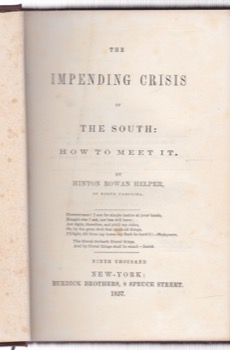
Hardcover. NY, Burdick Brothers, reprint, 1857, Book: Very Good, Dust Jacket: None, Hardcover, embossed brown cloth with gilt lettering on spine. Ninth thousand. The Impending Crisis is often considered the only popular antislavery work by a southern author prior to the outbreak of the Civil War. Helper (1829-1909)'s argument that "slavery was economically unsound" caused this work to be "officially banned in the South"; in the North, it "vied in popularity and influence with Uncle Tom's Cabin" (Howes). The book stoked fears among southern slaveholders that the "North would promote a class conflict among southern whites," and helped drive many towards secessionism. Bookplate on inside front cover, front fly leaf missing. Otherwise a clean copy in exceptionally nice condition.
Hardcover. Boston, Rockwell & Churchill, 1st, 1894, Book: Very Good, Dust Jacket: None, Hardcover, dark olive-green cloth with gilt lettering, 415 pages. Preface by William Whitmore. Vol. I ONLY. Name on front fly leaf, rear cover with light soil, otherwise internally clean.
Hardcover. London, Longmans Green & Co., 1st, 1876, Book: Very Good, Dust Jacket: None, Hardcover. An early Himalayan travel book by the first English woman to travel so far into the Eastern Himalaya. She and her British Army chaplain husband traversed the Nepal-Sikkim frontier from Darjeeling to Junnoo Mountain, overcoming many obstacles on the way. Although early, it is regarded as a mountaineering classic. 4to, xvi, 612 pages, chromolithograph frontispiece, large folding map, 9 chromolithographs, engraved vignettes, top edge gilt. Original red pictorial cloth with handsome gilt design on cover and spine, as well as elaborate borders.
Hardcover. Princeton NJ, Princeton University Press, 3rd pr., 2017, Book: Very Good, Dust Jacket: Very Good, Hardcover in a bright dust jacket, 316 pages. David Hume is widely regarded as the most important philosopher ever to write in English, but during his lifetime he was attacked as "the Great Infidel" for his skeptical religious views and deemed unfit to teach the young. In contrast, Adam Smith was a revered professor of moral philosophy, and is now often hailed as the founding father of capitalism. Remarkably, the two were best friends for most of their adult lives, sharing what Dennis Rasmussen calls the greatest of all philosophical friendships. The Infidel and the Professor is the first book to tell the fascinating story of the friendship of these towering Enlightenment thinkers-and how it influenced their world-changing ideas. The book follows Hume and Smith's relationship from their first meeting in 1749 until Hume's death in 1776. It describes how they commented on each other's writings, supported each other's careers and literary ambitions, and advised each other on personal matters, most notably after Hume's quarrel with Jean-Jacques Rousseau. Clean copy.
Hardcover. NY, Benjamin Blom, reprint, 1972, Book: Very Good, Dust Jacket: None, Hardcover, 271 pages. Originally published 1928, this is the 1972 re-issue. Introduction by Wallace Rice and illustrations by Norman Lindsay. 271 pages. Blue cloth with gold spine titles in darker blue title window, with light shelf-wear. Spine square. Binding sound. No jacket,
Hardcover. Boston, Little, Brown and Company, 1st, 1957, Book: Very Good, Dust Jacket: None, Hardcover, blue cloth with gilt lettering on spine. Volume XI in The History of United States Naval Operations in World War II. 360 pages, illustrated with maps (one fold-out) and b&w photos. Gilt on spine with light fading, lacks dust jacket, dj flap copy pasted inside front cover, otherwise clean, tight copy.
Hardcover. Princeton NJ, Princeton University Press, 1st, 1973, Book: Very Good, Dust Jacket: Good, Hardcover in a lightly worn dust jacket. Foreword by Joseph Frank. Erich Kahler sees cultural history as a subtle process in which reality plays upon consciousness and consciousness itself is forever transforming reality. He traces the ebb and flow of this relationship by studying changes in narrative form from its beginnings in the Gilgamesh Cycle to the end of the eighteenth century. The general direction is tow Erich Kahler sees cultural history as a subtle process in which reality plays upon consciousness and consciousness itself is forever transforming reality. He traces the ebb and flow of this relationship by studying changes in narrative form from its beginnings in the Gilgamesh Cycle to the end of the eighteenth century. Clean copy.
Hardcover. NY, Oxford University Press, 1st, 1985, Book: Very Good, Dust Jacket: Very Good, Hardcover in a bright, unclipped dust jacket, 364 pages. The Second World War's Pacific conflict was one of the most complex in history. It embrioled peoples from opposite sides of the globe; it was fought in China, across the expanses of the Pacific, and in the jungles of Southeast Asia; and it was devastating in its consequences for civilians and servicemen alike. It saw the first use of atomic weapons, hastened the end of the Western empires in Asia, and marked America's rise to the position of the most powerful nation in the world. Christopher Thorne, whose previous studies of the war in the Pacific have become landmarks in the field, here weaves together both the entire network of international relations surrounding the war and the impact the war had on all the societies involved--Indian as well as American; Australian and New Zealand as well as Japanese; Korean, Chinese, and Southeast Asian as well as British, French, and Dutch. The Issue of War draws on material gathered over many years in the Far East, Western Europe, and the U.S.--material including wartime films, broadcasts, and newspapers,as well as countless private and offical papers. Representing a synthesis of military, diplomatic, economic, intellectual, and social history, it not only places the war in the context of developments before 1941, but illuminates various patterns that cut across the familiar distinctions between Asia and the West or between Japan and the Allies. Name on front fly leaf, otherwise clean.
Softcover. NY, Center For Migration Studies, 3rd pr., 1999, Book: Very Good, Dust Jacket: None, Softcover, 230 pages. The Italians of San Francisco is the first comprehensive description of the economic and social aspects of the Italian migratory experience in San Francisco to be presented in a side-by-side bilingual edition, providing teachers and students of Italian and English with a linguistically definitive and an historically important learning tool. This text pieces together the fragmented story of one of the largest immigrant groups to come to California charting the history of their economic and social development as it began in San Francisco, and as it was to be found throughout California. The Italians of San Francisco tells the story of a community whose strength was maintained in the vibrancy and perseverance of its members, and whose accomplishments were achieved through the ambition and efforts of each of its members. Clean copy.
Softcover. Cambridge UK, Cambridge University Press, 1st pbk., 2002, Book: Very Good, Dust Jacket: None, Softcover, 359 pages. In this major reevaluation of Isaac Newton's intellectual life, Betty Jo Teeter Dobbs shows how his pioneering work in mathematics, physics, and cosmology was intertwined with his study of alchemy. Professor Dobbs argues that to Newton those several intellectual pursuits were all ways of approaching Truth, and that Newton's primary goal was not the study of nature for its own sake but rather an attempt to establish a unified system that would have included both natural and divine principles. She also argues that Newton's methodology was much broader than modern scholars have previously supposed, and she traces the evolution of his thought on the intertwined problems of the microcosmic "vegetable spirit" of alchemy and the "cause" of the cosmic principle of gravitation. Clean, bright copy.
Hardcover. Pinceton NJ, Princeton University Press, 1st, 1979, Book: Very Good, Dust Jacket: Very Good, Hardcover in a bright dust jacket, 315 pages. The Western ideal of individualism had a pervasive influence on the culture of the Meiji period in Japan (1868-1912). Janet Walker argues that this ideal also had an important influence on the development of the modern Japanese novel. Focusing on the work of four late Meiji writers, she analyzes their contribution to the development of a type of novel whose aim was the depiction of the modern Japanese individual. Professor Walker suggests that Meiji novels of the individual provided their readers with mirrors in which to confront their new-found sense of individuality. Her treatment of these novels as confessions allows her to discuss the development of modern Japanese literature and "the modern literary self" both in themselves and as they compare their prototypes and analogues in European literature. The author begins by examining the evolution of a literary concept of the inner self in Futabatei Shimei's novel Ukigumo (The Floating Clouds), Kitamura Tokoku's essays on the inner life, and Tayama Katai's I-novel Futon (The Quilt). She devotes the second half of her book to Shimazaki Toson, the Meiji novelist who was most influenced by the ideal of individualism. Here she traces Toson's development of a personal ideal of selfhood and analyzes in detail two examples of the lengthy confessional novel form that he created as a vehicle for its expression.
Hardcover. NY, James Pott & Co., 1st, 1905, Book: Very Good, Dust Jacket: None, Hardcover, blue cloth with bright gilt design to cover, gilt lettering on spine, 127 pages. Introduction by George Meredith. Bookplate/name on inside front cover. Otherwise a clean, bright copy.

 "The Howe Brothers and the American Revolution by: Ira D. Gruber")
 "The Huguenots: Their Settlements, Churches, and Industries in England and Ireland: With an Appendix Relating to the Huguenots in America by G.P. Disoswayby: Smiles, S")
 "The Huk Rebellion: A Study of Peasant Revolt in the Philippines by: Benedict J. Kerkvliet")
 "The Human Nature of a University by: Goheen, Robert F.")

 "The Hungarian Revolutionby: George Mikes")
 "The Idea and Practice of World Government by: Mangone, Gerard J.")
 "The Illustrator in America, 1880-1980: A Century of Illustration (SIGNED COPY)by: Reed, Walt and Roger Reed")
 "The Image of Thomas Jeffersonby: Cunningham, Jr., Noble E.")
 "The Immigrant Threat: The Integration of Old and New Migrants in Western Europe since 1850 by: Leo Lucassen")
 "The Impact of World War II on Italian Americans 1935-Present by: Mormino, Gary R. (Ed.)")
 "The Impending Crisis of the South: How to Meet Itby: Hinton Rowan Helper")

 "The Inaugural Addresses of the Mayors of Boston. VOLUME I. from 1822 to 1851 by: City Registrar Of Boston")
 "The Indian Alps and how we crossed them:being a narrative of wo years' residence in the Eastern Himalaya and two months' tour into the interior by: Lady Pioneer A pse")


 "The Invasion of France and Germany, 1944-1945: History of United States Naval Operations in World War II, Volume 11 by: Morison, Samuel Eliot")
 "The Inward Turn of Narrative (Bollingen Series)by: Erich Kahler")
 "The Issue of War: States, Societies, and the Far Eastern Conflict, 1941-1945 by: Thorne, Christopher")
 "The Italians of San Francisco 1850-1930 - Gli Italiani Di San Francisco 1850-1930 (Bilingual Edition)by: Deanna Paoli Gumina")
 "The Janus Faces of Genius: The Role of Alchemy in Newton's Thoughtby: Dobbs, Betty Jo Teeter")
 "The Japanese Novel of the Meiji Period and the Ideal of Individualismby: Janet A. Walker")
 "The Japanese Spirit by: Okakura Yoshisaburo")
 "The Jews of East Central Europe Between the World Wars by: Mendelsohn, Ezra")