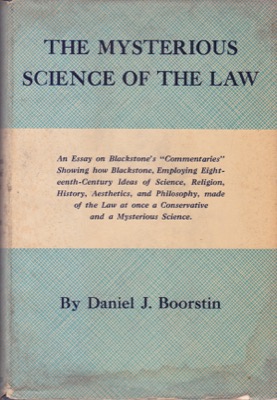
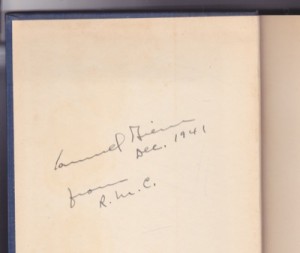
Hardcover. Cambridge MA, Harvard University Press, 1st, 1941, Book: Very Good, Dust Jacket: Fair, Hardcover in a worn, soiled dust jacket. Bright blue cloth covers with spine label. 257 pages. Frontispiece, 9 black and white illustrations. The Mysterious Science of Law was based on Boorstin's Yale SJD thesis. (He also held an Oxford BCL and was admitted to the Inner Temple.). It was the first of many important books by Boorstin, who went on to became a prominent historian and, from 1975 to 1987, Librarian of Congress. Appears to se SIGNED on the inside cover and dated Dec., 1941. Otherwise a clean copy.
Hardcover. NY, Kraus Reprint, reprint, 1977, Book: Very Good, Dust Jacket: None, Hardcover, brown cloth, 341 pages. A reprint of a book first published in 1856. No dust jacket issued.
Hardcover. Princeton Architectural Press, 1st, 2005, Book: Very Good, Dust Jacket: Very Good, Hardcover, 224 pages. Daring, bold, dramatic, towering, impossibly glamorous: this is how we imagine New York in its golden age, and this is how Samuel H. Gottscho, the preeminent architectural photographer of his generation, captured it. Through his lens, New York of the 1930s became the quintessential modern metropolis, a round-the-clock city in which night was as charismatic as day. Rigorously editing out the Depression-weary city's more seamy aspects--its tenement slums, breadlines, and soup kitchens--Gottscho presented a dreamlike Gotham of skyscrapers and penthouse luxury that literally and figuratively glowed with glamour's sheen. His gimlet eye focused on the bold interplay of sun and shadow, dramatizing the chiseled forms of Manhattan's signature skyline and bridges. The Empire State and Chrysler buildings, Rockefeller Center, the Plaza, the George Washington Bridge--Gottscho brought them all to sparkling life. In this beautifully produced, landmark book, historian Donald Albrecht presents 175 of Gottscho's extraordinary images of the city, from the Battery to Harlem. An introductory essay tells the story of this legendary photographer, describing his working methods and philosophy, while placing his work in the broader context of photographic history.
Hardcover. Washington DC, National Geographic Society, 1924, Book: Very Good, Dust Jacket: None, Hardcover, red cloth covers with black spine labels with gilt lettering. Six issues from the first half of 1924, 696 pages devoid of ads or inserts. Clean, bright pages, some color, mostly b&w. Include:s 1, Lost Tribes of Islam, Eastern Darfur; 2, Carthage Acheology; 3, Sahara by Automobile; 4, Hawaiian Islands; 5, Sakurajima, Japan volcanic eruption; 6, Norway; and 7, Tunisia. Clean, no markings. DOMESTIC SHIPPING ONLY.
Hardcover. Washington DC, National Geographic Society, 1913, Book: Very Good, Dust Jacket: None, Hardcover, red cloth covers with faded black spine labels with gilt lettering flaking, faded. Six issues from the second half of 1913, 597 pages devoid of ads or inserts. Clean, bright pages, some color, mostly b&w. Clean, no markings. DOMESTIC SHIPPING ONLY.
Hardcover. Washington DC, United States Government Printing Office, 4th Ed., 1925, Book: Very Good, Dust Jacket: None, Hardcover, green cloth with gilt lettering, 270 pages, b&w photos throughout. This 4th Edition contains new information on 10 new national monuments and three new pictures, updated from the 1921 3rd ed. Name on inside front cover, otherwise tight, clean copy.
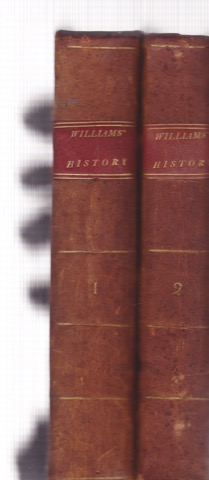
Burlington VT, Samuel Mills, 2nd Ed., 1809, Book: Very Good, Dust Jacket: None, Hardcovers, 2 volume set. Second Edition, Corrected and Much Enlarged, after the first edition of 1794. 487 total pages. Vol. 1 does NOT have the folding map frontis. The handwritten name of Peter Starr (1778-1860) appears on the title page of both volumes. He was the head of a prominent Middlebury family whose name now graces two buildings: Starr Hall and Starr Library (now home to the Axinn Center). Brown calf covers with some rubbing and chipping to edges, red morocco spine labels with gilt lettering. Clean, tight set.
Hardcover. Chapel Hill , University of North Carolina, 1st, 1949, Book: Very Good, Dust Jacket: None, Hardcover, dark green cloth, gilt lettering, design on spine, 280 pages. "The story of a Confederate childhood, a Reconstruction boyhood, and the education of a medical pioneer in the new South." This book is first of all a personal narrative that is alternately dramatic, thoughtful, and hilariously funny. It is also a vivid picture of plantation life before and during the Civil War and the beginnings of the building of a New South. Clean copy, spine a bit darkened.
Hardcover. Seattle, University of Washington Press, 1st, 2003, Book: Very Good, Dust Jacket: Very Good, Hardcover in a bright dust jacket. 290 pages, b&w illustrations. In 1896, a small group of prospectors discovered a stunningly rich pocket of gold at the confluence of the Klondike and Yukon rivers, and in the following two years thousands of individuals traveled to the area, hoping to find wealth in a rugged and challenging setting. Ever since that time, the Klondike Gold Rush - especially as portrayed in photographs of long lines of gold seekers marching up Chilkoot Pass - has had a hold on the popular imagination. In this first environmental history of the gold rush, Kathryn Morse describes how the miners got to the Klondike, the mining technologies they employed, and the complex networks by which they obtained food, clothing, and tools. She looks at the political and economic debates surrounding the valuation of gold and the emerging industrial economy that exploited its extraction in Alaska, and explores the ways in which a web of connections among America's transportation, supply, and marketing industries linked miners to other industrial and agricultural laborers across the country. The profound economic and cultural transformations that supported the Alaska-Yukon gold rush ultimately reverberate to modern times. Clean copy.
Hardcover. Cambridge MA, Harvard University Press, 1st, 2003, Book: Very Good, Dust Jacket: Very Good, Hardcover in a bright dust jacket, 362 pages. Hitler, Koonz says, understood the German people's need for a sense of coherence in the wake of what many saw as the degeneracy of the Weimar Republic--and 'he promised to rescue old-fashioned values of honor and dignity' by offering a secular faith to replace lost religious certainties. Koonz explores the promotion of these beliefs in German culture and law, and how they led to the catastrophe of the Holocaust, adding much to our understanding of how a civilized society could reach such infamous levels of violence. Clean copy.
Softcover. Washington DC, The Infantry Journal, reprint, 1944, Book: Very Good, Dust Jacket: None, Small softcover, 335 pages. "The primary purpose of this book is to provide a guide to the main forces, institutional and ideological, in the Nazi system." Published for the American servicemen. Name on front cover,mild wear to covers.
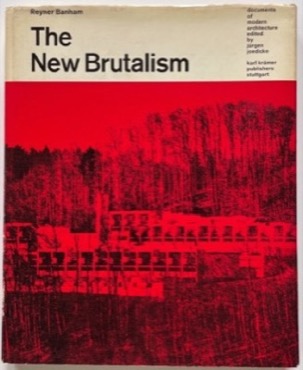
Hardcover. London, The Architectual Press, 1st, 1966, Book: Very Good, Dust Jacket: Good, Hardcover in a bright, lightly edgeworn dust jacket. First edition of Reyner Banham's foundational disquisition on Brutalist architecture presenting, per the liner notes, a scholarly history of the documentable facts on Brutalism, an eye-witness account of the period and personalities that produced it, and a comparative critique of numerous buildings regarded rightly or wrongly as examples of Brutalist architecture. Explores texts and buildings by an international roster of architects including Le Corbusier, Mies van der Rohe, James Stirling, Sir Owen Williams, Louis Kahn, Johannes van den Broke, Vladimir Bodiansky, William G. Howell, Richard Llewelyn-Davies, Denys Lasdun, Sir Basil Spence, Peter Moro, Andre Wogenscky, Atelier 5, Walter Forderer, Sverre Fehn, Oswald Mathias Ungers, Sir Leslie Martin, Vittorio Vigano, Aldo van Eyck, Paul Rudolph, Kiyonori Kikutake, Kunio Mayekawa, and not least, the architects regarded by Banham as the founders of the New Brutalism, Peter and Alison Smithson. 196 pages, illustrated throughout in black-and-white. Clean copy.
Softcover. Cambridge UK, Cambridge University Press, reprint, 1975, Book: Very Good, Dust Jacket: None, Softcover, 532 pages. In a preface written for this paperback edition, Professor Hay examines some of the changes in Renaissance scholarship since the first publication of this volume in 1957. Successive chapters examine the social and economic structure of a continent about to establish trade and colonies in the New World, the intellectual and artistic movements which made up the Renaissance, the position of the Church on the eve of the Reformation, the political inheritance of the Middle Ages, with its rising nation states, and the growth of the Ottoman Empire. Clean copy.
Hardcover. Ithaca NY, Cornell University Press, 1st, 1968, Book: Very Good, Dust Jacket: Very Good, Hardcover in a bright, unclipped dust jacket, 387 pages. A study of nationalisms of the modern world on all continents. Includes Black Nationalism in Africa. Name on front fly leaf otherwise clean.
Hardcover. NY, The Outlook Company, 1st, 1910, Book: Very Good, Dust Jacket: None, Hardcover, bright red cloth with gilt lettering, top edge gilt, 268 pages. Collects speeches made by Roosevelt in August and September 1910 on his tour of the United States, in which he espoused his political platform of social welfare and opposition to corporate political power. Bookplate on inside front cover, otherwise a clean, sharp copy.
Hardcover. NY, Verso, 1st, 2009, Hardcover in a bright, unclipped dust jacket, 561 pages. The New Old World looks at the history of the European Union, the core continental countries within it, and the issue of its further expansion into Asia. It opens with a consideration of the origins and outcomes of European integration since the Second World War, and how today's EU has been theorized across a range of contemporary disciplines. It then moves to more detailed accounts of political and cultural developments in the three principal states of the original Common Market-France, Germany and Italy. A third section explores the interrelated histories of Cyprus and Turkey that pose a leading geopolitical challenge to the Community. The book ends by tracing ideas of European unity from the Enlightenment to the present, and their bearing on the future of the Union. The New Old World offers a critical portrait of a continent now increasingly hailed as a moral and political example to the world at large. Clean copy.
Hardcover. NY, Macmillan , 1st, 1970, Book: Good, Dust Jacket: Good, Hardcover in a dust jacket, 383 pages. Ex-lib with light stamping, spine label, dust jacket glued to covers. Clean inside. The complete and authoritative history of the Mets. Has 150 pages of records: the team, every player, each season. Has 64 pages of action and behind-the-scenes photographs of the team and the players. Filled with action and anecdote, from October 17, 1960 when the National League awarded a franchise to New York to the miracle year of 1969 and the Mets were World Champions.
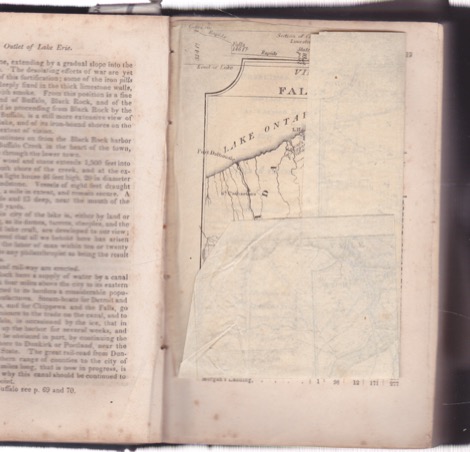
Hardcover. NY, A. T. Goodrich, 1st, 1839, Book: Good, Hardcover, publisher's ribbed dark green cloth, gilt-lettered at the spine. Cloth tight and sound. 12mo, With four views and nine (of 10) maps, all in very good condition. The map opposite page 78 pertaining to the Niagara Falls area has been excised. Previous owner's 1840 ownership signature on reverse on copyright page bleeds through to title page. Water stain to front endpapers, affects first 10 pages, otherwise tight and clean.
Hardcover. NY, Charles Scribner's Sons, 1st, 1906, Book: Very Good, Dust Jacket: None, Hardcover, blue cloth with gilt stamping on spine and front cover. Hardcover. Light overall wear, very good, clean & sound condition without dust jacket. 443 pages with maps and a facsimile reproduction, all excellent condition. Publisher's promotional flyer jaid in. Clean copy.
Hardcover. NY, The Century Co., 1st, 1917, Book: Good, Dust Jacket: None, Hardcover, green cloth stamped in gilt. 346 pages. Frontis. portrait, illustrated with b&w plates and folding facsimile documents. "Authoritative information as to how the soldiers of the Allies are transported, housed and trained, how a battle is prepared for in advance, etc. " Author observed British Postal Censorship and war, including trench-fighting, during WWI. Eric Fisher Wood, Sr. (1889 1962) was an American civil engineer, architect, author, and officer in the United States Army, retiring with the rank of Brigadier General. Book shows mild shelf wear, name and stamp to front endpapers, otherwise clean. Good plus.
Softcover. NY, National Railway Publication Company, 1939, Book: Very Good, Dust Jacket: None, Softcover, original printed paper wrappers, 1536 pages. Thick handbook for the railroad steamboat trade, with detailed schedules, maps, advertisements, all pertaining to the shipment of goods. Printed on thin, cheap stock that's tanning. Still very good wth clear tape reinforcement to spine.
Hardcover. Chicago, University Of Chicago Press, 1st, 1990, Book: Very Good, Dust Jacket: Very Good, Hardcover in a bright dust jacket, 280 pages. This American art history book explores the early cultural development of the movement in Chicago, pulling from previously unpublished primary sources. 20 color reproductions along with black and white photographs and sketches and a timeline in the back. First study of Modernism in Chicago, examining the struggle between the "old guard's" ideals of traditional 19th century art versus an "avant garde" of painters, illustrators, photographers, and sculptors. Focuses on the cultural context in which art evolved. Clean copy.
Softcover. NY, Vintage Books, reprint, 1982, Book: Very Good, Dust Jacket: None, Softcover, 309 pages. The "old revolutionaries" were Samuel Adams, Isaac Sears, Thomas Young, Richard Henry Lee, and Charles Carroll. Of widely varying backgrounds and interests, all of them had their greatest influence in the years between 1769 and 1776, and all of them saw their power transferred after the war to the men we know as "the Founding Fathers." In telling the stories of these men, Maier shows how the American Revolution was less a collective movement than a commitment to an ideal of a republic, which different people interpreted differently. She describes not just why Americans made the Revolution, but what the Revolution did to them.

 "The Mysterious Science of the Law: An essay on Blackstone's commentaries showing how Blackstone, Employing Eighteenth-century Ideas of Science, Religion, History, Aesthetics, and Philosophy, made of the Law at once a Conservative and")
 "The Myth of Hiawatha: And other oral legends, mythologic and allegoric, of the North American Indianby: Schoolcraft, Henry")
 "The Mythic City: Photographs of New York by Samuel H. Gottscho, 1925-1940by: Donald Albrecht")
 "The National Geographic Magazine, Vol. XLV (45), No. 1 - No. 6 (January - June, 1924)by: N/A")
 "The National Geographic Magazine, Vol. XXIV (24), No. 7 - No. 12 (July - December, 1913)by: N/A")
 "The National Parks Portfolio by: Robert Sterling Yard")
 "The Natural and Civil History of Vermontby: Williams, Samuel")

 "The Natural Bent:The Memoirs of Dr. Paul B. Barringer by: Barringer, Paul B.")
 "The Nature of Gold: An Environmental History of the Klondike Gold Rushby: Morse, Kathryn")
 "The Nazi Conscience by: Claudia Koonz")
 "The Nazi Stateby: William Ebenstein")
 "The New Brutalism: Ethic or Aesthetic?by: Reyner Banham")

 "The New Cambridge Modern History, Vol. 1: The Renaissance, 1493-1520 by: G. R. Potter, Editor: Denys Hay")
 "The New Nationalism by: Snyder, Louis L.")
 "The New Nationalismby: Theodore Roosevelt /Introduction by Ernest Hamlin Abbott")
 "The New Old Worldby: Perry Anderson")
 "The New York Mets: The Whole Storyby: Koppett, Leonard")
 "The Night The Revolution Began: The Boston Tea Party, 1773by: Wesley S. Griswold")
 "The North American Tourist by: N/A")
 "The Northmen Columbus and Cabot 985 1503: The Voyages of the Northmen edited by Julius E. Olson; The Voyages of Columbus and of John Cabot edited by Edward Gaylord Bourne.; Original Narratives of Early American History")
 "The Note-Book of an Intelligence Officerby: Wood, Eric Fisher")
 "The Official Guide of the Railways and Steam Navigation Lines of the United States, Canada, Porto Rico, Mexico and Cuba. 72d Year, No. 9, October 1939by: National Rai")
 "The Old Guard and The Avant Garde: Modernism In Chicago, 1910-1940by: Prince, Sue Ann (editor)")
 "The Old Revolutionaries: Political Lives in the Age of Samuel Adams by: Pauline Maier")