Softcover. St. Johnsbury VT, St. Johnsbury Republican, 1t, 1928, Book: Very Good, Dust Jacket: None, Softcover, 120 pages. A pictorial chronicle of the flood considered "the worst natural disaster to ever strike Vermont in modern times" covering the state with 8.71 inches of rain. According to the National Weather Service, "1285 bridges were lost as well as countless numbers of homes and buildings destroyed and hundreds of miles of roads and railroad tracks washed out." The book shows the results of the rainfall: rising water, destroyed railroad tracks, and leveled houses. Name on front fly leaf otherwise a clean copy in exceptional condition.
Softcover. NY, Ballantine Books, reprint, 1989, Book: Very Good, Dust Jacket: None, Softcover, 242 pages, b&w illustrations. Describes the causes and background of the Zulu War, recounts the experiences of British and Zulu survivors, and looks at the strategies and tactics of the war. Clean copy.
Hardcover. UK, Imprint Academic, 1st, 2004, Book: Very Good, Dust Jacket: Very Good, 208 pages. Clean, unmarked copy with only minor wear to dust jacket. This book examines Oakeshott's political philosophy within the context of his more general conception of philosophical understanding. The book stresses the underlying continuity of his major writings on the subject and takes seriously the implications of understanding the world in terms of modality. The book suggests strongly that Oakeshott's philosophy of political activity cannot be reduced to a branch of conservatism, liberalism, or postmodernism or a theory or set of doctrines which fit neatly into any conventional school, like that of Idealism or Skepticism. Rather, Oakeshott's philosophy of political activity is a provocation to all of the currently dominant schools of political theory and political practice. It questions their presuppositions and exposes as ambiguous, arbitrary, or confused all of the supposed certainties which they take for granted. It does all this by offering profound insights into the character and limits of both political activity and political theory in the modern world.
Hardcover. San Marino,CA, The Huntington Library, 1st, 1949, Book: Very Good, Dust Jacket: Very Good, Hardcover in a lightly worn, price-clipped dust jacket, 161 pages. Official records from the Pinkerton detective agency & other documentary sources are drawn on to present the story of "a plot and counterplot, stranger than fiction" involving a plan to assassinate president-elect Abraham Lincoln while en route to his inauguration in Washington in 1861, over 4 years before he was killed by John Wilkes Booth at Ford's Theatre. Previous owner's inscription on front fly leaf, otherwise clean.
Hardcover. London, Eliot Stock, 1st, 1896, Book: Fair, Dust Jacket: None, AUTHOR'S INSCRIPTION on tipped-in card. 241 pages, b&w illustrations by Alfred Beaver and others. Light green cloth covers w/ gilt lettering and design. Ink markings to first few pages. Wear to cover corners. Hinges cracked. Staining to end papers and some pages.
Softcover. Barre VT, Modern Printing Co., 1st, 1980, Book: Very Good, Dust Jacket: None, Softcover, 104 pages. Green paper wrapper with tipped on color photograph, black lettering, Fold-out map in rear.
Hardcover. NY, Harcourt Brace & Co., 1st, 1993, Book: Very Good, Dust Jacket: Very Good, Hardcover in a bright dust jacket, 226 pages. Bringing Lincoln's own words to young readers, a collection of the sixteenth president's speeches, letters, and writings reveals the man behind the politician and is highlighted by linocut illustrations depicting Lincoln and his times by Stephen Alcorn. Clean copy.
Hardcover. London, Jonathan Cape, 1st, 2007, Book: Very Good, Dust Jacket: Very Good, Hardcover, 773 pages, b&w illustrations. Clean, unmarked copy with only minor wear to dust jacket.
London, Athlone Press, 1st, 1958, Book: Very Good, Dust Jacket: Very Good, Hardcover in a bright, unclipped dust jacket, 151 pages. Previous owner's name inside front cover. Clean otherwise.
Hardcover. Athens, Ga., Hill Street Press, LLC, 1st, January 1999, Book: Very Good, Dust Jacket: Very Good, Hardcover, 155 pages. B&w illustrations throughout. Light spotting to top edge. Rubbing and light soiling to dust jacket. Else a nice, clean copy.
Hardcover. Albuquerque, University of New Mexico Press, 1st, 1995, Book: Very Good, Dust Jacket: Very Good, Hardcover in a bright dust jacket. 250 pages. b&w illustrations. The Progressive Era promoted a vision of America united by an emphasis on science and progressive reform. The zeal to modernize business, government and social relations extended to farm families and the ways women defined their roles. In this study of the expert advice offered by the domestic economy movement, Holt argues that women were not passive receptors of these views. Seeing their place in agriculture as multi-faceted and important, they eagerly accepted improved education and many modern appliances but often rejected suggestions conflicting with their own views of the rewards and values of farm life. Progressive reform inevitably left a mixed legacy; science and technology did not perfect rural society. But many programs such as 4-H and Master Homemaker still exist and are still shaped by women's desire to preserve and pass on the possibilities of rural life. Clean copy.
London, John Murray, 1st, 1963, Book: Very Good, Dust Jacket: Good, Hardcover in a lightly worn dust jacket, 229 pages illustrated in b&w by Victor Ambrus. The early (1914-34) and very readable Kenya memoirs of an administration official. Seaton presents his own particular vision of East Africa as it was from 1913 to 1926, the unsophisticated Africa with its peoples and wild life, before the golden age came to an end. Previous owner's name on front fly leaf, otherwise clean.
Hardcover. US, Damiani, 1st, 2012, Book: Very Good, Dust Jacket: None, Hardcover, 144 pages. Like new in publishers shrink-wrap. Spanning 50 years and three generations, Joe's Junk Yard is a personal narrative that explores the history of the family's scrap metal business. Kereszi's disquieting, tender photographs of the last decade of the junkyard, accompanied by business ephemera and family scrapbook photographs, tell the story of this family and its struggles with a changing economy.
Hardcover. Baltimore MD, Genealogical Publishing Company, reprint, 1999, Book: Very Good, Dust Jacket: None, Hardcover, blue cloth with gilt lettering, 351 pages. Edmund Bailey O'Callaghan's Documentary History of the State of New-York, published in four volumes between 1849 and 1851, is one of the key source-books for genealogical and historical research in New York State. Interspersed throughout its more than 4,350 pages are copies of important genealogical records of the seventeenth and eighteenth centuries, among which are census records, rate lists, lists of early settlers, and rolls of militia companies. This present volume is an extract of all the important genealogical records in the O'Callaghan work, brought together in just under 300 pages, contains a complete index of names, and overcomes, for individuals unfamiliar with Dutch or German nomenclature, the confusion caused by variant spellings of family names. The records are arranged in this work in the same sequence in which they appear in the Documentary History. Clean, bright copy.
Hardcover. NY, The Macmillan Company,, 1st, 1948, Book: Very Good, Dust Jacket: Very Good, Three hardcover volumes in bright dust jackets, complete set. Blue cloth covers and gilt spine lettering. Volumes 1 & 2 are historical and cover the development of American literature from its European roots, and volume 3 is a comprehensive bibliography. This is a standard work in its field. Vol. 1: 636 pages, Vol.2: 639-1422; Vol. 3: 817 pages. The contents are clean and unmarked--there are no bookplates or ownership names. Dust jackets in protective mylar, no slipcase.
Hardcover. US, Combined Books, 1st, 1993, Book: Very Good, Dust Jacket: Very Good, Hardcover, 312 pages, b&w illustrations. Light shelf-wear to dust jacket, else a clean, tight copy. The destruction of George Armstrong Custer's command at Little Bighorn by the Sioux and Northern Cheyenne on 25 June, 1876 has been etched in the national memory and has remained one of America's longest lingering controversies. The Little Bighorn Campaign penetrates the mysteries of Custer's disaster as well as the broader context of the 1876 campaign against the Sioux.
Hardcover. Evergreen/Taschen, 1st, 2000, Book: Very Good, Dust Jacket: Very Good, Hardcover, 432 pages. A reproduction of some of the "Little Nemo" comic strip from the early 20th century. This volume reflects the distinctive art-nouveau style of the original drawings and follows Little Nemo as he journeys nightly into the world of dreams. The strip was introduced to America over a century ago, and these pages still have the power to astonish and touch anyone that reads them. The utter timelessness of this strip, both in artwork and vision, is the kind of testament to genius that very few graphic artists ever receive. Winsor McCay was such a genius and his major work, Little Nemo in Slumberland, is a vastly rich exploration of human dreams.
Hardcover. London/New York, Edward Arnold, 1st, 1895, Book: Very Good, Dust Jacket: None, 297 pages. Hardcover with no dust jacket. Red cloth covers with gilt design. Multiple gutter cracks. Moderate to heavy rubbing to edges. Top corners bumped. Clean copy.
Hardcover. Boston, Little, Brown & Company, First Edition, 2002, Book: Very Good, Dust Jacket: Very Good, 594 pages. Hardcover. Black & white illustrations throughout. Dust jacket with light marginal wear. Features behind the scenes gossip & interviews with a wide variety of stars, writers & guests, too numerous to detail here. Clean, unmarked copy.
Hardcover. New York , W. W. Norton & Company, 1st, 2007, Book: Very Good, Dust Jacket: Very Good, Hardcover. Like new in publishers shrink-wrap. 352 pages, b&w illustrations. A photographic account of Jewish life in America draws on the archives of the premiere national Jewish newspaper, Forward, in a visual tribute that pairs essays by leading intellectuals, including Leon Weiseltier and Deborah E. Lipstadt, with images of such subjects as a shtetl beauty contest, Lower East Side pushcart markets, and labor rallies.
Hardcover. Oxford UK, Clarendon Press, 1st, 1991, Book: Very Good, Dust Jacket: Very Good, Hardcover set, complete in two volumes, both with bright dust jackets. Locke on Money presents for the first time the entire body of the philosopher's writings on this important subject (other than Two Treatises of Government). Accurate texts, together with an apparatus listing variant readings and significant manuscript changes, record the evolution of Locke's ideas from the original 1668-74 paper on interest to the three pamphlets on interest and coinage published in the 1690s. The introduction by Patrick Hyde Kelly establishes the wider context of Locke's writings in terms of contemporary debates on these subjects, the economic conditions of the time, and the circumstances of writing and publication. It shows, notably, that Locke's supposed responsibility for the 1696 recoinage is a myth. The account of what Locke derived from Mercantilist writings and of how he reformulated these in accordance with his philosophy illuminates his contribution to the evolution of economics, and will aid reappraisal of Two Treatises. The picture that emerges confirms Locke's status as major economic thinker, contrary to the prevalent view of recent decades. There are two volumes in the edition. The first contains the introductory matter, and the texts of the Early Writings on Interest, 1688-74, and Some Considerations. The second comprises Short Observations, Further Considerations, and the Appendices, Bibliography, and Index. 664 total pages. Name on front fly leaf in Vol. 1, otherwise clean.
Hardcover. London, Bucknell University Press, 1st, 2003, Book: Very Good, Dust Jacket: Very Good, Hardcover in a bright dust jacket, 199 pages. This book shows how, in his enormously influential Essay Concerning Human Understanding (1689), John Locke embraces the new rhetoric of seventeenth-century natural philosophy, adopting the strategies of his scientific contemporaries to create a highly original natural history of the human mind. With the help of Locke's notebooks, letters, and journals, Peter Walmsley reconstructs Locke's scientific career, including his early work with the chemist Robert Boyle and the physician Thomas Sydenham. He demonstrates too how the Essay embodies in its form and language many of the preoccupations of the science of its day, from the emerging discourses of experimentation and empirical taxonomy to developments in embryology and the history of trades. Widely research and lucidly and engagingly written, Locke's Essay and the Rhetoric of Science constitutes an important new reading of Locke, on that shows both his brilliance as a writer and his originality in turning to science to effect a radical re-invention of the study of the mind. Pencil marking to front fly leaf, otherwise clean.
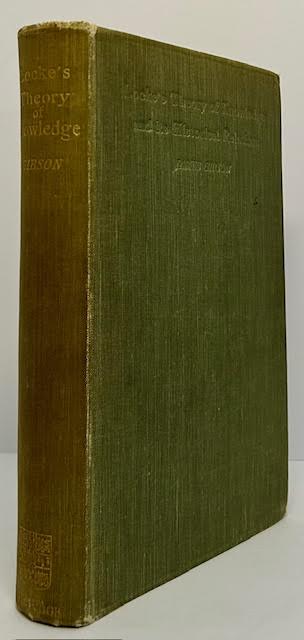
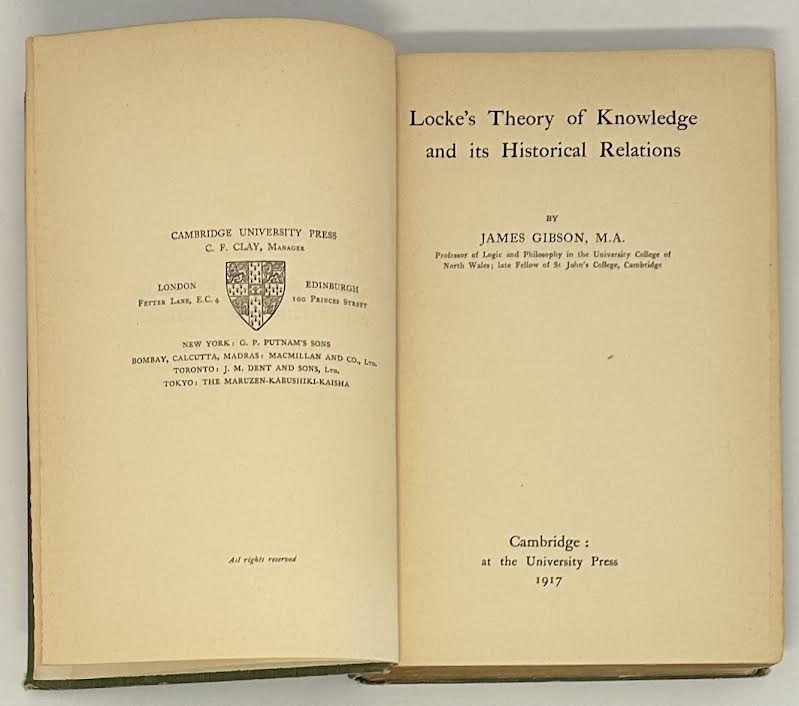
Hardcover. London, England, Cambirdge at the University Press, 1st Edition, 1917, Book: Good, Dust Jacket: None, 338 pages. Hardcover. Green cloth cover boards, gilt title on spine and front cover board, gilt faded on cover, some agewear. Some light pencil within. Previous owner's name on front flyleaf. Some tanning to pages and edges.

 "Lights and Shadows of the Flood of 1927: Vermont at Its Worst, Vermonters at Their Bestby: Charles T. Walter")
 "Like Lions They Fought: The Zulu War and the Last Black Empire in South Africaby: Edgerton, Robert B.")
 "Limits of Political Theory, The: Oakeshott's Philosophy of Civil Association by: McIntyre, Kenneth B.")
 "Lincoln and the Baltimore Plot, 1861by: Cuthbert, Norma B. (Editor)")
 "LINCOLN'S INN FIELDS AND THE LOCALITIES ADJACENT: Their Historical and Topographical Associationsby: Heckethorn, Charles W.")
 "Lincoln: History of a Mountain Town from First Settlements to the Present. by: Reed, Richard V.")
 "Lincoln: In His Own Words by: Abraham Lincoln (Author), Milton Meltzer (Editor), Stephen Alcorn (Illustrator)")
 "Line Upon a Wind: An Intimate History of the Last and Greatest War Fought at Sea Under Sail: 1793-1815by: Mostert, Noel")
 "Lineage Organization In Southeastern Chinaby: Maurice Freedman")
 "Lines Are Drawn: Political Cartoons of Civil Warby: Smith, Kristen M.")
 "Linoleum, Better Babies and the Modern Farm Woman, 1890-1930 by: Marilyn Irvin Holt")
 "Lion in the Morningby: Seaton, Henry")
 "Lions and Foxes - Men and Ideas of the Italian Renaissanceby: Alexander, Sidney")
 "Lisa Kereszi: Joe's Junk Yardby: Strand, Ginger")
 "Lists of Inhabitants of Colonial New York: Excerpted from the Documentary History of the State of New York by: O'Callaghan, Edmund Bailey")
 "Literary History of the United States (3 volumes)by: Robert E.Spiller, Willard Thorp, Thomas H. Johnson, Henry Seidel Canby (editors)")
 "Little Bighorn Campaign, The : March-September 1876 (Great Campaigns Series)by: Sarf, Wayne Michael")
 "Little Nemo: 1905-1914by: Winsor McCay and Bill Blackbeard")
 "Little Tour in America, Aby: Hole, S. Reynolds")
 "Live From New York - An Uncensored History of Saturday Night Liveby: Shales, Tom/James Andrew Miller")
 "Living Lens, A: Photographs of Jewish Life from the Pages of the Forwardby: Newhouse, Alana")
 "Locke on Money. Edited together with Ancillary Manuscripts, an Introduction, Critical Apparatus, and Notes by Patrick Hyde Kelly.(2 Volumes)by: Locke, John and Kelly,")
 "Locke's Essay and the Rhetoric of Science by: Walmsley, Peter")
 "Locke's Theory of Knowledge and its Historical Relationsby: Gibson, James")