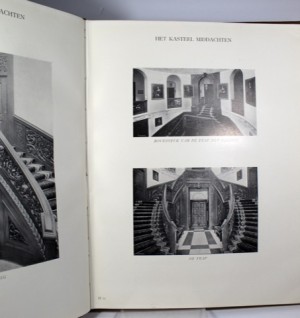
Softcover. Amsterdam, Amsterdam Scheltema en Holkema's Boekhandel, First Edition, 1912, Book: Very Good, Dust Jacket: None, Hardcover, large folio size, in Dutch text. 40 pages text followed by 470 plates in black & white. Brown cloth covered boards with embossed illustration in black & gilt. Moderate rubbing, scuff marks to covers. Fraying to head & heel of spine. Gilt titles to cover & spine. Tender front board with crack to top quarter hinge. Toning to edges throughout. Striking, full page black & white illustrations detailing castles, gardens, mansions, intricate woodwork throughout. Previous owner's signature & stamp to front flyleaf. Otherwise clean & unmarked.
Hardcover. Glens Falls, Champlain Publishing, 1st, 1914, Book: Very Good, Dust Jacket: None, 255 pages. Blue cloth covers with title rubbed from spine and some rubbing to gilt title on cover. Book has slight damp smell. Clean, tight copy.
Hardcover. Scranton PA, Newmarket, 1st, 1999, Book: Very Good, Dust Jacket: Very Good, Hardcover in a bright dust jacket. Illustrated with 72 photos and 19 posters. Based on interviews conducted over a period of 18 months. Fascinating and instructive comments by Kazan on his casting decisions, directorial techniques and perceptions, etc. All 19 of Kazan's films are discussed, including: A Tree Grows in Brooklyn (1947), Gentleman's Agreement (1947), A Streetcar Named Desire (1951), On the Waterfront (1954), East of Eden (1955), etc. Also recounted here are his role in the McCarthy era, his controversial testimony before the House Un-American Activities Committee in 1952, his thoughts about the blacklist, and involvement with the Communist Party. Filmography. Credits. Bibliography. Index. Clean copy.
Softcover. NY, Guggenheim Museum, 1st, 2003, Book: Very Good, Dust Jacket: None, 267 pages, illustrated throughout in color and b&w. Clean, unmarked copy with only minor wear to wrappers. In 1915, Kazimir Malevich changed the future of modern art when his experiments in painting led the Russian avant-garde into pure abstraction. He called his innovation Suprematism--an art of pure geometric form meant to be universally comprehensible regardless of cultural or ethnic origin. His Suprematist masterpiece, White Square on White (1920-27), continues to inspire artists throughout the world. Focused exclusively on this defining moment in Malevich's career, Kazimir Malevich: Suprematism features nearly 120 paintings, drawings and objects, among them several recently discovered masterworks. In addition, the book includes previously unpublished letters, essays and diaries, along with essays by international scholars, who shed new light on this popular figure and his devotion to the spiritual in art.
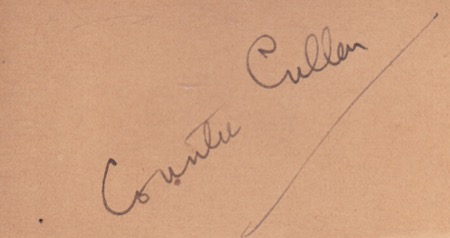
Hardcover. UK, Oxford University Press, 2nd pr., 1926, Book: Good, Dust Jacket: None, Hardcover, pale orange cloth with title on spine label. Former copy belonging to COUNTEE CULLEN (1903-1946), with his signature on the front fly leaf. Cullen was an American poet, novelist, children's writer, and playwright, particularly well known during the Harlem Renaissance. 248 pages, b&w frontis. Small paper scars to front endpapers, otherwise clean.
Hardcover. Princeton NJ, Princeton University Press, 1st, 1992, Book: Very Good, Dust Jacket: Very Good, Hardcover in a bright dust jacket, 281 pages, b&w illustrations. "For, Lo! We live in an Iron Age--In the age of Steam and Fire!" wrote a poet mesmerized by the engines that were transforming American transportation, agriculture, and industry during his lifetime. Indeed, by the nineteenth century fire had become America's leitmotif--for good and for ill. "Keeping the flame" was deadly serious: even the slightest lapse of attention could convert a fire from friendly ally to ravaging destroyer. To examine the cultural context of fire in "combustible America," Margaret Hazen and Robert Hazen gather more than a hundred illustrations, most never before published, together with anecdotes and information from hundreds of original sources, including newspapers, diaries, company records, popular fiction, art, and music. What results is an immensely entertaining and encyclopedic history that ranges from stories of the tragic "great fires" of the century to fire imagery in folktales and popular literature. Dealing more with technology than with fire in nature, the book provides a vast amount of information on fire manipulation and prevention in urban life. Hazen and Hazen discuss the people who worked with fire--or against it. Founders, gaffers, blacksmiths, boilers at saltworks, and housewives knew how to "read" a fire and employ it for their purposes. A few dedicated investigators inquired about the scientific nature of heat and flame. And firefighters gradually progressed from "bucket brigades" to "using fire to fight fire" with the newly invented steam engine. The colorful stories of these Americans--the risks they took and the rewards they received--will fascinate not only social historians but also a broad audience of general readers. Clean copy.
Hardcover. Lavenham, Terence Dalton Limited, 1st, 1983, Book: Very Good, Dust Jacket: Good, Hardcover, 190 pages. Minor dust jacket edge wear, small chunk missing on top left corner, with protective clear cover. A very clean and tight copy. Many dramatic incidents recorded here for the first time. Large format. B/w photos and diagrams. Index.
Softcover. Norman OK, University of Oklahoma Press, reprint, 1997, Book: Very Good, Dust Jacket: None, Softcover, 351 pages. George Wilkins Kendall, who founded the New Orleans Picayune in 1837, was a restless, impatient, and colorful character in an exciting era. For thirty years he guided the Picayune and built it into a powerful force in behalf of America's westward expansion. Kendall's vigorous editorials championed the cause of the infant Republic of Texas. When the Texan Santa Fe Expedition was organized in 1841, for the purpose of occupying New Mexico (then still under Mexican rule), Kendall left his editorial chair to participate--and was marched off to Mexico as a captive for seven months when the expedition was overwhelmed at Santa Fe. A few years later, when Kendall accompanied American forces invading Mexico during the Mexican War, he became America's first war correspondent--reporting directly from the battlefront. His effective "courier expresses" brought the first news of each battle to an eager nation, including President Polk, who often read news of the war in Kendall's Picayune before hearing it from his field commanders. Clean copy.
Hardcover. Princeton NJ, Princeton University Press, 1st, 1982, Book: Very Good, Dust Jacket: Good, Hardcover in a lightly worn dust jacket with a hole on front fore-edge, 318 pages. Mutsu Munemitsu was the Foreign Minister of Japan during the time of the Sino-Japanese War from 1894 until the signing of the peace treaty on May 8, 1895. Mutsu was responsible for the secret documents on diplomatic matters in which he was involved, such as the Sino-Japanese War of 1894-1895 and the facts about the Triple Intervention. The phrase "kenken" means "serving the sovereign with a pained heart," thus showing his loyalty to serve the Emperor. The documents in this book are exceedingly important as they are virtually the only material mentioning the diplomatic situations in the days of the Sino-Japanese War of 1894-1895. Name on front fly leaf otherwise clean.
Hardcover. Princeton NJ, Princeton University Press, 1st, 2023, Book: Very Good, Dust Jacket: Very Good, Hardcover in a bright dust jacket, 624 pages, black and white illustrations. The diplomat and historian George F. Kennan (1904-2005) ranks as one of the most important figures in American foreign policy and one of its most complex. Drawing on many previously untapped sources, Frank Costigliola's authoritative biography offers a new picture of a man of extraordinary ability and ambition whose idea of containing the Soviet Union helped ignite the Cold War but who spent the next half century trying to extinguish it. Clean copy.
Softcover. New York, Pantheon Books, 1st, 1982, Book: Very Good, Dust Jacket: None, 74 page catalog of 44 rich works of Kentucky quilting heritage. 63 color plates and 12 b&w photographs. A comprehensive collection of 19th century Kentucky quilting.
Hardcover. Nairobi, The English Press,, 1st, 1954, Book: Good, Dust Jacket: None, Hardcover, blue cloth with black title on front, 117 pages + postscript. The Mau Mau, the black challenge to white supremacy and the need for British rule to remain in Kenya. Name on front fly leaf, light marking to margins on some pages.
Hardcover. NY, W. W. Norton & Company, 1st, 2008, Book: Very Good, Dust Jacket: Very Good, Hardcover, 320 pages. Extraordinary photographs, along with extensive captions, document the transition from a barely explored paradise to a modern nation. This stunning collection of 720 photographs, many of them drawn from family archives and scrapbooks and all carefully restored, is one of the most important visual records of Africa in the late nineteenth and early twentieth centuries ever to have been published. The early photographers captured the beauty and dangerous allure of life on this spectacular frontier: the ceremonies and traditional attire of the native people, the fantastic machinery used in construction of the Uganda Railway, the gradual development of trade on the coast and in the country's interior, the hardships of the East African Campaign during World War I, and the pioneering spirit of early European settlers and farmers. Many of the most famous names and places connected with Africa appear in these pages, including Karen Blixen's farm and Ernest Hemingway and Theodore Roosevelt on safari.
Hardcover. NY, Harry N Abrams, 1st, 1989, Book: Very Good, Dust Jacket: Very Good, 264 pages, illustrated throughout in b&w. Clean, unmarked copy with only minor wear to dust jacket. "A lavish, information-packed look at the people and places of an important, exciting era in art history. "?Publishers Weekly. From 1900 to 1930, Montparnasse was the center of artistic life for the whole world. A major contribution to the social and cultural history of the period? with its informative text and hundreds of photographs?. As The Washington Post said, Kiki's Paris "celebrates the people who made the modern movement in art, music and literature, most of whom were friends or lovers of Kiki, the woman Hemingway called 'The Queen of Montparnasse.'"
Softcover. New York, Harry N. Abrams , reprint, 2002, Book: Very Good, Dust Jacket: Very Good, 263 pages, softcover with French flaps. A major contribution to the social and art history of Paris in the early 20th century. Heavily illustrated with black-and-white photographs. Minor rubbing and edgewear to wraps. Unmarked. A clean and tight copy.
Hardcover. Baltimore, Johns Hopkins University Press, 1st, 2003, Book: Very Good, Dust Jacket: Very Good, Hardcover in a bright dust jacket with a small closed tear to front panel. INSCRIBED BY HUDDLESTON on the dedication page. Huddleston has paired archival images of the first modern war with his own, contemporary color shots of the same locations, at the same time of year, at the same time of day. Some sites of suicidal charges have become Kmarts, mini-malls or swamps strewn with metal and plastic trash. The juxtapositions possess surprising power. In an overexposed and damaged archival shot of the Confederate prisoner of war camp at Andersonville, Ga., a filthy crowd of anonymous men packs the frame, while on the facing page Huddleston presents his own fine-tuned image of a muted, borderless sky. Office buildings, grocery stores and fast food franchises have sprouted where Union Major General George H. Thomas and Confederate General John Bell Hood slugged it out for December days in Nashville 141 years ago. Near the site of some of the heaviest fighting between blue and gray, a KFC sign now advertises discounts on the colonel's secret recipe. Clean copy.
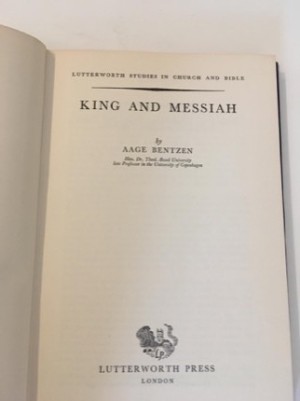
Hardcover. London, Lutterworth, 1st UK, 1955, Book: Very Good, Dust Jacket: None, Hardcover, blue cloth with faded gilt lettering on spine, 115 pages. A fascinating glimpse into the debate in Scandinavia concerning a number of inter-related Biblical themes focused on the concept of the Messiah, a debate associated with scholars such as Mowinckel, Pedersen, Widengren, and Bentzen himself. The argument traces the development of the Messianic figure from its Old Testament roots, starting with the Messiah of many of the Psalms, which represents a demythologised form of the Oriental conception of kingship, through the eschatologised Messiah of the prophetic thought of Isaiah and Micah, and then to the prophet-Messiah of Second Isaiah, which although still a present and entirely human figure, embodies the insight that the saviour of Israel must suffer and be cast in the role of a Moses Redivivus as leader of a new Exodus. The Son of Man of Daniel 7 carries this eschatologising process even further, until the Christology of the New Testament emerges as a creative synthesis of these Old Testament types. In this synthesis, Jesus is a new Adam, the Messiah present in the flesh and present still in His body the Church, the suffering Prophet playing the part of the new Moses and the once and future Divine King. Bentzen argues that ultimately this figure of Christ the Messiah transcends not only the Old Testament types on which it is based, but also the subsequent historical development of the Christian Messianic tradition.
Hardcover. NY, Coward, McCann & Geoghegan, 4th pr., 1974, Book: Very Good, Dust Jacket: Very Good, Hardcover in an unclipped dust jacket, 48 pages illustrated in colors and b&w by Margot Tomes. A lead statue of King George III relates the events leading to the American Rovolution through indignant ratings about what he observes. Clean copy.
Hardcover. NY, W. W. Norton & Company, 1st, 1988, Book: Very Good, Dust Jacket: Very Good, Hardcover in a bright, unclipped dust jacket. Written by two members of archaeological expeditions which have excavated at Caesarea, the ancient city on the coast of Israel built by Herod the Great, this book tells the story of the great city, from its beginnings to its destruction in the 13th century. Readers discover this past through archaeologists' eyes, as the text considers not only artifacts and written sources but the processes by which archaeologists reconstruct the past. A companion volume to a traveling exhibition of Caesarean artifacts, this is very highly recommended for both its clarity and creativity. 244 pages illustrated in color plus index. Clean.
Softcover. San Diego, CA, IDW Publishing, Reprint, 2018, Book: Very Good, Dust Jacket: None, 308 pages. Softcover. A very clean, unmarked copy with only minor edgewear. This book is a centennial birthday bash hosted by Dean Mullaney, Bruce Canwell, and Brian Walker, with contributions by Brendan Burford, Lucy Shelton Caswell, Jared Gardner, Ron Goulart, Jeffrey Lindenblatt, Carl Linich, Paul Tumey, and Germund von Wowern. More than just comics, it's a celebration of the profound impact that King Features has had on popular culture!
Hardcover. Woodstock VT, Countryman Press, 4th pr., 1999, Book: Very Good, Dust Jacket: Very Good, Hardcover in a bright, price-clipped dust jacket, 416 pages, b&w illustrations. Now largely forgotten, the massacres of 1675 to 1676, known as King Philip's War, ended the harmonious relations that had existed between native Americans and the colonists since their arrival at Plymouth Rock in 1620. Tensions had been rising as the number of settlers grew, and the pillaging of an outlying farm by affronted young braves escalated into open hostilities. Pitched battles were fought from Rhode Island to Maine. Hundreds of English died as farmers fled and cowered behind stockades or in the few port towns. Thousands of natives were slaughtered and the rest dispersed or sold into slavery in the West Indies. The savagery resulted in the clearing of the native populations from southern New England and the unopposed expansion of the New England colonies. It also became the brutal model on which the United States came to deal with its native peoples. King Philip's War tells the story with such close attention to detail that each ambush, each burned-out farm, becomes a vivid image. The authors make abundant use of maps and photographs of old sites to enable the reader to follow the course of the war: the book forms an exhaustive guide for the armchair historian or anyone wishing to visit the monuments and battlefields today. Clean copy.
Hardcover. New York, E. P. Dutton & Company, First Edition, 1938, Book: Very Good, Dust Jacket: None, 107 pages. Hardcover. Previous owner's signature to front flyleaf. Black & white illustrations throughout. Dust jacket with moderate wear, tears to edges & chipping, now protected with a plastic cover. Toning throughout. Clean & unmarked.
Hardcover. Boston, Little Brown, 1st, 1977, Book: Very Good, Dust Jacket: Very Good, Hardcover in a bright, unclipped dust jacket, 338 pages. Light edgewear to dj, remainder dot bottom edge. A novel of Henry Knox's 1776 winter raid on Fort Ticonderoga to bring cannon to beleaguered Boston. Endpapers map. Clean copy.
Hardcover. New York , Abrams, 1st, 1999, Book: Very Good, Dust Jacket: Very Good, Hardcover, 254 pages, 173 illustrations, 131 in color. Although he is now seen as a progenitor of the "naive" style, during his lifetime Edward Hicks (1780-1849) was known only as a devout, impoverished Quaker minister who liked to paint. With a few exceptions, his extant body of work is made up of 62 "Peaceable Kingdom" pictures, based on Isaiah's biblical prophecy. Although these paintings, known for their charmingly wide-eyed and sensuous beasts, use potent color and effective design, they are technically unsophisticated and repetitive in the extreme. But they contain a powerfully serene devoutness, a mood probably expressed in compensation for Hicks's guilt about an avocation viewed as frivolous by other Quakers. As the popularity of folk art boomed in the early 20th century, Hicks's homely visions were popularized and became the focus of scholarly attention, and this work is probably the best to date. Weekley, the director of museums at Colonial Williamsburg, shrewdly considers Hicks's "secular" life and art through the filter of his intense piety and copiously illustrates her large-format book with brilliant color plates.

 "Kasteelen Buitenplaatsen Tuinen en Parken van Nederland (Dutch Text)by: Jongsma, H.")

 "Kathi of Skenesboroughby: Curtis, May Belle")
 "Kazan: The Master Director Discusses His Films-Interviews with Elia Kazan by: Young, Jeff")
 "Kazimir Malevich: Suprematismby: Gurianova, Nina/ Jean-Claude Marcade , Tatyana Mikhienko")
 "Keats and Shakespeare: A Study of Keats' Poetic Life from 1816 to 1820 by: John Middleton Murry/Countee Cullen (SIGNED COPY)")

 "Keepers of the Flame: The Role of Fire in American Culture, 1775-1925by: Margaret Hindle and Robert M Hazen")
 "Keepers of the Sea: A History of the Yachts and Tenders of Trinity Houseby: Woodman, Richard")
 "Kendall of the Picayuneby: Copeland, Fayette")
 "Kenkenroku: a Diplomatic Record of the Sino-Japanese War, 1894-1895 by: Munemitsu, Mutsu /Translated By Gordon Mark Berger")
 "Kennan: A Life Between Worlds by: Costigliola, Frank")
 "Kentucky Quilts, 1800-1900: The Kentucky Quilt Projectby: Holstein, Jonathan, and John Finley.")
 "Kenya's Warning: The Challenge to White Supremacy in Our British Colonyby: Wilson, Christopher")
 "Kenya: A Country in the Making, 1880-1940by: Pavitt, Nigel")
 "Ki Ki's Paris: Artists and Lovers 1900-1930by: Kluver, Billy/ Julie Martin")
 "Kiki's Paris: Artists and Lovers 1900-1930by: Kluver, Billy and Julie Martin")
 "Killing Ground: The Civil War and the Changing American Landscape (INSCRIBED COPY)by: John Huddleston")
 "King and Messiahby: Aage Bentzen")

 "King George's Head Was Made of Lead by: F. N. Monjo/Margot Tomes")
 "King Herod's Dream: Caesarea on the Sea by: Holum, Kenneth G.; Hohlfelder, Robert L.; Bull, Robert J.; Raban, Avner")
 "King of the Comics: 100 Years of King Featuresby: Canwell, Bruce")
 "King Philip's War : The History and Legacy of America's Forgotten Conflictby: Eric B. Schultz, Michael J. Tougias")
 "King's Daughters, The - An Intimate and Authentic Studyby: Asquith, Cynthia")
 "King's Iron, Theby: Peck, Robert Newton")
 "Kingdoms of Edward Hicks, Theby: Weekley, Carolyn J.")