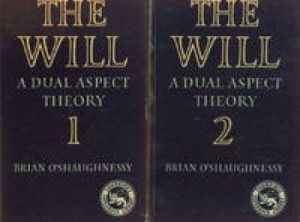
Softcover. Cambridge UK, Cambridge University Press, reprint, 1983, Book: Good, Dust Jacket: None, Two softcover volumes, Parts 1 and 2, 259 and 368 pages. A philosophical study of the nature of bodily action and the will - and the responsibility we have for our own active bodily movements, which is distinct from though closely related to both causal and moral responsibility. Name on front fly leaf and light pencil notations to 20 pages in volume 1, light stain in volume 2 on copy block, not affecting text.
Hardcover. NY, Arno Press, reprint, 1977, Book: Very Good, Dust Jacket: None, Hardcover, dark green cloth with gilt lettering. A facsimile reprint of the London 1717 edition. 405 pages plus publisher's ads. Light pencil notes on front endpapers with owner's name in ink. Otherwise clean, tight copy.
Hardcover. UK, Oxford University Press, reprint, 2005, Book: Very Good, Dust Jacket: None, Hardcover in glossy boards, 712 pages. John Wilmot, second Earl of Rochester (1647-80), was a leading member of the group of "court wits" surrounding Charles II and one of the wittiest and most sexually explicit poets in English. In this long-awaited edition, Harold Love, a leading scholar of seventeenth-century manuscript circulation, presents a scholarly text based on detailed examination of Wilmot's manuscripts, with full textual and explanatory notes. This is a reprint of the 1999 first printing. Light notations to about 30 pages, otherwise bright, tight copy.
Hardcover. UK, Oxford University Press, 1st, 2012, Book: Very Good, Dust Jacket: Very Good, This is the first volume in the four-volume edition of The Works of Lucy Hutchinson, the first-ever collected edition of the writings of the pioneering author and translator. Hutchinson (1620-81) had a remarkable range of her interests, from Latin poetry to Civil War politics and theology. In two parts, two volumes: 797 total pages. This edition of her translation of Lucretius's De rerum natura offers new biographical material, demonstrating the changes and unexpected continuities in Hutchinson's life between the work's composition in the 1650s and its dedication in 1675. Hers is the first complete surviving English translation of one of the great classical epics, a challenging text at the borderlines of poetry and philosophy. For the first time, the Lucretius translation is made available alongside the Latin text Hutchinson used, which differs in innumerable ways from versions known today. The commentary, the fullest in any edition of a literary translation, provides multiple ways into further understanding of the translation and its contexts. Written at a momentous period in political and literary history, Hutchinson's Lucretius throws light on the complex transition between 'ancient' and 'modern' conceptions of the classical canon and of natural philosophy. It offers a case study in the history of reading, and more specifically of reading by a woman. Name on front fly leaves, pencil notations to front fly leaf, a dozen pages in Part 1. DUE TO WEIGHT, DOMESTIC SHIPPING ONLY.
Hardcover. Bristol UK, Thoemmes Press, reprint, 1998, Book: Very Good, Dust Jacket: None, Hardcover, maroon cloth, 537 pages. Gilt lettering on a green band on the spine. A reprint of the 1830 edition. Clean copy.
Softcover. London/NY, Routledge, reprint, 2001, Book: Very Good, Dust Jacket: None, Softcover, 328 pages. This unique collection of essays, published together for the first time, not only elucidates the complexity of ancient Greek thought, but also reveals Karl Popper's engagement with Presocratic philosophy and the enlightenment he experienced in his reading of Parmenides. As Karl Popper himself states himself in his introduction, he was inspired to write about Presocratic philosophy for two reasons - firstly to illustrate the thesis that all history is the history of problem situations and secondly, to show the greatness of the early Greek philosophers, who gave Europe its philosophy, its science and its humanism. Light pencil marking to 8 pages.
Hardcover. New Haven CT, Yale University Press, 1st, 2001, Book: Very Good, Dust Jacket: None, Hardcover in burgundy cloth boards with gilt lettering to front panel and spine, as issued w/out dj. Short inscription on front fly leaf, otherwise clean. This book gathers together for the first time an important body of texts written between 1672 and 1686 by the great German philosopher and polymath Gottfried Leibniz. These writings, most of them previously untranslated, represent Leibniz's sustained attempt on a problem whose solution was crucial to the development of his thought, that of the composition of the continuum. The volume begins with excerpts from Leibniz's Paris writings, in which he tackles such problems as whether the infinite division of matter entails "perfect points," whether matter and space can be regarded as true wholes, whether motion is truly continuous, and the nature of body and substance. Comprising the second section is Pacidius Philalethi, Leibniz's brilliant dialogue of late 1676 on the problem of the continuity of motion. In the selections of the final section, from his Hanover writings of 1677-1686, Leibniz abandons his earlier transcreationism and atomism in favor of the theory of corporeal substance, where the reality of body and motion is founded in substantial form or force. Leibniz's texts (one in French, the rest in Latin) are presented with facing-page English translations, together with an introduction, notes, appendixes containing related excerpts from earlier works by Leibniz and his predecessors, and a valuable glossary detailing important terms and their translations.
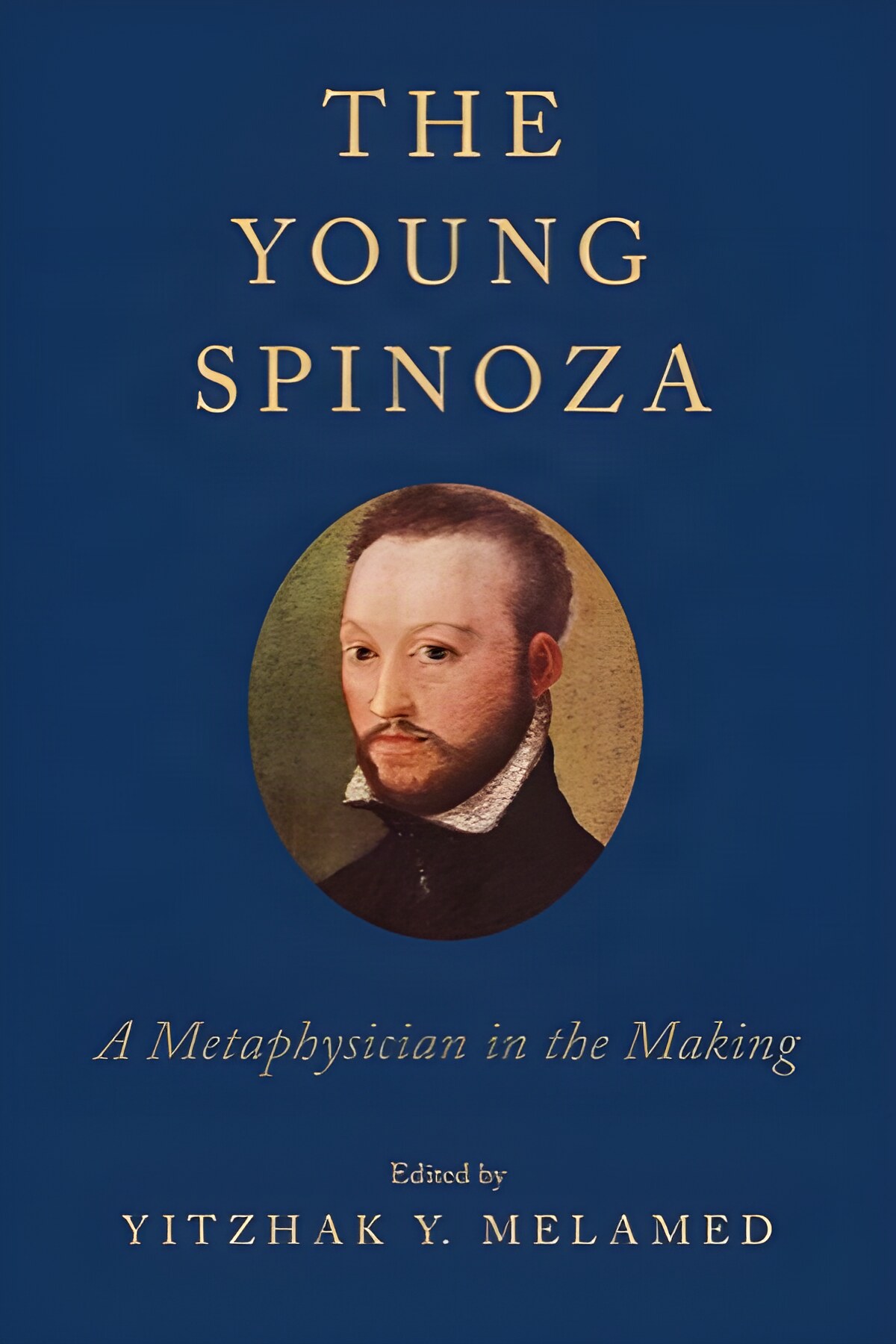
Softcover. NY, Oxford University Press, 1st, 2015, Book: Very Good, Dust Jacket: None, Softcover, 360 pages. Ex nihilo nihil fit. Philosophy, especially great philosophy, does not appear out of the blue. In the current volume, a team of top scholars-both up-and-coming and established-attempts to trace the philosophical development of one of the greatest philosophers of all time. Featuring twenty new essays and an introduction, it is the first attempt of its kind in English and its appearance coincides with the recent surge of interest in Spinoza in Anglo-American philosophy. Spinoza's fame-or notoriety-is due primarily to his posthumously published magnum opus, the Ethics, and, to a lesser extent, to the 1670 Theological-Political Treatise. Few readers take the time to study his early works carefully. If they do, they are likely to encounter some surprising claims, which often diverge from, or even utterly contradict, the doctrines of the Ethics. Consider just a few of these assertions: that God acts from absolute freedom of will, that God is a whole, that there are no modes in God, that extension is divisible and hence cannot be an attribute of God, and that the intellectual and corporeal substances are modes in relation to God. Yet, though these claims reveal some tension between the early works and the Ethics, there is also a clear continuity between them. Name, date on front fly leaf, otherwise clean.
Softcover. Oxford UK, Blackwell, 1st, 1999, Book: Very Good, Dust Jacket: None, Softcover, 332 pages. The Zizek Reader - which includes a Foreword by Zizek and a new, previously unpublished essay on cyberspace - provides a comprehensive and accessible introduction to the flamboyant work of a figure who has been variously described as 'one of the most arresting, insightful and scandalous thinkers in recent memory' and 'the Giant of Ljubljana'. His work is an extraordinary mix of Hegel and Hitchcock, Schelling and science fiction, Kant and courtly love, Stalin and Stephen King, all of which is strongly seasoned with Lacanian psychoanalysis. Divided into three parts - Culture, Woman and Philosophy - the Reader not only provides careful explications of the individual extracts within each section but also connects these extracts in a general introduction, mapping the shiftings of Zizek's thought within the Lacanian framework. The essays on woman offer feminism ammunition from unexpected sources, within a reading of Lacan that goes counter to his ambiguous reception by feminists. In fact, at this collection dazzlingly demonstrates, Zizek provides us with one of the most limpid and persuasive readings so far produced of Lacan's difficult thought. Name on inside of front cover, otherwise clean.
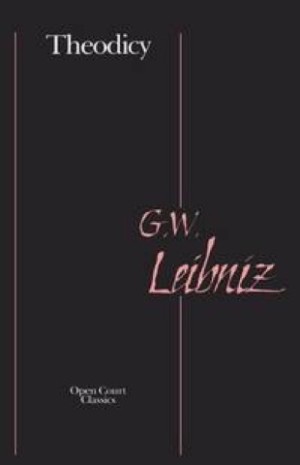
Softcover. La Salle IL, Open Court, reprint, 1990, Book: Very Good, Dust Jacket: None, Softcover, 448 pages. In this 1710 treatise, Gottfried Liebniz's only book-length work, he applies the idea of philosophical 'optimism'- that we live in the best of all possible worlds-to the 'problem of evil'- If a benevolent God exists, why do terrible things happen? He explores the possibility that humanity's happiness is not necessarily part of God's plan.Much of Leibniz's thinking in the realm of the sciences flowed from his philosophy-he believed the universe to operate under simple, intelligible, interconnected rules. Understanding how he approached the metaphysical world and humanity's place in it is vital to understanding his contributions to modern science. The impact of the work of this German mathematician (1646-1716) on modern science and technology is all but incalculable. His notation for infinitesimal calculus-which he developed independently of Newton-remains in use today, and his invention of binary counting is the basis for modern computing. He was a powerfully influential philosopher as well, and is still considered, alongside Descartes and Spinoza, one of the great 17th-century rationalists.
Softcover. Indianapolis, Hackett Publishing, reprint, 1989, Book: Very Good, Dust Jacket: None, Softcover, 358 pages. This volume includes Whewell's seminal studies of the logic of induction (with his critique of Mill's theory), arguments for his realist view that science discovers necessary truths about nature, and exercises in the epistemology and ontology of science. The book sets forth a coherent statement of a historically important philosophy of science whose influence has never been greater: every one of Whewell's fundamental ideas about the philosophy of science is presented here. Clean, bright copy.
Hardcover. Bristol UK, Thoemmes, reprint, 1990, Book: Very Good, Dust Jacket: None, Hardcover, red cloth with gilt lettering on spine, 554 pages. A facsimile reprint of the 1733 edition. Name on front fly leaf, otherwise clean.
Softcover. Princeton, Princeton University Press, 1st Edition, 2000, Book: Very Good, Dust Jacket: None, 382 pages. Softcover in very good condition with full color photo of Isaiah Berlin to cover. Tight copy. Clean & unmarked text.
Softcover. Louisville KY, Fons Vitae , Revised Ed., 2009, Book: Very Good, Dust Jacket: None, Softcover, 197 pages. Some of the earliest, most rare, formative, and concise examples of Sufi methodology to appear in translation, these works examine the inherently defective nature of the soul, the roles it must assume, the path it must travel towards purification, and how to best manage that itinerary while avoiding the pitfalls and obstacles of the journey. Clean copy.
Hardcover. Oxford UK, Clarendon Press, 1st, 1957, Book: Very Good, Dust Jacket: None, Hardcover, blue cloth with gilt lettering on spine, 148 pages, paper with light tanning. The relationship between formal logic and general philosophy is discussed under headings such as A Re-examination of Our Tense-Logical Postulates, Modal Logic in the Style of Frege, and Intentional Logic and Indeterminism. The relationship between formal logic and general philosophy is discussed under headings such as A Re-examination of Our Tense-Logical Postulates, Modal Logic in the Style of Frege, and Intentional Logic and Indeterminism. Name on front fly leaf, otherwise clean.
Hardcover. Oxford UK, Oxford University Press, 1st, 2016, Book: Very Good, Dust Jacket: Very Good, Hardcover in a bright dust jacket, 175 pages. Despite recent advances in Locke scholarship, philosophers and political theorists have paid little attention to the relations among his three greatest works: An Essay Concerning Human Understanding, Two Treatises of Government, and Epistola de Tolerantia. As a result our picture of Locke's thought is a curiously fragmented one. Toleration and Understanding in Locke argues that these works are unified by a concern to promote the cause of religious toleration. Making extensive use of Locke's neglected replies to Proast, Nicholas Jolley shows how Locke draws on his epistemological principles to criticize religious persecution - for Locke, since revelation is an object of belief, not knowledge, coercion by the state in religious matters is not morally justified. In this volume Jolley also seeks to show how the Two Treatises of Government and the letters for toleration adopt the same contractualist approach to political theory; Locke argues for toleration from the function of the state where this is determined by the decisions of rational contracting parties. Throughout, attention is paid to demonstrating the range of Locke's arguments for toleration and to defending them, where possible, against recent criticisms. The book includes an account of the development of Locke's views about religious toleration from the beginning to the end of his career; it also includes discussions of his individualism about knowledge and belief, his critique of religious enthusiasm, his commitment to the minimal creed, and his teachings about natural law. Locke emerges as a rather systematic thinker whose arguments are highly relevant to modern debates about religious toleration. Light pencil marking to some pages.
Hardcover. Berkeley CA, University of California Press, 1st, 1966, Book: Very Good, Dust Jacket: Very Good, Hardcover in a bright, unclipped dust jacket. Reissue of Burke's long out-of-print experimental novel, originally published in 1931. With a new Foreword by Burke for this edition. Clean copy.
Hardcover. Washington D. C., Island Press, First Edition, 1996, 235 pages. Hardcover. Off white cloth boards with orange titles to spine. Bright dust jacket with only light marginal wear. Very clean & unmarked. Crisp, tight copy.
Hardcover. London, Routledge & Kegan Paul, reprint, 1969, Book: Very Good, Dust Jacket: Good, Hardcover in a lightly worn and chipped dust jacket, 166 pages. (German and English Translation): The German text with the translation by D. F. Pears & B. F. McGuinness, and with the Introduction by Bertrand Russell. Clean copy.
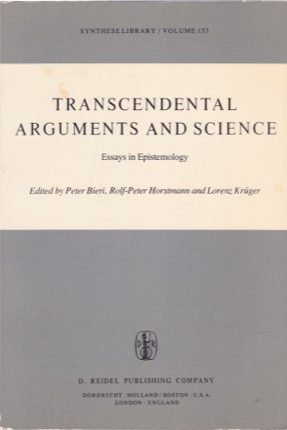
Softcover. Boston, Reidel Publishing, 1st, 1979, Book: Very Good, Dust Jacket: None, Softcover, 314 pages. The goal of the present volume is to discuss the notion of a 'conceptual framework' or 'conceptual scheme', which has been dominating much work in the analysis and justification of knowledge in recent years. More specifi- cally, this volume is designed to clarify the contrast between two competing approaches in the area of problems indicated by this notion: On the one hand, we have the conviction, underlying much present-day work in the philosophy of science, that the best we can hope for in the justifi- cation of empirical knowledge is to reconstruct the conceptual means actually employed by science, and to develop suitable models for analyzing conceptual change involved in the progress of science. This view involves the assumption that we should stop taking foundational questions of epistemology seriously and discard once and for all the quest for uncontrovertible truth. The result- ing program of justifying epistemic claims by subsequently describing patterns of inferentially connected concepts as they are at work in actual science is closely connected with the idea of naturalizing epistemology, with concep- tual relativism, and with a pragmatic interpretation of knowledge. On the other hand, recent epistemology tends to claim that no subsequent reconstruction of actually employed conceptual frameworks is sufficient for providing epistemic justification for our beliefs about the world. This second claim tries to resist the naturalistic and pragmatic approach to epistemology and insists on taking the epistemological sceptic seriously. Name on front fly leaf, otherwise clean.
Hardcover. New York, John Wiley & Sons, reprint, 1888, Book: Very Good, Dust Jacket: None, Hardcover, 452 pages. Blue cloth covers with gilt titles and black embossed illustration, b&w tissue-protected frontispiece of Ruskin's portrait, brown decorated endpapers, top edge gilt. Slight edgewear and rubbing to covers, previous owner's inscription on blank preview page, a few brown markings to right edge of page block, pages crisp and otherwise unmarked, stiff binding; overall, a very clean, tight copy.
Hardcover. Bristol UK, Thoemmes Press, reprint, 1997, Book: Very Good, Dust Jacket: None, Hardcover, blue cloth with gilt lettering on spine, 195 plus 276 pages. A facsimile reprint of the 1682 edition. One of 9 volumes in More's collected works. Name on front fly leaf otherwise a clean, bright copy.
Hardcover. NY, Garland Publishing, reprint, 1978, Book: Very Good, Dust Jacket: None, Hardcover, orange cloth with black lettering on spine, 195+ 276 pages. Facsimile of the original 1682 edition. From the 'British Philosophers and Theologians of the 17th and 18th Century' series, edited by Rene Wellek. Name on front fly leaf otherwise clean.











 "Three Early Sufi Texts: A Treatise on the Heart, Stations of the Righteous, The Stumblings of Those Aspiringby: Al-Naysaburi, Abu 'Abd Al-Rahman Al-Sulami, and Honerk")


 "Toleration and Understanding in Locke by: Jolley, Nicholas")
 "Towards a Better Life: Being a Series of Epistles, or Declamations by: Kenneth Burke")

 "True and the Beautiful, Theby: Ruskin, John")
 "TWO CHOICE AND USEFUL TREATISES ; The One LUX ORIENTALIS ; or An Enquiry into the Opinion of the Eastern Sages Concerning the Praeexistence of Souls. Being a Key to Unlock the Grand Mysteries of Providence. In Relation to Mans Sin an")
![Two Choice and Useful Treatises. [British Philosophers and Theologians of the 17th and 18th Centuries] by: Joseph Glanvill](javascript:largeIMTop('https://www.browsingisarousing.com/shop/images/Two-Choice-and-Useful-Treatises.-British-Philosophers-and-Theologians-of-the-17th-and-18th-Centuries386834-440941.jpg','https://www.browsingisarousing.com/shop/images/Two-Choice-and-Useful-Treatises.-British-Philosophers-and-Theologians-of-the-17th-and-18th-Centuries386834-440941.jpg',0,'386834',0,'') "Two Choice and Useful Treatises. [British Philosophers and Theologians of the 17th and 18th Centuries] by: Joseph Glanvill")
