Hardcover. Ithaca NY, Cornell University Press, 1st, 1990, Book: Very Good, Dust Jacket: Very Good, Hardcover in a bright dust jacket, 249 pages. Berkeley's Essay towards a New Theory of Vision (1709), his first substantial publication, revolutionized the theory of vision. His approach provided the framework for subsequent work in the psychology of vision and remains influential to this day. Among philosophers, however, the New Theory has not always been read as a landmark in the history of scientific thought, but instead as a halfway house to Berkeley's later metaphysics. In this book, Margaret Atherton seeks to redress the balance through a commentary on and a reinterpretation of Berkeley's New Theory. Clean copy.
Hardcover. Cambridge MA, Harvard University Press, 1st, 1989, Book: Very Good, Dust Jacket: Very Good, Hardcover, 192 pages. Light sun-fade to dust jacket spine, else a clean, tight copy. Michael Slote challenges the long-dominant conception of individual rationality, which has to a large extent shaped the very way we think about the essential problems and nature of rationality, morality, and the relations between them. He contests the accepted view by appealing to a set of real-life examples, claiming that our intuitive reaction to these examples illustrates a significant and prevalent, if not always dominant, way of thinking. Slote argues that common sense recognizes that one can reach a point where "enough is enough," be satisfied with what one has, and, hence, rationally decline an optimizing alternative. He suggests that, in the light of common sense, optimizing behavior is often irrational.
Hardcover. NY, Macmillan Company, 1st, 1936, Book: Very Good, Dust Jacket: None, Hardcover, gray cloth with gilt lettering on spine faded, 271 pages. The book covers the life and work of Bishop Butler and the impact his philosophy had on the Age of Reason. Name, date on front fly leaf, otherwise a clean, tight copy.
Hardcover. New York, Viking Studio Books, 2nd pr., 1994, Book: Very Good, Dust Jacket: None, Unpaginated. Hardcover with no dust jacket in a slipcase. Clean, tight copy with only light fading to slipcase. Paper on top of slip case is starting to become unglued. Bright colorful pictures throughout.
Softcover. UK, Cambridge University Press, reprint, 1996, Book: Very Good, Dust Jacket: None, Softcover, 141 pages. This volume contains the essential points of Jean Bodin's theory of sovereignty, a landmark in legal theory and royalist ideology. The four chapters presented form the core of Bodin's classic work, Six Livres de la Republique. Bodin was primarily responsible for introducing the seductive but erroneous notion that sovereignty is indivisible, that the entire power of the state had to be vested in a single individual or group. This thesis, combined with the prevailing crisis of authority during the French religious wars, led Bodin to a systematically absolutist interpretation of the French and other European monarchies. This is the first complete translation of this material into English since 1606, and is accompanied by a lucid introduction, chronology, and bibliography. Clean copy.
Hardcover. Oxford UK, Clarendon Press, 1st, 1981, Book: Very Good, Dust Jacket: Very Good, Hardcover in a bright dust jacket, 313 pages. The Consolations of Philosophy by Boethius, whose English translators include King Alfred, Geoffrey Chaucer, and Queen Elizabeth I, ranks among the most remarkable books to be written by a prisoner awaiting the execution of a tyrannical death sentence. Its interpretation is bound up with his other writings on mathematics and music, on Aristotelian and propositional logic, and on central themes of Christian dogma. Chadwick begins by tracing the career of Boethius, a Roman rising to high office under the Gothic King Theoderic the Great, and suggests that his death may be seen as a cruel by-product of Byzantine ambitions to restore Roman imperial rule after its elimination in the West in AD 476. Subsequent chapters examine in detail his educational programme in the liberal arts designed to avert a threatened collapse of culture and his ambition to translate into Latin everything he could find on Plato and Aristotle. Name on front fly leaf, otherwise bright and clean.
Softcover. Berkeley, University of California Press, 1st pbk, 1987, Book: Very Good, Dust Jacket: None, Softcover, 839 pages. Traces the history of bribery from ancient Egypt to ABSCAM, examines changing perceptions of bribery, and discusses the legal, ethical and religious injunctions against bribes. Clean, bright copy.
Hardcover. Oxford UK, Oxford University Press, 1st, 2015, Book: Very Good, Dust Jacket: Very Good, Hardcover in a bright dust jacket, 286 pages. Sarah Hutton presents a rich historical study of one of the most fertile periods in modern philosophy. It was in the seventeenth century that Britain's first philosophers of international stature and lasting influence emerged. Its most famous names, Hobbes and Locke, rank alongside the greatest names in the European philosophical canon. Bacon too belongs with this constellation of great thinkers, although his status as a philosopher tends to be obscured by his statusas father of modern science. The seventeenth century is normally regarded as the dawn of modernity following the breakdown of the Aristotelian synthesis which had dominated intellectual life since the middle ages. In this period of transformational change, Bacon, Hobbes, Locke are acknowledged tohave contributed significantly to the shape of European philosophy from their own time to the present day. But these figures did not work in isolation. Sarah Hutton places them in their intellectual context, including the social, political and religious conditions in which philosophy was practised. She treats seventeenth-century philosophy as an ongoing like all conversations, some voices will dominate, some will be more persuasive than others and there will be enormous variationsin tone from the polite to polemical, matter-of-fact, intemperate. The conversation model allows voices to be heard which would otherwise be discounted. Hutton shows the importance of figures normally regarded as 'minor' players in philosophy (e.g. Herbert of Cherbury, Cudworth, More, Burthogge,Norris, Toland) as well as others who have been completely overlooked, notably female philosophers. Crucially, instead of emphasizing the break between seventeenth-century philosophy and its past, the conversation model makes it possible to trace continuities between the Renaissance and seventeenth century, across the seventeenth century and into the eighteenth century, while at the same time acknowledging the major changes which occurred.
Hardcover. UK, Oxford University Press, reprint, 2003, Hardcover in pictorial boards, 309 pages. Byzantine philosophy is an almost unexplored field. Being regarded either as mere scholars or as primarily religious thinkers, Byzantine philosophers have not been studied on their own philosophical merit. The eleven contributions in this volume, which cover most periods of Byzantine culture from the 4th to the 15th century, for the first time systematically investigate the attitude the Byzantines took towards the views of ancient philosophers, to uncover the distinctive character of Byzantine thought. Clean, bright copy.
Softcover. Evanston IL, Northwestern University , 1st, 2002, Book: Very Good, Dust Jacket: None, Softcover, 325 pages. Devoted to the most important American Continental philosopher of his generation and one of the discipline's founding fathers, and featuring some of the field's most distinguished luminaries, this anthology constitutes a critical document in Continental philosophy, reflecting its recent history, its present state, and its debt to Calvin Schrag. Taking up themes central to Schrag's own philosophical concerns, these essays refer throughout to his salient "interventions" in the dialogue of late twentieth-century thought characterized as "postmodernity." In doing so, all contributors address, implicitly or directly, the question of philosophy's role and responsibility, or "task." The volume begins with an overview of this task and of Schrag's contributions to it, written from the perspective of a resolute defender of the phenomenological tradition that Schrag's work has extended and reconfigured. Clean copy.
Softcover. Cambridge [England] ; New York, Cambridge University Press, reprint, 1993, Book: Very Good, Dust Jacket: None, Softcover, 389 pages. Minor wear to edges of cover. Previous owner's inscription on front flyleaf. Slight foxing on top edge. Inside is bright, clean and unmarked. A nice copy.
Hardcover. NY, Harper & Row, reprint, Book: Very Good, Dust Jacket: Very Good, Hardcover in a bright dust jacket, 119 pages. A book on linguistics by Noam Chomsky, written with the purpose of deepening 'our understanding of the nature of language and the mental processes and structures that underlie its use and acquisition'. Chomsky wished to shed light on these underlying structures of the human language, and subsequently whether one can infer the nature of an organism from its language. Cartesian linguistics refers to a form of linguistics developed during the time of RenE Descartes, a prominent 17th century philosopher whose ideas continue to influence modern philosophy. In Cartesian Linguistics, Chomsky traces the development of linguistic theory from Descartes to Wilhelm von Humboldt, that is, from the period of the Enlightenment directly up to Romanticism. The central doctrine of Cartesian linguistics maintains that the general features of grammatical structure are common to all languages and reflect certain fundamental properties of the mind. Clean copy.
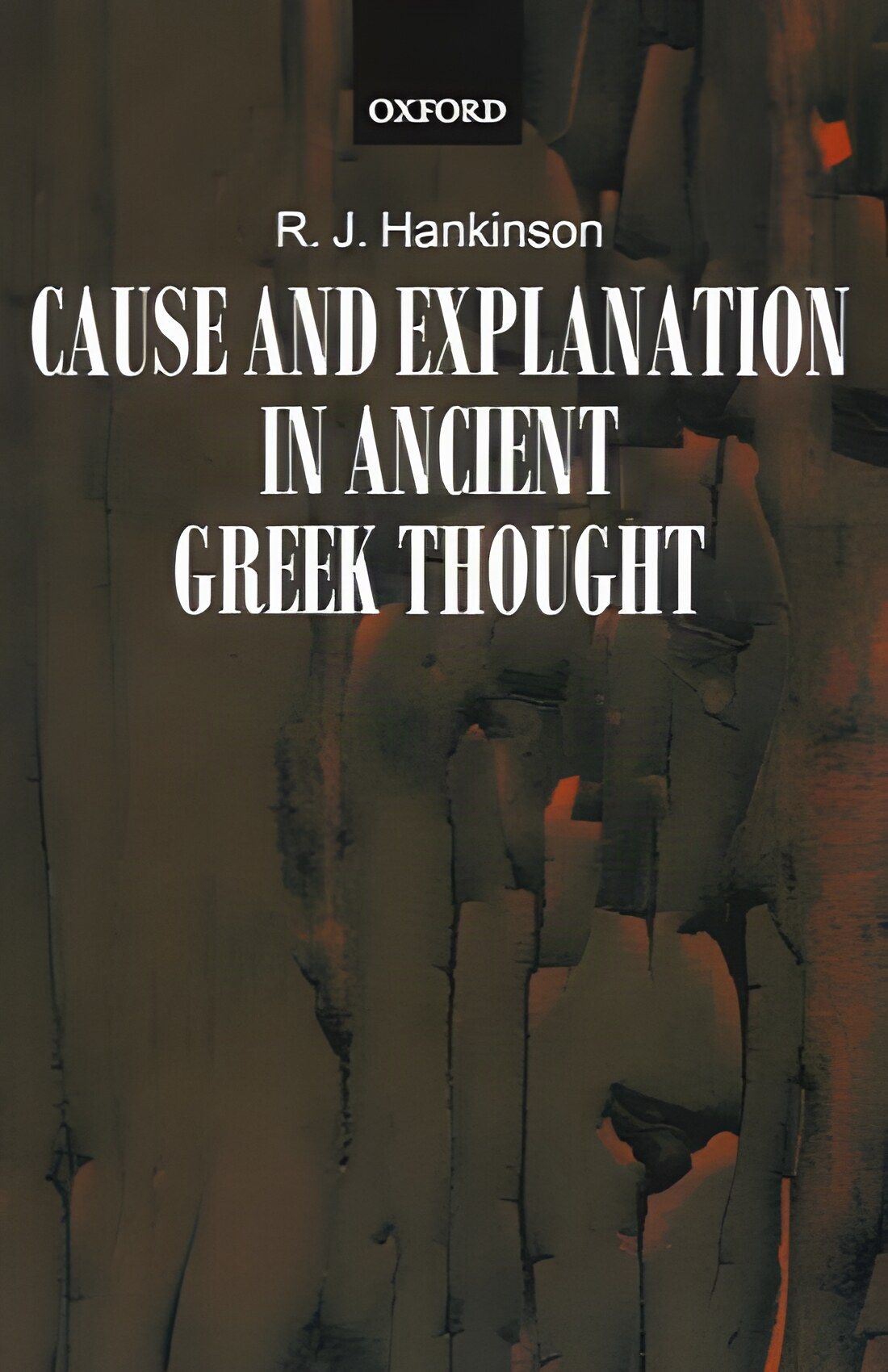
Softcover. UK, Clarendon Press, reprint, 2004, Book: Very Good, Dust Jacket: None, Softcover, 499 pages. R. J. Hankinson traces the history of ancient Greek thinking about causation and explanation, from its earliest beginnings through more than a thousand years to the middle of the first millennium of the Christian era. He examines ways in which the Ancient Greeks dealt with questions about how and why things happen as and when they do, about the basic constitution and structure of things, about function and purpose, laws of nature, chance, coincidence, and responsibility. Clean copy.
Hardcover. Bristol UK, Thoemmes Press, reprint, 1995, Book: Very Good, Dust Jacket: None, Hardcover, red cloth with gilt lettering on the spine, 375 pages. VOLUME 2 ONLY. A facsimile reprint of the Grant Richards 1900 edition.
Hardcover. Bristol UK, Thoemmes Press, reprint, 1995, Book: Very Good, Dust Jacket: None, Hardcover, red cloth with gilt lettering on the spine, 338 pages. VOLUME 1 ONLY. A facsimile reprint of the 1698 and 1900 editions. Pencil notations to about 40 pages in the treatise dealing with Enthusiasm.
Softcover. UK, Oxford University Press, reprint, 2006, Book: Very Good, Dust Jacket: None, Softcover, 435 pages. Cicero's Topica is one of the canonical texts on ancient rhetorical theory. This is the first full-scale commentary on this work, and the first critical edition of the work that is informed by a full analysis of its translation. Marcus Tullius Cicero was a Roman philosopher, politician, lawyer, orator, political theorist, consul, and constitutionalist. He came from a wealthy municipal family of the Roman equestrian order, and was one of Rome's greatest orators and prose stylists. Name on front fly leaf otherwise clean.
Hardcover. NY, Octagon Books, reprint, 1971, Book: Very Good, Dust Jacket: None, Hardcover, blue cloth with gilt stamping, 224 pages. First published in 1933. Name on front fly leaf, otherwise bright and clean.
Softcover. Oxford, UK, Clarendon Press, Reprint, 1978, Book: Very Good, Dust Jacket: None, 306 pages. Softcover with light wear to wraps. Sunfade to spine. Spine faded. Small black mark on rear wrap, some lines highlighted on four pages. Light toning throughout, illustrated by tables & figures in bw.
Softcover. New York, Oxford University Press, 1st, 1997, Book: Very Good, Dust Jacket: None, 297 pages. Softcover. In very good condition, clean and bright inside. Wrapper has a slight yellowing at top edge, barely visable. Binding tight.
Hardcover. Canada, McGill-Queen's University Press, 1st, 1982, Book: Very Good, Dust Jacket: None, 227 pages. Hardcover. Brown cloth cover boards, black title on spine and front cover. Pages clean and bright. Spine straight. Binding tight. Previous owner's name on front flyleaf. Brown endpapers. This book challenges widespread asumptions about common-sense philosophies and provides a major reassessment of an influential segment of the history of ideas.
Hardcover. Oxford UK, Clarendon Press, 1st, 1935, Book: Very Good, Dust Jacket: None, Hardcover, blue cloth with gilt lettering on spine, 347 pages. Light pencil notes on rear fly leaf, otherwise clean, tight copy. Volume 1 only of a two volume set.
Hardcover. Oxford UK, Clarendon Press, 1st, 1935, Book: Very Good, Dust Jacket: None, Hardcover, blue cloth with gilt lettering on spine, pages 349-708. A clean, tight copy. Volume 2 only of a two volume set.
Softcover. Cambridge MA, Harvard University Press, 4th pr., 2001, Book: Very Good, Dust Jacket: None, Softcover, 656 pages. John Rawls's work on justice has drawn more commentary and aroused wider attention than any other work in moral or political philosophy in the twentieth century. Rawls is the author of two major treatises, A Theory of Justice (1971) and Political Liberalism (1993); it is said that A Theory of Justice revived political philosophy in the English-speaking world. But before and after writing his great treatises Rawls produced a steady stream of essays. Some of these essays articulate views of justice and liberalism distinct from those found in the two books. They are important in and of themselves because of the deep issues about the nature of justice, moral reasoning, and liberalism they raise as well as for the light they shed on the evolution of Rawls's views. Some of the articles tackle issues not addressed in either book. They help identify some of the paths open to liberal theorists of justice and some of the knotty problems which liberal theorists must seek to resolve. A complete collection of John Rawls's essays. Owner's name on front fly leaf otherwise clean.

 "Bishop Butler and the Age of Reason: A Study in the History of Thoughtby: Mossner, Ernest Campbell")


 "Boethius: The Consolations of Music, Logic, Theology, and Philosophy by: Chadwick, Henry")

 "British Philosophy in the Seventeenth Century by: Hutton, Sarah")
![Byzantine Philosophy and Its Ancient Sources by: Ierodiakonou, Katerina [Editor]](https://www.browsingisarousing.com/shop/images/Byzantine-Philosophy-and-Its-Ancient-Sources_by_Ierodiakonou-Katerina-Editor386262-438221.jpg "Byzantine Philosophy and Its Ancient Sources by: Ierodiakonou, Katerina [Editor]")


 "Characteristics of Men, Manners, Opinions, Times, Etc. - Vol. 2by: Anthony Earl of Shaftesbury")
 "Characteristics of Men, Manners, Opinions, Times, Etc. - Vol. Iby: Anthony Earl of Shaftesbury")

 "Classic Deities in Bacon: A Study in Mythological Symbolism by: Lemmi, Charles")


 "Collected Essays (Volume 1) by: Bradley, F. H.")
