Hardcover. Oxford UK, The Voltaire Foundation, 1st, 1991, Book: Very Good, Dust Jacket: None, Hardcover in blue cloth, gilt lettering on spine, 251 pages. As France moved from the seventeenth to the eighteenth century, it found itself in the grip of anglomanie - a fascination with new English ideas in the domains of science and philosophy. Chief among the English thinkers it enthusiastically embraced was John Locke. On his visits to France and in his personal correspondence, Locke interacted with prominent French thinkers, scientists and savants of the day, such as Charles Barbeyrac and Pierre Magnol, and his works engaged in a critical dialogue with those of Descartes. However, Locke has been feted to such an extent that his position in the history of ideas in France is often overlooked. In Locke in France 1688-1734, Ross Hutchison re-examines and re-contextualises the precise nature and extent of Locke's influence in France by exploring how his ideas were incorporated into contemporary French debates and controversies in the transitional period from the seventeenth to the eighteenth century. Hutchison highlights the various channels of dissemination which brought Locke to the attention of the French, including translations of his major works and his personal friendships with French Protestant exiles. Hutchison also presents case studies of interactions in which Lockean ideas played a dominant role in the evolution of French thought, ranging from political theory to the nature of language, theories of education, and the relation between soul and matter. Clean copy, no dust jacket.
Hardcover. Oxford UK, Clarendon Press, 1st, 1991, Book: Very Good, Dust Jacket: Very Good, Hardcover set, complete in two volumes, both with bright dust jackets. Locke on Money presents for the first time the entire body of the philosopher's writings on this important subject (other than Two Treatises of Government). Accurate texts, together with an apparatus listing variant readings and significant manuscript changes, record the evolution of Locke's ideas from the original 1668-74 paper on interest to the three pamphlets on interest and coinage published in the 1690s. The introduction by Patrick Hyde Kelly establishes the wider context of Locke's writings in terms of contemporary debates on these subjects, the economic conditions of the time, and the circumstances of writing and publication. It shows, notably, that Locke's supposed responsibility for the 1696 recoinage is a myth. The account of what Locke derived from Mercantilist writings and of how he reformulated these in accordance with his philosophy illuminates his contribution to the evolution of economics, and will aid reappraisal of Two Treatises. The picture that emerges confirms Locke's status as major economic thinker, contrary to the prevalent view of recent decades. There are two volumes in the edition. The first contains the introductory matter, and the texts of the Early Writings on Interest, 1688-74, and Some Considerations. The second comprises Short Observations, Further Considerations, and the Appendices, Bibliography, and Index. 664 total pages. Name on front fly leaf in Vol. 1, otherwise clean.
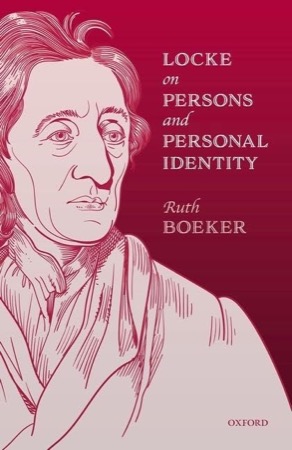
Hardcover. UK, Oxford University Press, 1st, 2021, Book: Very Good, Dust Jacket: Very Good, Hardcover in a bright dust jacket, 303 pages. Ruth Boeker offers a new perspective on Locke's account of persons and personal identity by considering it within the context of his broader philosophical project and the philosophical debates of his day. Her interpretation emphasizes the importance of the moral and religious dimensions of his view. By taking seriously Locke's general approach to questions of identity, Boeker shows that we should consider his account of personhood separately from his account of personal identity over time. On this basis, she argues that Locke endorses a moral account of personhood, according to which persons are subjects of accountability, and that his particular thinking about moral accountability explains why he regards sameness of consciousness as necessary for personal identity over time. In contrast to some neo-Lockean views about personal identity, Boeker argues that Locke's account of personal identity is not psychological per se, but rather his underlying moral, religious, metaphysical, and epistemic background beliefs are relevant for understanding why he argues for a consciousness-based account of personal identity. Taking his underlying background beliefs into consideration not only sheds light on why many of his early critics do not adopt Locke's view, but also shows why his view cannot be as easily dismissed as some of his critics assume. Clean copy.
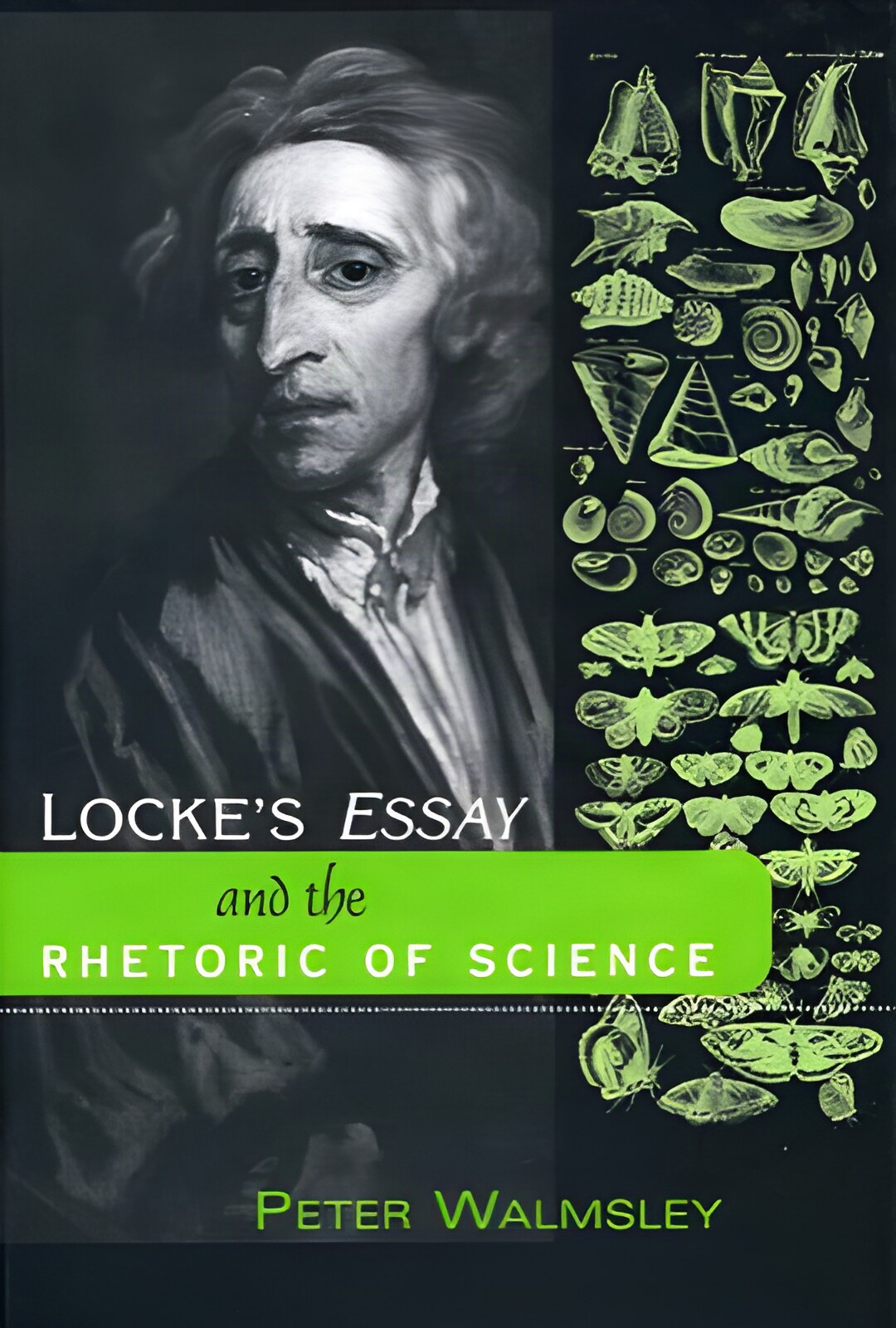
Hardcover. London, Bucknell University Press, 1st, 2003, Book: Very Good, Dust Jacket: Very Good, Hardcover in a bright dust jacket, 199 pages. This book shows how, in his enormously influential Essay Concerning Human Understanding (1689), John Locke embraces the new rhetoric of seventeenth-century natural philosophy, adopting the strategies of his scientific contemporaries to create a highly original natural history of the human mind. With the help of Locke's notebooks, letters, and journals, Peter Walmsley reconstructs Locke's scientific career, including his early work with the chemist Robert Boyle and the physician Thomas Sydenham. He demonstrates too how the Essay embodies in its form and language many of the preoccupations of the science of its day, from the emerging discourses of experimentation and empirical taxonomy to developments in embryology and the history of trades. Widely research and lucidly and engagingly written, Locke's Essay and the Rhetoric of Science constitutes an important new reading of Locke, on that shows both his brilliance as a writer and his originality in turning to science to effect a radical re-invention of the study of the mind. Pencil marking to front fly leaf, otherwise clean.
Hardcover. London, England, Cambirdge at the University Press, 1st Edition, 1917, Book: Good, Dust Jacket: None, 338 pages. Hardcover. Green cloth cover boards, gilt title on spine and front cover board, gilt faded on cover, some agewear. Some light pencil within. Previous owner's name on front flyleaf. Some tanning to pages and edges.
Hardcover. Cambridge UK, Cambridge University Press, 1st, 1953, Book: Very Good, Dust Jacket: Good, Hardcover in a worn dust jacket with a chunk gone from rear panel, 309 pages. This book gives a complete account of all that Locke saw, did and heard during his four years in France. The entries vary from laconic jottings to detailed accounts - full of colour and wit - of life in Paris and the provinces. Locke's variety of interests presents a vivid and thorough account of France at that time. He observed and recorded the absolutism of Louis XIV and the poverty of the peasants, the growing persecution of the Protestants and the external manifestations of Catholicism, recent developments in science and technology - even agricultural methods and the system of taxes. So that this is a book for the general reader as well as for the student of Locke, the social historian and the historian of science. Three b&w plates including a map of his travels. Name on front fly leaf, rubber withdrawn stamp on copyright page, otherwise clean.
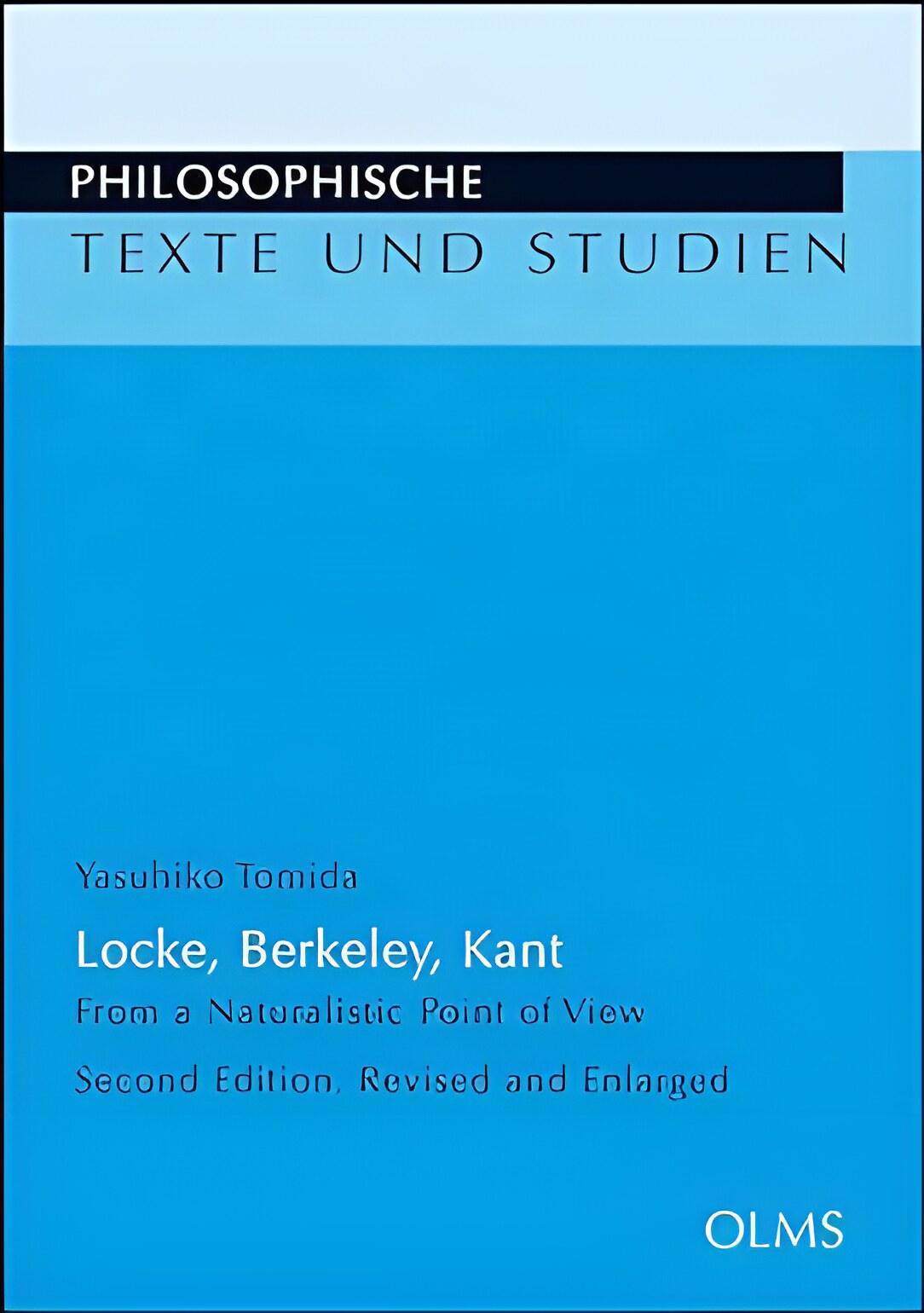
Softcover. Zurich, Georg Olms, 1st, 2012, Book: Very Good, Dust Jacket: None, Softcover, 220 pages. INSCRIBED BY AUTHOR on the front fly leaf. This volume consists of Yasuhiko Tomida's notable essays on Locke, Berkeley, and Kant, as well as a thought-provoking article written in collaboration with an experimental physicist. Tomida asserts that the logical space of the theory of ideas is originally "naturalistic" in Quine's sense of the term and that Berkeley and Kant 'distort' it in their respective ways, thus offering a wholly new viewpoint concerning the historiography of the theory of ideas.
Hardcover. UK, Cambridge University Press, 1st, 1994, Book: Very Good, Dust Jacket: Good, Hardcover in a dust jacket with mild fading to spine edge, short closed tear, 227 pages. William Walker's analysis of John Locke's An Essay Concerning Human Understanding offers a challenging and provocative assessment of Locke's importance as a thinker, bridging the gap between philosophical and literary-critical discussion of his work. He is revealed as a crucial figure for emerging modernity, less the familiar empiricist innovator and more a proto-Nietzschean thinker. Walker's reading of Locke is finely attentive to the text and resourceful in placing the Essay in its broadest philosophical and historical context. Light pencil notations on front fly leaf.
Hardcover. Princeton NJ, Princeton University Press, 1st, 1992, Book: Very Good, Dust Jacket: Very Good, Hardcover, 387 pages. Black cloth covers slightly bowed. Some light notes in pencil. Previous owners name on front endpaper. Dust jacket shows light wear.
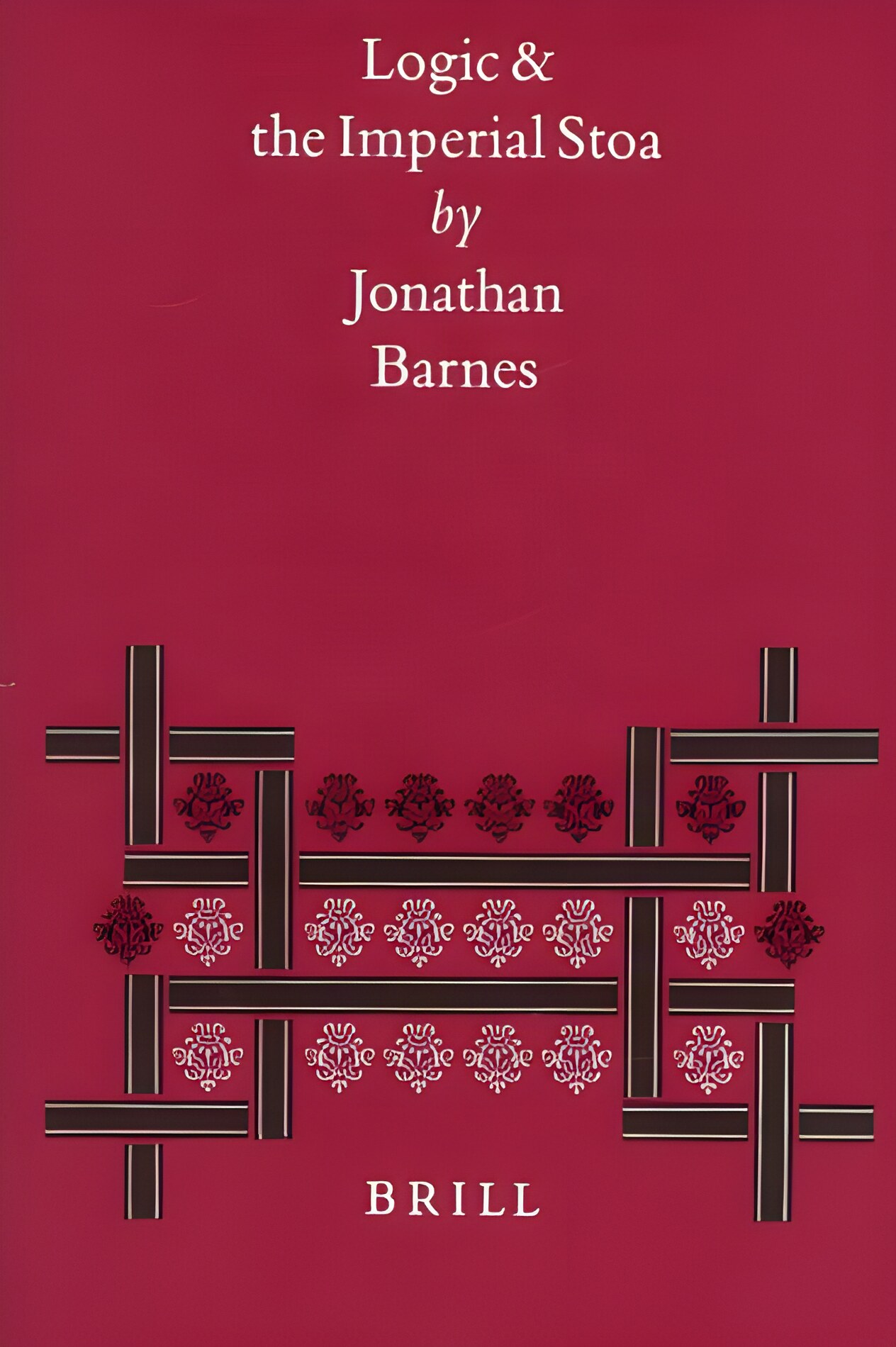
Hardcover. Leiden/NY, Brill, 1st, 1997, Book: Very Good, Dust Jacket: Very Good, Hardcover in a bright dust jacket, 165 pages. Name and date on front fly leaf, otherwise clean. The main argument of this book, against a prevailing orthodoxy, is that the study of logic was a vital - and a popular - part of stoic philosophy in the early imperial period. The argument relies primarily on detailed analyses of certain texts in the Discourses of Epictetus. It includes some account of logical 'analysis', of 'hypothetical' reasoning, and of 'changing' arguments. Written both for historians and for philosophers, and presupposing no logical expertise, this is an important contribution to the history of philosophy in the early imperial period.
Softcover. Robin May, 1st, 2009, Book: Very Good, Dust Jacket: None, 378 pages. Softcover. Pages clean. Binding good. Wrapper very good. In very good condition. The magic of May's journey portrayed in these pages will answer so may of our questions about the paranormal, while assuaging many of our fears about death and that which comes after.
Hardcover. UK, Oxford University Press, 1st, 2013, Book: Very Good, Dust Jacket: Very Good, Hardcover in a bright dust jacket, 326 pages. Lucretius' didactic masterpiece De Rerum Natura (On the Nature of Things) is one of the most brilliant and powerful poems in the Latin language, a passionate attempt at dispelling humanity's fear of death and its enslavement by false beliefs about the gods, and a detailed exposition of Epicurean atomist physics. For centuries, it has raised the question of whether it is primarily a poem or primarily a philosophical treatise, which also presents scientific doctrine. The current volume seeks to unite the three disciplinary aspects -- poetry, philosophy, and science -- in order to offer a holistic response to an important monument in cultural history. With ten original essays and an analytical introduction, the volume aims not only to combine different approaches within single covers, but to offer responses to the poem by experts from all three scholarly backgrounds. Philosophers and scholars of ancient science look closely at the artistic placement of individual words, while literary critics explore ethical matters and the contribution of Lucretius' poetry to the argument of the poem. Topics covered include death and grief, evolution and the cosmos, ethics and politics, perception, and epistemology.Name and date on front fly leaf, light pencil marking to about 25 pages.
Hardcover. Philadelphia PA, United Lutheran Publication House, 1st, 1923, Book: Very Good, Dust Jacket: None, Hardcover, 355 pages, b&w illustration. Dark green cloth with gilt design, lettering.
Softcover. NY, W. W. Norton , reprint, 1984, Book: Very Good, Dust Jacket: None, Softcover, 339 pages. In Felix Gilbert's skilled analysis, the figures of Niccolo Machiavelli, whose writing changed the way people think about politics, and Francesco Guicciardini, whose History of Italy is one of the first classics of modern historical writing, provide important clues to interpreting the Renaissance. "Instead of treating these two great figures in isolation, Professor Gilbert puts them into the context of their times, into the stream of political thinking and historical writing of which they were a part. . . .His book is the fruit of years of writing of which they were a part. . . .His book is the fruit of years of original research among Florentine archives and of careful thought about the problems of Renaissance politics and historiography." Clean, bight copy.
Hardcover. Cambridge MA, Harvard University Press, 1st, 1977, Book: Very Good, Dust Jacket: Good, Hardcover in an edgeworn dust jacket, 500 pages. "The Ecclesiastical History of New England from the First Planting in the Year 1620, unto the Year of Our Lord 1698." With reproductions of the title-pages from the 1702 edition. Edited by Kenneth B. Murdock, with the assistance of Elizabeth W. Miller. Clean copy.
Softcover. Carbondale IL, Southern Illinois University, 1st, 1995, Book: Very Good, Dust Jacket: None, Softcover, 114 pages. In this engrossing double volume, the work and thought of Nicolas Malebranche is examined through the eyes of Simon Foucher and Dortous de Mairan. Part 1 consists of Richard A. Watson's translation of the first published critique, by Simon Foucher, of Malebranche's main philosophical work, Of the Search for the Truth. In the second part, Marjorie Grene presents a meticulous translation of the long correspondence between Malebranche and Jean-Jacques Dortous de Mairan that ended shortly before Malebranche's death. Both Watson and Grene provide insightful introductions to their translations. Clean copy.
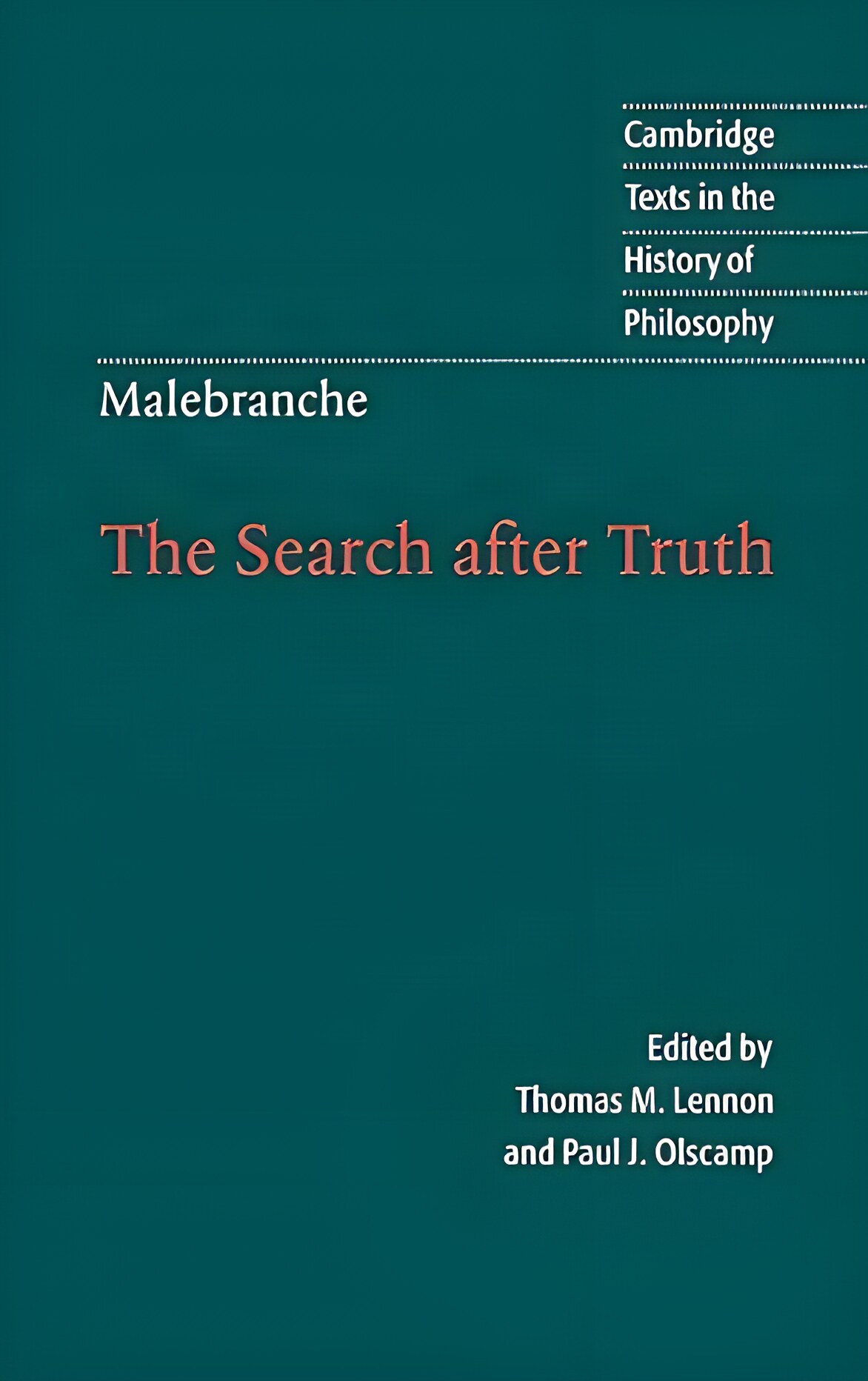
Softcover. Cambridge UK, Cambridge University Press, 1st, 1997, Book: Very Good, Dust Jacket: None, Softcover, 775 pages. Malebranche is now recognized as a major figure in the history of philosophy, occupying a crucial place in the Rationalist tradition of Descartes, Spinoza and Leibniz. The Search after Truth is his first, longest and most important work; this volume also presents the Elucidations that accompanied its third edition, the result of comments that Malebranche solicited on the original work and an important repository of his theories of ideas and causation. Together, the two texts constitute the complete expression of his mature thought, and are written in his subtle, argumentative and thoroughly readable style. Bright, clean copy.
Hardcover. London, Routledge, 1st, 2003, Book: Very Good, Dust Jacket: Very Good, Hardcover in a bright dust jacket, 289 pages. Nicolas Malebranche (1638-1715) is one of the most important philosophers of the seventeenth century after Descartes. A pioneer of rationalism, he was one of the first to champion and to further Cartesian ideas. Andrew Pyle places Malebranche's work in the context of Descartes and other philosophers, and also in its relation to ideas about faith and reason. He examines the entirety of Malebranche's writings, including the famous The Search After Truth, which was admired and criticized by both Leibniz and Locke. Pyle presents an integrated account of Malebranche's central theses, occasionalism and 'vision in God', before exploring and assessing Malebranche's contribution to debates on physics and biology, and his views on the soul, self-knowledge, grace and the freedom of the will. This penetrating and wide-ranging study will be of interest to not only philosophers, but also to historians of science and philosophy, theologians, and students of the Enlightenment or seventeenth century thought.
Softcover. indianapolis, Hackett Publishing, reprint, 2008, Book: Very Good, Dust Jacket: None, Softcover, 388 pages. Contains the most helpful version of Hobbes's political and moral philosophy available in English. Includes the only English translation of De Homine, chapters X-XV. Features the English translation of De Cive attributed to Hobbes. Clean copy.
Hardcover. London, Rudolf Steiner Publishing, 1st, 1945, Book: Good, Hardcover, red cloth faded to tan on front and spine, 211 pages. Translation by H. Collison. Name and stamp on front fly leaf, no other markings.
NY, Cosmopolitan Book Corp., 1st Thus, 1928, Book: Very Good, Dust Jacket: None, Hardcover, 137 pages, 12 color plates by Dean Cornwell. Color illustrated frontispiece. Prelim pages with light foxing. Previous owner's signature on front end paper. Soil and light edgewear to covers. Plates clean and bright.
Hardcover. Berg Publishers, 1st, 1988, Book: Very Good, Dust Jacket: None, Hardcover, 528 pages. This historico-critical edition of Schopenhauer's manuscript remains contains Schopenhauer's entire surviving philosophical notes, from his university years until his death in 1860. Translated here into English for the first time, it provides a fascinating insight into the workings of Schopenhauer's mind and an important key to his philosophical work. Translated by E.F.J. Payne
Hardcover. Burlington VT, Ashgate, 1st, 2005, Book: Very Good, Dust Jacket: None, Hardcover, black cloth stamped in gilt, 263 pages. (Early Modern Englishwoman: a Facsimile Library of Essential Works) Name on front fly leaf otherwise clean.


 "Locke on Money. Edited together with Ancillary Manuscripts, an Introduction, Critical Apparatus, and Notes by Patrick Hyde Kelly.(2 Volumes)by: Locke, John and Kelly,")
 "Locke's Theory of Knowledge and its Historical Relationsby: Gibson, James")


 "Locke, Literary Criticism, and Philosophy by: Walker, William")




 "Lutheran Church in American History, Theby: Wentz, Abdel Ross")

 "Magnalia Christi Americana: Books I and IIby: Mather, Cotton With Kenneth B. Murdock (Ed) With Elizabeth Miller")

 "Malebrancheby: Pyle, Andrew")

 "Man as Symphony of the Creative Word: (Esoteric Studies) Twelve lectures given in Dornach, Switzerland from October 19th to November 11th, 1923 by: Steiner, Rudolf")