Softcover. New York, Dover Publications Inc., 1st, 1982, Book: Very Good, Dust Jacket: None, 121 pages. Softcover. Light edgewear to wrappers. Black and white pictures throughout. Rothstein was a photojournalist for more than 45 years and the photographs in this volume are from his years as photographer for the Farm Security Administdration. His job was to photographs small towns, rural areas and general agricultural conditions throughout the country.
Hardcover. Washington, D. C., Smithsonian, 1st, 1998, Book: Very Good, Dust Jacket: Very Good, Hardcover, 58 pages. Illustrated with full color photographs. Clean, bright copy.
Hardcover. Oxford UK, Bodleian Library, University of Oxford, 1st, 2011, Book: Very Good, Dust Jacket: None, 112 pages. Hardcover with no dust jacket. Clean, unmarked copy with only minor wear to boards. Sepia pictures throughout. To celebrate the acquisition of the archive of distinguished artist Tom Phillips, the Bodleian Library asked the artist to assemble and design a series of books drawing on his themed collection of over 50,000 photographic postcards. These encompass the first half of the twentieth century, a period in which, thanks to the ever cheaper medium of photography, ordinary people could afford to own portraits of themselves. Each book in the series contains two hundred images chosen from a visually rich vein of social history. Their covers also feature thematically linked paintings, specially created for each title, from Phillips's signature work, A Humument. Readers, as its title suggests, shows people reading (or pretending to read) a wide variety of material, from the Bible to Film Fun, either in the photographer's studio, in their own home, or on vacation on the beach. Each of these unique and visually stunning books give a rich glimpse of forgotten times and will be greatly valued by art and history lovers alike.
Softcover. Zurich, Scalo, 1st, 2002, Book: Very Good, Dust Jacket: None, Softcover, 100 pages. Illustrated with full color and black & white photographs. Features essays by William S. Burroughs, Jack Kerouac, Dara Horn, and more. Text in German and English. Clean, bright copy.
Hardcover. US, Smart Art Press, 1st, 2001, Book: Very Good, Dust Jacket: Very Good, 90 pages. Like new in publisher's shrink-wrap. ''Anthony Hernandez's "Pictures for Rome" (1998-99), made while he was a fellow at the American Academy, make no reference to any iconic images of that historic city and its famous edifices. Instead, these elegantly disturbing color photographs examine what could be considered a series of unofficial urban monuments composed from the distressed architectural elements and detritus found inside abandoned buildings..."Pictures for Rome" are pictures of haunted places. Whether they chronicle the bones and viscera of an aborted commercial structure or never-finished hospital, a vacant housing complex or long-deserted schoolhouse, these images engage the ghostly relic of urban renewal, the failed construction projects and real estate disasters that conjure modernism's less glamorous side. And they remind us that even in Rome, the mother city, everything is disposable... "Pictures for Rome" are not, in other words, the same thing as pictures "of" Rome. These images do not describe a specific city at all; instead, they chart concealed landscapes that exist in a world apart from the vitality and velocity of today's consumerist metropolis...A deep undersea silence seems to engulf the modern ruins that Hernandez photographs... Blurring the line dividing past and present, they leave our temporal compass spinning wildly.''--Ralph Rugoff
Softcover. Wooster, College of Wooster Art Museum, The, 1st, 2000, Book: Very Good, Dust Jacket: Very Good, 55 pages. Softcover. Minor wear to cover edges. Full page black & white photographs throughout. Clean unmarked text.
Hardcover. New York, Knopf, 1st, 1991, Book: Very Good, Dust Jacket: Very Good, 69 pages. Hardcover with dust jacket. Clean, unmarked copy with only minor wear to dust jacket.
Hardcover. Zurich, Scalo, 1st, 1993, Book: Very Good, Dust Jacket: Very Good, Hardcover, 205 pages, color photos throughout by Mayer. Edited by Gunther Doeker-Mach. Like new in a bright, unclipped dust jacket. Color photographs of native peoples of Russian Far East hunting, fishing, reindeer herding and their environment. Includes three essays describing problems of these peoples arising from tension between Russian colonisation and their struggle to preserve their identity.
Hardcover. Daylight Books, 1st, 2011, Book: Very Good, Dust Jacket: Very Good, Like new in publisher's shrink-wrap. 144 pages. 55 black and white photographs. The world of Bruce Haley is not for the faint-hearted. Bruce has traveled the globe photographing some of the darkest moments that only the intrepid want to face and visiting his website is a nail biting experience. SUNDER is a stunning exploration of the former USSR and other Iron Curtain countries, but equally as interesting are the accompanying essays, in particular, the wonderful piece by Andrei Codrescu (you may be famliar with his essays read on NPR), and by Kirsten Rian. He is a master photographer showing us the pathos and beauty of a culture that has been ravaged by war and turmoil. His eight year photographic investigation is a stark perspective of the collapse of the communist empire, but Bruce shares it on a human scale.
Paperback. Hanover NH, Hood Museum of Art, 1st, 2006, Book: Very Good, Dust Jacket: Very Good, 87 pages, paperback. Photo documentation of the 1968 student riots in France. Essays by Thomas Crow and Anne Sa'adah. Light rubbing to wraps. Black-and-white photography throughout. Unmarked. Bright and clean. A tight copy. May 9 through 13, 1968 was the beginning of a time of upheaval and social spectacle that pitted students and workers against an unsympathetic government in a series of spirited protests that would fundamentally change France. This catalogue showcases photographs of the famous events by French photographer Serge Hambourg. Hambourg captured the various moods and moments of the protests, including powerful portraits of student leaders Jacques Sauvageot, Daniel Cohn-Bendit, and Alain Geismar, writer Louis Aragon, and filmmaker Jean-Luc Godard.
Hardcover. New Haven, CT, Yale University Press, 1st, 2014, Book: Very Good, Dust Jacket: Very Good, Hardcover in publisher's shrink-wrap. 160 pages, illustrated with 110 color images. Photographer Laura McPhee, noted for her stunning large-scale landscapes and portraits of the people who live and work in them, has been traveling to eastern India for over a decade. There she has devoted her perceptive vision to picturing layers of history, culture, religion, and class as they appear in private heritage homes and public markets, in lively street festivals, and in the faces of city dwellers in Calcutta (also known as Kolkata). This exquisitely produced book features a selection of McPhee's works made in and around India's former capital.
Hardcover. Hong Kong, Visionary World, 1st, 2005, Book: Very Good, Dust Jacket: Very Good, 176 pages. Oversized hardcover with dust jacket. Very clean, unmarked copy with only minor wear to dust jacket. Price sticker on rear dust jacket. Color photographs throughout. Over 20 years worth of photography from Asia.
Hardcover. New York, Princeton Architectural Press, 1st, 2008, Book: Very Good, Dust Jacket: Very Good, Hardcover, 192 pages. A collection of highlights from the Maresca collection of snapshot photographs housed at the Newark Musuem, featuring images from the 1920s through the 1960s. Essays by Marvin Heiferman, Geoffrey Batchen, and Nancy Martha West; interview with Frank Maresca conducted by Heiferman; foreword by Mary Sue Sweeney Price. 192 pages; profusely illustrated in duo-toned b&w and color.
Hardcover. New York, Harper Design, 1st, 2007, Book: Very Good, Dust Jacket: Very Good, Hardcover, 128 pages. Illustrated with 75 gorgeous b&w photographs of John F. Kennedy, Jacqueline and their children by Richard Avedon. Foreword by Robert Dallek. Text by Shannon Thomas Perich.
Hardcover. New York, Norton, 1st, 2005, Book: Very Good, Dust Jacket: Very Good, A monograph focusing for the first time exclusively on Kertesz's early Hungarian prints; selected from more than 1,000 contact prints in the artist's estate and reproduced actual size. Photographs by Andre Kertesz; introduction by Bruce Silverstein; essay by Robert Gurbo. 160 pages; 66 duo-toned b&w plates + 11 text illustrations; 5.25 x 5.25 inches.
Rome, Contrasto, 1st, 2010, Book: Very Good, Dust Jacket: None, Hardcover, 136 pages, 53 b&w plates. A collection of 53 photographs of Pompeii, never published before, shot by the master photographer Mimmo Jodice. Unique images, visions conjuring up a long-lost past tradition, coupled with texts by Ethan Canin, Jim Nisbet and Jay Parini. No dj issued.
Hardcover. NY, Aperture, 1st, 1996, Book: Very Good, Dust Jacket: Very Good, Hardcover, first edition, first printing. 9.5 x 13 inches. 192 pages with 113 duo-toned b&w photographic images offering a 40-year retrospective of the Magnum photographer's front line work. Compelling war pictures.
Hardcover. Gottingen GR, Steidl, 1st, 2015, Book: Very Good, Dust Jacket: Very Good, Hardcover, 237 pages, b&w plates throughout. Hoppe traveled throughout Germany between 1925 and 1938, photographing movie stars, workers and peasants, the birth of the Autobahn, and the explosion of industrial building. This collection includes parts of his 1930 book "Deutsche Arbeit" and many photos never previously seen. Clean copy in a dust jacket.
Hardcover. New Haven CT, Yale /Houston Museum of Fine Arts, 1st, 2007, Book: Very Good, Dust Jacket: Very Good, Hardcover, 168 pages. Chen Changfen (b. 1941) began to photograph the Great Wall twenty years before the Chinese government officially adopted it as the national symbol in 1984. This fascinating book presents a small fraction of his decades-long study of the monumental form and conveys the fertile range of themes and ideas that Chen has investigated, each informed by traditional Chinese art, history, and philosophy. Combining a unique blend of traditional and contemporary technical processes, Chen's richly evocative photographs at once celebrate the remarkable series of building campaigns that produced the Wall and memorialize the thousands of conscripted laborers whose lives were sacrificed to its construction.One of the most striking features of Chen's photographs is their unexpected variety of perspectives and moods, capturing the vicissitudes of weather, time, and human history that have acted upon it. By excluding the people, highways, factories, and modern buildings that encroach on and daily destroy sections of the Wall, however, Chen eliminates major aspects of the Wall's present reality from his pictures. In a thoughtful essay and interview with the artist, Anne Wilkes Tucker probes the meanings of such omissions and guides the reader through Chen's extraordinary images. The Great Wall of China is essential reading for photographers, historians, and travelers.
Hardcover. Berlin, Museum fur Verkehr und Technik, 1st, 1990, Book: Very Good, Dust Jacket: None, Hardcover, tan boards with paste-down label, 40 pages. Wonderful duotone photos, mostly portraits of Berliners in 1948. GERMAN TEXT. Introduction by Alfred Gottwaldt. Clean copy.
Hardcover. San Francisco, Chronicle Books, 1st, 2006, Book: Very Good, Dust Jacket: Very Good, Hardcover, 120 pages, color photos. Terry Falke's wry, lyrical photographs center on the terrain of the American Southwest and the ubiquity of humanity s imprint on it. The images in Observations in an Occupied Wilderness both honor and subvert the grand tradition of western landscape photography, conveying the bleak splendor of the land and Falke's sheer love of looking. Gorgeous, sardonic, and playful, Falke's work emphasizes beauty and incongruity, and is as much about human nature as it is about the land. Shot with a large-format camera, the resultant images are personal and provocative, raising as many questions than they answer. This remarkable debut monograph is a shrewd exploration of our last wild places.
Hardcover. NY, Thames & Hudson, 1st, 2006, Book: Very Good, Dust Jacket: Very Good, Hardcover, 240 pages. This groundbreaking publication announces the death of the conventional portrait. In an age when we are bombarded with flawless images of youthful beauty, when rejuvenation is available through a jar of cream or a scalpel, artists and photographers seek to portray the face in new ways.Through a variety of techniques, including computer manipulation, photomontage, and retouching, the artists present their new portraits. They replace clarity with blur, the split-second with the elastic moment, questioning the notion of a fixed identity, of universality of expression, of what constitutes beauty. Whether Cindy Sherman's disquieting disguises, Gillian Wearing's masked self-portrait, LawickMuller's composite portraits of couples, or Orlan's disturbing experiments with cosmetic surgery, these faces demand attention. 260 illustrations, 165 in color.
Hardcover. Damiani, 1st, 2007, Book: Very Good, Dust Jacket: Very Good, Hardcover, 260 pages. Italian photographer Maurizio Galimberti works exclusively in Polariod. His mosaics of square, white-bordered frames have captured personalities including Andres Serrano, Wim Wenders, Monica Bellucci and Sting, among many others, piece by piece. When he doesn't scratch designs onto the developing pictures with a stick or even a toothbrush, preemptively disrupting any sense that his work directly reflects the real, he takes hundreds of shots of the same subject and eventually assembles up to 140 in a single finished grid. His patrons have included Conde Nast, Rizzoli and Time, and, in advertising, Cartier, Rolex, Nokia, Fiat and Veuve Cliquot. This personal portfolio of the city of New York is full of clean-edged skyscrapers and bridges, limitless streets, multicolored signs, vivid people and limpid skies. Galimberti's Big Apple is thoroughly deconstructed and reconstructed, and the resulting unreal city corresponds perfectly with the soul of New York.
Softcover. NY, Aperture Foundation, 1997, Book: Very Good, Dust Jacket: None, Softcover, 80 pages. A large, beautifully designed photography publication with many full page photographs in black and white and color. Glossy wraps. Guest edited by W.M. Hunt, this issue of Aperture features work by photographers and scientists in their efforts to capture delirium on paper. Images ranging from contemporary through 19th Century show how delirium, clinical or colloquial, has been documented, analyzed, codified, worked over, and wondered about for the last 150 years, together creating a psychic agitation that can be as dark as it is witty. Artists included Nancy Burson, Debbie Fleming Caffrey, Ellen Carey, Henri Cartier-Bresson, Sally Mann, Robert Mapplethorpe, Eugene Richards, Weegee and many others .
Softcover. NY, Aperture Foundation, 2001, Book: Very Good, Dust Jacket: None, Softcover, 80 pages. A large, beautifully designed photography publication with many full page photographs in black and white and color. Glossy wraps. Includes numerous images by Paul Caponigro, Dr. Howard Eugene Edgerton, Jacques-Henri Lartigue, Eadweard Muybridge, Rineke Dijkstra, Hiroshi Sugimoto, Nicholas Nixon and many more.
Softcover. NY, Edition 7L, 1st, 2007, Book: Very Good, Dust Jacket: None, Flexible vinyl covers, 232 pages. Out documents an era at once so close and so far away: the wild, glamorous, disco-and-drugs decade between the end of the Vietnam war and the advent of AIDS, when, in certain parts of Manhattan, every night was party night. As the editor of Andy Warhol's Interview from 1971 to 1983, Bob Colacello was perfectly placed to record this life of art openings, movie premieres, cocktail parties, dinner parties, charity balls and after-hours clubs; he wrote about the best of them in a monthly column called "Out." In 1975, Swiss art dealer Thomas Ammann gave Colacello one of the first miniature 35mm cameras, a black plastic Minox small enough to hide in his jacket pocket, and Colacello began snapping photographs too. Sneaking a shot of Henry Kissinger holding forth at a dinner party, or Bianca Jagger letting loose at Studio 54, Colacello was in the middle of the action, "an accidental photographer" more akin to a secret agent than any typical paparazzo. With their skewed angles, multilayered compositions, and moody lighting, his images have an immediacy and grit not often found in the work of professional party photographers. And what subjects! Diana Vreeland, Calvin Klein, Jack Nicholson, Richard Gere, Cher, Raquel Welch, Mick Jagger, Diane von Furstenberg, Barry Diller, Valentino, Yves Saint Laurent, Nan Kempner, Robert Rauschenberg, Roy Lichtenstein and always Warhol himself. Because space in Interview was limited, only a handful of Colacello's pictures were published each month. Most of those collected in Out have never been seen before.
Hardcover. NY, Simon and Schuster/Ridge Press, 1st, 1958, Book: Very Good, Dust Jacket: Good, Hardcover, 192 pages. A famous photographic exploration of childhood. Over 300 b&w images trace toddlers to teenagers playing, learning and growing up. Light shelfwear, previous owner's bookplate inside front cover. Otherwise clean and bright. Dust jacket good plus with $10 flap price.
Hardcover. NY, Stewart Tabori & Chang, 1st, 1996, Book: Very Good, Dust Jacket: Very Good, Hardcover, 113 pages. Anton Corbijn initiated a new era in portrait photography for the rock and pop music scene with his atmospheric, often melancholy images. Here is a photographer who travels the world, tirelessly seeking to capture its idols in quiet moments and catch a trace of their essential being behind all the fame and glamour. Taken primarily in black and white with a hand-held camera and without auxiliary lighting, most of Corbijn's photographs are shot in those quiet moments between performances. Beyond the reach of the glaring spotlights, on the dark side of the star cult - literally and metaphorically - Corbijn finds what interests him more than gesture, image or glamour: the unusual degree of privacy and closeness that turns his portraits into genuine character studies.Corbijn has now moved beyond the boundaries of music photography and Star Trak reads like a visual encyclopedia of the icons of our culture, gathering together outstanding personalities from the worlds of film, literature, rock music and fashion. He visits film directors Wim Wenders, David Lynch, and Martin Scorsese, actors Johnny Depp, Gerard Depardieu and Jodie Foster, and alongside the older rebels - like Mick Jagger and Leonard Cohen - he includes the enfants terribles of the Eighties and Nineties - Kurt Cobain, Billy Idol, and Slash. Corbijn couples the excesses of William S. Burroughs with the beauty of supermodels Naomi and Christy, and brings Salman Rushdie and Bono together in front of the camera.
Hardcover. New Haven CT, Yale University Press, 1st, 2012, Book: Very Good, Dust Jacket: Very Good, Hardcover, 288 pages. As a prolific photographer for House Beautiful, Better Homes and Gardens, Architectural Digest, and Sunset magazine, Maynard L. Parker (1900-1976) was a pioneer in documenting residential spaces and landscapes for postwar America. His extensively published, sun-kissed brand of photography made him a critical contributor to domestic design culture from the 1940s into the 1960s. Parker's lens revealed the homes and lifestyles of affluent Americans and celebrities, including Judy Garland, Clark Gable, and Bing Crosby, as well as the interiors, gardens, and built works of Samuel Marx, Frank Lloyd Wright, Thomas Church, and Cliff May, offering an alluring template for living in a new consumer age. Maynard L. Parker: Modern Photography and the American Dream is the first monograph to consider Parker and his work. Lavishly illustrated essays by leading scholars set Parker's photography against the backdrop of an unprecedented demographic shift, the Cold War, and a suburban society increasingly fixated on consumption.
Hardcover. Steidl/The George Eastman House , 1st, 2007, Book: Very Good, Dust Jacket: Very Good, Hardcover, 288 pages. Imagining Paradise is the first book to showcase the treasures of The George Eastman House's incomparable Richard and Ronay Menschel Library. It features over 250 rare books, each beautifully illustrated here and accompanied by commentary from prominent scholars. A large and handsome volume itself, as befits its subject, it ranges over the history of the medium of photography, its practitioners and its processes -- from bucolic landscapes, to travel and exploration, science and medicine, the literary and the illustrious. It encompasses the incunabula of William Henry Fox Talbot through the reveries of Maxime Du Camp and Francis Frith; the vision of Peter Henry Emerson to Alfred Stieglitz's Camera Work and 291; and the exceptional published and unpublished books by Alvin Langdon Coburn. It documents works illustrated with tipped-in original salt prints, albumen prints, platinum prints, photogravures, carbon prints, collotypes and Woodburytypes. It includes translations in five languages of Louis Jacques Mande Daguerre's seminal instructional manual describing the daguerreotype process and works of great and unusual beauty, such as a red leather, bronze-trimmed Bible, illustrated in the 1860s with 56 photographs by Francis Frith. No other library in the world holds this breadth and depth of the history, aesthetics and technology of photography and no other book can bring them so thoroughly into the reader's hands. This exceptional collection of rare books was formed from the Eastman Historical Photographic Collection of the Kodak Company, which encompassed the collections of many of the most important photographic scientists, historians and collectors in the world. Due to size and weight, DOMESTIC SHIPPING ONLY.
Hardcover. NY, Calla Editions, 1st, 2010, Book: Very Good, Dust Jacket: Very Good, Hardcover. 128 pages. Picture this: A master photographer shoots the most breathtaking movie star of her time high in the Canadian Rockies in the summer of 1953. And the negatives are filed away for nearly 60 years -- most never seen until now! It was yet another assignment for LOOK magazine staff photographer John Vachon. But when he arrived in Banff, Alberta, in mid-August of 1953 to shoot Marilyn Monroe on location making River of No Return, Vachon encountered an opportunity never afforded the many great photographers who took pictures of Marilyn during her short life. Due to an injured ankle that prevented her from filming, Vachon got access to Marilyn over a period of several days. Vachon's lens captured her in a variety of contexts and countenances. Here is Marilyn the way we want to remember her: luminous, sexually charismatic, smiling radiantly -- even on crutches. This extraordinary portfolio of revealing images ranges from her mugging poolside to riding high on a ski lift to nuzzling with her then-husband-to-be, the legendary Joe DiMaggio -- the only time that the two posed formally together for a photographer.
Hardcover. NY, Random House, 1st, 2003, Book: Very Good, Dust Jacket: Very Good, Hardcover, 264 pages. color and b/w plates. Includes biographical sketches of all the musicians. Includes, but is not limited to: B.B. King, Willie Nelson, Bonnie Raitt, Bruce Springsteen, Beck, Bob Dylan, Mary J. Blige, Steve Earle, Miles Davis, Etta James, Pete Seeger, Emmylou Harris, Tom Waits, The Dixie Chicks, and more. Short essays by musicians Patti Smith, Rosanne Cash, Steve Earle, Mos Def, Ryan Adams, and Beck.
Hardcover. Taschen, 1st, 2007, Book: Very Good, Dust Jacket: Very Good, Hardcover, 264 pages. Alison Jackson has photographed the Queen of England on the toilet, George Bush and Tony Blair chatting in the sauna, Mick Jagger doing gymnastics, and Monica Lewinsky lighting Bill Clinton's cigar. Or has she? The likenesses are uncanny, but of course, her subjects are look-alikes. Her photos demonstrate that while seeing is believing, the truth is another story entirely. In her work, Jackson says, "Likeness becomes real and fantasy touches on the believable. The viewer is suspended in disbelief. I try to highlight the psychological relationship between what we see and what we imagine. This is bound up in our need to look--our voyeurism--and our need to believe." Indeed, by showing "celebrities" ostensibly caught unawares, Jackson's pictures show us what we imagine might go on behind closed doors. Jackson's work causes controversy, because it threatens to cross the line between the private and public life of our contemporary icons. Because we unquestioningly accept the authenticity of the photograph, it would appear that we are being given a glimpse of something confidential, a private moment. It is only upon closer examination that we question the reality of the image, and hopefully this makes us question our unwitting tendency to believe everything we see in the media today.
Hardcover. NY, powerHouse Books, 1st, 2006, Book: Very Good, Dust Jacket: None, Hardcover, 96 pages, introduction "Spirit & Flesh: Mexico's Sexual Revolution by Ruben Martinez, afterword by Pedro Meyer, essay by Trisha Ziff, illustrated with photos and art work documenting local sex workers. No dust jacket issued.
Hardcover. privately printed, 1st, 2007, Book: Very Good, Dust Jacket: Very Good, Hardcover, 64 pages. With over 60 beautiful color plates, this gorgeous book of flower photographs is bound to appeal to a wide audience of anyone interested in Nature, Beauty, Meditation or Art. Tenneson explores the world of botanicals in a way that is completely unique. These photographs transcend mere documentation; they encourage the viewer to see flowers in a whole new way. Joyce Tenneson's breathtaking photographs have graced the covers of major magazines, as well as museums and galleries. Her ethereal portraits of roses, tulips, poppies and other garden blooms also come accompanied by select quotes from authors such as Emily Dickinson, William Carlos Williams, and Anais Nin.
Hardcover. NY, Aperture, 1st, 2000, Book: Very Good, Dust Jacket: Very Good, Hardcover, 176 pages. In a convergence of brilliant color and compelling visual narrative, this new collection of photographs by Pascal Maitre reveals an Africa unfamiliar to most Westerners. He portrays a wide range of experience in sub-Saharan Africa: in Niger's desert, soldiers juggle goats and machine guns; within the forest, a rosary dangles from the chest of a warrior in a Bassorian initiation ceremony. In this startlingly beautiful land, ornamented by the marks of human struggle and worship, contradictions are plentiful. Rich in detail and elegant composition, Maitre's photographs immerse us in an Africa beyond the familiar media depictions. He shows an Africa living with the contradictions of tradition and modernization, of ritual headdresses and plastic flip-flops, of tribal wars and machine guns, of ancestral deities and nonbelievers. A lively preface by Cameroon-born author Calixthe Beyala.
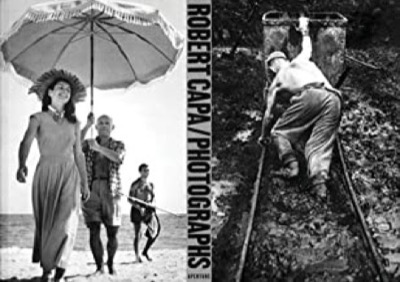
Hardcover. NY, Aperture, 1st, 2005, Book: Very Good, Dust Jacket: Very Good, Hardcover, 192 pages. Robert Capa: Photographs is a major retrospective of one of the century's greatest photographers. Drawing upon hundreds of previously unseen images, this collection reveals Capa as one of the great poets of the camera. In these photographs, we see the world through the eyes of a driven humanist who was also a documentarian of the highest caliber. While previous volumes on Capa have focused on his role as a war photographer, Robert Capa: Photographs shows us the remarkable range of his work: the sufferings as well as the tenderness, humor, and wonder of his subjects. The extraordinary book includes poignant comments by Capa's close friend Henri Cartier-Bresson and by Cornell Capa (Robert's younger brother and the Founding Director of the International Center of Photography), as well as a historical essay by Robert Capa biographer Richard Whelan. The dramatic collection of images in Robert Capa: Photographs shows that he captured-through the events of history-the very heart of humanity.
Hardcover. Steidl, 1st, 2007, Book: Very Good, Dust Jacket: Very Good, Hardcover, 440 pages. NOTE: DUE TO SIZE & WEIGHT, DOMESTIC SHIPPING ONLY. Alberto Diaz Gutierrez--better known as Alberto Korda--is internationally recognized as the master of revolutionary Cuban photography. His most famous image is his powerful 1960 portrait of Che Guevara, "Heroic Guerrilla," which has since become the most reproduced image in the history of photography--though Korda never received any royalties from its reproduction, because he made the photograph for the Cuban newspaper, Revolucion. It is less well known that, prior to the 1959 Revolution, Korda was considered the "Avedon of Cuba," a progressive fashion photographer whose portraits of leading Cuban models, such as Norka, graced the covers of fashion magazines around the world. Likewise, his work of the 1970s and 80s, in which he explored underwater photography and also returned to fashion, has been largely neglected. Korda: A Revolutionary Lens covers every aspect of Korda's extraordinary output, paying particular attention to his work in fashion, Cuban society and the Revolution. It also includes his extensive documentation of Castro and Che. All prints have been produced under the supervision of Jose A. Figueroa, Korda's photographic assistant throughout the 1960s and 70s.
Hardcover. San Francisco, Chronicle Books, 1st, 2000, Book: Very Good, Dust Jacket: Very Good, Hardcover, 172 pages. Hailed by Ansel Adams as "the greatest photographer of the nude," Ruth Bernhard is an icon in the photographic world. As told by Ruth in countless conversations with close friend and biographer Margaretta Mitchell, this thoughtful, illustrated memoir is a true tribute to the legendary artist. Reminiscent of a personal scrapbook, the engaging text is adorned with an abundance of fascinating memorabilia and nostalgic snapshots. Woven throughout is correspondence between Ruth and her mentor Edward Weston, as well as interviews with friends, colleagues, students, and her long-time printer. Also included is a special section entitled "Workshop," which surveys Ruth's acclaimed teaching methods. Coinciding with an exhibition in honor of Ruth's 95th birthday, Ruth Bernhard: Between Life and Art is a beautiful celebration of an extraordinary woman.
Hardcover. NY, Aperture, 1st, 1998, Book: Very Good, Dust Jacket: Very Good, Hardcover, 168 pages. A native of Kazakhstan, Ljalja Kuznetsova traversed the expanses of the Central Asian steppe to photograph the gypsies, or Roma people, whose mysterious comings and goings have fascinated her since she was a child. Shaking the Dust of Ages: Gypsies and Wanderers of the Central Asian Steppe is the first book devoted to these pictures, for which Kuznetsova won the Mother Jones Leica Medal of Excellence and the Paris Grand Prix for Photography. Kuznetsova's photographs present rare, intimate portraits of gypsies-- whose freedom from the ties of civilization is reflected in the wild winds and unlimited vistas of the steppe landscape. As Kuznetsova traveled through Kazakhstan, Turkmenistan, Uzbekistan, and the Ukraine, the gypsies continually inspired her. She found in them a people without frontiers, living independent of politics, religious dispute, or social class. Though their presence on the steppe is becoming a thing of the past, Kuznetsova's cast of characters and their world seem timeless in these images.
Softcover. Washington, Smithsonian Institution Press, 1st, 1993, Book: Very Good, Dust Jacket: None, Softcover with light wear to paper wrappers. Clean, tight copy. Landscape images made with a large format panorama camera. Photographs by Lois Conner, with an interview; afterword by Richard Woodward. 61 pages; 31 duo-toned b&w plates; 10 x 8.5 inches. Technical information. From the Smithsonian's Photographers at Work series, edited by Constance Sullivan.
Hardcover. London, Carpet Bombing Culture, 1st, 2015, Book: Very Good, Dust Jacket: None, Hardcover, illustrated boards. 216 pages, b&w photos. A unique collection of portraits personally selected by one of the UKs foremost portrait photographers covering alternative London's unique counter-cultural history from Punks, New Romantics, Goths, Disco Queens, Soul Boys, Fetish Worshippers, Rockers, Cyberpunks, Ravers, Clubbers and Party Animals. Derek Ridgers has been a feature in the clubs and on the streets of the capital for over 50 years - indulging in his obsession for documenting the people dressed up for the glorious night.
Hardcover. NY, Thames & Hudson, 1st, 2013, Book: Very Good, Dust Jacket: None, Hardcover, 312 pages, pictorial boards with black cloth spine. Brassai (1899-1984) was the first and is still the most famous photographer to chronicle Paris after dark. Born in Hungary, he came to the French capital in 1924, working first as a journalist and then embracing photography, but it was the Paris of the 1930s that forms the bedrock of his body of work. Walking the city's streets at night, Brassai captured a previously unseen world on camera. He shows us every face and every facet, from tough guys and showgirls to prostitutes and pleasure-seekers, from the bustling cafes and dance halls to the stillness of deserted streets and mist-shrouded monuments. Through his eyes, Paris becomes a world of shadows, in which light, the prerequisite for any photograph, is reduced to dimly lit windows, streetlamps in the fog, or reflections on a rain-soaked pavement. This book brings together some of the best-known images from Brassai's classic Paris After Dark and The Secret Paris of the 30's, showcasing them alongside previously unpublished photos and archive material. It places his work in its historical and artistic context, analyzing the unique nature of his photographic vision: part reportage, part social document, part poetic exploration. 296 illustrations, 214 in duotone.
Hardcover. Just Clicked Publications , 1st, 2004, Book: Very Good, Dust Jacket: None, Hardcover. Features the photographic work of Academy Award winning Cinematographer Karl Struss taken when he visited Bermuda in the late 1950s. Mr. Struss first visited Bermuda in 1912. Enchanted with the island, he returned in the fall of 1913 to take more photographs. This led to his appointment in 1914 by the Bermuda Trade Development Board to take photographs for the Island's 1915-16 official tourists' guide, Bermuda: Nature's Fairyland. Mr. Struss did not return to Bermuda for more than 40 years, until the late 1950s when he came with his wife Ethel. His photographs from that trip show Bermuda on the cusp of social and economic change. The original transparencies were taken with Ektachrome colour film on a stereo camera.
Hardcover. San Francisco, Pomegranate Communications, 1st, 2004, Book: Near Fine, Dust Jacket: Near Fine, Like new in publisher's shrink-wrap. Hardcover, 136 pages, b&w photos of the artist at work. Foreword by David Driskell, introduction by Ruth Fine.
Softcover. Martha's Vineyard Historical Society, 1st, 1998, Book: Very Good, Dust Jacket: None, Softcover, 296 pages, b&w photos by Mark Lennihan. It is the people of Martha's Vineyard who give voice to the Vineyard "sense of place." Here, in their own words excerpted from interviews with oral historian Linsey Lee, are the photographed portraits and stories of seventy-five Vineyarders, chronicling the continuity and the changes of life on the Vineyard over the last one hundred years. We find farmers, fishermen, neighbors, boat builders and summer people. There are stories of shipwrecks, race relations, ice cutting, rum running, one-room schoolhouses, whaling captains and whaling wives, Portuguese customs, Wampanoag heritage and more, chronicling a way of life that has continued for generations and is fast disappearing.
Softcover. Seattle, University of Washington, 1st, 1974, Book: Very Good, Dust Jacket: None, Softcover. Introduction by Margery Mann. A retrospective look at Cunningham's long career. Includes many of her best images. B&w images throughout. A clean copy in wrappers.
Hardcover. Chicago, University of Chicago Press, 1st, 2016, Book: Very Good, Dust Jacket: Very Good, Hardcover 192 pages. On September 25, 1890, the Mormon prophet Wilford Woodruff publicly instructed his followers to abandon polygamy. In doing so, he initiated a process that would fundamentally alter the Latter-day Saints and their faith. Trading the most integral elements of their belief system for national acceptance, the Mormons recreated themselves as model Americans. Mary Campbell tells the story of this remarkable religious transformation in Charles Ellis Johnson and the Erotic Mormon Image. One of the church's favorite photographers, Johnson (1857-1926) spent the 1890s and early 1900s taking pictures of Mormonism's most revered figures and sacred sites. At the same time, he did a brisk business in mail-order erotica, creating and selling stereoviews that he referred to as his "spicy pictures of girls." Situating these images within the religious, artistic, and legal culture of turn-of-the-century America, Campbell reveals the unexpected ways in which they worked to bring the Saints into the nation's mainstream after the scandal of polygamy.
Hardcover. NY, Aperture, 1st, 1996, Book: Very Good, Dust Jacket: Very Good, Hardcover, first edition, first printing. 9.5 x 13 inches. 192 pages with 113 duo-toned b&w photographic images offering a 40-year retrospective of the Magnum photographer's front line work. Compelling war pictures.

 "American West in the Thirties: 122 Photographsby: Rothstein, Arthur")
 "Cuba y Cubaby: Burri, Rene")
 "Readers: Vintage People on Photo Postcardsby: Phillips, Tom")
 "Du: Robert Frank - Part Twoby: NA/Robert Frank")
 "Anthony Hernandez: Pictures for Romeby: Rugoff, Ralph")
 "Steel & Real Estate - Margaret Bourke-White and Corporate Culture in Cleveland 1927 - 1929by: Bourke-White, Margaret/Geraldine Wojno Kiefer")
 "Great British, Theby: Arnold, Eve")
 "Forgotten Peoples of Siberia, Theby: Mayer, Fred")
 "Sunderby: Haley, Bruce")
 "Protest in Paris 1968: Photographs by Serge Hambourgby: Hambourg, Serge")
 "Home and the World, The: A View of Calcuttaby: McPhee, Laura")
 "Ardent Eye by: Kemp, Hans")
 "Now Is Then: Snapshots from the Maresca Collectionby: Heiferman, Marvin")
 "The Kennedys: Portrait Of A Familyby: Avedon, Richard")
 "Andre Kertesz: The Early Yearsby: Kertesz, Andre")
 "Pompeii: Echoes from the Grand Tourby: Jay Parini, Ethan Canin, Jim Nisbet, Angelo Cannavacciuolo (Creator), Mimmo Jodice (Photographer), Marcello Fiori (Introduction")
 "Dark Odysseyby: Griffiths, Philip Jones")
 "E.O. Hoppe: The German Work: 1925-1938by: Phillip, Prodger")
 "The Great Wall of China: Photographs by Chen Changfen (Houston Museum of Fine Arts)by: Anne Wilkes Tucker and Jonathan D. Spence")
 "Menschen am Zerstorten Anhalter Bahnhof: Fotografien Henry Ries Berlin 1948by: Ries, Henry")
 "Observations in an Occupied Wilderness: Photographs by Terry Falkeby: Falke and Carol McCusker, Terry")
 "Face: The New Photographic Portraitby: William A. Ewing")
 "Maurizio Galimberti: New York Polaroidby: Giuliana Scim")
 "Aperture 148: Delirium - Summer 1997(Aperture Magazine)by: Aperture Foundation Inc. Staff")
 "Aperture 158: Photography and Time (Aperture Magazine)by: Aperture Foundation Inc. Staff")
 "Bob Colacello's Outby: Colacello, Bob")
 "The World is Youngby: Miller, Wayne")

 "Maynard L. Parker: Modern Photography and the American Dreamby: Jennifer A. Watts")
 "Imagining Paradise: The Richard and Ronay Menschel Libraryby: Manfred Heiting, Sheila Foster, et al.")
 "Marilyn, August 1953: The Lost LOOK Photos by: Mr. Brian Wallis Chief Curator and John Vachon")
 "American Music: Photographs by: Annie Leibovitz")
 "Alison Jackson: Confidentialby: Alison Jackson , Will Self , et al.")
 "Flesh Life: Sex in Mexico City by: Rodriguez, Joseph; Martinez, Ruben")
 "Intimacy: The Sensual Essence of Flowersby: Tenneson, Joyce")
 "Mon Afrique: Photographs of Sub-Saharan Africaby: Pascal Maitre and Calixthe Beyala")
 "Alberto Korda: A Revolutionary Lensby: Mark Sanders, Cristina Vives, et al.")
 "Ruth Bernhard: Between Art and Lifeby: Margaretta Mitchell and Ruth Bernhard")
 "Shaking the Dust of Ages: Gypsies and Wanderers of the Central Asian Steppeby: Ljalja Kuznetsova , Inge Morath, et al.")
 "Great War, The: The Persuasive Power of Photographyby: Thomas, Gail Fann")
 "Panoramas of the Far East: Photographs by Lois Connerby: Conner, Lois")
 "The Dark Carnival: Portraits from the Endless Night by: Ridgers, Derek (Photographer)")


 "Brassai: Paris Nocturne by: Sylvie Aubenas (Author), Quentin Bajac (Author)")


 "Bermudian Journey by: Struss, Karl")
 "Romare Beardenby: Stewart, Frank(photographer)")
 "Vineyard Voices: Word, Faces & Voices of Island Peopleby: Linsey Lee/Mark Lennihan")
 "Imogen! Imogen Cunningham Photographs 1910-1973 by: Imogen Cunningham, Introduction: Margery Mann")
 "Charles Ellis Johnson and the Erotic Mormon Imageby: Mary Campbell")
 "Dark Odysseyby: Griffiths, Philip Jones")