Hardcover. NY, F.A. Stokes Company, 1st, 1900, Book: Very Good, Dust Jacket: None, Hardcover, red cloth with bright gilt stamping, 137 pages. Top edge gilt. Ribbon marker, photographic frontispiece portrait of actor John Drew, as well as numerous photographs of John Drew (and other actresses) in various dramatic productions. Clean copy.
Hardcover. NY, W.W. Norton, 1st, 1955, Book: Very Good, Dust Jacket: Good, Hardcover in a bright, price-clipped dust jacket that has a few tape repairs. B&w drawings by Arthur Conrad. Sequel to "John Goffe's Mill". This volume speaks of the "human history" changes to the mill site over the 200 years and 8 generations of his family who owned the property. Since the mid-18th century, author George Woodbury's family had owned a Bedford NH mill. His childhood home, he returned there to restore his great, great, great, great grandfather's saw and grist mill. He had set aside his Harvard Peabody Museum archaeologist career to restore, rebuild and work the mill. "What he couldn't swap or buy he invented and built himself".
Hardcover. New Haven CT, Yale University Press, 1st, 2010, Book: Very Good, Dust Jacket: Very Good, Hardcover, 224 pages, profuse color and b&w illustrations and plates. The essays in John La Farge's Second Paradise explore the artist's reemergence as a plain air landscape painter, his use of the sketchbook, and his late decorative work, which was reinvigorated by the experience of light and color he discovered in the South Seas. Further discussions examine the prevailing notions of tropical paradise perpetuated since Captain Cook's "discovery" of Polynesia in the late 18th century, and offer the first extended comparison of the careers and art of La Farge and Paul Gauguin, who arrived in Tahiti only days after La Farge left in 1891. Featuring many previously unpublished works, this beautiful book is a major contribution to the study of La Farge's life and art. Like new in publishers shrink-wrap.
Hardcover. Oxford UK, Oxford University Press, 1st, 2011, Book: Very Good, Dust Jacket: Very Good, Hardcover in a bright dust jacket, 252 pages. Peter Anstey presents an innovative study of John Locke's views on the method and content of natural philosophy--the study of the natural world. He argues that Locke was an advocate of the Experimental Philosophy: the new approach to natural philosophy championed by the scientists of the Royal Society who were opposed to speculative philosophy. Clean, bright copy.
Hardcover. Cambridge UK, Cambridge University Press, 1st, 2006, Book: Very Good, Dust Jacket: Very Good, Hardcover in a bright dust jacket, 767 pages. 'This book is a major new intellectual and cultural history of intolerance and toleration in early modern and early Enlightenment Europe. John Marshall offers an extensive study of late seventeenth-century practices of religious intolerance and toleration in England, Ireland, France, Piedmont and the Netherlands and of the arguments which John Locke and his associates made in defence of 'universal religious toleration'. He analyses early modern and early Enlightenment discussions of toleration; debates over toleration for Jews and Muslims as well as for Christians; the limits of toleration for the intolerant, atheists, 'libertines' and 'sodomites'; and the complex relationships between intolerance and resistance theories including Locke's own Treatises. This study is a significant contribution to the history of the 'republic of letters' of the 1680s and the development of early Enlightenment culture and will be essential reading for scholars of early modern European history, religion, political science, and philosophy.' Clean copy.
Hardcover. Tucson, University of Arizona Press, 1st, 1970, Book: Very Good, Dust Jacket: None, 2 Volume hardcover set in slipcase. Volume 1 - A Stylistic Analysis. 312 pages. Illustrations primarily in black & white. Features biographical information. Dust jacket with light wrinkling, spotting along rear bottom edge. Clean, tight copy. Volume 2 - Catalogue Raisonne. 576 pages. Features black & white illustrations. Dust jacket with light wear, wrinkling to rear. Clean, tight copy. Slipcase with very minor wear.
Hardcover. New York, HarperCollins, 1st, 2014, Book: Very Good, Dust Jacket: Very Good, 652 pages. Hardcover. B/w illustrations throughout. Gilt title on spine. Dust jacket unclipped. In excellent shape, binding tight, looks barely read. Clean and unmarked inside and out.
Hardcover. Boston, Little, Brown, and Company, 1st, 1932, Book: Good, Dust Jacket: None, Hardcover, dark blue cloth with gilt design and lettering, 437 pages. Includes [9] leaves of plates, illustrations, portraits, bibliographical references, and index. A fine biography on America's sixth President, and the second Adams to hold that office. Clark gives equal attention to Adams' early diplomatic career, his time in State politics, in the U.S. Senate, as Secretary of State, and of his extensive career as an elder-statesman after his Presidency. Spine gilt faded, corners worn, name on front endpapers, otherwise clean.
Hardcover. London, Oxford University Press, reprint, 2011, Book: Very Good, Dust Jacket: None, Two volume set complete, glossy boards, 977 pages in total. Professor Toomer's two-volume set is not only an indispensable reference work but also provides the first thorough treatment of the scholarship of John Selden, acknowledged as the most learned man of 17th-century England. All of his numerous published works, especially in the fields of history, law, and Hebraica, are critically examined and described in detail. The narrative also relates his writings to contemporary events, in the Civil War and the parliaments (including the Long Parliament) in which he played a prominent part, and to the work of other scholars in Europe (notably Scaliger and Grotius) and in Britain (including Camden and Ussher). Selden's involvement with the Universities, the support of libraries, and the promotion of scholarship is discussed. The work will be an essential resource, not only for the life of a major figure of his time, but also for the intellectual history of 17th-century England in general. No djs as issued, like new.
Softcover. Wilmington, DE, Delaware Art Museum, 1st, 1988, Book: Very Good, Dust Jacket: None, Softcover, 150 pages. Exhibition catalog. Mostly black-and-white, with some color, illustrations. Light sun-fade to spine. A little wear to bottom corner of front cover. Very good, unmarked copy.
Hardcover. Hartford, CT, American Publishing Company, Reprint, 1980, Book: Very Good, Dust Jacket: None, Hardcover, blue cloth with gilt design, 298 pages. "Property of U.S. Navy" stamped on bottom edge. Clean, unmarked text.
Hardcover. NY, Columbia University Press, 1st, 1974, Book: Very Good, Dust Jacket: Very Good, Hardcover in a bright dust jacket, 200 pages. 'Carol Berkin's lively narrative of one British Loyalist's disastrous career uncovers in an arresting manner the other side of the U. S. Revolution. The Revolution, from Sewall's point of view, was an unnecessary and unworthy attack by charlatans and demagogues on the best society the world had yet created. Although Sewall sought to avoid confrontation with his increasingly revolutionary friends, including Sam & John Adams and John Hancock, and at the same time be independent in his appointed posts, he was trapped in the political hierarchy of colonial Massachusetts. When the Revolution began in earnest, he left a beleaguered Boston to take refuge in England where he met the same fate as the other Tory refugees: he was an insignificant colonial, unworthy of royal patronage. ' Name on front fly leaf, otherwise clean.
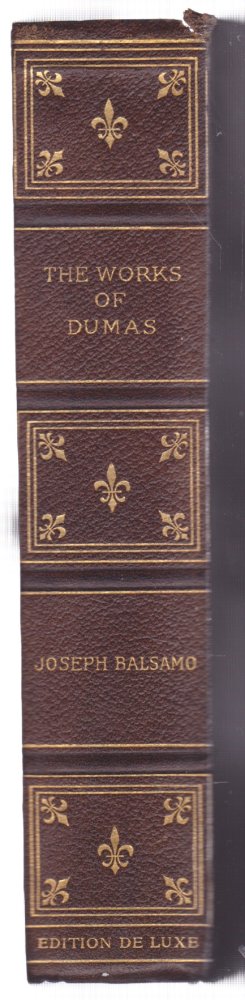
Hardcover. Philadelphia, Nottingham Society, Ltd Ed., 1900, Book: Very Good, Dust Jacket: None, Hardcover, marbled boards with 3/4 leather, gilt lettering on spine, top edge gilt. B&w frontis. Joseph Balsamo is a historical novel set in the late 18th century and tells the story of Joseph Balsamo, a charismatic and mysterious figure who becomes involved in the political and social upheavals of the time. Balsamo is a master of disguise and deception, and he uses his skills to manipulate the people around him and gain power and influence. Along the way, he becomes embroiled in a love triangle with two women, Marie Antoinette and Countess Cagliostro. The novel is full of intrigue, romance, and adventure, and it provides a vivid portrayal of life in France during the years leading up to the French Revolution. 8th volume from the set. Limited to 1000 copies. There is some fraying to the top edge of the cover. Otherwise a clean, tight copy.
Hardcover. Barre MA, Imprint Society, 1st thus, 1971, Book: Very Good, Dust Jacket: None, Hardcover in a slipcase, 248 pages. Many illustrations from manuscript charts and drawings by Ingraham, introduction by Mark D. Kaplanoff, one of 1950 copies. Binding is decorated gray paper over boards, with yellow cloth spine and pasted on label. A record of a voyage for the sea otter trade, with a route that took the ship to the Sandwich (Hawaiian) Islands, the Marquesas, and China as well as to the northwest coast of North America.
Hardcover. St. Paul MN, Minnesota Historical Society, 1st, 1976, Book: Very Good, Dust Jacket: Very Good, Hardcover in a bright, unclipped dust jacket, 294 pages. Lightly illustrated with a few full-page and in-text photographs. The journals of Joseph N. Nicollet, an important explorer who documented the geography of the Coteau plains and large parts of the Mississippi and Missouri rivers (and of course, Minnesota). Nicollet was well-known for recording the Native American names of the places he explored. INSCRIBED BY BOTH BRAYS on the title page. Clean copy.
Hardcover. Philadelphia, J.B. Lippincott, 1st, 1918, Book: Very Good, Dust Jacket: None, Hardcover, brown cloth with a pastedown on front cover with title and illustration. Offers a powerful visual record of the United States' contribution to World War I. This collection of lithographs by renowned artist Joseph Pennell provides a unique glimpse into the nation's war effort, focusing on the crucial role of American industry. Previous owner's note on the front fly leaf, otherwise clean.
Hardcover. Urbana IL, University of Illinois Press, 1st, 1961, Book: Very Good, Dust Jacket: Very Good, Hardcover in alightly worn dust jacket, 260 pages. "In this first biography of Warren since 1865, John Cary re-establishes Warren's deserved reputation as an American patriot and leading figure of the American Revolution. He ranks Warren with Samuel Adams as the two most important figures in the Massachusetts revolutionary movement." Name on front fly leaf, otherwise clean.
Hardcover. New York, Wiley & Halsted, 2nd Ed., 1822, Book: Very Good, Dust Jacket: None, 246, 256 pages, two volumes bound as one. A total of 6 engraved plates - 2 illustrations in vol. I and 4 illustrations in vol. II, but lacks the map, an illustration at page 20, fold-out chart and frontispiece portrait that some dealers describe. Polished brown calf with leather label, gilt lettering still very readable. Previous owner's small stamp on front fly leaf, otherwise clean.
Hardcover. New Haven CT, Yale University Press, 2nd pr., 1922, Book: Good, Dust Jacket: None, Hardcover, marbled boards with gray cloth spine, 333 pages plus index. Endpapers map. Janet Schaw, a supporter of the Crown, illustrates the extent to which the American Revolution had, by 1775, become a close, personal insurgency, pitting neighbor against neighbor. Schaw was a young, well-educated Scottish woman who traveled to North Carolina to visit her older brother Robert, the owner of a plantation on the Cape Fear River near Wilmington. She arrived in March of 1775 and while in North Carolina witnessed, among other things, land clearing through controlled burning and the killing of an alligator. More important, she observed a society that was splitting asunder under the stress of revolutionary politics. The decisions of the Wilmington Committee forced men and women along the Cape Fear to take sides. Worn covers with spine cloth coming loose. Binding is solid.
Hardcover. New Haven CT, Yale University Press, 4th pr., 1927, Book: Very Good, Dust Jacket: None, Hardcover, marbled boards with a gray cloth spine, title label on spine, 343 pages, endpapers map, top edge gilt. Journey of Janet Schaw, a Scottish woman who traveled through the American colonies and the Caribbean in the late 18th century. Her observations provide firsthand accounts of colonial society, politics, slavery, and daily life on the eve of the American Revolution. With historical notes and context by the editor, this work offers valuable insight into the era from a unique perspective. Bookplate on inside front cover, otherwise clean.
Softcover. Athens GA, University of Georgia Press, reprint, 2001, Softcover, clean, unmarked pages. 415 pages, followed by a short Index. Fanny Kemble offers a gripping, first-hand account of life on a Southern plantation before the Civil War. Combining a keen observational style with a candid narrative voice, Kemble lays bare the complexities of plantation life, including the stark realities of slavery and the socio-economic hierarchies of antebellum Georgia. The journal entries provide an intimate glimpse into the daily lives of both the enslaved and the plantation owners, reflecting her deep moral convictions and growing abolitionist sentiments against a backdrop of genteel Southern culture. Fanny Kemble, a British actress and writer, was thrust into the world of the Southern elite through her marriage to a plantation owner, which provided her with unprecedented access to the intricacies of plantation management and its social fabric.
Softcover. NY, MJF Books, reprint, 1997, Hardcover in a bright dust jacket, 191 pages plus index. In 1834, Osborne Russell joined an expedition from Boston, under the direction of Nathaniel J. Wyeth, which proceeded to the Rocky Mountains to capitalize on the salmon and fur trade. He would remain there, hunting, trapping, and living off the land, for the next nine years. Journal of a Trapper is his remarkable account of that time as he developed into a seasoned veteran of the mountains and experienced trapper. Clean copy.
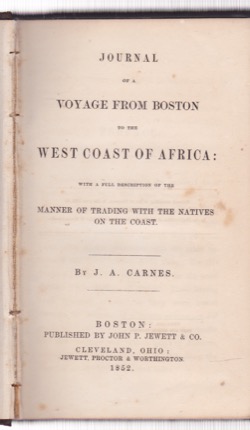
Hardcover. Boston, John P. Jewett & Co., 1st, 1852, Book: Very Good, Dust Jacket: None, Hardcover, original blind stamped cloth with gilt stamped lettering on spine. 479 pages with mild foxing to a few pages. Very good plus, no markings.

 "John Drew by: Dithmar, Edward A.")
 "John Goffe's Legacy by: Woodbury, George")
 "John La Farge's Second Paradise: Voyages in the South Seas, 1890-1891 (Yale Art Gallery) by: Hodermarsky, Elisabeth")
 "John Locke and Natural Philosophy by: Anstey, Peter R.")
 "John Locke, Toleration and Early Enlightenment Culture (Cambridge Studies in Early Modern British History) by: Marshall, John")
 "John Marin - A Stylistic Analysis and Catalogue Raisonne by: Reich, Sheldon")
 "John Marshall and Alexander Hamilton: Architects of the American Constitution by: Konefsky, Samuel J.")
 "John Quincy Adams: American Visionary by: Kaplan, Fred")
 "John Quincy Adams: Old Man Eloquent by: Bennett Champ Clark")
 "John Selden: A Life in Scholarship (Two Volumes) by: Toomer, G. J.")
 "John Sloan: Spectator of Life by: Elzea (curators), Rowland, Elizabeth Hawkes")
 "Joining the Navy: Or Abroad with Uncle Sam by: Paynter, JNO. H.")
 "Jonathan Sewall: Odyssey of an American Loyalist by: Berkin, Carol")
 "Joseph Balsamo (De Luxe Works of Dumas) Vol VIII: Marie Antoinette Romances by: Dumas, Alexander")
 "Joseph Ingraham's Journal of the Brigantine Hope on a Voyage to the Northwest Coast of North America, 1790-1792 by: Ingraham, Joseph; Kaplanoff, Mark D.")
 "Joseph N. Nicollet on the Plains and Prairies; The Expeditions of 1838-39 With Journals, Letters, and Notes on the Dakota Indians (INSCRIBED COPY) by: Bray, Martha Col")
 "Joseph Pennell's Pictures of War Work in America by: Joseph Pennell")
 "Joseph Warren: Physician, Politician, Patriot by: Cary, John")
 "Journal of a Cruise Made to the Pacific Ocean by Captain David Porter in the United States Frigate Essex in the Years 1812, 1813, and 1814 (2 Vols in One) by: Porter,")
 "Journal of a Lady of Quality Being the Narrative of a Journey from Scotland to the West Indies North Carolina and Portugal in the Years 1774 to 1776 by: Andrews, Evang")
 "Journal of a Lady of Quality: Being the narrative of a journey from Scotland to the West Indies, North Carolina, and Portugal, in the years 1774 to 1776 by: Janet Scha")
 "Journal of a Residence on a Georgian Plantation in 1838-1839 by: Kemble, Frances Anne")
 "Journal of a Trapper: A Hunter's Rambles Among the Wild Regions of the Rocky Mountains, 1834 - 1843 by: Osborne Russell (Author), Aubrey L. Haines (Editor)")
 "Journal of a Voyage From Boston to the West Coast of Africa; with a Full Description of the Manner of Trading with the Natives on the Coast by: J. A. Carnes")