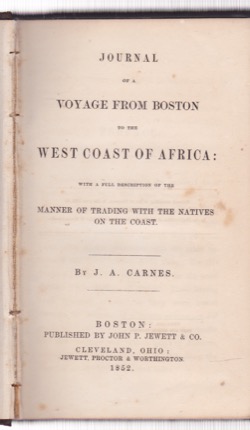
Hardcover. Boston, John P. Jewett & Co., 1st, 1852, Book: Very Good, Dust Jacket: None, Hardcover, original blind stamped cloth with gilt stamped lettering on spine. 479 pages with mild foxing to a few pages. Very good plus, no markings.
Hardcover. London, Society for the Promotion of Hellenic Studies, 1st, 1903 1904, Book: Very Good, Dust Jacket: None, Two years (1903 and 1904) bound in one volume. Handsome half black calf with raised bands on spine along with red label and gilt lettering. Part one for 1903: 373 pages plus 13 full-page b&w and color plates. Part two for 1904: 354 pages plus 14 b&w (including 2 fold-outs). Former university library with minimal stamping to edge of text block and on bookplate inside front cover. Sticker residue to bottom of spine.
Hardcover. London, Society for the Promotion of Hellenic Studies, 1st, 1905 1906, Book: Very Good, Dust Jacket: None, Two years (1905 and 1906) bound in one volume. Handsome half black calf with raised bands on spine along with red label and gilt lettering. Part one for 1905: 382 pages plus 13 full-page b&w plates and 1 color fold-out. Part two for 1906: 303 pages plus 16 b&w and 2 color plates. Former university library with minimal stamping to edge of text block and on bookplate inside front cover. Sticker residue to bottom of spine.
Hardcover. London, Society for the Promotion of Hellenic Studies, 1st, 1913 1914, Book: Very Good, Dust Jacket: None, Two years (1913 and 1914) bound in one volume. Handsome half black calf with raised bands on spine along with red label and gilt lettering. Part one for 1913: 410 pages plus 22 full-page b&w plates. Part two for 1914: 362 pages plus 20 b&w plates. Plus a 164 page catalogue of lantern slides in the Society's collection. Former university library with minimal stamping to edge of text block and on bookplate inside front cover. Sticker residue to bottom of spine.
Hardcover. London, Society for the Promotion of Hellenic Studies, 1st, 1915 1916, Book: Very Good, Dust Jacket: None, Two years (1915 and 1916) bound in one volume. Handsome half black calf with raised bands on spine along with red label and gilt lettering. Part one for 1915: 290 pages plus 9 full-page b&w plates. Part two for 1916: 417 pages plus 9 b&w plates. Former university library with minimal stamping to edge of text block and on bookplate inside front cover. Sticker residue to bottom of spine. Chip to calf at top of spine.
Hardcover. Auburn NY, Knapp, Peck and Thomson, 1st, 1887, Book: Fair, Dust Jacket: None, Hardcover, original red cloth, gilt titles and rules, blind-stamped double border. 581 pages including Errata leaf. Includes several fold-out maps, plus pockets inside the front and rear boards containing maps and plans. Engraved frontispiece of Sullivan, engraved portraits in text of Brigadier General James Clinton, Colonel Peter Gansevoort (from a portrait by Gilbert Stuart, famous for his portrait of George Washington), and Colonel Philip Van Cortlandt. John Sullivan was an American general in the Revolutionary War and a delegate in the Continental Congress. Sullivan served as a major general in the Continental Army and as Governor (or 'President') of New Hampshire. He is most famous for leading the Sullivan Expedition in 1779, a scorched earth campaign against the Iroquois towns that had taken up arms against the American revolutionaries. This volume contains journals by 27 officers present during the campaign, and has become the authoritative primary source of the event. Both front and rear hinges cracked with spine cloth loose, battlefield map at page 288 has a tear but no loss, front signature with title page loose but whole. All other maps present in envelopes and in very good condition. Covers worn.
Hardcover. New York, Argosy-Antiquarian Ltd., Reprint, 1963, Book: Very Good, Dust Jacket: None, Hardcover, 272 pages. limited edition (#10 of 750 copies). A diary of the late Emil Teichmann, edited and with an introduction by his son Oskar. Foreword by Ernest Gruening. Illustrated with b/w drawings and maps. Frontis portrait of author. Top edge stained blue. Blue cloth with gilt pictorial front and gilt lettering on spine. Light wear to top and bottom of spine.
Hardcover. London, Faber and Faber Limited, 1st, 1959, Book: Very Good, Dust Jacket: Good, Hardcover in an edgeworn dust jacket, 334 pages. The editor has chosen excerpts from de Tocquville's 14 notebooks he kept on his visit to America 1831-32. The detailed notes were the raw material that became his classic Democracy In America. Many of these observations never made into the final work. Clean copy.
Softcover. Lincoln NE, University Of Nebraska Press , 1st pbk, 1995, Book: Very Good, Dust Jacket: None, Softcover, 432 pages. Collects letters and essays that are published during the 1850s and 1860s. This title highlights the notorious 1850 article "Judaism in Music". It includes prose pieces such as "On the Performing of Tannhauser"; "On Musical Criticism"; and, "Music of the Future". It offers suggestions for the reform of opera houses in Vienna, Paris, and Zurich. Clean copy.
Softcover. Jefferson NC, McFarland & Company, 1st, 1998, Book: Very Good, Dust Jacket: None, Softcover, 157 pages. In late 1922, Judge Emil Fuchs purchased the woebegone Boston Braves--primarily to bring his ailing friend, Christy Mathewson, back into the game he loved so much. A true fan, Judge Fuchs poured his fortune into the team, intent on giving Boston's long-suffering National League fans a winner. He introduced Ladies' Days, contracted to have Braves games broadcast on radio, and successfully campaigned to allow Sunday baseball in Boston. Moreover, he gave the fans a competitive team, climaxed by the Braves' dramatic pennant race with the New York Giants in 1933.
Hardcover. New York , Thomas Y. Crowell Company, 7th printing, 1950, Book: Very Good, Dust Jacket: Good, Hardcover, 306 pages, b&w photos. Light wear, rubbing and sunning to dust jacket. Book itself is very good.
Hardcover. Chicago, University of Chicago Press, 1st, 1968, Book: Very Good, Dust Jacket: Very Good, Hardcover in a lightly worn dust jacket, 178 pages. A new perspective on the Supreme Court during the Reconstruction period. Name on front fly leaf, otherwise clean.
Softcover. NY, MFA Publications, reprint, 2003, Book: Very Good, Dust Jacket: None, Softcover, 368 pages. Julien Levy opened his New York gallery in 1931, and the following year assembled the first Surrealist show ever held in that city. Over the next two decades he exhibited works by Dali, Ernst, Joseph Cornell, Calder, Eugene Berman, Tchelitchew, Giacometti, Arshile Gorky and many other luminaries of twentieth-century art, giving a number of them their first shows. But Levy was more than a gifted dealer: he also had a gift for friendship, and in this charming, anecdotal memoir he recounts his intimate dealings with some of the most innovative figures of his generation. He crossed the Atlantic with Duchamp and introduced Tanguy to New York. He conceived the idea for Dali's Birth of Venus pavilion at the World's Fair, shared a summer house with Ernst and fished with Andre Breton (yielding a memorable description of the Surrealist leader's run-in with a blowfish). And he was with Gorky in the final, tragic days before the painter's suicide. Memoir of an Art Gallery is the story of prescient vision and lifelong devotion. By turns humorous and moving, and back in print after many years, it is also one of the most enjoyable works ever written about the pivotal time when Manhattan became the art capital of the world. This edition features a new introduction by Ingrid Schaffner, senior curator at the Institute of Contemporary Art in Philadelphia.
Softcover. Kansas City, Andrews McMeel Publishing, 1st pbk, 1999, Book: Very Good, Dust Jacket: None, Softcover, 120 pages, profusely illustrated. The Kansas City Jazz Museum traces the evolution of jazz music in America, from the early 1920s to the present day, focusing on the contributions of such Kansas City-based musicians as Count Basie, Charlie Parker, Lester Young, and other jazz greats. Clean, bright copy.
Softcover. Princeton NJ, Princeton University Press, 1st, November 1989, Book: Very Good, Dust Jacket: None, Softcover, 325 pages. Clean, unmarked copy with only minor edgewear to wrappers.
Softcover. Amsterdam, Amsterdam Scheltema en Holkema's Boekhandel, First Edition, 1912, Book: Very Good, Dust Jacket: None, Hardcover, large folio size, in Dutch text. 40 pages text followed by 470 plates in black & white. Brown cloth covered boards with embossed illustration in black & gilt. Moderate rubbing, scuff marks to covers. Fraying to head & heel of spine. Gilt titles to cover & spine. Tender front board with crack to top quarter hinge. Toning to edges throughout. Striking, full page black & white illustrations detailing castles, gardens, mansions, intricate woodwork throughout. Previous owner's signature & stamp to front flyleaf. Otherwise clean & unmarked.
Hardcover. Glens Falls, Champlain Publishing, 1st, 1914, Book: Very Good, Dust Jacket: None, 255 pages. Blue cloth covers with title rubbed from spine and some rubbing to gilt title on cover. Book has slight damp smell. Clean, tight copy.
Hardcover. Scranton PA, Newmarket, 1st, 1999, Book: Very Good, Dust Jacket: Very Good, Hardcover in a bright dust jacket. Illustrated with 72 photos and 19 posters. Based on interviews conducted over a period of 18 months. Fascinating and instructive comments by Kazan on his casting decisions, directorial techniques and perceptions, etc. All 19 of Kazan's films are discussed, including: A Tree Grows in Brooklyn (1947), Gentleman's Agreement (1947), A Streetcar Named Desire (1951), On the Waterfront (1954), East of Eden (1955), etc. Also recounted here are his role in the McCarthy era, his controversial testimony before the House Un-American Activities Committee in 1952, his thoughts about the blacklist, and involvement with the Communist Party. Filmography. Credits. Bibliography. Index. Clean copy.
Softcover. NY, Guggenheim Museum, 1st, 2003, Book: Very Good, Dust Jacket: None, 267 pages, illustrated throughout in color and b&w. Clean, unmarked copy with only minor wear to wrappers. In 1915, Kazimir Malevich changed the future of modern art when his experiments in painting led the Russian avant-garde into pure abstraction. He called his innovation Suprematism--an art of pure geometric form meant to be universally comprehensible regardless of cultural or ethnic origin. His Suprematist masterpiece, White Square on White (1920-27), continues to inspire artists throughout the world. Focused exclusively on this defining moment in Malevich's career, Kazimir Malevich: Suprematism features nearly 120 paintings, drawings and objects, among them several recently discovered masterworks. In addition, the book includes previously unpublished letters, essays and diaries, along with essays by international scholars, who shed new light on this popular figure and his devotion to the spiritual in art.
Hardcover. UK, Oxford University Press, 2nd pr., 1926, Book: Good, Dust Jacket: None, Hardcover, pale orange cloth with title on spine label. Former copy belonging to COUNTEE CULLEN (1903-1946), with his signature on the front fly leaf. Cullen was an American poet, novelist, children's writer, and playwright, particularly well known during the Harlem Renaissance. 248 pages, b&w frontis. Small paper scars to front endpapers, otherwise clean.
Hardcover. Princeton NJ, Princeton University Press, 1st, 1992, Book: Very Good, Dust Jacket: Very Good, Hardcover in a bright dust jacket, 281 pages, b&w illustrations. "For, Lo! We live in an Iron Age--In the age of Steam and Fire!" wrote a poet mesmerized by the engines that were transforming American transportation, agriculture, and industry during his lifetime. Indeed, by the nineteenth century fire had become America's leitmotif--for good and for ill. "Keeping the flame" was deadly serious: even the slightest lapse of attention could convert a fire from friendly ally to ravaging destroyer. To examine the cultural context of fire in "combustible America," Margaret Hazen and Robert Hazen gather more than a hundred illustrations, most never before published, together with anecdotes and information from hundreds of original sources, including newspapers, diaries, company records, popular fiction, art, and music. What results is an immensely entertaining and encyclopedic history that ranges from stories of the tragic "great fires" of the century to fire imagery in folktales and popular literature. Dealing more with technology than with fire in nature, the book provides a vast amount of information on fire manipulation and prevention in urban life. Hazen and Hazen discuss the people who worked with fire--or against it. Founders, gaffers, blacksmiths, boilers at saltworks, and housewives knew how to "read" a fire and employ it for their purposes. A few dedicated investigators inquired about the scientific nature of heat and flame. And firefighters gradually progressed from "bucket brigades" to "using fire to fight fire" with the newly invented steam engine. The colorful stories of these Americans--the risks they took and the rewards they received--will fascinate not only social historians but also a broad audience of general readers. Clean copy.
Hardcover. Lavenham, Terence Dalton Limited, 1st, 1983, Book: Very Good, Dust Jacket: Good, Hardcover, 190 pages. Minor dust jacket edge wear, small chunk missing on top left corner, with protective clear cover. A very clean and tight copy. Many dramatic incidents recorded here for the first time. Large format. B/w photos and diagrams. Index.
Softcover. Norman OK, University of Oklahoma Press, reprint, 1997, Book: Very Good, Dust Jacket: None, Softcover, 351 pages. George Wilkins Kendall, who founded the New Orleans Picayune in 1837, was a restless, impatient, and colorful character in an exciting era. For thirty years he guided the Picayune and built it into a powerful force in behalf of America's westward expansion. Kendall's vigorous editorials championed the cause of the infant Republic of Texas. When the Texan Santa Fe Expedition was organized in 1841, for the purpose of occupying New Mexico (then still under Mexican rule), Kendall left his editorial chair to participate--and was marched off to Mexico as a captive for seven months when the expedition was overwhelmed at Santa Fe. A few years later, when Kendall accompanied American forces invading Mexico during the Mexican War, he became America's first war correspondent--reporting directly from the battlefront. His effective "courier expresses" brought the first news of each battle to an eager nation, including President Polk, who often read news of the war in Kendall's Picayune before hearing it from his field commanders. Clean copy.
Hardcover. Princeton NJ, Princeton University Press, 1st, 1982, Book: Very Good, Dust Jacket: Good, Hardcover in a lightly worn dust jacket with a hole on front fore-edge, 318 pages. Mutsu Munemitsu was the Foreign Minister of Japan during the time of the Sino-Japanese War from 1894 until the signing of the peace treaty on May 8, 1895. Mutsu was responsible for the secret documents on diplomatic matters in which he was involved, such as the Sino-Japanese War of 1894-1895 and the facts about the Triple Intervention. The phrase "kenken" means "serving the sovereign with a pained heart," thus showing his loyalty to serve the Emperor. The documents in this book are exceedingly important as they are virtually the only material mentioning the diplomatic situations in the days of the Sino-Japanese War of 1894-1895. Name on front fly leaf otherwise clean.

 "Journal of a Voyage From Boston to the West Coast of Africa; with a Full Description of the Manner of Trading with the Natives on the Coast by: J. A. Carnes")

 "Journal of Hellenic Studies: Volume XXIII & Volume XXIV by: Journal of Hellenic Studies")
 "Journal of Hellenic Studies: Volume XXV & Volume XXVI by: Journal of Hellenic Studies")
 "Journal of Hellenic Studies: Volume XXXIII & Volume XXXIV by: Journal of Hellenic Studies")
 "Journal of Hellenic Studies: Volume XXXV & Volume XXXVI by: Journal of Hellenic Studies")
 "Journals of the Military Expedition of Major General John Sullivan against the Six Nations of Indians in 1779; With Records of Centennial Celebrations by: Cook, Frede")
 "JOURNEY TO ALASKA IN THE YEAR 1868, A. Being a Diary of the Late Emil Teichmann. Edited by his son Oskar. by: Teichmann, Emil")
 "Journey to America by: de Tocqueville, Alexis; Edited by J. P. Mayer")
 "Judaism in Music and Other Essays by: Wagner, Richard; Warner, James Conrad (translator)")
 "Judge Fuchs and the Boston Braves, 1923-1935 by: Robert S. Fuchs; Wayne Soini")
 "Judge Landis and Twenty-Five Years of Baseball by: Spink, J. G. Taylor")
 "Judicial Power and Reconstruction Politics by: Kutler, Stanley I.")
 "Julien Levy: Memoir Of An Art Gallery by: Joseph Cornell, Salvador Dali, et al.")
 "Kansas City--And All That's Jazz by: Kansas City Jazz Museum")
 "Kant and the Philosophy of History by: Yovel, Yirmiyahu")
 "Kasteelen Buitenplaatsen Tuinen en Parken van Nederland (Dutch Text) by: Jongsma, H.")


 "Kathi of Skenesborough by: Curtis, May Belle")
 "Kazan: The Master Director Discusses His Films-Interviews with Elia Kazan by: Young, Jeff")
 "Kazimir Malevich: Suprematism by: Gurianova, Nina/ Jean-Claude Marcade , Tatyana Mikhienko")
 "Keats and Shakespeare: A Study of Keats' Poetic Life from 1816 to 1820 by: John Middleton Murry/Countee Cullen (SIGNED COPY)")


 "Keepers of the Flame: The Role of Fire in American Culture, 1775-1925 by: Margaret Hindle and Robert M Hazen")
 "Keepers of the Sea: A History of the Yachts and Tenders of Trinity House by: Woodman, Richard")
 "Kendall of the Picayune by: Copeland, Fayette")
 "Kenkenroku: a Diplomatic Record of the Sino-Japanese War, 1894-1895 by: Munemitsu, Mutsu /Translated By Gordon Mark Berger")