Hardcover. Tokyo, Sophia University, 1st, 1970, Book: Very Good, Dust Jacket: Very Good, 210 pages, b&w illustrations. Beige cloth spine with patterned boards and a bright dust jacket with a glassine wrapper.
Hardcover. New York, John Day , 1st, 1941, Book: Good, Dust Jacket: Fair, Hardcover, 339 pages, SIGNED BY AUTHOR on front preliminary page, with illustrations. Dust jacket edge wear and tear, inch chunk missing from top edge, price clipped. Previous owner's signature on front fly leaf, otherwise, clean and tight copy.
Hardcover. NY, DK, 1st US, 2017, Book: Very Good, Dust Jacket: Very Good, Hardcover in a bright dust jacket, 256 pages, lavishly illustrated in color throughout. "A beautiful and enthralling guide to more than 80 of the world's most celebrated, rare, and important written works, from the Dead Sea Scrolls to Anne Frank's diary. Including handwritten illuminated manuscripts, seminal printed volumes, and some of the greatest examples of illustrated literature, each exquisite chapter charts both the evolution and the legacy of every landmark book profiled." Clean, bright copy.
Hardcover. New York, Clarkson Potter, 1st, 1986, Book: Very Good, Dust Jacket: Very Good, 682 pages. Hardcover with dust jacket. Features over 750 illustrations, including 300 in full color. Light edgewear to dust jacket, faint foxing to top edge. Clean, tight copy.
Softcover. NY, Metropolitan Museum of Art, 1st, 1995, Book: Very Good, Dust Jacket: None, Softcovers, complete in two volumes, housed in a glossy illustrated slipcase with light fading to top edge. Volume I: Paintings: Problems and Issues, 149 pages, index. Color and B&W plates. Volume II: Paintings, Drawings and Prints: Art-Historical Perspectives, 262 pages, index. B&W and color reproductions. This set is a two-volume catalogue of the Metropolitan Museum's paintings by Rembrandt as well as pictures once thought to be by the master but now recognised as the efforts of his pupils, contemporary followers, and the occasional later imitator. Bookplate on inside front covers. A heavy set. DOMESTIC SHIPPING ONLY.
Hardcover. NY, The New Press , 1st, 1998, Book: Very Good, Dust Jacket: Very Good, Hardcover book with a bright dust jacket in a slipcase that also includes interview tapes. A startling first-person history of slavery. Using excerpts from the thousands of interviews conducted with ex-slaves in the 1930s by researchers working with the Federal Writers' Project, the astonishing audiotapes made available the only known recordings of people who actually experienced enslavement-recordings that had gathered dust in the Library of Congress until they were rendered audible for the first time specifically for this set. Two sixty-minute audiotapes: the first is original recordings of former slaves recorded in the 1930s, the second features dramatic readings by Esther Rolle, James Earl Jones and other black artists. Foreword by Robin D. G. Kelley.
Softcover. University Press of Maryland, 2000, Softcover, 306 pages. Memoir (translated from the German by Henny Wenkart) of a Jewish woman in 19th-century Russia, with scholarly introduction and analysis. Pauline Wengeroff's memoir tells what it was like to be a Jewish girl and a Jewish woman in 19th-century Russia, as foundations of faith and tradition eroded around her. Clean copy.
Hardcover. Chicago, The Lakeside Press, 1st, 1913, Book: Very Good, Dust Jacket: None, Hardcover, dark green cloth stamped in gilt, top edge gilt, 137 pages. Tight, attractive copy of this early "Lakeside Classic," the annual keepsake presented by this printer/publisher to friends and clients starting in 1903. The frontispiece is a portrayal of Chicago in 1853 with a tissue guard. Includes: Introduction; William Bross - extracted from "What I remember of early Chicago", a lecture delivered Jan. 23, 1876; Charles Cleaver - extracts from articles which appeared first in the Chicago tribune; Joseph Jefferson, Chicagoan - reprinted from "The autobiography of Joseph Jefferson"; and Chicago's first railroad systems - reprinted from Andraes's "History of Chicago." Clean, bright copy.
Hardcover. Chicago, The Lakeside Press, 1st, 1915, Book: Very Good, Dust Jacket: None, Hardcover, dark green cloth stamped in gilt, top edge gilt, 140 pages. Tight, attractive copy of this early "Lakeside Classic," the annual keepsake presented by this printer/publisher to friends and clients starting in 1903. In this volume there have been gathered the personal experiences of some ten individuals who passed through the great Chicago Fire of 1871. The total area burned over was 2,124 acres, the number of buildings destroyed was about 17,450 and the persons rendered homeless nearly 100,000; out of a population of about 300,000. This work has two large fold-outs the first of which is opposite the title page and is entitled: "Chicago After the Great Fire of 1871". It is in two pieces with the last section separated along fold, minor tape repair. The second fold out (after page 36) is a map showing the course of the Chicago Fire of 1871 and is in excellent condition. No markings.
Hardcover. Orangeburg SC, Sandlapper Publishing, 2nd pr., 1987, Book: Very Good, Dust Jacket: Good, Hardcover, 120 pages, b&w illustrations. The author documents the customs and lifestyles of a proud group of Sea Island blacks. Beginning with the first freedmen and their descendents, he reveals a colorful and provocative story, told in words of island natives and illustrated with photographs taken around the turn of the century. INSCRIBED BY DAISE on the half-title page. Clean copy with color fading to dust jacket spine and part of front cover.
Hardcover. NY, Time Life, reprint, 1981, Book: Very Good, Dust Jacket: None, 474 pages. Hardcover with no dust jacket. Dark blue leather bound with gilt titles to front cover and spine. Embossed decoration on front cover. Gilt text block edges, red ribbon marker. Clean, tight copy. Fascinating reminiscences of our Civil War by an important participating leader on the Southern side with wide experience. Covers wartime highlights, anecdotes, and other recollections drafted some 3 decades after the conclusion of hostilities.
Hardcover. London, National Gallery London, 1st, 1999, Book: Very Good, Dust Jacket: Very Good, 360 pages. Softcover with dust jacket. Slight soiling to dust jacket. An otherwise clean, unmarked copy with only minor edgewear. Color illustrations throughout.
Hardcover. Reno NV, University of Nevada, 1st, 2008, Book: Very Good, Dust Jacket: Very Good, Hardcover in a bright dust jacket, 152 pages. SIGNED BY BOTH AUTHORS opposite the half title page. A photographic journey through Reno history then and now, illustrated in color and b&w. Clean copy.
Softcover. NY, Mahlon Day, 1824, Book: Fair, Dust Jacket: None, Softcover, 64 page booklet with string binding. A report proposing building a institution to house and reform juvenile delinquents. Laid in is a tattered cover note signed by C.D. Colden/President and R.F. Mott/ Secretary. Overall fair with chipped edges, paper tanned but complete.
Hardcover. New Hampshire, State of New Hampshire, 1st, 1868, Book: Good, Dust Jacket: None, 401 pages, hardcover. Adjutant General's report of New Hampshire from 1868. Stamped boards, gilt titling intact. Heavy chipping to spine. Corners bumped. Moderate edgewear and rubbing to boards as well. Mild age toning to text block edge. Gutter crack at rear panel. Unmarked. A clean copy.
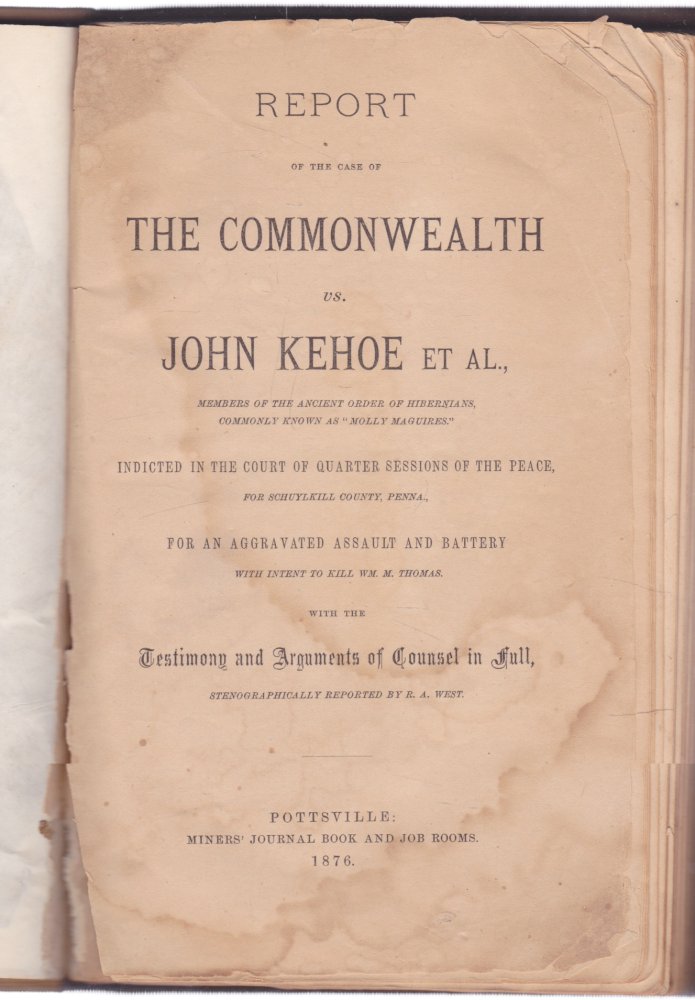
Hardcover. Pottsville PA, Miners' Journal Book and Job Rooms, 1st, 1876, Book: Good, Dust Jacket: None, Original softcover volume rebound in plain tan cloth, 262 pages. "Members of The Ancient Order of Hibernians, Commonly Known as Molly Maguires. Indicted in the Court of Quarter Sessions of the Peace, for Schuylkill County, Penna., for an Aggravated Assault and Battery". A record of the trial against John Kehoe Et Al., Members of the Ancient Order of Hibernians, Commonly Known as "Molly Maguires": Indicted in the Court of Quarter Sessions of the Peace, for Schuylkill County, Penna., for an Aggrevated Assault and Battery with Intent to Kill Wm. M. Thomas : with the Testimony and Arguments of Counsel in Full, Stenographically Reported by R.A. West. Cover and first 12 pages chipped, with light water stain. Interior clean, tear to page 57, no loss of paper. Name on front fly leaf.
Hardcover. Washington DC, Government Printing Office, 1st, 1863, Book: Good, Dust Jacket: None, Hardcover, embossed brown cloth, with gilt lettering on spine. 659 pages including index. Volume 3 covers the war's Western Theater. This book is the third report of the Joint Committee on the Conduct of the War, which was a committee of the US Congress during the American Civil War. The committee was tasked with investigating allegations of misconduct or incompetence by Union Army officers and contractors. The reports provide detailed accounts of these investigations and shed light on the political and military context of the era. Contains testimony concerning the massacre of over 100 Cheyenne and Arapahoe Indians at Sand Creek, Colorado Territory, by U.S. troops under Col. Chivington and Maj. Anthony. Covers are worn and stained, first 70 pages with light stain to margins, not affecting text.
Hardcover. Washington DC, Government Printing Office, 1st, 1895, Book: Fair, Dust Jacket: None, Hardcover, 187 pages of text followed by 34 folding plates. The first section is the message transmitting the report of the Board of Engineers for the purpose of ascertaining the feasibility, permanence, and cost of construction and completion of the Nicaragua Canal by the route contemplated. The 34 plates that follow are all folding plans that map the project (1st 22 plates), the remaining dozen are profiles of water levels in the different planned divisions. The cover of the volume is detached as are the first 16 pages, but everything is present. The rest of the book is intact and all the plates are present and in very good condition.
Hardcover. Claremont, NH, Vt. State Legislature, 1st, 1861, Book: Very Good, Dust Jacket: None, Two large matching volumes, embossed brown cloth. Vol 1: 289 black & white woodcut illustrations, 558 pages. Light edgewear to covers, 1 x 1" chip to cloth at bottom of spine, internally clean, tight. Vol lI. Page 559-980. 76 woodcuts. Section following index in rear has all called-for maps, charts & views. 2 large color folding maps, color plates & charts (3 fold-out) and 20 lithographic scenic views of Vermont. Volume in excellent condition. This set includes a catalogue of nearly 3000 specimens of rock, 370 specimens of minerals and several hundred specimens of organic remains. These volumes still stand as the most comprehensive examination of Vermont's geology yet published. Lovely views of Vermont. This is a heavy and oversized book and will require extra shipping. International customers please ask for a shipping quote before purchasing.
Hardcover. NY, Isaac Riley, 1st, 1809/1810, Book: Good, Dust Jacket: None, Two hardcover volumes, leather bound with maroon labels with gilt lettering "Tyler's Reports". Vol. 1, 496 pages, dated 1809. Vol. 2, 488 pages, dated 1810. Both with an index to the Principal Matters. Royall Tyler became an assistant judge of the Vermont Supreme Court in 1801 and from 1807 through 1813 served as chief justice (the ninth in Vermont history); during this time he presided over a number of important trials (e.g., that of Stephen Jacob in 1802, involving slavery, and that of the Black Snake crew in 1808, dealing with smuggling on Lake Champlain), prepared two volumes (1809-1810) of Reports of the Vermont Supreme Court (covering 1800-1803), and became professor of jurisprudence at the University of Vermont (1811-1814). Calf covers scuffed, discolored, bindings strong, interiors clean. Previous owner's bookplate, related newspaper clipped laid in.
Hardcover. NY, Simon & Schuster, 1st, 2002, Book: Very Good, Dust Jacket: Very Good, Hardcover in a bright, unclipped dust jacket. A thoughtful history of the legendary New York City neighborhood chronicles the Village's role as a bohemian enclave that became the home of and transformed the lives of such individuals as Edna St. Vincent Millay, Emma Goldman, Eugene O'Neill, Margaret Sanger, and Thomas Wolfe, who came to the neighborhood to pursue individual artistic, personal, and political dreams. Clean copy.
Hardcover. New York, Burns Archive Press, 1st Edition, 2003, Book: Very Good, Dust Jacket: None, 4 Volumes: (SIGNED) In slipcase. DOMESTIC SHIPPING ONLY. Slipcase still has original mylar wrap (See image). 1845-1870 The Pioneer Era 1871-1895 The Antiseptic Era 1896-1920 The X-Ray Era 1921-1945 The Serology Era Limited to 2,150 copies including a special cased edition of 1000 copies. Color, b/w and sepia illustrations throughout. Black, decorated cover boards in like new condition. Pages clean, binding tight, spines straight. Slipcase fine.
Hardcover. New Deli, Academic Foundation, 1st, 2015, Book: Very Good, Dust Jacket: Very Good, Hardcover in a bright dust jacket, 158 pagea. Clean, bright copy.
Hardcover. Chicago, University of Chicago Press, 1st, 2006, Book: Very Good, Dust Jacket: Very Good, Hardcover in bright, unclipped dust jacket. 575 pages, b&w illustrations. Stephen Kercher here provides the first comprehensive look at the satiric humor that flourished in the United States during the 1950s and early 1960s. Focusing on an impressive range of comedy--not just standup comedians of the day but also satirical publications like MAD magazine, improvisational theater groups such as Second City, the motion picture Dr. Strangelove, and TV shows like That Was the Week That Was--Kercher reminds us that the postwar era saw varieties of comic expression that were more challenging and nonconformist than we commonly remember. His history of these comedic luminaries shows that for a sizeable audience of educated, middle-class Americans who shared such liberal views, the period's satire was a crucial mode of cultural dissent. For such individuals, satire was a vehicle through which concerns over the suppression of civil liberties, Cold War foreign policies, blind social conformity, and our heated racial crisis could be productively addressed. Clean copy.

 "Religious Study of the Mount Haguro Sect of Shugendo, A: An Example of Japanese Mountain Religion by: Earhart, H. Byron")
 "Reluctant Republic, The (SIGNED COPY) by: Van de Water, Frederic F.")
 "Remarkable Books: The World's Most Beautiful and Historic Works by: Michael Collins, Alexandra Black, Thomas Cussans, John Farndon, Philip Parker")
 "Rembrandt - The Human Form and Spirit by: Guillaud, Jacqueline/Maurice Guillaud")
 "Rembrandt/Not Rembrandt in the Metropolitan Museum of Art: Aspects of Connoisseurship by: Metropolitan Museum of Art (New York, N.Y.); Rembrandt Harmenszoon Van Rijn;")
 "Remembering Slavery: African Americans Talk About Their Personal Experiences of Slavery and Emancipation by: Ira Berlin/Marc Favreau/Steven Miller")


 "Rememberings: The World of a Russian-Jewish Woman in the Nineteenth Century by: Pauline Wengeroff")
 "Reminiscences of Chicago During the Forties and Fifties by: McIlvaine, Mabel (Intro.) William Bross; Charles Cleaver; Joseph Jefferson")

 "Reminiscences of Chicago During the Great Fire by: McIlvaine, Mabel")
 "Reminiscences of Sea Island Heritage: Legacy of Freedmen on St. Helena Island (SIGNED COPY) by: Daise, Ronald")
 "Reminiscences of the Civil War (Collector's library of the Civil War) by: Gordon, John B.")
 "Renaissance Florence: The Art of the 1470's by: Rubin, Patricia Lee")
 "Reno Now and Then (SIGNED COPY) by: Cobb, Neal and Fenwick, Jerry")
 "Report of a Committee appointed by The Society for the Prevention of Pauperism in the City of New York by: Griscom & others, John")


 "Report of the Adjutant-General of the State of New Hampshire for the Year Ending June 1, 1868 by: Clarke, John")
 "Report of the Case of The Commonwealth vs. John Kehoe et al. by: R.A. West")

 "Report of the Joint Committee on the Conduct of the War (Part 3) by:")
 "Report of the Nicaragua Canal Board by: Ludlow and others, Lieut. Col. William")
 "Report on the Geology of Vermont: Descriptive, Theoretical, Economical, and Scenographical (2 vols) by: Hitchcock, Edward, Albert D. Hager and Others")
 "Reports of Cases Argued and Determined in the Supreme Court of Judicature of the State of Vermont ( 2 Vols.) by: Royall Tyler")


 "Republic of Dreams: Greenwich Village: The American Bohemia, 1910-1960 by: Wetzsteon, Ross")
 "Respiratory Disease: A Photographhic History 1845-1945, Selections From the Burns Archive (4 volume set) (SIGNED) by: Burns M.D., Stanley B.")


 "Resurgent India: Ideas and Priorities by: Agarwala, Ramgopal; Kumar, Rajiv; Shah, Rajesh")
 "Revel with a Cause: Liberal Satire in Postwar America by: Stephen E. Kercher")