Softcover. Baltimore, Johns Hopkins University Press, 1st, 2007, Book: Very Good, Dust Jacket: None, Softcover, 155 pages. Thomas Dennis emigrated to America from England in 1663, settling in Ipswich, a Massachusetts village a long day's sail north of Boston. He had apprenticed in joinery, the most common method of making furniture in sixteenth- and seventeenth-century Britain, and he became Ipswich's second joiner, setting up shop in the heart of the village. During his lifetime, Dennis won wide renown as an artisan. Today, connoisseurs judge his elaborately carved furniture as among the best produced in seventeenth-century America. Robert Tarule, historian and accomplished craftsman, brilliantly recreates Dennis's world in recounting how he created a single oak chest. Writing as a woodworker himself, Tarule vividly portrays Dennis walking through the woods looking for the right trees; sawing and splitting the wood on site; and working in his shop on the chest-planing, joining, and carving. Dennis inherited a knowledge of wood and woodworking that dated back centuries before he was born, and Tarule traces this tradition from Old World to New. He also depicts the natural and social landscape in which Dennis operated, from the sights, sounds, and smells of colonial Ipswich and its surrounding countryside to the laws that governed his use of trees and his network of personal and professional relationships. Clean copy.
Hardcover. NY/London, Sotheby's Parke Bernet, Revised Ed., 1985, Book: Very Good, Dust Jacket: Very Good, Hardcover, 376 pages. 26 illustrations in color, and 420 in black and white. Originally published in 1979. John Harris was one of England's leading Architectural Historians at the time this book was written. He was curator of the Drawing Collection for RIBA. (Royal Institute of British Architects). Each section introduces a period such as: the Age of Estate Cartographers and the Garden Converstations, The Country House and Sporting Art: John Wootton, Peter Tillemans and Others, Caneletto and the Architectural Topographers, Gainsborough and the Picturesque, The Art of Turner and Constable. Harris comments on the artists , their style and pictures.
Hardcover. New Haven CT, Yale University Press, 1st, 2007, Book: Very Good, Dust Jacket: Very Good, Hardcover, 224 pages. How does the artist's self-conception change in old age? How does old age affect artistic practice? In this intriguing study, art historian Philip Sohm considers some of the greatest artists of Renaissance and Baroque Italy and their experiences of aging. Sohm investigates how art critics, collectors, biographers, and fellow artists dealt with old painters, what mental landscapes preconditioned responses to art by the elderly, and how biology and psychology were co-opted to explain the imprint that artists left on their art. He also looks carefully at the impact of prejudices, stereotypes, and other imaginary truths about old age. For some artists, the problems of old age were related to physical decline-Poussin's hands became shaky, Titian's eyesight dimmed. For others, psychological symptoms emerged. The book's cast of characters includes Michelangelo, the hypochondriac young fogy; Titian, the shrewd marketer of old age; the multiphobic Pontormo; and others. With sensitivity and insight, Sohm uncovers what it meant to be an old artist and how successive generations have looked at the art of an old master.
Softcover. NY, Shapolsky Publishers, 2nd Ed., 1988, Book: Very Good, Dust Jacket: None, Softcover, 196 pages, b&w photos throughout. Introduction by Thomas Hess. Fred McDarrah (1926-2007) was a photojournalist, author, and staff photographer for the Village Voice known for documenting the Beat Generation and the New York art world. The present work is a vital document of an exuberant moment in cultural history. Clean copy.
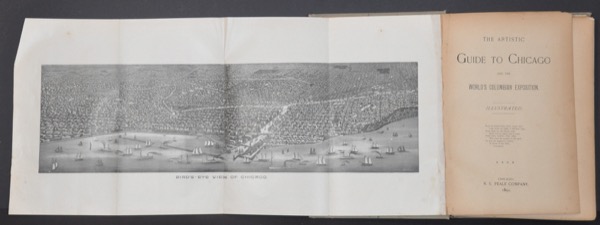
Hardcover. Columbian Art Company, 1st, 1892, Book: Very Good, Dust Jacket: None, Hardcover, bound in gray cloth with black and gilt titles and black embossed images to front. Illustrated with a fold-out frontispiece and with several full-page black and white illustrations, styled as plates, all illustrations in black and white. First published by R.S. Peale Co. the year before. A lovely overview of tourist spots in Chicago that World's Fair attendees could visit while enjoying the fair.
Softcover. London/NY, Verso Books, reprint, 2002, Book: Very Good, Dust Jacket: None, Softcover, 226 pages, b&w illustrations. Unravels the appalling mass of lies, hypocrisy and betrayals that have surrounded accounts of the 1961 assassination of Patrice Lumumba-the first prime minister of the Republic of Congo and a pioneer of African unity-since it perpetration. Making use of a huge array of official sources as well as personal testimony from many of those in the Congo at the time, Ludo De Witte reveals a network of complicity ranging from the Belgian government to the CIA. Patrice Lumumba's personal strength and his quest for African unity emerges in stark contrast with one of the murkiest episodes in twentieth-century politics.
Hardcover. Boston, Little, Brown and Company, reprint, 1957, Book: Very Good, Dust Jacket: None, Hardcover, blue cloth with gilt lettering on spine. Volume X in The History of United States Naval Operations in World War II. 399 pages, illustrated with maps (one fold-out) and b&w photos. Gilt on spine with light fading, lacks dust jacket, dj flap copy pasted inside front cover, otherwise clean, tight copy.
Hardcover. Westport CT, Greenwood Press, 1st, 2003, Book: Very Good, Dust Jacket: None, Hardcover, glazed pictorial boards, 177 pages. Postma draws on primary sources and current historical scholarship to offer secondary readers and researchers a comprehensive and well-written history. He covers the entire Atlantic slave trade era, from the 1400s to the final abolition of chattel slavery in the New World in 1888. The focus is on Africa and the entire New World. While he describes the many horrors of the Middle Passage, he also examines how the slave trade contributed to the development of the modern international economy. The last chapters discuss the efforts to abolish the slave trade and its legacy. Throughout, Postma documents the sources that support his discussion and conclusions. Chapter notes are supplemented by an extensive annotated bibliography that includes books, articles, films, and electronic resources. The volume concludes with biographical sketches of important people and excerpts from primary documents written by enslaved Africans and white officials. The black-and-white reproductions of period illustrations add little to the text. Clean copy.
Hardcover. Seattle, Fantagraphics, 1st, 2023, Book: Very Good, Dust Jacket: None, Hardcover, pictorial cloth, 212 pages. Atlas holds a special place among aficionados of the genre, producing more horror titles and issues by far, than anyone in the industry. While the quality of EC's six horror/sci-fi titles was unsurpassed with their elite cadre of talent, Atlas was the equivalent of the B-movies studio, churning out anywhere from 8 to 12 different horror titles a month, giving a wider array of artists, including some of the best craftsmen of the era, a chance to show off their talents: in addition to those already mentioned, future volumes will include Bill Everett, John Romita, Bernie Krigstein, Jerry Robinson, Harry Anderson, and Matt Fox. Stories from Marvel's Atlas line have barely been reprinted. The Fantagraphics Atlas Comics Library is the first attempt to publish a carefully curated line of Atlas titles. The first volume, Adventures Into Terror, includes a treasure trove of stories drawn by many of the most stylistically accomplished artists of the Golden Age including George Tuska, Carl Burgos, Mike Sekowsky, Joe Maneely, and Joe Sinnott. Highlights include Russ Heath's two-part story "The Brain" from issue #4 and "Return of the Brain" from issue #6; Basil Wolverton's classic "Where Monsters Dwell" from issue #7; Gene Colan's moody "House of Horror" in issue #3; and Don Rico's wild layouts are on display from #4's "The Torture Room." The stories are written firmly in the tradition of the pulpy, perverse, borderline deranged style that brought Fredric Wertham, the United States Senate Sub-Committee, and public opinion down like a sledgehammer on comics in the early '50s. Edited by Atlas scholar Dr. Michael J. Vassallo, scanned directly from the published comics, and meticulously restored by Allan Harvey, the first volume of the new Fantagraphics Atlas Library series is an event among comics lovers, collectors, and historians.
Hardcover. NY, Oxford University Press, 1st, 1998, Book: Very Good, Dust Jacket: Very Good, Hardcover in a very good dust jacket with fading to spine, 403 pages. The concept of the atom is very near scientific bedrock, touching first causes, fundamental principles, our conception of the nature of reality. This book is a translation from the French of a history of atomic thought and theory, from ancient Greece to the present day. Pullman grounds his coverage of scientific theory always in the religious and philosophical context of the times, covering the whole period of Western civilization, including in passing the major scientific philosophies of the Muslim world and India. The transition of atomism from a philosophical position to an experimental science, in the mid-19th century, is well handled, and the coverage is nicely rounded out by a treatment of the first visual proof of atoms' material existence by direct microscopic imaging of individual atoms about 10 years ago. Name on front fly leaf otherwise clean.
Hardcover. Chicago, University of Chicago Press, 1st, 1996, Book: Very Good, Dust Jacket: Very Good, Hardcover in a bright dust jacket. Clean, bright copy, 467 pages. Illustrated with 36 pages of historic Plates, b/w, on coated paper. One of the most famous works of history, Johan Huizinga presents a brilliant portrait of life, thought, and art in 14th and 15th century France and the Netherlands.
Hardcover. Chicago, University of Chicago Press, 1st, 1996, Book: Very Good, Dust Jacket: Very Good, Hardcover in a bright dust jacket. Clean, bright copy, 467 pages. Illustrated with 36 pages of historic Plates, b/w, on coated paper. One of the most famous works of history, Johan Huizinga presents a brilliant portrait of life, thought, and art in 14th and 15th century France and the Netherlands.
Hardcover. Champaign IL, Sagamore Publishing, 1st, 1997, Book: Very Good, Dust Jacket: Very Good, Hardcover in a bright dust jacket. 307 pages, b&w illustrations. SIGNED by all contributors on the front free endpaper - Kerry Keene, Raymond Sinibaldi, David Hickey, and Babe Ruth's granddaughter Linda Ruth Tosetti. The definitive work on his early years, The Babe in Red Stockings, represents not only a detailed study of his remarkable on-field achievements, but also delves into his happy-go-lucky, playful, and occasionally temperamental nature. Dozens of new pieces of information are added to further complete the portrait of one of America's most fascinating figures, the one and only Babe Ruth.
Hardcover. Princeton NJ, Princeton University Press, 1st, 1999, Book: Very Good, Dust Jacket: Very Good, Hardcover in a bright dust jacket, 335 pages. The Barbarians Speak re-creates the story of Europe's indigenous people who were nearly stricken from historical memory even as they adopted and transformed aspects of Roman culture. The Celts and Germans inhabiting temperate Europe before the arrival of the Romans left no written record of their lives and were often dismissed as "barbarians" by the Romans who conquered them. Accounts by Julius Caesar and a handful of other Roman and Greek writers would lead us to think that prior to contact with the Romans, European natives had much simpler political systems, smaller settlements, no evolving social identities, and that they practiced human sacrifice. A more accurate, sophisticated picture of the indigenous people emerges, however, from the archaeological remains of the Iron Age. Here Peter Wells brings together information that has belonged to the realm of specialists and enables the general reader to share in the excitement of rediscovering a "lost people." In so doing, he is the first to marshal material evidence in a broad-scale examination of the response by the Celts and Germans to the Roman presence in their lands.
Hardcover. Princeton NJ, Princeton University Press, 1st, 1999, Book: Very Good, Dust Jacket: Very Good, Hardcover in a bright dust jacket, 335 pages with b&w illustrations. Re-creates the story of Europe's indigenous people who were nearly stricken from historical memory even as they adopted and transformed aspects of Roman culture. The Celts and Germans inhabiting temperate Europe before the arrival of the Romans left no written record of their lives and were often dismissed as "barbarians" by the Romans who conquered them. Accounts by Julius Caesar and a handful of other Roman and Greek writers would lead us to think that prior to contact with the Romans, European natives had much simpler political systems, smaller settlements, no evolving social identities, and that they practiced human sacrifice. A more accurate, sophisticated picture of the indigenous people emerges, however, from the archaeological remains of the Iron Age. Here Peter Wells brings together information that has belonged to the realm of specialists and enables the general reader to share in the excitement of rediscovering a "lost people." Clean copy.
Softcover. Annapolis MD, Naval Institute Press, reprint, 1989, Book: Very Good, Dust Jacket: None, Softcover, 596 pages. The second part of H. P. Willmott's three-volume history of the war in the Pacific, this work tells how Japan arrived at a situation in which war with the United States was the only means of ensuring long-term security and resolving her immediate problems of access to raw materials and of an unwinnable war in China. Totally balanced in presentation, the book also explains the basis of Allied miscalculations and provides explanations of the defeats that overwhelmed American, British, and Dutch forces throughout Southeast Asia in a little more than three months. Willmott argues that it was Japan's concentration and economy of force that contributed to its success in that early campaign. It was a later decision to disperse forces over a large area, he says, that resulted in Japan's loss of the Coral Sea and Midway battles and ultimately the entire war. Clean copy
Hardcover. NY, Avid Reader Press / Simon & Schuster, 1st, 2023, Book: Very Good, Dust Jacket: Very Good, Hardcover in a bright, unclipped dust jacket. A magnum opus from acclaimed baseball writer Joe Posnanski, The Baseball 100 is an audacious, singular, and masterly book that took a lifetime to write. The entire story of baseball rings through a countdown of the 100 greatest players in history, with a foreword by George Will. Longer than Moby-Dick and nearly as ambitious, The Baseball 100 is a one-of-a-kind work by award-winning sportswriter and lifelong student of the game Joe Posnanski. In the book's introduction, Pulitzer Prize-winning commentator George F. Will marvels, "Posnanski must already have lived more than two hundred years. How else could he have acquired such a stock of illuminating facts and entertaining stories about the rich history of this endlessly fascinating sport?" Clean, bight copy.
Hardcover. Boston, Little, Brown and Company, reprint, 1950, Book: Very Good, Dust Jacket: None, Hardcover, blue cloth with gilt lettering on spine. Volume I in The History of United States Naval Operations in World War II. 432 pages, illustrated with maps and b&w photos. Gilt on spine with light fading, lacks dust jacket, otherwise clean, tight copy.
Hardcover. Princeton NJ, Princeton University Press, 1st, 1993, Book: Very Good, Dust Jacket: Very Good, Hardcover in a bright dust jacket with light edgewear, 419 pages. By the mid-1600s, the commonsense, manifest picture of the world associated with Aristotle had been undermined by skeptical arguments on the one hand and by the rise of the New Science on the other. What would be the scientific image to succeed the Aristotelian model? Thomas Lennon argues here that the contest between the supporters of Descartes and the supporters of Gassendi to decide this issue was the most important philosophical debate of the latter half of the seventeenth century. Descartes and Gassendi inspired their followers with radically opposed perspectives on space, the objects in it, and how these objects are known. Lennon maintains that differing concepts on these matters implied significant moral and political differences: the Descartes/Gassendi conflict was typical of Plato's perennial battle of the gods (friends of forms) and giants (materialists), and the crux of that enduring philosophical struggle is the exercise of moral and political authority. Lennon demonstrates, in addition, that John Locke should be read as having taken up Gassendi's cause against Descartes. In Lennon's reinterpretation of the history of philosophy between the death dates of Gassendi and Malebranche, Locke's acknowledged opposition to Descartes on some issues is applied to the most important questions of Locke exegesis.
Hardcover. NY/London, Verso, 1st, 2003, Book: Very Good, Dust Jacket: Very Good, Hardcover in a bright, unclipped dustjacket. The violence that has ravaged Algeria has often defied explanation. Regularly invoked in debates about political Islam, transitions to democracy, globalization, and the right of humanitarian interference, Algeria's tragedy has been reduced to a clash of stereotypes: Islamists vs.a secular state, terrorists vs. innocent civilians, or generals vs. a defenseless society. The prevalence of such simplistic representations has disabled public opinion inside as well as outside the country and contributed to the intractability of the conflict. This collection of essays offers a radical corrective to Western misconceptions. Rejecting essentialist and determinist approaches, Hugh Roberts explores the outlook and evolution of the various internal forces as they emerged--the Islamists, the Berberists, the factions within the army, and the regime in general--and he looks at external interests and actors. Clean copy.
Hardcover. Berkeley CA, University of California Press, 1st, 1994, Book: Very Good, Dust Jacket: Very Good, Hardcover in a bright dust jacket, 200 pages, b&w illustrations. Kathleen Kete's wise and witty examination of petkeeping in nineteenth-century Paris provides a unique window through which to view the lives of ordinary French people. She demonstrates how that cliche of modern life, the family dog, reveals the tensions that modernity created for the Parisian bourgeoisie. Kete's study draws on a range of literary and archival sources, from dog-care books to veterinarians's records to Dumas's musings on his cat. The fad for aquariums, attitudes toward vivisection, the dread of rabies, the development of dog breeding-all are shown to reflect the ways middle-class people thought about their lives. Petkeeping, says Kete, was a way to imagine a better, more manageable version of the world-it relieved the pressures of contemporary life and improvised solutions to the intractable mesh that was post-Enlightenment France. Clean copy.
Hardcover. NY, Alfred A. Knopf, 1st, 1946, Book: Very Good, Dust Jacket: None, Hardcover, 313 pages plus index. Tan cloth boards that show minor fading to top, spine and light discoloration to back cover. Otherwise very good. No dust jacket. Generous selection of black and white illustrations. This copy also complete with both the fold-out maps that are often missing: (1) City of Richmond in 1861; and (2) Richmond-Petersburg Theatre of Operations. These ten chapters reconstitute, across an eighty-year gap, the everyday life of a capital city close behind the fighting fronts of a prolonged war. From records that originated close to the facts or in the midst of them--newspapers, advertisements, diaries, letters, stenographic reports of the time--Mr. Bill discloses how people lived on the home front of the Confederacy. He tells in abundant detail what the people did to amuse themselves, what rumors alternately exalted and depressed them, about what and whom they gossiped, what they found procurable in the black market and what it cost them.
Softcover. NY, American Telephone and Telegraph Company, 1938, Book: Very Good, Softcover, blue wraps, 6 3/4 x 10 inches, 22 pages of text + 24 pages of plates (photos). Account of the massive effort to restore telephone service after the devastating hurricane of September 21, 1938. Clean copy, mild musty odor.
NY, St. Martin's Press, 1st, 2002, Book: Very Good, Dust Jacket: Very Good, Hardcover in a bright, unclipped dust jacket. A masterful, definitive, and eloquent look at the enormous cultural and economic impact on America of New England's textile mills. The author, an award-winning CBS producer, traces the history of American textile manufacturing back to the ingenuity of Francis Cabot Lodge. The early mills were an experiment in benevolent enlightened social responsibility on the part of the wealthy owners, who belonged to many of Boston's finest families. But the fledgling industry's ever-increasing profits were inextricably bound to the issues of slavery, immigration, and workers' rights. William Moran brings a newsman's eye for the telling detail to this fascinating saga that is equally compelling when dealing with rags and when dealing with riches. Clean copy.

 "The Artisan of Ipswich: Craftsmanship and Community in Colonial New England by: Robert Tarule")
 "The Artist & the Country House: A History of Country House & Garden View Painting 1540-1870 by: John Harris")
 "The Artist Grows Old: The Aging of Art and Artists in Italy, 1500-1800 by: Philip Sohm")
 "The Artist's World in Pictures: New York School by: Fred McDarrah; Gloria S. McDarrah")
 "The Artistic Guide to Chicago and the Worlds Colombian Exposition by: Columbian Expostion")

 "The Assassination of Lumumba by: De Witte, Ludo/ Fenby, Renee (Transl.)/ Wright, Ann (Transl.)")
 "The Atlantic Battle Won, May 1943-May 1945: History of United States Naval Operations in World War II, Volume 10 by: Morison, Samuel Eliot")
 "The Atlantic Slave Trade by: Postma, Johannes")
 "The Atlas Comics Library No. 1: Adventures Into Terror Vol. 1 The Fantagraphics Atlas Comics Library by: Colan, Gene; Heath, Russ; Wolverton, Basil")
 "The Atom in the History of Human Thought by: Pullman, Bernard")
 "The Autumn of the Middle Ages by: Johan Huizinga")
 "The Autumn of the Middle Ages by: Johan Huizinga")
 "The Babe in Red Stockings: An In Depth Chronicle of Babe Ruth With the Boston Red Sox 1914-1919 (SIGNED COPY) by: Hickey, David/ Keene, Kerry/ Sinibali, Raymond")
 "The Barbarians Speak How the Conquered Peoples Shaped Roman Europe by: Wells, Peter S.")
 "The Barbarians Speak: How the Conquered Peoples Shaped Roman Europe by: Wells, Peter S.")
 "The Barrier and Javelin: Japanese and Allied Pacific Strategies, February to June 1942 by: H. P Willmott")
 "The Baseball 100 by: Joe Posnanski")
 "The Battle of the Atlantic: September 1939 - May 1943 (History of United States Naval Operations in World War Ii, Volume 1) by: Morison, Samuel Eliot")
 "The Battle of the Gods and Giants:The Legacies of Descartes and Gassendi 1655-1715 by: Thomas M. Lennon")
 "The Battlefield: Algeria 1988 2002 Studies in a Broken Polity by: Roberts, Hugh")
 "The Beast in the Boudoir: Petkeeping in Nineteenth-Century Paris by: Kathleen Kete")

 "The Bell System Meets its Greatest Test (Hurricane and Flood of September 21, 1938) by: Bradley, Judson S")
 "The Belles of New England:The Women of the Textile Mills and the Families Whose Wealth They Wove by: Moran, William")