Hardcover. Munich, Prestel Publishing, 1st, 2011, Book: Very Good, Dust Jacket: Very Good, Hardcover, 219 pages, color illustrations. Circle of Animals features twelve enormous bronze animal heads, each depicting a segment of the Chinese zodiac. Ai Weiwei's first piece of public art, it is an extraordinary accomplishment in its own right. But as this book explains, the origins and motivation behind the piece are as compelling as the work itself. Like new in publisher's shrink-wrap.
Softcover. San Francisco, Chronicle Books, 1st, 2018, Softcover, 128 pages. Includes essays by Ai Weiwei, Cheryl Haines, Jasmine Heiss, and David Spalding. Renowned artist Ai Weiwei engaged nearly 900,000 visitors in a conversation about human rights with his art installation @Large: Ai Weiwei on Alcatraz. In one participatory piece, Yours Truly, visitors sent 92,829 postcards to prisoners of conscience around the world. This book delves into those postcards' lasting impact. Five former prisoners and their loved ones reflect on the experience of receiving hundreds of postcards while imprisoned. Essays and a statement by Ai Weiwei contextualize this extraordinary project. And photographs taken during the exhibition show visitors and the messages they wrote. The book also includes four pre-addressed, tear-out postcards, inviting readers-whether art lovers or activists-to send hope to individuals still imprisoned for defending human rights. Clean copy.
Hardcover. France, Arthaud, 1st, 1967, Book: Very Good, Dust Jacket: Very Good, 209 pages. French text. Minor dust jacket edge wear and tear with minor yellowing on inside flaps. Otherwise, a very clean and tight copy.
Hardcover. NY, Harry N. Abrams, 1st, 1994, Book: Very Good, Dust Jacket: Very Good, Hardcover, red cloth covers with an acetate dust jacket. 164 pages with 50 illustrations including 24 plates in full color. Text by Deborah Eisenberg. Jennifer Bartlett creates her most personal paintings, all made between 1991 and 1992. Here, in each work, the unflinching presence of time is carefully, conspicuously monitored by a clock - light gray for day, dark gray for night. But motifs, color combinations, even certain images variously recur throughout the 24 paintings, shaking us up, causing us to realize that even the most seemingly casual, intimate scenes (a child's bedroom, a bathroom, the garden fish pond) are the trappings of much larger concerns.Clean copy.
Softcover. San Francisco, Chronicle Books, 1st, 1998, Book: Very Good, Dust Jacket: None, Softcover, 112 pages. B&w photographs. Collaborating with some of the world's finest dancers from such illustrious dance companies as the Martha Graham Dance Company, Pilobolus, San Francisco Ballet, the Parsons Dance Company, and Ballet Tech, she captures moments of startling grace and power. In 90 duotone images, Greenfield's dancers defy gravity and push the limits of the possible. A preface takes us behind the scenes in her studio, and the photographer's own captions illuminate the challenges of making pictures that recreate the seeming effortlessness of dance. As inspiring as it is technically remarkable, this collection of incomparable images is sure to captivate dance lovers, photographers, and all who admire the beauty and strength of the human body.
Hardcover. NY, Thomas Y. Crowell, BC Ed., 1982, Book: Very Good, Dust Jacket: Very Good, Hardcover in a bright, unclipped dust jacket. No price on flap so assumed a book club edition. Clean copy with colorful illustrations on every page by Barton.
Hardcover. NY, Thomas Y. Crowell, 1st, 1982, Book: Very Good, Dust Jacket: Very Good, Hardcover in a bright, unclipped dust jacket. Byron Barton introduces young readers to the fun of the airport in this bold and colorful book. From the excitement of arrival to the wonder of taking off, Airport captures all the magic of an airport with joyous and powerful images and simple text.
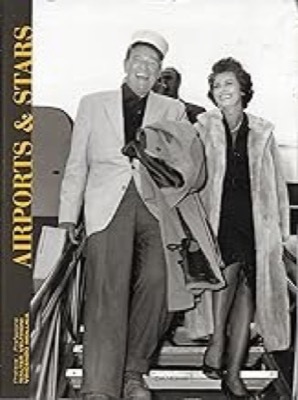
Softcover. Italy, Damiani, 1st, 2005, Book: Very Good, Dust Jacket: None, Softcover, 160 pages. A collection of photographs of Hollywood actors, royalty and other celebrities from the golden age of Italian film--the 1950s and 1960s--arriving in Rome, back when comings and goings were event enough to merit a flash, and when the photographers who are now known as paparazzi could walk right up to the airplane steps. Here those independent lensmen--a profession and a genre born in the era documented here, one on the forefront of new realism and photojournalism--capture the salutes and waves, flamboyant and discreet, of Rome's stars as they descended to earth, seizing the mythical something that they seemed to bring with them from the sky to terra firma. Clean copy.
Softcover. New York , Epic Comics, 1st US, 1989, Book: Very Good, Dust Jacket: None, 64 pages, softcover comic book format. Illustrated throughout in color by Otomo. Clean, bright copy.
Softcover. New York , Epic Comics, 1st US, 1989, Book: Very Good, Dust Jacket: None, 64 pages, softcover comic book format. Illustrated throughout in color by Otomo. Clean, bright copy.
Softcover. New York , Epic Comics, 1st US, 1988, Book: Very Good, Dust Jacket: None, 60 pages, softcover comic book format. Illustrated throughout in color by Otomo. Clean, bright copy.
Softcover. New York , Epic Comics, 1st US, 1989, Book: Very Good, Dust Jacket: None, 64 pages, softcover comic book format. Illustrated throughout in color by Otomo. Clean, bright copy.
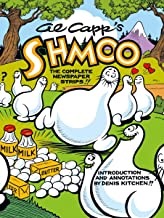
Hardcover. Dark Horse, 1st, 2011, Book: Very Good, Dust Jacket: Very Good, Hardcover, 199 pages. As part of the Dark Horse Archives series, all Shmoo newspaper strip appearances and storylines are being collected for the first time ever in a deluxe, oversized hardcover .In addition to every weekly and Sunday Shmoo newspaper appearance from 1948 to 1976, this collection also features rare Al Capp photographs and Shmoo illustrations from its marketing heyday.
Hardcover. Dark Horse, 1st, 2008, Book: Very Good, Dust Jacket: Very Good, Hardcover, 176 pages. First appearing in Al Capp's "Li'l Abner" comic strip in 1948, the oddly shaped (and happily edible) Shmoo became an overnight phenomenon, spawning an unprecedented merchandising frenzy in the late '40s and 50s. As part of the Dark Horse Archives series, ALL Shmoo comic book appearances are being collected for the first time ever in a deluxe hardcover edition! In addition to every issue of Shmoo Comics from 1949 and 1950, rare bonus stories, and Shmoo-centric advertisements from yesteryear, Al Capp's Complete Shmoo: The Comic Books features an introduction and annotations by certified Shmoo-ologist Denis Kitchen. A persistent presence in pop culture, the selfless Shmoo has served humanity for decades - mostly by offering itself as food - but also by entertaining and tickling our funny bones like no other creature can. Treat yourself to these hilarious adventures, featuring Washable Jones, Super Shmoo, Frankenshmoo, Fu Manshmoo and truly a cast of thousands! This archival collection sports a new cover by Peter Poplaski.
Hardcover. New Haven CT, Yale University Press, 1st, 2006, Book: Very Good, Dust Jacket: Very Good, Hardcover in a bright dust jacket, 190 pages, Includes chronology, footnotes, selected bibliography, list of exhibited works, index. Profusely illustrated with color and b&w prints. This beautifully illustrated book highlights the contrasts and correspondences in the lives and work of two of Modernism's greatest innovators, Josef Albers (1888-1976) and Laszlo Moholy-Nagy (1895-1947). Beginning in the 1930s, Albers and Moholy-Nagy each developed a rigorously abstract language that condensed art to its visual fundamentals: line, color, texture, light, and form. This language experienced a creative explosion during their Bauhaus years, when both artists moved freely between media and disciplines. Essays by leading scholars follow the artists' separate paths through to their emigration to the United States, where each continued to push tirelessly the conventions of artistic practice--Albers at Black Mountain College in North Carolina and then at Yale University, and Moholy-Nagy in Chicago at the New Bauhaus School and the Institute of Design. As highly influential teachers, Albers and Moholy-Nagy became important catalysts for the transmission of Modernist ideas from Europe to America.
Hardcover. New York, Abrams, 1st, 1974, Book: Very Good, Dust Jacket: Good, 360 pages. Hardcover. Illustrations in full color and black & white. Previous owners name at top right corner of front endpaper. Maroon streaks along bottom edge of pages 355-356 due to printers error. Dust jacket with moderate wear. Clean, tight copy.
Hardcover. New Havn CT, Yale University Press, 1st , 2001, Book: Very Good, Dust Jacket: Very Good, 333 pages. Hardcover with dust jacket. Illustrated in color, B&W. Clean, tight copy. Few painters lived the intellectual adventures of the early twentieth century as intensely as Albert Gleizes. At the centre of the public scandal over Cubism that broke out in Paris in 1911, he was with Marcel Duchamp and Francis Picabia in New York during the war and was one of the first European avant-garde artists to respond to the scale and vigour of New York life. Gleizes was also one of the few French painters of the 1920s to recognise nonrepresentational painting as the logical development of Cubism. His work as a painter is accompanied by an immense body of theoretical work, addressing the question posed so starkly by Duchamp and Picabia: why should we paint? What is the justification for the work of art? Over his life he touches on many spheres of human activity - religious, political and cultural history, physics and the philosophy of work. This book follows Gleizes' argument as it evolves, drawing on painting, and both published and unpublished writings. It reveals Gleizes, not just as a significant historical personality, but as a man whose work and thinking remains surprisingly fresh and relevant to the needs of our own time.
Softcover. New York, Princeton Architectural Press, 1st, 2002, Book: Near Fine, Dust Jacket: None, Softcover, 184 pages, b&w illustrations. Albert Kahn's contribution to North American industrial architecture is best characterized by a simplicity of expression in his designs of flexible spaces for manufacturing and production. Working in Detroit, Kahn began a long and fruitful collaboration with the automobile mogul Henry Ford, that was based on a shared vision of modernism and industry. Kahn rapidly established himself as an architect capable of responding to the new demands of mass production by employing the patented system of reinforced concrete developed by his brother, an engineer. Guided by functionalist principles and a sense of manufacturing organizations, Kahn anticipated assembly line operations and developed innovative typological characteristics for the modern factory. His projects included Ford Motor Company River Rouge Plant, Dearborn, Michigan; Burroughs Adding Machine Company, Detroit, Michigan; Tractor Plant, Stalingrad, Russia; General Motors Building, Chicago World's Fair; and Kellogg Company, Battle Creek, Michigan. Through incisive text, Albert Kahn - part of a growing series with Adalberto Libera and Adolf Loos - brings to light the novelty of Kahn's designs and his advancement of the machine aesthetic. Over ninety black-and-white photographs and drawings illustrate the extensive number of projects realized by "the architect of Ford."
Hardcover. Cambridge MA, MIT Press, 1st, 1997, Book: Very Good, Dust Jacket: Very Good, Hardcover, 176 pages. Albert Renger-Patzsch, together with August Sander and Karl Blossfeldt, was one of the undisputed pioneers of twentieth-century German photography. Indeed, what Sander achieved in portrait photography and Blossfeldt in plant photography, Renger-Patzsch achieved in his renderings of objects and the material world. As a protagonist of the movement that came to be known as Neue Sachlichkeit (New Objectivity), he wanted to record, phenomenologically as it were, the exact appearance of objects -- their form, material, and surface. Thus he rejected any kind of artistic claim for himself. Believing that the photographer should strive to capture the "essence of the object," he called for documentation rather than art.
Hardcover. Steidl, 1st, 2007, Book: Very Good, Dust Jacket: Very Good, Hardcover, 440 pages. NOTE: DUE TO SIZE & WEIGHT, DOMESTIC SHIPPING ONLY. Alberto Diaz Gutierrez--better known as Alberto Korda--is internationally recognized as the master of revolutionary Cuban photography. His most famous image is his powerful 1960 portrait of Che Guevara, "Heroic Guerrilla," which has since become the most reproduced image in the history of photography--though Korda never received any royalties from its reproduction, because he made the photograph for the Cuban newspaper, Revolucion. It is less well known that, prior to the 1959 Revolution, Korda was considered the "Avedon of Cuba," a progressive fashion photographer whose portraits of leading Cuban models, such as Norka, graced the covers of fashion magazines around the world. Likewise, his work of the 1970s and 80s, in which he explored underwater photography and also returned to fashion, has been largely neglected. Korda: A Revolutionary Lens covers every aspect of Korda's extraordinary output, paying particular attention to his work in fashion, Cuban society and the Revolution. It also includes his extensive documentation of Castro and Che. All prints have been produced under the supervision of Jose A. Figueroa, Korda's photographic assistant throughout the 1960s and 70s.
Hardcover. Princeto NJ, Princeton University Press, 3rd Ed., 1948, Book: Very Good, Hardcover set, Volume 1: The life and art of Albrecht Durer 311 pages. Volume 2: Handlist, Concordances, and Illustrations 208 pages. 325 Illustrations. A beautiful 2 volume set with detailed biography and detailed information on paintings, prints and drawings. Both volumes are cloth bound hardback with gilt lettering on front and spine of each volume. Previous owner's name on front fly leaves. Otherwise clean.
hardcover. London, Mitchell Beazley, 1st, 2003, Book: Very Good, Dust Jacket: Very Good, Hardcover, 256 pages illustrated in color. A visual history of the record album cover. Great graphic reference. In a bright, unclipped dust jacket.
Hardcover. NY, Skira, 1st, 2008, Book: Very Good, Dust Jacket: Very Good, Hardcover, 240 pages. Winner of the 1990 Pritzker Architecture Prize, Italian architect and theorist Aldo Rossi (1931-1997) gained international renown for his imaginative and starkly beautiful designs. Rossi's writings, drawings and buildings have distinguished him as one of the great architects of our time. They are unique for their simple forms such as cones, cylinders, prisms, and cubes. His work is at once bold yet ordinary, original without being novel, refreshingly simple in appearance but extremely complex in content and meaning. Rossi has been able to follow the lessons of classical architecture without copying them. In a period of diverse styles and influences, Aldo Rossi has eschewed the fashionable and popular to create an architecture singularly all his own. Sketches, drawings, concepts, watercolors, and collages from the early 1960s through to 1998 help us to understand Aldo Rossi the artist and architect, as well as his mindset and how he elaborated his projects. The volume is complete with a register of the Aldo Rossi Foundation's works. This is truly a valuable tool for scholars.
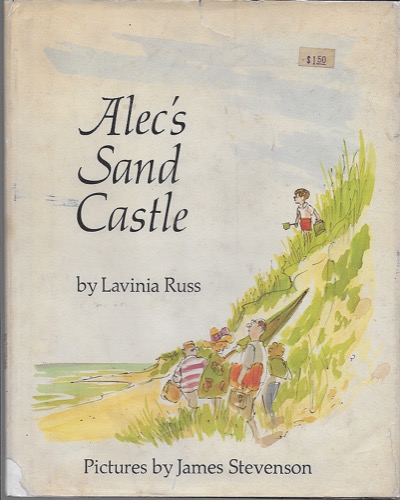
Hardcover. NY, Harper & Row, 1st, 1972, Book: Very Good, Dust Jacket: Good, Hardcover. Color illustrations by James Stevenson. New Yorker cartoonist's first children's book of many to follow. Dust jacket with soil, edgewear, chip to bottom 1" of spine, small price sticker.
Softcover. Damiani, 1st, 2011, Book: Very Good, Dust Jacket: None, Softcover in publisher's shrink-wrap. Italian photographer Alex Fakso got his start at the age of 13, photographing his own works of graffiti on trains. Since then, Fakso has become a prominent personality in the underground world of street art. His latest project Fast or Die is a raw and honest portrayal of the often chaotic lives of subway graffiti artists from London to Tokyo.
Softcover. NY, Damiani, 1st, 2011, Book: Very Good, Dust Jacket: None, Softcover in publisher's shrink-wrap. Italian photographer Alex Fakso got his start at the age of 13, photographing his own works of graffiti on trains. Since then, Fakso has become a prominent personality in the underground world of street art. His latest project Fast or Die is a raw and honest portrayal of the often chaotic lives of subway graffiti artists from London to Tokyo.
Hardcover. Waterville ME, Charta and Colby Museum of Art, 1st, 2012, Book: Very Good, Dust Jacket: None, Hardcover, bound in illustrated paper covered boards with titles present to the spine and front board. 128 pages, 60 color plates. Maine/New York surveys three decades of paintings by Alex Katz (born 1927). A quintessential New York artist, Katz is also a part-time resident of rural Maine, and the subject matter of his paintings accordingly shifts from landscape to cityscape, from rural vignette to Manhattan interior. In this volume, published for an exhibition at Colby College Museum of Art--where the largest public collection of Katz's resides--the pleasant haze of city afternoons is juxtaposed with the flickering greens of a rural path; the buzz of a fashionable social occasion with the dusk as it descends on a pond in the Maine woods. Along the way, we encounter the family members and friends who populate Katz's paintings, cast in his distinctive treatments of light and atmosphere. Clean copy.
Hardcover. GR, Hirmer/Mdm Salzburg Museum der Moderne, 1st, 2013, Book: Very Good, Dust Jacket: None, Hardcover, pictorial boards, 240 pages, color illustrations. Text in English and German. This catalogue is published on the occasion of the exhibitions 'Alex Katz. New York/Maine'. Clean, bright copy with minor bump to edges, corner.
Softcover. New York, Marlborough Gallery, Inc., 1st, 1983, Book: Very Good, Dust Jacket: None, Softcover exhibition catalog, 38 pages. 16 Color illustrations throughout. Minor wear to cover. Otherwise very tight and clean copy.
Hardcover. Kansas City, Kemper Museum of Contemporary Art , 1st, Book: Very Good, Dust Jacket: None, Hardcover, pictorial boards, exhibition catalog, unpaginated. New York artist Alex Katz is best known for his eye-catching, large-scale portraits, figures, and landscapes, but in the mid-1950s he painted intimate works, originating the style that would become the hallmark of his mature work. By the early 1960s, he established a procedure of making small sketches using oil paint on Masonite board, which he would enlarge and modify, then make into paper cartoons to transfer to the canvas. He produces one or more small sketches for every large painting. Although Katz considers the large works to be his major productions, small-scale paintings are the underpinning of his work, revealing his initial passion for a subject--a love at first sight before it has fully matured. While his big paintings are akin to a public performance, the small paintings are rehearsals that reveal not only how he works but more importantly why he is interested in a particular subject. This volume focuses on the achievement and significance of Katz's small paintings.
Hardcover. Washington DC, National Gallery of Art, 1st, 1998, Book: Very Good, Dust Jacket: Very Good, 367 pages 337 illustrations 267 in color. Foreword by Earl A. Powell III. Published on the occasion of the exhibition from the National Gallery of Art, Washington DC 29 March-12 July 1998. Exhibition History by Alexander S.C. Rower. Selected Bibliography by Alexander S.C. Rower.
Hardcover. NY, Scribner, 1st, 2015, Book: Very Good, Dust Jacket: Very Good, 384 pages. Hardcover with dust jacket. Clean, unmarked copy with only minor wear to dust jacket.
Hardcover. New York, Scribner, 1st, 2015, Book: Very Good, Dust Jacket: Very Good, 384 pages. Hardcover with dust jacket. Very clean, unmarked copy with only minor wear to edges. Color and black & white images throughout. Tight copy.
Hardcover. Norman, OK, University of Oklahoma Press, 1st, 1971, Book: Very Good, Dust Jacket: None, Hardcover, 270 pages illustrated throughout with photographs in sepia and drawings in b&w. Autobiography of a Canadian-born sculptor of Western subjects, considered one of the best sculptors of horses in the world. Black cloth spine with red paper boards, no dust jacket. Black pictorial slipcase with light wear. Beautiful copy. Like new.
Hardcover. Konemann, 1st US, 1996, Book: Very Good, Dust Jacket: Very Good, Hardcover, large format, 344 pages. Profusely illustrated with black & white photographs by Alexander Rodchenko. Dust jacket shows light rubbing to back cover. Large, heavy book. Clean, tight copy. This is the most complete volume published outside of Russia to capture the photographic work of Alexander Rodchenko, one of the former Soviet Union's greatest artists
Hardcover. Prestel, 1st, 2018, Book: Very Good, Dust Jacket: Very Good, Hardcover, large volume in a slipcase, 736 pages. This stunning volume delves into the extraordinary illustrated notebooks of Alexander von Humboldt's journeys through the Americas, which reveal the graphic musings of an intrepid explorer, a writer and philosopher, and the father of the environmental movement. On occasion of the 250th anniversary of Humboldt's birth, the drawings from these diaries are now available in a large format, slip-cased edition. Structured thematically, the 450 illustrations have been painstakingly reproduced, complete with handwritten notes, ink stains and water spots. Humboldt drew everything he saw--Incan ruins, electric eels, the transit of Mercury, silver mines, and ocean currents. In addition to being remarkably well preserved, these drawings offer tremendous insight into Humboldt's prescient observations. Featuring commentary by a renowned expert on Humboldt's work, this breathtaking volume will bring to life one of history's most accomplished thinkers. Still sealed in publisher's shrinkwrap. DOMESTIC SHIPPING ONLY.
NY, Lothrop, Lee & Shepard, 1st US, 1998, Book: Very Good, Dust Jacket: None, Pictorial boards, color illustrations by Hughes. Hoping that a surprise birthday party will help to cheer up neighbor and store owner Mr. MacNally, Alfie plans an additional, extra-special surprise and fears he cannot keep his plans a secret.
Softcover. Washington, D.C., National Collection of Fine Arts/Smithsonian, 1st, 1973, Book: Very Good, Dust Jacket: None, 167 pages. Softcover. Catalog for Exhibition February 23-May 13, 1973. Black & white illustrations. Light wear. Clean, tight copy.
Hardcover. NY, Random House, 1st, 1969, Book: Very Good, Dust Jacket: Very Good, Hardcover in a bright dust jacket. Eleven stories of suspense illustrated by Arthur Shilstone, 208 pages. Collected are the following: The Day the Children Vanished by Hugh Pentecost, Through a Dead Man's Eye by Cornell Woolrich, The Disappearance of Mr. Davenheim by Agatha Christie, Green Ice by Stuart Palmer, The Grave Grass Quivers by MacKinlay Kantor, The Case of the Irate Witness by Erle Stanley Gardner, Adventure of the Grice-Paterson Curse by August Derleth, The Headmaster by Michael Gilbert, The Adventureof the Seven Black Cats by Ellery Queen, The Wicked Cousin by Leslie Charteris, The Footprint in the Sky by John Dickson Carr. Clean, bright copy.
Hardcover. NY, Regan Books/HarperCollins, 1st, 2003, Book: Very Good, Dust Jacket: Very Good, Hardcover in a bright, price-clipped dust jacket. 850 pages, b&w illustrations. This comprehensive biography of one of the most notorious film directors in history is a remarkably thorough and balanced portrayal of a complicated, brilliant man. Iit follows "Hitch" from his humble beginnings as a greengrocer's son in England, a sensitive and reserved boy who somehow still had the charisma to amass an enormous network of friends and colleagues, to his domination of the American film industry. His fascination with murder and the psychology of killers began early in life, as the slightly-eccentric Hitchcock family enjoyed lively dinner discussions about famous villains of their day: Dr. Crippen, Jack the Ripper, and Adelaide Bartlett, among others. One of the gems of this book is the inclusion of a treasury of early short stories Hitchcock wrote for The Telegraph, as well as an extensive filmography, which alone is 100 pages long! It's also heavily sprinkled with entertaining anecdotes and references from and about the actors, writers and musicians he worked with on every film: his deep friendship with Ingrid Bergman, teaching Gregory Peck about wine, falling out with Tippi Hedren, battles with the Selznicks, collaborations with writers like John Steinbeck and Ray Bradbury, and much more.
Hardcover. Amon Carter Museum , 1st, 1982, Book: Very Good, Dust Jacket: Very Good, Hardcover, 480 pages. Illustrated with 119 plates (some color), b/w text drawings and photos + 1 map (3 panel fold-out). 4to. Catalogue Raisonne by Karen Reyn.
Hardcover. Amon Carter Museum , 1st, 1982, Book: Very Good, Dust Jacket: Very Good, Hardcover, 480 pages. Illustrated with 119 plates (some color), b/w text drawings and photos + 1 map (3 panel fold-out). 4to. Catalogue Raisonne by Karen Reyn.
Hardcover. New York, National Gallery of Art/Callaway Editions, 1st, 1983, Book: Very Good, Dust Jacket: Very Good, Hardcover, 247 pages. Illustrated with black & white photographs. Dust jacket with 2 tape repaired tears at bottom edge of front cover. Clean, tight copy. Alfred Stieglitz was a seminal figure in 20th century art. One of the foremost photographers in the century, he also helped other photographers define what the aesthetic means in photography. He also was a champion for many of the best known photographers, and seriously boosted their careers. In painting, he was an early advocate of important 20th century artists like Arthur Dove and Georgia O'Keeffe. In addition, he published two influential journals about photography, and exhibited art in his famous gallery in New York. Clearly, though, photography was his first love. "I have all but killed myself for Photography." This book focuses on his central vision of photography ("search for objective truth and pure form") which increasingly was about "antiphotographs" or images that move beyond simple representation. This concept is examined both in 73 of his best images and through numerous excerpts from his voluminous writings on the subject (over 200 essays).
Hardcover. Boston, MA, New York Graphic Society, 1st, 1977, Book: Very Good, Dust Jacket: Very Good, Hardcover, 335 pages. 134 black-and-white illustrations. Bibliography and index. Dust jacket slightly sun-faded. Examines Steiglitz's revolutionary role in the American avant-garde from the turn of the century to 1917. Clean copy.
Hardcover. Boston, Little Brown & Co , 1st, 1983, Book: Very Good, Dust Jacket: Very Good, Hardcover, 180 pages, b&w illustrations. Previous owner's inscription on prelim page. Light shelf-wear and rubbing to price clipped dust jacket, else a clean, tight copy.
Hardcover. New York , The Museum of Modern Art, 2nd pr., 1995, Book: Very Good, Dust Jacket: Very Good, Hardcover, 112 pages. 109 illustrations (64 tritones, 45 duotones). Oversized red cloth cover with light wear to edges. Dust jacket has minor bumping to some edges, otherwise clean. Inside is bright and neat. A nice copy.
Hardcover. New Haven CT, Yale University Press, 1st, 2019, Book: Very Good, Dust Jacket: Very Good, Hardcover in a bright dust jacket, 259 pages, b&w, some color illustrations. Alfred Stieglitz (1864-1946) was an enormously influential artist and nurturer of artists even though his accomplishments are often overshadowed by his role as Georgia O'Keeffe's husband. This new book from celebrated biographer Phyllis Rose reconsiders Stieglitz as a revolutionary force in the history of American art. Born in New Jersey, Stieglitz at age eighteen went to study in Germany, where his father, a wool merchant and painter, insisted he would get a proper education. After returning to America, he became one of the first American photographers to achieve international fame. By the time he was sixty, he gave up photography and devoted himself to selling and promoting art. His first gallery, 291, was the first American gallery to show works by Picasso, Rodin, Matisse, and other great European modernists. His galleries were not dealerships so much as open universities, where he introduced European modern art to Americans and nurtured an appreciation of American art among American artists. Clean copy.
Softcover. Indianapolis, Indianapolis Museum of Art, 1st, 1973, Book: Very Good, Dust Jacket: None, Exhibition catalogue of Alfred Thompson Bricher. Softcover, 103 pages; plates in black & white; chronology. Cover: "A Pensive Moment" (color). In very good condition.

 "Ai Weiwei: Circle of Animalsby: Delson, Susan")




 "Airportby: Barton, Byron")





 "Albert Gleizes - For and Against the Twentieth Century by: Brooke, Peter")
 "Albert Kahn: Architect of Fordby: Bucci, Federico")


![Albin Egger-Lienz:1868-1926, Katalog der Bestande im Tiroler Landesmuseum Ferdinandeum,[zum 70. Todesjahr]. [Hrsg.: Tiroler Landesmuseum Ferdinandeum]. Bearb. von Gert Ammann. Mit einem Geleitw. von Ila Egger-Lienz](javascript:largeIMTop('https://www.browsingisarousing.com/shop/images/Albin-Egger-Lienz1868-1926-Katalog-der-Bestaumlnde-im-Tiroler-Landesmuseum-Ferdinandeumzum-70.-Todes372984-395907.jpg','https://www.browsingisarousing.com/shop/images/Albin-Egger-Lienz1868-1926-Katalog-der-Bestaumlnde-im-Tiroler-Landesmuseum-Ferdinandeumzum-70.-Todes372984-395907.jpg',0,'372984',0,'') "Albin Egger-Lienz:1868-1926, Katalog der Bestande im Tiroler Landesmuseum Ferdinandeum,[zum 70. Todesjahr]. [Hrsg.: Tiroler Landesmuseum Ferdinandeum]. Bearb. von Gert Ammann. Mit einem Geleitw. von Ila Egger-Lienz")




 "Alexander Calder 1898-1976by: Prather, Marla; Pierre, Arnauld")


 "Alexander von Humboldt: The Complete Drawings from the American Travel Journalsby: Ottmar Ette / Julia Maier / Hermann Parzinger (Foreword)")


 "Alfie and the Birthday Surpriseby: Hughes, Shirley")

 "Alfred Hitchcock's Daring Detectivesby: Hitchcock. Alfred")


![Alfred Jacob Miller: Artist on the Oregon Trail by: Alfred Jacob Miller] Tyler, Ron (edited by)](https://www.browsingisarousing.com/shop/images/Alfred-Jacob-Miller-Artist-on-the-Oregon-Trail_by_Alfred-Jacob-Miller-Tyler-Ron-edited-by362812-429994.jpg "Alfred Jacob Miller: Artist on the Oregon Trail by: Alfred Jacob Miller] Tyler, Ron (edited by)")
![Alfred Jacob Miller: Artist on the Oregon Trail by: Alfred Jacob Miller] Tyler, Ron (edited by)](javascript:largeIMTop('https://www.browsingisarousing.com/shop/images/Alfred-Jacob-Miller-Artist-on-the-Oregon-Trail_by_Alfred-Jacob-Miller-Tyler-Ron-edited-by371872-391711.jpg','https://www.browsingisarousing.com/shop/images/Alfred-Jacob-Miller-Artist-on-the-Oregon-Trail_by_Alfred-Jacob-Miller-Tyler-Ron-edited-by371872-391711.jpg',0,'371872',0,'') "Alfred Jacob Miller: Artist on the Oregon Trail by: Alfred Jacob Miller] Tyler, Ron (edited by)")




 "Alfred Thompson Bricher (1837-1908)by: Brown, Jeffrey R.")