Hardcover. New York, Burt Franklin, reprint, 1969, Book: Very Good, Dust Jacket: None, Reprint of the original 1898 edition. 15 b&w plates. Red cloth, gilt lettering to spine. Oblong. Spine somewhat loose, not affecting binding. Small stains near spine, else a very nice copy. No dust jacket.
Hardcover. Orangeburg SC, Sandlapper Publishing, 2nd pr., 1987, Book: Very Good, Dust Jacket: Good, Hardcover, 120 pages, b&w illustrations. The author documents the customs and lifestyles of a proud group of Sea Island blacks. Beginning with the first freedmen and their descendents, he reveals a colorful and provocative story, told in words of island natives and illustrated with photographs taken around the turn of the century. INSCRIBED BY DAISE on the half-title page. Clean copy with color fading to dust jacket spine and part of front cover.
Hardcover. NY, Time Life, reprint, 1981, Book: Very Good, Dust Jacket: None, 474 pages. Hardcover with no dust jacket. Dark blue leather bound with gilt titles to front cover and spine. Embossed decoration on front cover. Gilt text block edges, red ribbon marker. Clean, tight copy. Fascinating reminiscences of our Civil War by an important participating leader on the Southern side with wide experience. Covers wartime highlights, anecdotes, and other recollections drafted some 3 decades after the conclusion of hostilities.
Hardcover. Cambridge MA, MIT Press, 2nd Pr., 1994, Book: Very Good, Dust Jacket: Very Good, Hardcover, 251 pages, with her photo-illustrated dust jacket. Who speaks? Who is silent? Who is seen? Who is absent? These questions focus on how cultures are constructed through pictures and words, how we are seduced into a world of appearances: into a pose of who we are and aren't. On both an emotional and an economic level, images and texts have the power to make us rich or poor. In these essays and reviews, written over the last decade, Barbara Kruger addresses that power with intelligence and wit, in the hope of engaging both our criticality and our dreams of affirmation. Barbara Kruger is an artist whose pictures and words engage issues of power, sex, money, difference, and death. Her work has appeared throughout America, Europe, and Japan in galleries, newspapers, magazines, and museums and on billboards, matchbooks, TV programs, t-shirts, postcards, and shopping bags. She has written about television, film, and cultures for Artforum, Esquire, the New York Times, and the Village Voice.
Hardcover. London, National Gallery London, 1st, 1999, Book: Very Good, Dust Jacket: Very Good, 360 pages. Softcover with dust jacket. Slight soiling to dust jacket. An otherwise clean, unmarked copy with only minor edgewear. Color illustrations throughout.
Hardcover. New Haven CT, Yale University Press, 2nd pr., 2003, Book: Very Good, Dust Jacket: Very Good, Hardcover in a bright dust jacket, 519 pages, illustrated in color and b&w. This enthralling book views the lives and greatest works of the Renaissance masters through the prism of their ardent rivalry. Rona Goffen, one of the most highly respected scholars of the Italian Renaissance today, brings Michelangelo, Leonardo, Raphael, and Titian to life in this lively account of their passionate strivings to outdo both living competitors and the masters of antiquity.?Who would have thought that the serene masterpieces of the High Renaissance owed so much of their vitality to backstage brawling? Only Rona Goffen knows enough to trace these labyrinthine rivalries. In her book the artists take on cinematic vitality, making us see the artifacts produced by such creative brawlers in entirely new ways. Clean, bright copy. DUE TO WEIGHT, DOMESTIC SHIPPING ONLY.
Hardcover. NY, Flammarion, 1st, 2004, Book: Very Good, Dust Jacket: Very Good, Hardcover, 224 pages, color and b&w illustrations. Rene Herbst's enduring furniture designs provide fundamental lessons for today's interior designers. A staunch modernist, Herbst was a founding member and later president of the Union des artistes modernes (UAM) in France, which sought to make domestic comfort accessible to all, regardless of class. The diversity of his work is testament to his prolific and creative output, and his design is marked by its simplicity and functionality. The French architect turned designer was nicknamed the "man of steel" because he pioneered the use of the material for furniture years before mass production on a large scale was possible. In 1929 he created several versions of his celebrated Sandow Chair, which ignited his research into serial production and inaugurated the era of mass production. This book presents a selection of the best works from the Herbst Collection held by the library of the Musee des Arts decoratifs in Paris, and demonstrates how Herbst was the catalyst of a new style of living that spurred the birth of modernity.
Hardcover. Washington DC, National Gallery of Art, 1st, 2007, Book: Very Good, Dust Jacket: Very Good, 296 pages, color plates throughout. Exhibition catalog, five scholarly essays. In publisher's shrinkwrap.
Hardcover. Germany, Hatje Cantz Publishers, 1st, 2006, Book: Very Good, Dust Jacket: Very Good, Hardcover, 159 pages. Like new in publishers shrink-wrap. The prominent Genovese architect Renzo Piano--recipient of the 1998 Pritzker Award and architect of the Whitney Museum of American Art and Morgan Library renovations, as well as the new New York Times building--has just completed a new and unusual museum building--the Zentrum Paul Klee on the outskirts of Bern. The center, says Piano, is dedicated to the "poet of silence," and thus it was fitting to consider building a museum that would speak softly. The Zentrum Paul Klee rises upward in the form of three hills connected by a 150-meter-long thoroughfare, the "Museum Street" serving as a path within the complex. The three structures make up a harmonious yet prominent landscape sculpture whose roofs are supported by innovative steel construction. Includes photographs, design sketches, plans and models--a living image of a magnificent building.
Hardcover. Germany, Hatje Cantz Publishers, 1st, 2006, Book: Very Good, Dust Jacket: Very Good, Hardcover, 159 pages. Like new in publishers shrink-wrap. The prominent Genovese architect Renzo Piano--recipient of the 1998 Pritzker Award and architect of the Whitney Museum of American Art and Morgan Library renovations, as well as the new New York Times building--has just completed a new and unusual museum building--the Zentrum Paul Klee on the outskirts of Bern. The center, says Piano, is dedicated to the "poet of silence," and thus it was fitting to consider building a museum that would speak softly. The Zentrum Paul Klee rises upward in the form of three hills connected by a 150-meter-long thoroughfare, the "Museum Street" serving as a path within the complex. The three structures make up a harmonious yet prominent landscape sculpture whose roofs are supported by innovative steel construction. Includes photographs, design sketches, plans and models--a living image of a magnificent building.
Hardcover. Boston, Little Brown , 1st, 1959, Book: Very Good, Dust Jacket: Good, Hardcover. B&w drawings by Garth Williams. Stated First Edition, dust jacket unclipped with $3.50 price. Jacket with light edgewear, chipping, small piece gone from top of spine. Book is clean and tight.
Hardcover. NY, Oxford University Press, 1st, 1996, Book: Very Good, Dust Jacket: None, Hardcover, blue cloth covers with gilt stamping, 386 pages. "This book interprets Hooke's Lectures and Discourses of Earthquakes, and Subterraneous Eruptions (1667-1694). The volume consists of the original text of the Discourses transposed into modern type and paired with explanatory annotations; a brief up-to-date biography of Hooke, with emphasis on his geological contributions; and a comparison of selected passages from James Hutton, to show the transmission of ideas and Hooke's influence on later geologists. It will attract Earth scientists and science historians, along with general readers interested in the history of geology" (the publisher). Name and date on front fly leaf otherwise clean.
Hardcover. London, Laurence King Publishers, 1st, 2008, Book: Very Good, Dust Jacket: None, Hardcover, 192 pages. A pictorial tour of unique loos of the world. No dj issued.
Hardcover. Cambridge MA, MIT Press, 3rd pr., 2010, Book: Very Good, Dust Jacket: Very Good, Hardcover in a bright dust jacket, 354 pages. As curator Steve Dietz has observed, new media art is like contemporary art -- but different. New media art involves interactivity, networks, and computation and is often about process rather than objects. New media artworks are difficult to classify according to the traditional art museum categories determined by medium, geography, and chronology and present the curator with novel challenges involving interpretation, exhibition, and dissemination. This book views these challenges as opportunities to rethink curatorial practice. It helps curators of new media art develop a set of flexible tools for working in this fast-moving field, and it offers useful lessons from curators and artists for those working in such other areas of art as distributive and participatory systems. The authors, both of whom have extensive experience as curators, offer numerous examples of artworks and exhibitions to illustrate how the roles of curators and audiences can be redefined in light of new media art's characteristics. Rethinking Curating offers curators a route through the hype around platforms and autonomous zones by following the lead of current artists' practice. Name on front fly leaf, otherwise clean.
Hardcover. Ann Arbor, University of Michigan Press, 1st, 2002, Book: Very Good, Dust Jacket: Very Good, Hardcover in a bright dust jacket, 145 pages. How deeply into the structure of physical reality do the effects of our way of representing it reach? To what extent do constructivist accounts of scientific theorizing involve realist assumptions, and vice versa? This book provides a lucid and concise introduction to contemporary debates, taking as its theme the question of the relationship of representation and reality. It treats in an attractive and accessible way the historical, philosophical, and literary aspects of this question. In particular, it explores how the present relates to and configures claims to scientific knowledge from the past, taking as its main case study On the Nature of Things (De Rerum Natura), the poem on physics written by the Roman poet Lucretius in the 50s B.C.E. The book engages in a sustained argument about realist assumptions in scientific and other discourses through detailed analysis and discussion of some of the most important recent contributions to this debate. Engaging sympathetically but not uncritically with constructivist accounts of scientific knowledge, the book takes up a sustained critique of recent contributions to that debate, including those of Ian Hacking, Evelyn Fox Keller, Bruno Latour, and Hans-Jorg Rheinberger. Name on front fly leaf, pencil marking to about 20 pages.
Hardcover. NY, Knopf, 1st, 1980, Book: Very Good, Dust Jacket: Very Good, Hardcover in a bright dust jacket. 227 pages. Previous owner's signature on front fly leaf, else a clean, tight copy. Naipaul presents here four essays about the "half-made" societies, those still suffering from the profound deprivations of colonialism and prey to corruption." He examines the role of Eva Peron as the catalyst for violence in Argentina, with its yearning for a European culture and the physical, historical, cultural reality of the land in which the native Indians were wiped out and the colonialists took over. He writes of the infamous Michael X in Trinidad whose pretensions to power and destiny led to the man's insanity and execution following two pointless murders. Shorter essays address nihilism in the Congo and Naipaul's take on Joseph Conrad and the Heart of Darkness.
Cleveland, World Publishing Company, 1st, 1965, Book: Very Good, Dust Jacket: Very Good, Hardcover in a bright, unclipped dust jacket. 240 pages, b&w illustrations. Clean, tight copy of this history of the professional football team from it's founding by taxicab magnet Arther McBride to the championship season of 1964.
Hardcover. NY, Harcourt Brace, 1st, 1993, Book: Very Good, Dust Jacket: Very Good, Hardcover in a bright, unclipped dust jacket. The painter, writer, and political activist returns to his native South Africa, where he was once imprisoned for working for the African National Congress, and reflects on the decline of apartheid and his own attachment to the Boer state. He describes the travail of his country riven by racial conflict. He recounts his seven-year imprisonment for treason and shares the passionate love of an exile--he resides in Paris--for his native land. In the recent period of "stability laced with blood" as De Klerk and Mandela's forces struggle to maintain a precarious political equilibrium, Breytenbach has been allowed to return for visits with his Vietnamese wife. Part travelogue and part memoir, this account offers frequent political discussions about the rivalry between the African National Congress and the Inkatha Freedom Party. A careful observer of people, their surroundings, fauna and flora, Breytenbach weaves richly colored narrative history, local lore and personal allusions. Clean copy.
Hardcover. Toronto, Anansi, 1st, 2007, Book: Very Good, Dust Jacket: Very Good, Hardcover in a bright dust jacket, 280 pages. Slowly dying of Lou Gehrig's Disease, Donald, a middle-aged Chippewa-Finnish man, begins dictating family stories he has never shared with anyone, hoping to preserve history for his children. The dignity of Donald's death and his legacy encourages his loved ones to find a way to redeem and let go of the past, whether through his daughter's immersion in Chippewa religious ideas or his mourning wife's attempt to escape the malevolent influence of her own father. A deeply moving book about origins and endings, and how to live with honor for the dead, Returning to Earth is one of the finest novels of Harrison's long, storied career, and will confirm his standing as one of the most important American writers. Clean copy.
Hardcover. London/NY, Routledge, 1st, 2005, Book: Very Good, Dust Jacket: None, Hardcover, pictorial boards, 280 pages with index. Color and b&w illustrations. Why does art matter to us, and what makes it good? Why is the role of imagination so important in art? Illustrated with carefully chosen color and black-and-white plates of examples from Michaelangelo to Matisse and Poussin to Pollock, Revealing Art takes us on a compelling and provocative journey. Kieran explores some of the most important questions we can ask ourselves about art: how can art inspire us or disgust us? Is artistic judgement simply a matter of taste? Can art be immoral or obscene, and should it be censored? He brings such abstract issues to life with fascinating discussions of individual paintings, photographs and sculptures, such as Michelangelo's Pieta, Andres Serrano's Piss Christ and Francis Bacon's powerful paintings of the Pope. He also suggests some answers to problems that any one in an art gallery or museum is likely to ask themselves: what is a beautiful work of art? and can art really reveal something true about our own nature? Clean copy.
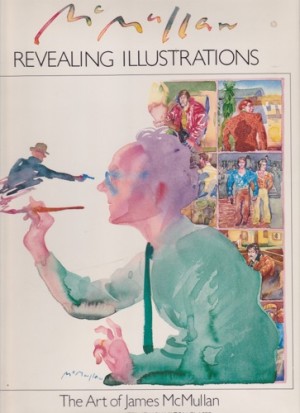
New York, Watson-Guptill Publications, 1st, 1981, Book: Very Good, Dust Jacket: Very Good, Hardcover, 143 pages, illustrated throughout. Text and illustrations by McMullan, introductory interview by Milton Glaser. Dust jacket edge wear and fade, minor foxing on top edge. Otherwise, very clean and tight copy.
Hardcover. Drawn & Quarterly;, Hardcover in oblong decorated orange cloth covers. color comics/cartoons throughout. Tom Gauld returns with his wittiest and most trenchant collection of literary cartoons to date. Perfectly composed drawings are punctuated with the artist's signature brand of humour, hitting high and low. After all, Gauld is just as comfortable taking jabs at Jane Eyre and Game of Thrones. Some particularly favoured targets include the pretentious procrastinating novelist, the commercial mercenary of the dispassionate editor, the willful obscurantism of the vainglorious poet. Quake in the presence of the stack of bedside books as it grows taller! Gnash your teeth at the ever-moving deadline that the writer never meets! Quail before the critic's incisive dissection of the manuscript! And most importantly, seethe with envy at the paragon of creative productivity!
Softcover. Bowie MD, Heritage Books, reprint, 2001, Book: Very Good, Dust Jacket: None, Softcover, 425 pages. A facsimile reprint of the 1904 edition. Volume 1 ONLY. The present-day New York City neighborhood of Harlem was founded in the mid-17th century by Dutch Protestants, whose numbers included Huguenots (or their descendants) who had fled the counter-Reformation in France and the Walloon provinces of Artois, Cambresis, and Hainalt. Riker's Harlem is an extremely detailed historical and genealogical account of Harlem from its establishment by Kuyter and Stuyvesant between 1656 and 1660 to the end of the 17th century. Following several preliminary chapters on the Dutch and French context for the settlement of "New Haerlem," the author treats us to what seem like minute-by-minute accounts of its colonial development, including early efforts to settle the territory that became Harlem, the original land patents and their subsequent rearrangement, Indian wars, displacement of Dutch rule by the British in 1663 (and the brief reoccupation by Dutch forces in 1673), 17th-century village life, migrations to New Jersey, influx of Swedes, difficulties in assimilating English ways, and much, much more.
Softcover. Bowie MD, Heritage Books, reprint, 2001, Book: Very Good, Dust Jacket: None, Softcover, Pages 426-908 . A facsimile reprint of the 1904 edition. Volume 2 ONLY. The present-day New York City neighborhood of Harlem was founded in the mid-17th century by Dutch Protestants, whose numbers included Huguenots (or their descendants) who had fled the counter-Reformation in France and the Walloon provinces of Artois, Cambresis, and Hainalt. Riker's Harlem is an extremely detailed historical and genealogical account of Harlem from its establishment by Kuyter and Stuyvesant between 1656 and 1660 to the end of the 17th century. Following several preliminary chapters on the Dutch and French context for the settlement of "New Haerlem," the author treats us to what seem like minute-by-minute accounts of its colonial development, including early efforts to settle the territory that became Harlem, the original land patents and their subsequent rearrangement, Indian wars, displacement of Dutch rule by the British in 1663 (and the brief reoccupation by Dutch forces in 1673), 17th-century village life, migrations to New Jersey, influx of Swedes, difficulties in assimilating English ways, and much, much more.
Hardcover. Newport VT, Vermont Civil War Enterprises, Reprint, Book: Very Good, Dust Jacket: None, 2 Hardcover Volumes. Reprint from early 2000's. Volume 1 - 455 pages. Hardcover. Imitation red leather covers. Gilt titles on spine and cover. Related article laid in. Previous owner's pencil inscription on front end paper has been erased. Otherwise clean, tight copy. Volume 2 - 408 pages. Hardcover. Imitation red leather covers. Gilt titles on spine and cover. Previous owner's pencil inscription on front end paper has been erased. Some pencil markings throughout. Otherwise clean, tight copy.
Softcover. Washington DC, National Museum of American Art and National Portrait Gallery, Smithsonian Institution, 1st, 1993, Book: Very Good, Dust Jacket: None, Softcover, 408 pages, illustrated throughout in color and b&w. Light edgewear and rubbing to wrappers, else a clean, tight copy.
Hardcover. Chicago, Art Institute of Chicago, 1st, 2017, Book: Very Good, Hardcover,324 pages. Published on the centenary of the Russian Revolution, this landmark book gathers information from the forefront of current research in early Soviet art, providing a new understanding of where art was presented, who saw it, and how the images incorporated and conveyed Soviet values. More than 350 works are grouped into areas of critical importance for the production, reception, and circulation of early Soviet art: battlegrounds, schools, the press, theaters, homes and storefronts, factories, festivals, and exhibitions. Paintings by El Lissitzky and Liubov Popova are joined by sculptures, costumes and textiles, decorative arts, architectural models, books, magazines, films, and more. Also included are rare and important artifacts, among them a selection of illustrated children's notes by Joseph Stalin's daughter, Svetlana Allilueva, as well as reproductions of key exhibition spaces such as the legendary Obmokhu (Constructivist) exhibition in 1921; Aleksandr Rodchenko's 'Workers' Club in 1925; and a Radio-Orator kiosk for live, projected, and printed propaganda designed by Gustav Klutsis in 1922. Bountifully illustrated, this book offers an unprecedented, cross-disciplinary analysis of two momentous decades of Soviet visual culture.
Hardcover. Chicago, Art Institute of Chicago, 1st, 2017, Book: Very Good, Hardcover,324 pages. Published on the centenary of the Russian Revolution, this landmark book gathers information from the forefront of current research in early Soviet art, providing a new understanding of where art was presented, who saw it, and how the images incorporated and conveyed Soviet values. More than 350 works are grouped into areas of critical importance for the production, reception, and circulation of early Soviet art: battlegrounds, schools, the press, theaters, homes and storefronts, factories, festivals, and exhibitions. Paintings by El Lissitzky and Liubov Popova are joined by sculptures, costumes and textiles, decorative arts, architectural models, books, magazines, films, and more. Also included are rare and important artifacts, among them a selection of illustrated children's notes by Joseph Stalin's daughter, Svetlana Allilueva, as well as reproductions of key exhibition spaces such as the legendary Obmokhu (Constructivist) exhibition in 1921; Aleksandr Rodchenko's 'Workers' Club in 1925; and a Radio-Orator kiosk for live, projected, and printed propaganda designed by Gustav Klutsis in 1922. Bountifully illustrated, this book offers an unprecedented, cross-disciplinary analysis of two momentous decades of Soviet visual culture.
Softcover. NY, Thunder's Mouth Press, reprint, 2005, Book: Very Good, Dust Jacket: None, Softcover, 259 pages. While the supremely popular Steal This Book is a guide to living outside the establishment, Revolution for the Hell of It is a chronicle of Abbie Hoffman's radical escapades that doubles as a guidebook for today's social and political activist. Hoffman pioneered the use of humour, theatre, and shock value to drive home his points, and in Revolution for the Hell of It he gives firsthand accounts of his legendary adventures, from the activism that led to the founding of the Youth International Party,or Yippies!, to the 1968 Democratic National Convention protests ("a Perfect Mess") that resulted in his conviction as part of the Chicago Seven. Clean. bright copy.
Hardcover. NY, Thames & Hudson, 1st, 2006, Book: Very Good, Dust Jacket: Very Good, Hardcover, 249 pages. Marking the fiftieth anniversary of the October 1956 Hungarian revolt against Soviet domination after World War II, this imposing volume contains powerful black-and-white photographs taken during the years preceding as well as the outbreak and crushing of the uprising by a German member of the international photojournalist cooperative Magnum. Introduced by Lessing's recollections and Hungarian French historian Francois Fejto's precis of the momentous events, the pictures appear in three chapters, "Communist Hungary," "The Revolution," and "The Failure." Hungarian novelist George Konrad's intense impressions of the time, during which he carried a rifle as a revolutionary young intellectual, follow the first chapter, and French political scientist Nicolas Bauquet's assessment of the revolt's impact on Western Europe's Communist parties, the USSR, and subsequent European history follows the third. Views of the cemetery in which the uprising's martyrs are now buried conclude the book elegiacally, and brief last words by Lessing and the director of Hungary's Institute 56 indicate who may forget what happened and why the rest of us should always remember. An extraordinary document.
Softcover. Oxford UK, Blackwell, reprint, 1998, Book: Very Good, Dust Jacket: None, Softcover, 630 pages. This is an account of 110 years of turbulence and change. At the offset there were not one, but two revolutions: by intent the first was egalitarian, the second - Bonaparte's - authoritarian. The tension between the two characterized the period and shaped the Republic that in the end emerged from the ruins of the Ancien Regime. Clean copy.
Hardcover. Lexington KY, University Press of Kentucky, 1st, 2014, Book: Very Good, Dust Jacket: Very Good, Hardcover, 328 pages, in a bright unclipped dust jacket, b&w illustrations. Noted for his charisma, talent, and striking good looks, director Rex Ingram (18931950) is ranked alongside D. W. Griffith, Marshall Neilan, and Erich von Stroheim as one of the greatest artists of the silent cinema. Ingram briefly studied sculpture at the Yale University School of Art after emigrating from Ireland to the United States in 1911; but he was soon seduced by the new medium of moving pictures and abandoned his studies for a series of jobs in the film industry. Over the next decade, he became one of the most popular directors in Hollywood, directing smash hits such as The Four Horsemen of the Apocalypse (1921), The Prisoner of Zenda (1922), and Scaramouche (1923). n Rex Ingram, Ruth Barton explores the life and legacy of the pioneering filmmaker, following him from his childhood in Dublin to his life at the top of early Hollywood's A-list and his eventual self-imposed exile on the French Riviera. Ingram excelled in bringing visions of adventure and fantasy to eager audiences, and his films made stars of actors like Rudolph Valentino, Ramon Novarro, and Alice Terry-his second wife and leading lady. With his name a virtual guarantee of box office success, Ingram's career flourished in the 1920s despite the constraints of an increasingly regulated industry and the hostility of Louis B. Mayer, who regarded him as a dangerous maverick. Barton examines the virtuoso director's career and controversial personal life-including his conversion to Islam, the rumors surrounding his ambiguous sexuality, and the circumstances of his untimely death. This definitive biography not only restores the visionary filmmaker to the spotlight but also provides an absorbing look at the daring and exhilarating days of silent-era Hollywood.
Hardcover. Woodbridge CT, Ox Bow Press,, 1st, 1987, Book: Very Good, Dust Jacket: Very Good, Hardcover in a bright dust jacket, 220 pages. Clean copy. The essays of Richard McKeon have long circulated piecemeal among scholars who see him as the leading twentieth-century philosopher and historian of rhetoric. This volume brings together McKeon's seminal works in rhetoric and philosophy, and vividly demonstrates the basis for this extraordinary reputation. | In his pursuit of rhetoric's fundamental qualities, McKeon ventures far beyond the traditional notion of rhetoric as simply a verbal art of persuasion. He details a history in which rhetoric functions as a tool for creating disciplines, arts, systems, and methods. Expression has always been an important element of rhetoric, but rhetoric also can serve as an organizational principle that provides the framework within which we can reveal and arrange the significant parts of any human understanding. | Given the prodigious range of McKeon's intellectual curiosity, his longtime and pervasive interest in rhetoric suggests the unique place he assigns it in the scheme of humanistic art
Hardcover. Boston, Roberts Brothers, 1st, 1892, Book: Good, Dust Jacket: None, Hardcover, brown cloth stamped in silver, 143 pages. Black & white illustrations by various artists, including Harriet Roosevelt Richards and E. H. Garrett. Tear to middle of front end paper. Lower part of front hinge cracked. Spine frayed at top & bottom and corners worn.
Hardcover. Boston, Museum of Fine Arts, 1st, 2008, Book: Very Good, Dust Jacket: Very Good, Hardcover in a bright dust jacket. It is little known that interbellum Britain hosted a generation of Modernist artists who absorbed the wealth of Continental avant-garde idioms and adapted them to their own unique ends. Some of this work was done under the rubric of Vorticism, the Neofuturist movement spearheaded by Wyndham Lewis, while other artists were closely associated with London's Grosvenor School of Art (and so came to be known collectively as the Grosvenor School), breaking new ground in the practice of linocut. Rhythms of Modern Life examines the impact of Cubism and Futurism on British printmaking in the years between the First and Second World Wars, focusing in particular on the dynamic imagery of 13 artists, including C.R.W. Nevinson, Paul Nash, Edward Wadsworth and David Bomberg, all early followers of Italian Futurism and British Vorticism, and on the works of Grosvenor School artists Claude Flight, Sybil Andrews, Cyril Power and Lill Tschudi. All of these artists coined styles that addressed the velocity of modern life, espousing industry, speed and an optimism for the century ahead. This book, the first survey of its kind, features more than 100 lithographs, etchings, woodcuts and linocuts, ranging from geometric abstractions to forceful impressions of the first fully mechanized war, Jazz Age images of sporting events, speed trials and other contemporary diversions. Clifford S. Ackley's introduction takes stock of the art historical moment and is followed by discussions of the prints, an overview of the history and technique of the modern linocut and short biographies of the artists.
Softcover. Columbia SC, S.C. Department of Archives and History, 1st, 1995, Book: Very Good, Dust Jacket: None, Softcover, 38 pages, b&w illustrations. Clean copy.
Hardcover. Roma, Paolo Buggiani, 1st, 1974, Book: Very Good, Dust Jacket: None, Non-paginated. Full color handpainted covers, with cutout window exposing image of Paolo Buggiani. Illustrated with black & white photographs. Brief text in English. Light wear to covers. Clean, unmarked copy.
Hardcover. New York, Harry N. Abrams, 1st, 2015, Book: Very Good, Dust Jacket: None, Hardcover. Like new in publisher's shrink-wrap. 192 pages, including 120 color plates. This catalog for an exhibition at the Royal Academy of Arts in London documents the first solo U.K. show devoted to this artist in more than 20 years. An essay by Steven Nash explores how certain European painters impacted Diebenkorn's development, and the last essay by Edith Devaney examines the centrality of drawing to his practice throughout his career.
Hardcover. The Monacelli Press , 1st, 2018, Book: Very Good, Dust Jacket: Very Good, Hardcover in a bright dust jacket, 264 pages. Richard Filipowski (1923-2008) was among the most gifted polymaths in the annals of American modernism. Whether as a painter, sculptor, or designer of furniture and jewelry, Filipowski developed a lush, abstract, and amazingly consistent visual language that marks him among the finest figures of midcentury art and design. As a student at the Institute of Design (formerly the New Bauhaus) in Chicago, he quickly became a protege of founder Laszlo Moholy-Nagy, who featured several of Filipowski's works in his seminal text Vision in Motion (1947); Filipowski was the only student Moholy-Nagy called upon to join the faculty, where he taught alongside Walter Gropius and Marcel Breuer. Recruited by Gropius to develop a course in design fundamentals at Harvard, which remains a cornerstone of design pedagogy to this day, he would move to MIT where he taught for more than three decades, until his retirement in 1988. With a foreword by Laszlo Moholy-Nagy's daughter Hattula, Richard Filipowski: Art and Design Beyond the Bauhaus is the first monograph of this master, who over the course of his career created a unique body of work in diverse media that has largely, until recently, been held in private collections due to his relative lack of compulsion to seek media attention or worldly rewards. But now through the efforts of the Filipowski family and new attention by design scholars--several of whom contribute essays here on Filipowski's graphic and painted works, sculpture, furniture, and position in design history--the work is being revealed to a new generation of aficionados. Richard Filipowski is a rich document of a life and career that is poised to reenter the canon of modernism.
Hardcover. Newburyport Press, 1st, 2006, Book: Very Good, Dust Jacket: Very Good, Hardcover in a bright, unclipped jacket. Richard Henry Arbib was considered one of the leading industrial designers in the United States in the years following World War II. By the 1950s, he had established himself as one of the true visionaries in his field, producing groundbreaking design concepts not only for automobiles, but for a range of products that included wristwatches, pens, boats and even personal helicopters--designs so innovative than many of them would still be considered advanced today. This book is an attempt to rediscover both the man and his extraordinary work. Combining a biographical essay and commentary by historian and collector Frederic A. Sharf with 35 never-before-seen drawings by Arbib, this is a revelatory look at one of the great artists of America's industrial history, and the first biographic study of his work.
Hardcover. London, Faber & Faber, 1st, 1937, Book: Very Good, Dust Jacket: None, Hardcover, green cloth lettered in gilt at the spine. Illustrated with eight photographic plates. 422 pages. Extended passages from Jefferies' work, with a general introduction in two parts: 'The English Genius' and 'To the Two Types of Jefferies Readers', introductions to each section, notes on the text, and the Epigraph. No dust jacket, clean copy.
Hardcover. New York, George Braziller, 1st, 1993, Book: Very Good, Dust Jacket: Very Good, Hardcover in a bright dust jacket, Unpaginated. Color and black & white photography. British artist Long ( Walking in Circles ) takes nature treks--in England's Lake District, the Sahara, Japan, Nepal--and creates site-specific works along the way. He fashions a mud circle in the river Avon, traces a line of snow near a temple in Kyoto and erects a circle of stones on a Swiss mountainside. The spare, deeply meditative photographs that he took en route sometimes call to mind prehistoric British megalithic monuments or Native American earthworks, as if he wants to tune in on planetary patterns of energy. At other times Long simply records what he sees, providing dramatic vistas of Iceland's vast rolling hills, Bolivia's high plateau, Washington's forests and Mount Everest's calm majesty. His images, poetic captions and unobstrusive siteworks reflect an artist who is at once traveler, nature-lover and adventurer.
Hardcover. San Francisco, CA, Fraenkel Gallery, 1st, 2013, Book: Very Good, Dust Jacket: Very Good, 32 pages. Hardcover with dust jacket. Very clean, like new in publishers shrink-wrap. A tight copy. In the early 2000s, Richard Misrach (born 1949) began a series titled On the Beach, a body of work that traveled extensively and has been highly influential. These color photographs deal with the human figure seen at a distance, on an unspecified beach or in the water, observed from an unsettling and difficult-to-identify point of view located high above. Misrach has continued this work, while vast changes in photographic technology over the intervening decade have caused a shift in approach, both conceptually and technically. Untitled is an artist book based on two photographs: the one made by Misrach and the other made concurrently, at the time of exposure, by the subjects of his photograph. The extreme detail explored in this work concisely summates both the artist's concerns and the ubiquity of digital technology as we are portrayed and portray ourselves.
Hardcover. ejby, Samlerens Forlag, 1st, 1980, Book: Very Good, Dust Jacket: Good, Hardcover. Non-paginated. Number 36 of only 75 copies SIGNED BY MORTENSEN on the color plate in front. Illustrated with full color examples of works by Richard Mortensen. Dust jacket shows standard wear. Large format. Clean, bright copy.
Hardcover. Koln GR, Taschen, 1st, 2000, Book: Very Good, Dust Jacket: None, Hardcover, 464 pages. Original publisher's faux wood boards, lettered orange at the spine and front cover. Copiously illustrated in color and black and white throughout. Text in English, German and French. Many photographs By Julius Shulman. Originally from Vienna, Richard Neutra came to America early in his career, settling in California. His influence on post-war architecture is undisputed, the sunny climate and rich landscape being particularly suited to his cool, sleek modern style. Neutra had a keen appreciation for the relationship between people and nature; his trademark plate glass walls and ceilings which turn into deep overhangs have the effect of connecting the indoors with the outdoors. Neutra's ability to incorporate technology, aesthetic, science, and nature into his designs brought him to the forefront of Modernist architecture. For the first time, all of Neutra's works (nearly 300 private homes, schools, and public buildings) are gathered together in one volume.
Hardcover. Germany, Hatje Cantz Publishers, 1st, 2006, Book: Very Good, Dust Jacket: Very Good, Hardcover, 104 pages.Like new in publisher's shrink-wrap. There are no smoking cowboys swinging their lassoes or bare-breasted blondes on heavy motorcycles in this droll collection of highly expressive drawings and watercolors. Au contraire, the inventive shapes and joyful colors recall children's drawings or paintings by the mentally ill. Half-figures of indeterminate gender with staring eyes, big ears and frizzy hair smirk challengingly at the viewer, offering an inventory of possibilities, many of which later find their way into Prince's joke paintings of the same period. This extraordinary little book presents these funny yet sinister works to a larger public for the first time, and allows readers to discover a new side of Richard Prince's oeuvre.


 "Reminiscences of Sea Island Heritage: Legacy of Freedmen on St. Helena Island (SIGNED COPY)by: Daise, Ronald")
 "Remote Control: Power Cultures and the World of Appearancesby: Kruger, Barbara")


 "Rene Herbst: Pioneer of Modernismby: Guillemette Delaporte")


 "Renoir Landscapes 1865-1883by: Bailey, Colin and Christopher Riopelle")
 "Renzo Piano: Zentrum Paul Klee, Bern, The Architectureby: Piano, Renzo")
 "Renzo Piano: Zentrum Paul Klee, Bern, The Architectureby: Piano, Renzo")




 "Restroom: Contemporary Designby: Hudson, Jennifer")
 "Rethinking Curating: Art After New Mediaby: Beryl Graham, Sarah Cook, Steve Dietz")


 "Return to Glory: The Story of the Cleveland Browns by: Bill Levy")

 "Revealing Illustrations: The Art of James McMullanby: McMullan, James")




 "Rex Ingram: Visionary Director of the Silent Screenby: Ruth Barton")

 "Rhyme Stewby: Dahl/Quentin Blake, Roald")
 "Rhymes and Ballads for Girls and Boysby: Coolidge, Susan")


 "Richard Diebenkornby: Bancroft, Sarah")
 "Richard Filipowski: Art and Design Beyond the Bauhausby: Marisa Bartolucci (Editor), Hattula Moholy-Nagy (Foreword)")
 "Richard H. Arbib: 1917-1995 Visionary American Designerby: Arbib, Richard")

 "Richard Long: Mountains and Watersby: Long, Richard")
 "Richard Misrach: 11.21.11 5:40 PMby: Misrach, Richard (Photographer)")
 "Richard Neutra : Complete Worksby: Barbara Mac Lamprecht, (Photography) Julius Shulman, (Editor) Peter Goessel")
 "Richard Prince: Hippie Drawingsby: Brautigan, Richard")